Iraq Hafnium Market Size, Share & Growth Rate
The Iraq Hafnium Market was estimated at USD 385 Million in 2025 and is projected to reach USD 539 Million by 2032, growing at a CAGR of 4.9% from 2026 to 2032. This growth trajectory is fueled by increased investments in the aerospace and nuclear sectors, where Hafnium's unique properties are in high demand. Additionally, the expansion of the semiconductor industry is expected to further augment the market, making it a focal point for investors and stakeholders.
Iraq Hafnium Market Year-wise Growth Rate and Key Drivers
This graph highlights how the Iraq Hafnium Market has steadily grown over the years, supported by major growth factors.
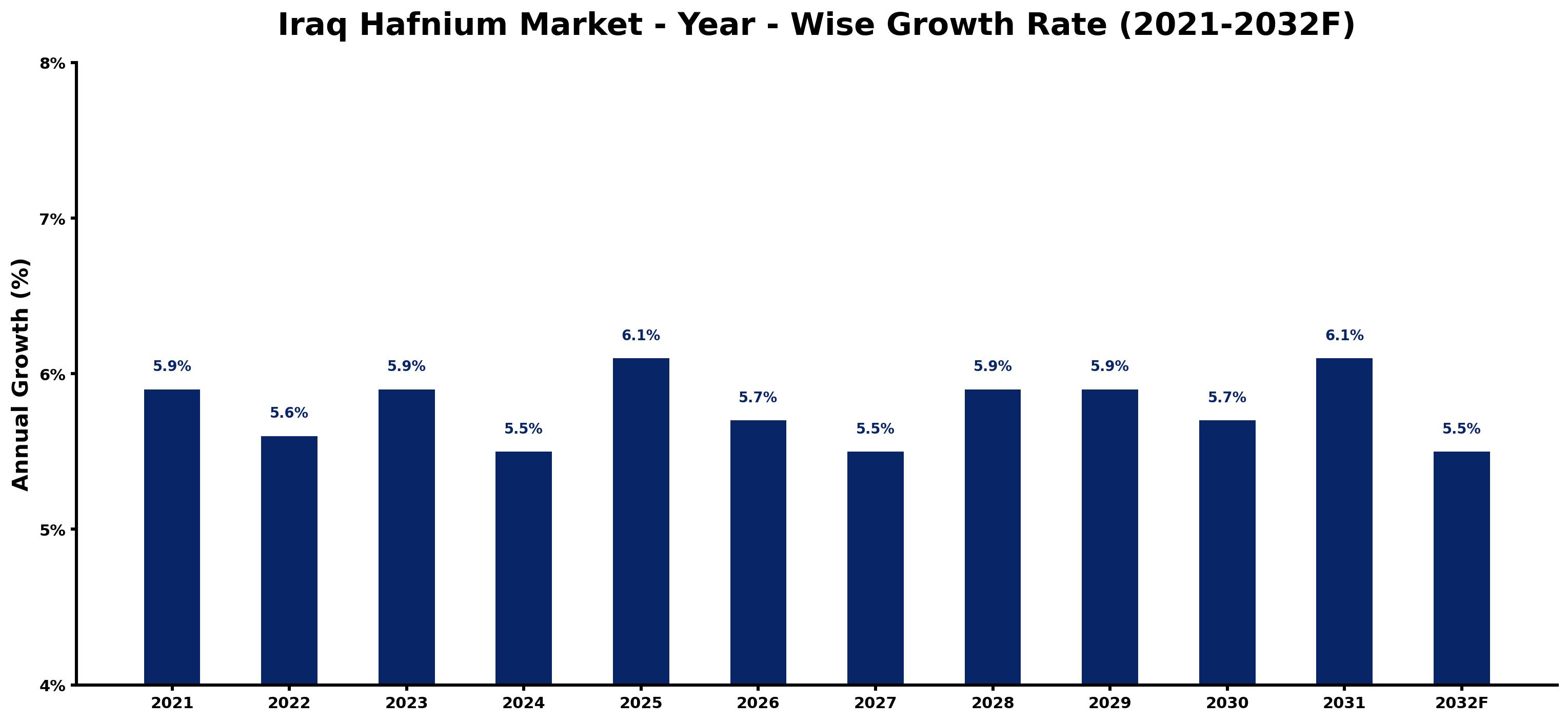
The table below presents the year‑wise growth rates along with the key drivers influencing the market
| Year | Growth Rate | Major Drivers |
| 2021 | 5.9% | increased investments in technology sectors |
| 2022 | 5.6% | growing demand for electronics manufacturing |
| 2023 | 5.9% | expansion of renewable energy projects |
| 2024 | 5.5% | rising interest in aerospace applications |
| 2025 | 6.1% | development of advanced materials industries |
| 2026 | 5.7% | surge in defense sector requirements |
| 2027 | 5.5% | strengthening automotive manufacturing capabilities |
| 2028 | 5.9% | growth in telecommunications infrastructure |
| 2029 | 5.9% | increased focus on research initiatives |
| 2030 | 5.7% | enhanced collaboration with global partners |
| 2031 | 6.1% | improved processing technologies adoption |
| 2032 | 5.5% | growing need for renewable technologies |
Note: Market size estimations and growth projections presented in this report are based on 6Wresearch's proprietary forecasting methodology, utilizing the latest available industry data, government publications, and primary research inputs.
Iraq Hafnium Market Synopsis
Currently, the Iraq Hafnium market is gaining momentum due to its crucial applications in high-tech industries, particularly aerospace and nuclear energy. As Iraq seeks to diversify its economy, the demand for this rare metal is projected to rise significantly, driven by technological advancements and increasing energy needs.
The use of Hafnium in semiconductor manufacturing and as a control rod material in nuclear reactors places it at the forefront of innovation. Furthermore, local businesses are exploring production capacity expansions, aligning with the global push for sustainable energy solutions.
Iraq Hafnium Market Key Takeaways
- The Hafnium market in Iraq is experiencing robust growth, particularly in aerospace and nuclear applications.
- Increasing investments in semiconductor technology are expected to drive further demand.
- Local production capacity is expanding, aiming to meet rising industry needs.
- Geopolitical factors and market volatility remain significant challenges.
- Innovation in Hafnium applications could open new market avenues, especially in advanced materials.
Evaluation of Restraints in Iraq Hafnium Market
Despite the positive growth outlook, several restraints continue to challenge the Iraq Hafnium market. The limited domestic production capacity necessitates reliance on imports, which may lead to supply chain vulnerabilities. Additionally, geopolitical instability in the region creates uncertainties that can affect pricing and availability. Furthermore, the lack of comprehensive local expertise hinders the development of a self-sufficient Hafnium market, ultimately impacting the overall market growth potential.
Iraq Hafnium Market Trends
Emerging trends in the Iraq Hafnium market include an increased focus on sustainability and the adoption of Hafnium-based technologies in renewable energy sectors. The growing demand for solar panel technologies and advancements in catalytic converters highlight Hafnium's versatility. Ongoing research and development efforts are aimed at exploring new applications, especially in the fields of advanced materials and medical devices, which could redefine market boundaries.
Iraq Hafnium Market Opportunities
Investors are presented with lucrative opportunities in the Iraq Hafnium market, particularly as the demand for Hafnium in high-tech industries rises. This includes opportunities in Hafnium mining, extraction projects, and partnerships with companies engaged in production and processing. The government's desire to attract foreign investments further incentivizes exploration and development within the market, paving the way for a more robust industrial framework.
Government Initiatives in the Iraq Hafnium Market
While there are no specific government policies currently targeting the Hafnium market, the Iraqi government is focused on broader regulations concerning mining and mineral exports. These regulations aim to promote transparency, sustainability, and responsible practices within the mining industry. Iraq's participation in the Extractive Industries Transparency Initiative (EITI) suggests a commitment to good governance, which will likely benefit future Hafnium market developments.
Future Insights of the Iraq Hafnium Market
Looking ahead to 2026-2032, the Iraq Hafnium market is expected to continue its upward trajectory, driven by expanding industrial applications and increasing technological innovations. The surge in nuclear energy initiatives, coupled with advancements in semiconductor manufacturing, will be pivotal in shaping the market landscape. However, vigilance regarding geopolitical conditions and regulatory stability will remain essential for sustainable growth.
Iraq Hafnium Market Latest Developments (2025 - 2026)
Recent developments in the Iraq Hafnium market indicate a concerted effort towards increasing production capacity and strengthening the local supply chain. Companies are investing in research to enhance the efficiency of Hafnium processing methods, while collaborations are forming to leverage technological innovations. Additionally, there is growing recognition of Hafnium's importance in emerging applications, further solidifying its role in Iraqs economic diversification strategy.
Iraq Hafnium Market - Key Attractiveness of the Report
- 10 Years of Market Numbers
- Historical Data Starting from 2022 to 2025
- Base Year: 2025
- Forecast Data until 2032
- Key Performance Indicators Impacting the Market
- Major Upcoming Developments and Projects
Key Highlights of the Report:
- Iraq Hafnium Market Outlook
- Market Size of Iraq Hafnium Market, 2025
- Forecast of Iraq Hafnium Market, 2032
- Historical Data and Forecast of Iraq Hafnium Revenues & Volume for the Period 2022-2032F
- Iraq Hafnium Market Trend Evolution
- Iraq Hafnium Market Drivers and Challenges
- Iraq Hafnium Price Trends
- Iraq Hafnium Porter's Five Forces
- Iraq Hafnium Industry Life Cycle
- Historical Data and Forecast of Iraq Hafnium Market Revenues & Volume By Type for the Period 2022-2032F
- Historical Data and Forecast of Iraq Hafnium Market Revenues & Volume By Hafnium Oxide for the Period 2022-2032F
- Historical Data and Forecast of Iraq Hafnium Market Revenues & Volume By Hafnium Carbide for the Period 2022-2032F
- Historical Data and Forecast of Iraq Hafnium Market Revenues & Volume By Other for the Period 2022-2032F
- Historical Data and Forecast of Iraq Hafnium Market Revenues & Volume By Application for the Period 2022-2032F
- Historical Data and Forecast of Iraq Hafnium Market Revenues & Volume By Super Alloy for the Period 2022-2032F
- Historical Data and Forecast of Iraq Hafnium Market Revenues & Volume By Optical Coating for the Period 2022-2032F
- Historical Data and Forecast of Iraq Hafnium Market Revenues & Volume By Nuclear for the Period 2022-2032F
- Historical Data and Forecast of Iraq Hafnium Market Revenues & Volume By Plasma Cutting for the Period 2022-2032F
- Historical Data and Forecast of Iraq Hafnium Market Revenues & Volume By Other for the Period 2022-2032F
- Iraq Hafnium Import Export Trade Statistics
- Market Opportunity Assessment By Type
- Market Opportunity Assessment By Application
- Iraq Hafnium Top Companies Market Share
- Iraq Hafnium Competitive Benchmarking By Technical and Operational Parameters
- Iraq Hafnium Company Profiles
- Iraq Hafnium Key Strategic Recommendations






































