Iraq Handicrafts Market Summary
The iraq handicrafts market was estimated at USD 1324 Million in 2025 and is projected to reach USD 1879 Million by 2032, growing at a CAGR of 6.1% from 2026 to 2032.
Iraq Handicrafts Market Year-wise Growth Rate and Key Drivers
This graph highlights how the Iraq Handicrafts Market has steadily grown over the past five years, supported by major growth factors.
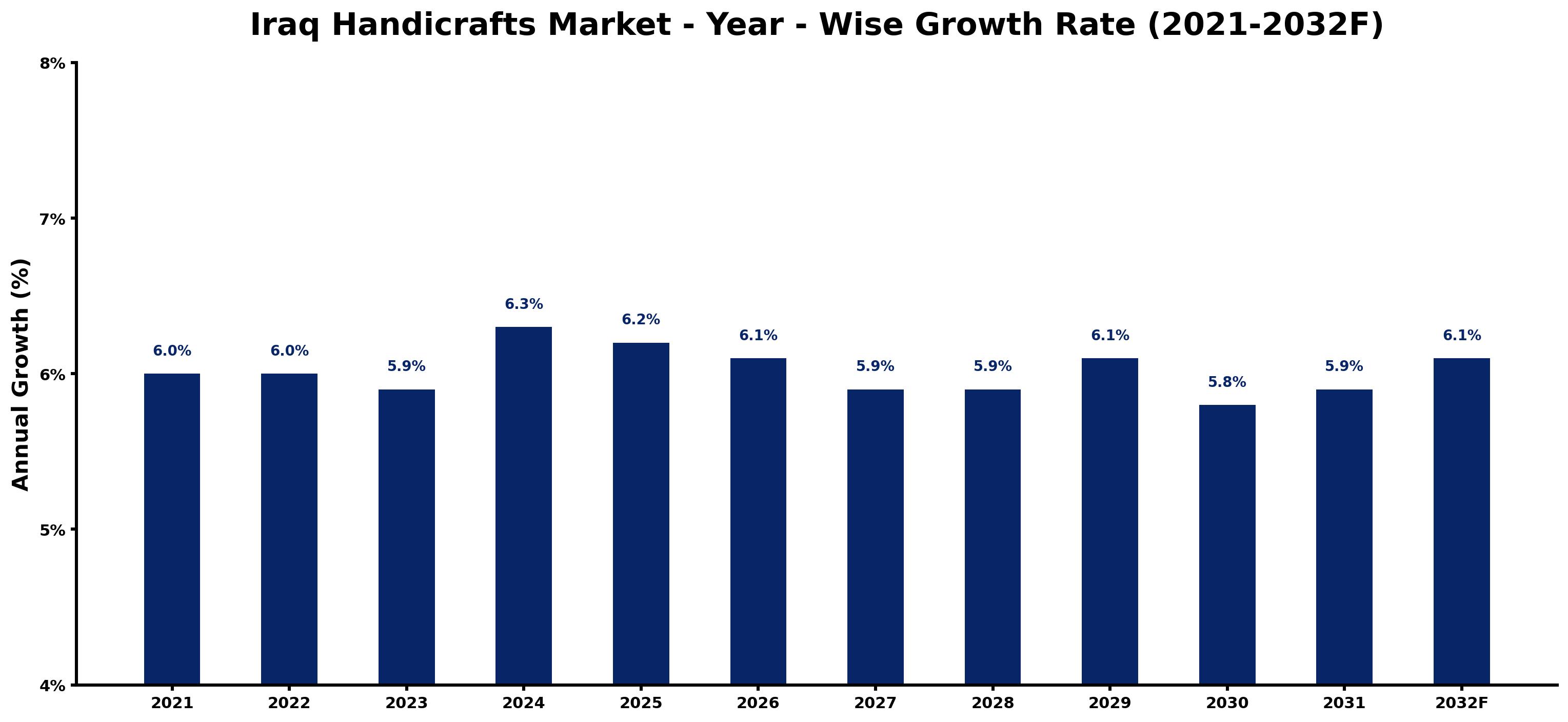
The table below presents the year wise growth rates along with the key drivers influencing the market
| Year | Growth Rate | Major Drivers |
| 2021 | 6.0% | Handicraft sales saw an uptick as local artisans gained visibility online. |
| 2022 | 6.0% | Tourism slowly resumed, driving interest in traditional Iraqi handicrafts among visitors. |
| 2023 | 5.9% | Local festivals showcased cultural heritage, attracting significant consumer engagement and sales. |
| 2024 | 6.3% | Social media platforms became pivotal in promoting unique craftsmanship to global audiences. |
| 2025 | 6.2% | Increased diaspora investment fostered collaboration between artisans and international buyers. |
| 2026 | 6.1% | Artisan cooperatives formed, enhancing efficiency and strengthening market presence regionally. |
| 2027 | 5.9% | Sustainability trends encouraged artisans to use eco-friendly materials and practices. |
| 2028 | 5.9% | Collaborations with local designers brought modern aesthetics to traditional handicrafts. |
| 2029 | 6.1% | Economic stabilization efforts improved consumer confidence in purchasing handmade goods. |
| 2030 | 5.8% | Export opportunities expanded, with handicrafts gaining traction in global markets. |
| 2031 | 5.9% | E-commerce platforms flourished, providing artisans with wider market access than traditional methods. |
| 2032 | 6.1% | Cultural workshops gained popularity, sparking renewed interest in artisan skills among youth. |
Note - Market size estimations and growth projections presented in this report are based on 6Wresearch's advanced forecasting approach, validated with industry datasets as of June 2026.
Iraq Handicrafts Market Synopsis
The Iraq Handicrafts Market is projected to reach 6.1% and witness significant growth during the forecast period (2026-2032). This market encapsulates a rich tapestry of traditional craftsmanship that reflects the country's historical and cultural essence. With a burgeoning interest in authentic handcrafted products, both locally and internationally, the Iraq handicrafts sector is undergoing a transformative period characterized by increased demand, artisan skill development, and a focus on sustainable practices.
Iraq Handicrafts Market Overview
The Iraq Handicrafts Market is distinguished by its wide array of traditional products such as ceramics, pottery, textiles, rugs, jewelry, and intricate woodwork. These items are not merely commodities; they embody the skill and tradition of local artisans, whose techniques have been meticulously passed down through generations. In recent years, there has been a revitalized effort to promote these handicrafts, enhancing their visibility both in domestic and international spheres. The growing appreciation for handmade products aligns with global trends favoring sustainability and ethical consumption, creating a promising landscape for the Iraq Handicrafts Market.
Iraq Handicrafts Market Trends and Opportunities
A notable trend in the Iraq Handicrafts Market is the surge in demand for unique, locally-made products. Consumers increasingly favor handicrafts that reflect authenticity and cultural heritage. The following trends are shaping the current market landscape:
- The resurgence of traditional techniques such as pottery, weaving, and metalwork underscores a commitment to quality craftsmanship.
- Artisans are innovating by integrating contemporary design elements into traditional crafts, thus appealing to a wider, modern audience.
- Online sales platforms have proliferated, allowing artisans to access broader markets and promote their work through social media channels.
- Environmental awareness is steering consumers towards sustainable consumption, favoring handmade products over mass-produced alternatives.
- Collaborative initiatives between artisans and designers are resulting in unique product lines that celebrate Iraqi cultural heritage while catering to modern tastes.
Iraq Handicrafts Market Challenges and Restraints
While the Iraq Handicrafts Market is poised for growth, it faces several pressing challenges. These challenges include:
- Political instability and security concerns that limit access to international markets and hinder business expansion.
- A lack of infrastructure and support systems for artisans, which impacts their ability to produce and market their crafts efficiently.
- The rise of inexpensive mass-produced goods that compete with traditional handicrafts, often leading to diminished demand for handmade items.
- Challenges in preserving artisanal craftsmanship, as younger generations may not have the same interest in traditional trades.
- Inconsistent quality standards and insufficient funding for artisan training programs that inhibit market competitiveness.
Iraq Handicrafts Market Investment Opportunities
The Iraq Handicrafts Market offers a wealth of investment opportunities for stakeholders interested in supporting this vital sector. Key areas for potential investment include:
- Production and export of traditional handicrafts such as carpets, jewelry, and pottery, capitalizing on growing global demand for unique products.
- Modernizing production techniques and facilities to enhance efficiency while preserving traditional methods.
- Improving marketing and distribution channels to elevate the visibility of Iraqi handicrafts in international markets.
- Fostering partnerships between local artisans and international designers to create contemporary adaptations of traditional crafts.
- Establishing training programs aimed at equipping artisans with skills necessary to innovate and adapt to market changes.
Iraq Handicrafts Market Government Investment and Initiatives
The Iraqi government recognizes the importance of the handicrafts sector as a means of preserving cultural heritage and stimulating economic growth. Key initiatives include:
- Implementation of training programs aimed at enhancing the skills of artisans, ensuring the continuity of traditional craftsmanship.
- Establishment of marketplaces that provide artisans with platforms to showcase and sell their products locally and internationally.
- Support for participation in national and international handicraft exhibitions to increase the visibility of Iraqi products.
- Efforts to protect traditional techniques through policy measures that encourage authentic craft production.
- Increased access to funding and resources to assist artisans in scaling their operations and improving product quality.
Iraq Handicrafts Market Latest Developments (May 2025 - June 2026)
In the period between May 2025 and June 2026, the Iraq Handicrafts Market has witnessed significant shifts towards modernization and increased global engagement. Artisans have been increasingly leveraging online platforms to reach international customers, with social media playing a pivotal role in promoting their work. Additionally, several government-sponsored initiatives aimed at improving artisan skills and infrastructure have been gaining traction, leading to enhanced quality and craftsmanship standards. Furthermore, there is a marked increase in collaborative projects that fuse traditional handicrafts with contemporary design, reflecting a blend of cultural heritage and modern consumer preferences.
Iraq Handicrafts Market Future Outlook
The outlook for the Iraq Handicrafts Market appears optimistic, with a sustained interest in traditional and handmade products both domestically and globally. As consumers increasingly seek authentic and culturally significant items, the demand for Iraqi handicrafts is expected to rise. Additionally, the proliferation of e-commerce platforms will continue to enhance market access for artisans, contributing to sustained growth. However, challenges related to infrastructure, raw material access, and regional stability will require strategic interventions to maximize the market's potential in the coming years.
Iraq Handicrafts Market - Key Attractiveness of the Report
- 10 Years of Market Numbers
- Historical Data Starting from 2022 to 2025
- Base Year: 2025
- Forecast Data until 2032
- Key Performance Indicators Impacting the Market
- Major Upcoming Developments and Projects
The market encompasses a range of traditional products, including ceramics, pottery, textiles, rugs, jewelry, and woodwork, all of which reflect Iraq's cultural and artistic heritage.
Yes, the government is implementing various initiatives aimed at providing training, creating markets for artisans, and promoting their crafts at national and international events to enhance their visibility and market access.
The market faces challenges such as political instability, competition from mass-produced goods, and a lack of infrastructure and funding for artisans, which can hinder growth and sustainability.
The future outlook is positive, driven by growing global interest in unique and authentic products, although it will require strategic planning to overcome existing challenges.
Key Highlights of the Report:
- Iraq Handicrafts Market Outlook
- Market Size of Iraq Handicrafts Market, 2025
- Forecast of Iraq Handicrafts Market, 2032F
- Historical Data and Forecast of Iraq Handicrafts Revenues & Volume for the Period 2022-2032F
- Iraq Handicrafts Market Trend Evolution
- Iraq Handicrafts Market Drivers and Challenges
- Iraq Handicrafts Price Trends
- Iraq Handicrafts Porter's Five Forces
- Iraq Handicrafts Industry Life Cycle
- Historical Data and Forecast of Iraq Handicrafts Market Revenues & Volume By Product Type for the Period 2022-2032F
- Historical Data and Forecast of Iraq Handicrafts Market Revenues & Volume By Woodware for the Period 2022-2032F
- Historical Data and Forecast of Iraq Handicrafts Market Revenues & Volume By Art metal Ware for the Period 2022-2032F
- Historical Data and Forecast of Iraq Handicrafts Market Revenues & Volume By Hand printed Textiles and Scarves for the Period 2022-2032F
- Historical Data and Forecast of Iraq Handicrafts Market Revenues & Volume By Embroidered and Crocheted Goods for the Period 2022-2032F
- Historical Data and Forecast of Iraq Handicrafts Market Revenues & Volume By Zari and Zari Goods for the Period 2022-2032F
- Historical Data and Forecast of Iraq Handicrafts Market Revenues & Volume By Imitation Jewellery for the Period 2022-2032F
- Historical Data and Forecast of Iraq Handicrafts Market Revenues & Volume By Sculptures for the Period 2022-2032F
- Historical Data and Forecast of Iraq Woodware Handicrafts Market Revenues & Volume By Others for the Period 2022-2032F
- Historical Data and Forecast of Iraq Handicrafts Market Revenues & Volume By Distribution Channel for the Period 2022-2032F
- Historical Data and Forecast of Iraq Handicrafts Market Revenues & Volume By Mass Retailers for the Period 2022-2032F
- Historical Data and Forecast of Iraq Handicrafts Market Revenues & Volume By Departmental Stores for the Period 2022-2032F
- Historical Data and Forecast of Iraq Handicrafts Market Revenues & Volume By Independent Retailers for the Period 2022-2032F
- Historical Data and Forecast of Iraq Handicrafts Market Revenues & Volume By Specialty Stores for the Period 2022-2032F
- Historical Data and Forecast of Iraq Handicrafts Market Revenues & Volume By Online Stores for the Period 2022-2032F
- Historical Data and Forecast of Iraq Handicrafts Market Revenues & Volume By Others for the Period 2022-2032F
- Historical Data and Forecast of Iraq Handicrafts Market Revenues & Volume By End-users for the Period 2022-2032F
- Historical Data and Forecast of Iraq Handicrafts Market Revenues & Volume By Residential for the Period 2022-2032F
- Historical Data and Forecast of Iraq Handicrafts Market Revenues & Volume By Commercial for the Period 2022-2032F
- Iraq Handicrafts Import Export Trade Statistics
- Market Opportunity Assessment By Product Type
- Market Opportunity Assessment By Distribution Channel
- Market Opportunity Assessment By End-users
- Iraq Handicrafts Top Companies Market Share
- Iraq Handicrafts Competitive Benchmarking By Technical and Operational Parameters
- Iraq Handicrafts Company Profiles
- Iraq Handicrafts Key Strategic Recommendations






































