Iraq Home Decor Market Summary
The iraq home decor market was estimated at USD 332 Million in 2025 and is projected to reach USD 449 Million by 2032, growing at a CAGR of 5.2% from 2026 to 2032.
Iraq Home Decor Market Year-wise Growth Rate and Key Drivers
This graph highlights how the Iraq Home Decor Market has steadily grown over the past five years, supported by major growth factors.
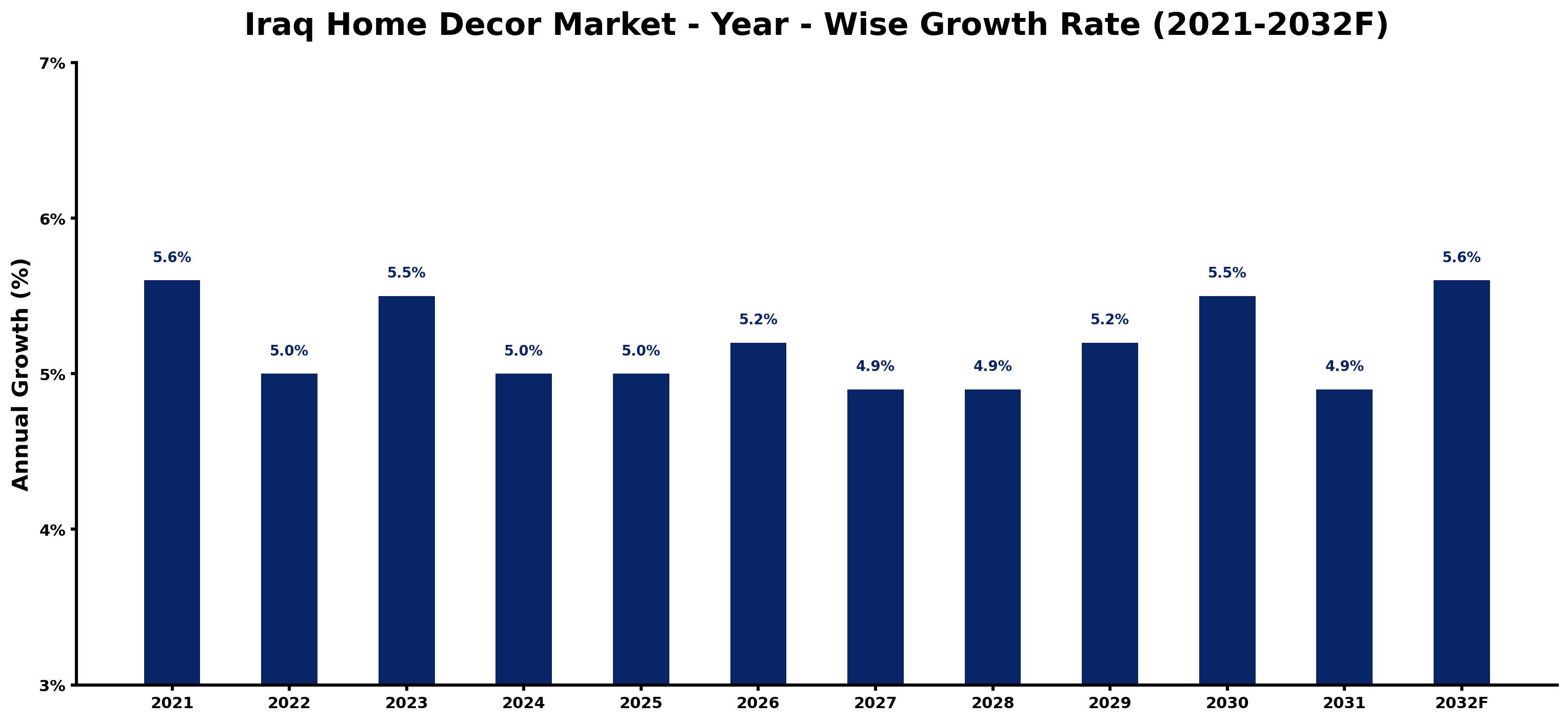
The table below presents the year wise growth rates along with the key drivers influencing the market
| Year | Growth Rate | Major Drivers |
| 2021 | 5.6% | Post-lockdown retail projects boosted consumer interest in home renovation and decor. |
| 2022 | 5.0% | Increased disposable income led to a more vibrant home decor spending trend. |
| 2023 | 5.5% | Urbanization trends prompted a demand for modern and stylish interior designs. |
| 2024 | 5.0% | Local artisans began gaining popularity for unique, culturally-inspired home decor items. |
| 2025 | 5.0% | New construction projects provided opportunities for interior design collaborations and partnerships. |
| 2026 | 5.2% | E-commerce platforms expanded, offering diverse home decor selections to consumers. |
| 2027 | 4.9% | Social media influenced design aesthetics, inspiring younger generations to redecorate homes. |
| 2028 | 4.9% | Sustainability became a focal point, driving demand for eco-friendly decor solutions. |
| 2029 | 5.2% | Cultural events and exhibitions showcased local craftsmanship, boosting market visibility. |
| 2030 | 5.5% | Technological advancements led to innovative smart home integrations within decor. |
| 2031 | 4.9% | Investment in tourism created demand for upscale interior designs in hospitality sectors. |
| 2032 | 5.6% | Civic pride in urban development projects encouraged residents to enhance home aesthetics. |
Note - Market size estimations and growth projections presented in this report are based on 6Wresearch's advanced forecasting approach, validated with industry datasets as of June 2026.
Iraq Home Decor Market Synopsis
The Iraq Home Decor Market is projected to reach 5.2% and witness significant growth during the forecast period (2026-2032). This expansion is largely attributed to a rising urban population, increases in disposable incomes, and an enhanced focus on contemporary interior design trends among Iraqi consumers. The market is characterized by a growing investment in a wide array of home decor products, including furniture, lighting fixtures, textiles, and various decorative accessories, reflecting the evolving preferences of the consumer base.
Iraq Home Decor Market Growth Drivers
Several key factors are driving the growth of the Iraq Home Decor Market. Firstly, the urban population is on the rise, leading to a burgeoning demand for aesthetically pleasing living environments. As more people move to urban centers such as Baghdad and Erbil, the need for stylish and functional home decor increases. Secondly, the increasing disposable income of consumers allows for more significant spending on home improvements, encouraging investments in high-quality decor. Thirdly, the shift towards modern and contemporary designs indicates a preference for stylish products that align with global home decor trends. Additionally, the influence of international brands is reshaping the market, presenting Iraqi consumers with diverse options and innovative designs.
- The growth of the urban population enhances demand for home decor products, reflecting changing lifestyles.
- Improved disposable income among consumers enables greater spending on aesthetic upgrades for homes.
- A shift towards modern and contemporary design fuels demand for stylish and functional home decor.
- Increased accessibility to international brands introduces innovative products and design flexibility.
- The trend toward sustainable and eco-friendly products caters to the environmentally conscious consumer base.
Iraq Home Decor Market Trends and Opportunities
The Iraq Home Decor Market is exhibiting notable trends that present opportunities for growth. There is a marked inclination towards minimalist and functional designs that accommodate urban living. Consumers are prioritizing versatility in products, seeking space-saving solutions without sacrificing style. Furthermore, neutral color palettes, including whites, greys, and earth tones, are increasingly popular, creating calm and sophisticated environments in homes. Eco-friendly materials, such as reclaimed wood and bamboo, are gaining traction as consumers become more environmentally aware. Additionally, the integration of traditional Iraqi craftsmanship into contemporary pieces has become a distinctive trend, allowing for a unique blend of heritage and modern aesthetics.
- Minimalist design trends reflect the urban lifestyle, focusing on functionality and practicality.
- Color preferences are shifting towards neutral tones, contributing to a soothing home environment.
- Eco-conscious consumers are demanding home decor made from sustainable materials.
- Traditional crafts are being integrated into modern designs, adding cultural significance to products.
- Online retail platforms are increasingly important for consumer engagement and purchasing convenience.
Iraq Home Decor Market Challenges and Restraints
Despite its growth potential, the Iraq Home Decor Market encounters several challenges. Economic instability, largely influenced by ongoing political unrest, impacts consumer confidence and spending behaviors. Additionally, local manufacturers face hurdles related to the availability of quality raw materials and skilled labor, which can affect product innovation and quality. The underdeveloped distribution network and retail infrastructure further complicate market access for both local and international brands. Fluctuations in exchange rates and stringent import regulations add a layer of uncertainty, complicating pricing strategies and market entry plans for various stakeholders.
- Political instability can lead to reduced consumer spending and overall market uncertainty.
- Challenges in sourcing quality raw materials impede local manufacturers' ability to compete.
- Limited infrastructure affects product distribution, hindering market access.
- Exchange rate fluctuations create unpredictability in pricing strategies for imported goods.
- Stringent regulations may complicate the market entry process for new entrants.
Iraq Home Decor Market Investment Opportunities
The Iraq Home Decor Market offers lucrative investment opportunities due to its growing population and rapid urbanization. As disposable incomes rise, the demand for a variety of home decor products continues to expand. Investors can benefit from forming partnerships with local manufacturers or retailers to better penetrate the market. Innovative and sustainable home decor solutions are also in high demand, providing an opportunity for market players to introduce environmentally friendly products. Understanding cultural nuances and consumer preferences is crucial for developing targeted strategies that resonate with Iraqi consumers, enabling businesses to establish a solid footing in the market.
- Partnerships with local retailers can enhance market penetration and distribution efficiency.
- Innovative product offerings that cater to sustainability trends align with consumer values.
- Investors can capitalize on the increasing demand for a modern and diverse home decor product range.
- Understanding consumer preferences can guide effective marketing strategies and product development.
- Enhanced focus on quality and design can attract a discerning clientele within urban markets.
Iraq Home Decor Market Government Investment and Initiatives
Government policies play a vital role in shaping the Iraq Home Decor Market by fostering economic growth and supporting local enterprises. Recent initiatives have aimed to boost investments in the home decor sector through financial incentives, tax breaks, and regulatory streamlining for businesses. The government is committed to improving infrastructure, thereby creating a more conducive environment for both domestic and foreign investments. Moreover, there is an increasing emphasis on promoting sustainable practices within the industry, alongside support for local artisans and craftsmen to uplift traditional production methods. Collectively, these efforts aim to stimulate market growth and strengthen Iraq's overall economic landscape.
Iraq Home Decor Market Latest Developments (May 2025 - June 2026)
In the period from May 2025 to June 2026, the Iraq Home Decor Market has observed noteworthy developments that indicate a shift towards more innovative product offerings and enhanced consumer engagement. Industry stakeholders are increasingly adopting digital marketing strategies to reach tech-savvy consumers, leveraging social media platforms for brand visibility and product promotion. Furthermore, collaborations between local artisans and designers are on the rise, facilitating the creation of unique products that blend modern aesthetics with traditional craftsmanship. Additionally, efforts to improve supply chain logistics have gained traction, aimed at ensuring timely delivery and access to quality products across various distribution channels.
Iraq Home Decor Market - Key Attractiveness of the Report
- 10 Years of Market Numbers
- Historical Data Starting from 2022 to 2025
- Base Year: 2025
- Forecast Data until 2032
- Key Performance Indicators Impacting the Market
- Major Upcoming Developments and Projects
Key Highlights of the Report:
- Iraq Home Decor Market Outlook
- Market Size of Iraq Home Decor Market, 2025
- Forecast of Iraq Home Decor Market, 2032F
- Historical Data and Forecast of Iraq Home Decor Revenues & Volume for the Period 2022-2032F
- Iraq Home Decor Market Trend Evolution
- Iraq Home Decor Market Drivers and Challenges
- Iraq Home Decor Price Trends
- Iraq Home Decor Porter's Five Forces
- Iraq Home Decor Industry Life Cycle
- Historical Data and Forecast of Iraq Home Decor Market Revenues & Volume By Product Type for the Period 2022-2032F
- Historical Data and Forecast of Iraq Home Decor Market Revenues & Volume By Furniture for the Period 2022-2032F
- Historical Data and Forecast of Iraq Home Decor Market Revenues & Volume By Textile for the Period 2022-2032F
- Historical Data and Forecast of Iraq Home Decor Market Revenues & Volume By Flooring for the Period 2022-2032F
- Historical Data and Forecast of Iraq Home Decor Market Revenues & Volume By Others for the Period 2022-2032F
- Historical Data and Forecast of Iraq Home Decor Market Revenues & Volume By Application Types for the Period 2022-2032F
- Historical Data and Forecast of Iraq Home Decor Market Revenues & Volume By Indoor for the Period 2022-2032F
- Historical Data and Forecast of Iraq Home Decor Market Revenues & Volume By Outdoor for the Period 2022-2032F
- Historical Data and Forecast of Iraq Home Decor Market Revenues & Volume By Distribution Channels for the Period 2022-2032F
- Historical Data and Forecast of Iraq Home Decor Market Revenues & Volume By Supermarkets and Hypermarkets for the Period 2022-2032F
- Historical Data and Forecast of Iraq Home Decor Market Revenues & Volume By Home D?cor Stores for the Period 2022-2032F
- Historical Data and Forecast of Iraq Home Decor Market Revenues & Volume By Gift Shops for the Period 2022-2032F
- Historical Data and Forecast of Iraq Home Decor Market Revenues & Volume By Online Stores for the Period 2022-2032F
- Historical Data and Forecast of Iraq Home Decor Market Revenues & Volume By Others for the Period 2022-2032F
- Iraq Home Decor Import Export Trade Statistics
- Market Opportunity Assessment By Product Type
- Market Opportunity Assessment By Application Types
- Market Opportunity Assessment By Distribution Channels
- Iraq Home Decor Top Companies Market Share
- Iraq Home Decor Competitive Benchmarking By Technical and Operational Parameters
- Iraq Home Decor Company Profiles
- Iraq Home Decor Key Strategic Recommendations






































