Iraq Hospitality Furniture Market Size, Share & Growth Rate
The Iraq Hospitality Furniture Market was estimated at USD 160 Million in 2025 and is projected to reach USD 218 Million by 2032, growing at a CAGR of 4.5% from 2026 to 2032. This growth trajectory is primarily driven by the burgeoning hospitality sector, characterized by an influx of new hotels, restaurants, and cafes. As the demand for high-quality, stylish, and durable furniture continues to rise, both local and international suppliers are strategically positioning themselves to cater to these evolving preferences.
Iraq Hospitality Furniture Market Year-wise Growth Rate and Key Drivers
This graph highlights how the Iraq Hospitality Furniture Market has steadily grown over the years, supported by major growth factors.
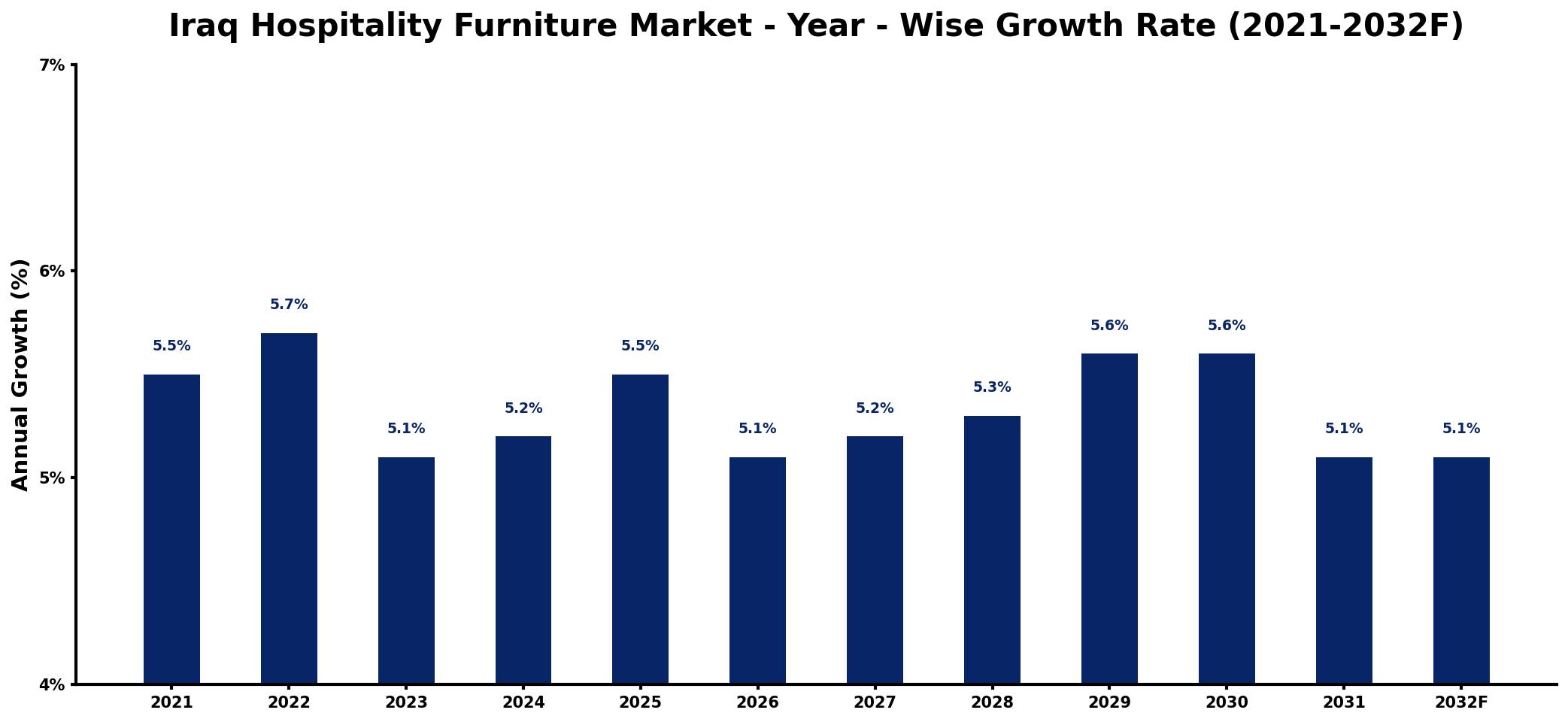
The table below presents the year‑wise growth rates along with the key drivers influencing the market
| Year | Growth Rate | Major Drivers |
| 2021 | 5.5% | Increased tourism sector investments |
| 2022 | 5.7% | Growing demand for luxury accommodations |
| 2023 | 5.1% | Expansion of local manufacturing capabilities |
| 2024 | 5.2% | Rise in international hotel chains |
| 2025 | 5.5% | Boost in government infrastructure projects |
| 2026 | 5.1% | Increased focus on sustainable practices |
| 2027 | 5.2% | Growth of regional business conferences |
| 2028 | 5.3% | Surge in domestic travel preferences |
| 2029 | 5.6% | Emergence of boutique hotel trends |
| 2030 | 5.6% | rising export shipment volumes |
| 2031 | 5.1% | Increased interest in cultural experiences |
| 2032 | 5.1% | growing regional consumption patterns |
Note: Market size estimations and growth projections presented in this report are based on 6Wresearch's proprietary forecasting methodology, utilizing the latest available industry data, government publications, and primary research inputs.
Iraq Hospitality Furniture Market Synopsis
The Iraq Hospitality Furniture Market is experiencing dynamic growth, underpinned by an expansion in the number of hospitality establishments. The increasing tourist influx has heightened the need for aesthetically appealing and functional furniture solutions that enhance the guest experience.
Local manufacturers are finding their niche amidst competition from international suppliers, offering a diverse range of products tailored to the unique demands of the Iraqi market. With trends leaning towards modern designs and eco-friendly materials, the market is evolving to meet the contemporary needs of hospitality businesses.
Iraq Hospitality Furniture Market Key Takeaways
- The market is benefiting from the growth of the tourism sector, creating demand for quality hospitality furniture.
- There is a notable trend towards sustainable materials, reflecting a broader commitment to environmental responsibility within the industry.
- Customizable furniture solutions are becoming increasingly popular, allowing establishments to create distinct and memorable atmospheres for guests.
- Competition is intensifying between local and international players, with innovation and design quality being key differentiators.
- Government policies favoring local manufacturing are shaping market dynamics and supporting domestic businesses.
Evaluation of Restraints in Iraq Hospitality Furniture Market
Despite its promising growth, the Iraq Hospitality Furniture Market faces substantial restraints that could hinder its potential. Political instability and ongoing security concerns pose significant risks, often deterring foreign investment and complicating supply chain logistics. Moreover, economic uncertainties, including fluctuating oil prices, have a direct impact on consumer spending behaviors and, consequently, profitability within the hospitality sector. Infrastructure challenges, such as inconsistent electricity supply and inadequate transportation networks, further complicate operational efficiency. These factors necessitate robust strategic planning and adaptability from businesses operating within the market.
Iraq Hospitality Furniture Market Trends
Current trends in the Iraq Hospitality Furniture Market reflect a strong shift towards contemporary and minimalist designs, aligning with global aesthetics in the hospitality industry. Additionally, the use of sustainable and eco-friendly materials is gaining traction, as businesses increasingly prioritize environmentally responsible practices. Furthermore, the demand for custom furniture solutions continues to rise, driven by the desire to create unique and immersive guest experiences that set establishments apart from competitors. This evolving landscape presents both challenges and opportunities as market participants strive to innovate and meet changing consumer preferences.
Iraq Hospitality Furniture Market Opportunities
The growth potential within the Iraq Hospitality Furniture Market is significant, particularly for investors interested in the burgeoning tourism sector. As the nation rebuilds and modernizes its hospitality infrastructure, opportunities for high-quality, durable furniture tailored to local tastes are abundant. Partnerships with local hospitality businesses can yield mutual benefits, allowing for customized solutions that meet specific needs. Engaging in this market enables stakeholders to capture a share of the increasing demand for premium hospitality furniture, while also establishing a strong foothold as the sector continues to expand.
Government Initiatives in the Iraq Hospitality Furniture Market
The Iraqi government is actively promoting local manufacturing within the hospitality furniture sector as part of its broader economic strategy. By implementing import tariffs and restrictions, the government aims to incentivize the production and consumption of domestically manufactured goods. Furthermore, quality assurance regulations and compliance standards have been established to safeguard the interests of consumers while enhancing the competitiveness of local businesses. These initiatives are designed to stimulate economic growth and reduce reliance on imported furniture, thereby strengthening the local manufacturing landscape.
Future Insights of the Iraq Hospitality Furniture Market
Looking ahead to 2026-2032, the Iraq Hospitality Furniture Market is positioned for continued expansion, largely driven by the anticipated growth of the tourism sector and ongoing investments in infrastructure. As disposable incomes rise and the number of hospitality establishments increases, demand for high-quality, stylish furniture will likely surge. Government efforts to promote tourism and enhance the overall guest experience will further catalyze this growth. Key market participants are expected to focus on innovation and sustainability in their product offerings, addressing the evolving needs of the industry and fostering a competitive advantage in this promising landscape.
Iraq Hospitality Furniture Market Latest Developments (2025 - 2026)
Recent developments within the Iraq Hospitality Furniture Market indicate a trend toward the integration of technology in furniture design and manufacturing processes. With an emphasis on enhancing guest experiences, businesses are exploring smart furniture solutions that offer both functionality and comfort. The local manufacturing sector is also seeing increased collaboration with international design firms, leading to a fusion of global trends with local craftsmanship. These advancements signal a positive direction for the market, fostering innovation and addressing the diverse needs of hospitality operators.
Iraq Hospitality Furniture Market - Key Attractiveness of the Report
- 10 Years of Market Numbers
- Historical Data Starting from 2022 to 2025
- Base Year: 2025
- Forecast Data until 2032
- Key Performance Indicators Impacting the Market
- Major Upcoming Developments and Projects
Key Highlights of the Report:
- Iraq Hospitality Furniture Market Outlook
- Market Size of Iraq Hospitality Furniture Market, 2025
- Forecast of Iraq Hospitality Furniture Market, 2032
- Historical Data and Forecast of Iraq Hospitality Furniture Revenues & Volume for the Period 2022-2032F
- Iraq Hospitality Furniture Market Trend Evolution
- Iraq Hospitality Furniture Market Drivers and Challenges
- Iraq Hospitality Furniture Price Trends
- Iraq Hospitality Furniture Porter's Five Forces
- Iraq Hospitality Furniture Industry Life Cycle
- Historical Data and Forecast of Iraq Hospitality Furniture Market Revenues & Volume By Type for the Period 2022-2032F
- Historical Data and Forecast of Iraq Hospitality Furniture Market Revenues & Volume By Wooden Furniture for the Period 2022-2032F
- Historical Data and Forecast of Iraq Hospitality Furniture Market Revenues & Volume By Leather & Fabric Furniture for the Period 2022-2032F
- Historical Data and Forecast of Iraq Hospitality Furniture Market Revenues & Volume By Metal Furniture for the Period 2022-2032F
- Historical Data and Forecast of Iraq Hospitality Furniture Market Revenues & Volume By Others for the Period 2022-2032F
- Historical Data and Forecast of Iraq Hospitality Furniture Market Revenues & Volume By Applications for the Period 2022-2032F
- Historical Data and Forecast of Iraq Hospitality Furniture Market Revenues & Volume By Economy Hotel for the Period 2022-2032F
- Historical Data and Forecast of Iraq Hospitality Furniture Market Revenues & Volume By Extended-stay Hotel for the Period 2022-2032F
- Historical Data and Forecast of Iraq Hospitality Furniture Market Revenues & Volume By Full-service Hotel for the Period 2022-2032F
- Historical Data and Forecast of Iraq Hospitality Furniture Market Revenues & Volume By Luxury Hotel for the Period 2022-2032F
- Historical Data and Forecast of Iraq Hospitality Furniture Market Revenues & Volume By Others for the Period 2022-2032F
- Historical Data and Forecast of Iraq Hospitality Furniture Market Revenues & Volume By Industry Vertical for the Period 2022-2032F
- Historical Data and Forecast of Iraq Hospitality Furniture Market Revenues & Volume By Hotels & Restaurants for the Period 2022-2032F
- Historical Data and Forecast of Iraq Hospitality Furniture Market Revenues & Volume By Public Places for the Period 2022-2032F
- Historical Data and Forecast of Iraq Hospitality Furniture Market Revenues & Volume By Corporate Offices for the Period 2022-2032F
- Historical Data and Forecast of Iraq Hospitality Furniture Market Revenues & Volume By Others for the Period 2022-2032F
- Iraq Hospitality Furniture Import Export Trade Statistics
- Market Opportunity Assessment By Type
- Market Opportunity Assessment By Applications
- Market Opportunity Assessment By Industry Vertical
- Iraq Hospitality Furniture Top Companies Market Share
- Iraq Hospitality Furniture Competitive Benchmarking By Technical and Operational Parameters
- Iraq Hospitality Furniture Company Profiles
- Iraq Hospitality Furniture Key Strategic Recommendations






































