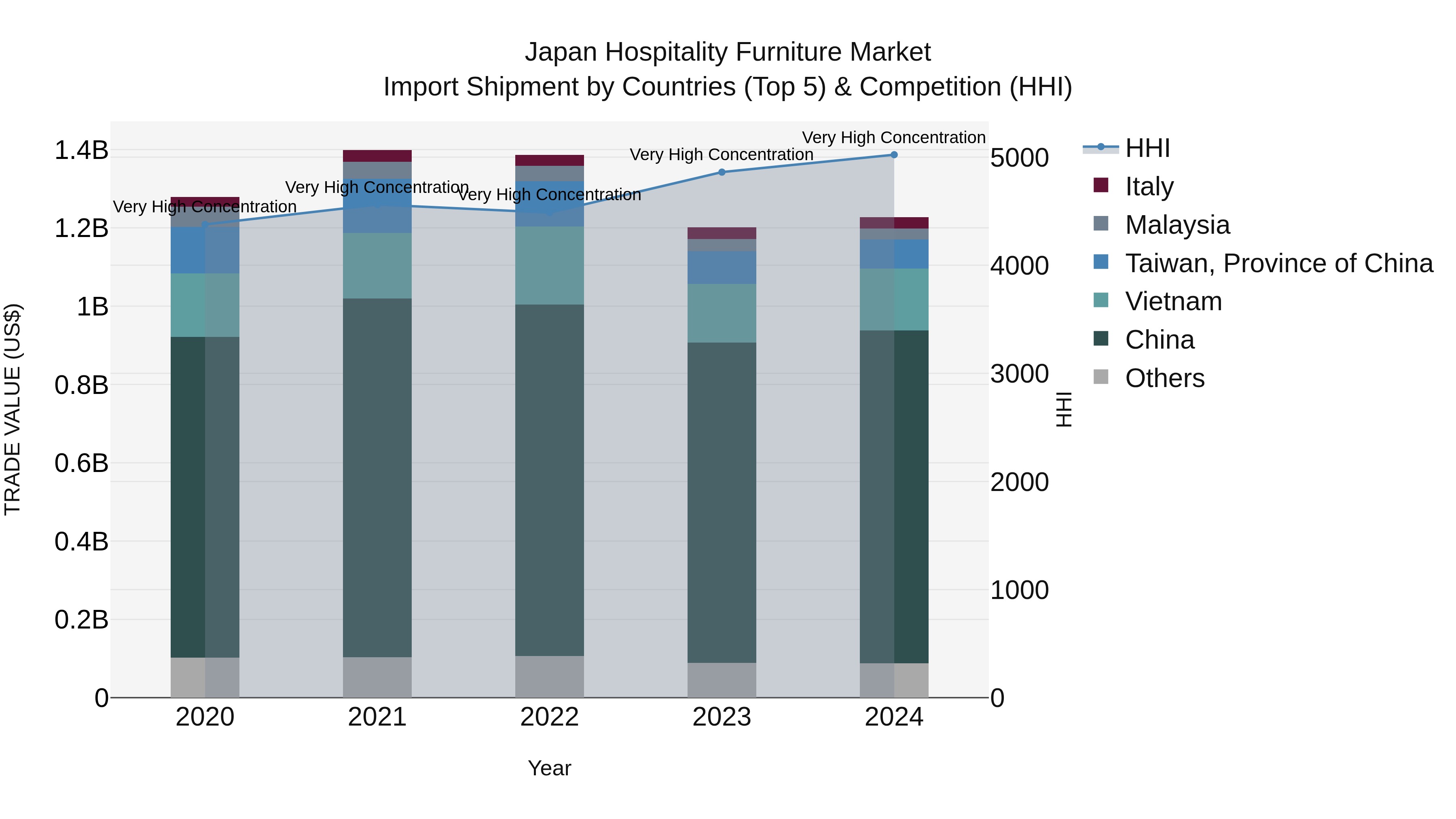
Japan Hospitality Furniture Market Import Shipment by Countries (Top 5) & Competition (HHI)
Despite the decline in HHI concentration and negative CAGR from 2020-2024, the hospitality furniture import market in Japan showed a slight growth with a 2.15% increase from 2023-2024. China, Vietnam, Taiwan, Italy, and Malaysia are the top exporters to Japan in 2024, indicating a diverse sourcing strategy. This suggests that despite challenges, the demand for hospitality furniture in Japan remains steady, with opportunities for further market expansion and competition among key exporting countries.
Japan Hospitality Furniture Market Synopsis
The Japan Hospitality Furniture Market is experiencing steady growth driven by the increasing number of tourists and the growing demand for high-quality, aesthetically pleasing furniture in hotels, restaurants, and other hospitality establishments. The market is characterized by a focus on modern designs, durability, and functionality to cater to the evolving needs and preferences of customers. Key trends include the adoption of eco-friendly materials, customization options, and innovative space-saving solutions. Major players in the market are focusing on expanding their product portfolios, enhancing customer service, and establishing strategic partnerships to strengthen their market presence. With the upcoming Tokyo Olympics and the government`s efforts to boost tourism, the Japan Hospitality Furniture Market is expected to continue its positive trajectory in the coming years.
Japan Hospitality Furniture Market Trends
The Japan Hospitality Furniture Market is experiencing a shift towards sustainable and eco-friendly designs, with a growing emphasis on natural materials such as wood and bamboo. Minimalist and functional designs are also gaining popularity, reflecting the Japanese aesthetic of simplicity and elegance. Customization and personalization options are becoming more prevalent as hotels and restaurants seek to create unique and immersive experiences for their guests. Additionally, there is a rising demand for multifunctional furniture pieces that can adapt to different spaces and purposes, especially in urban areas where space is limited. Japanese craftsmanship and attention to detail continue to be highly valued, with an increasing focus on quality and durability to ensure longevity in a competitive market.
Japan Hospitality Furniture Market Challenges
In the Japan Hospitality Furniture Market, challenges include intense competition among domestic and international manufacturers, leading to price pressures and the need for differentiation through design and quality. Additionally, the market faces fluctuations in consumer preferences and trends, requiring manufacturers to stay agile and innovative in product offerings. Another challenge is the impact of global economic conditions and exchange rate fluctuations on manufacturing costs and pricing strategies. Furthermore, the need to adhere to strict regulations and standards for safety and durability in hospitality furniture adds complexity to product development and production processes. Overall, navigating these challenges requires a deep understanding of the market dynamics and a proactive approach to stay competitive in the Japan Hospitality Furniture Market.
Japan Hospitality Furniture Market Investment Opportunities
The Japan Hospitality Furniture Market presents various investment opportunities due to the country`s thriving tourism industry and increasing demand for high-quality, aesthetically pleasing furniture in hotels, restaurants, and other hospitality establishments. Investors can consider opportunities in supplying custom-made furniture to luxury hotels and resorts, designing and manufacturing eco-friendly furniture to cater to the growing sustainability trend in the industry, or partnering with local designers to create unique and culturally inspired pieces. Additionally, there is potential for growth in the online furniture market segment by providing convenient and innovative solutions for purchasing hospitality furniture. Overall, the Japan Hospitality Furniture Market offers diverse investment avenues for those looking to capitalize on the country`s expanding hospitality sector.
Japan Hospitality Furniture Market Future Outlook
The Japan Hospitality Furniture Market is expected to witness steady growth in the coming years, driven by increasing tourism and hospitality infrastructure development in the country. With the upcoming Tokyo Olympics and the government`s focus on promoting tourism, there is a growing demand for high-quality, stylish, and functional furniture in hotels, restaurants, and other hospitality establishments. Additionally, the trend towards eco-friendly and sustainable furniture options is gaining traction, influencing purchasing decisions in the market. Moreover, the rise of boutique hotels and luxury accommodations in Japan is creating opportunities for innovative and customized furniture solutions. Overall, the Japan Hospitality Furniture Market is poised for expansion, with a focus on modern aesthetics, durability, and sustainability shaping the industry landscape.
Key Highlights of the Report:
- Japan Hospitality Furniture Market Outlook
- Market Size of Japan Hospitality Furniture Market, 2021
- Forecast of Japan Hospitality Furniture Market, 2031
- Historical Data and Forecast of Japan Hospitality Furniture Revenues & Volume for the Period 2018 - 2031
- Japan Hospitality Furniture Market Trend Evolution
- Japan Hospitality Furniture Market Drivers and Challenges
- Japan Hospitality Furniture Price Trends
- Japan Hospitality Furniture Porter's Five Forces
- Japan Hospitality Furniture Industry Life Cycle
- Historical Data and Forecast of Japan Hospitality Furniture Market Revenues & Volume By Type for the Period 2018 - 2031
- Historical Data and Forecast of Japan Hospitality Furniture Market Revenues & Volume By Wooden Furniture for the Period 2018 - 2031
- Historical Data and Forecast of Japan Hospitality Furniture Market Revenues & Volume By Leather & Fabric Furniture for the Period 2018 - 2031
- Historical Data and Forecast of Japan Hospitality Furniture Market Revenues & Volume By Metal Furniture for the Period 2018 - 2031
- Historical Data and Forecast of Japan Hospitality Furniture Market Revenues & Volume By Others for the Period 2018 - 2031
- Historical Data and Forecast of Japan Hospitality Furniture Market Revenues & Volume By Applications for the Period 2018 - 2031
- Historical Data and Forecast of Japan Hospitality Furniture Market Revenues & Volume By Economy Hotel for the Period 2018 - 2031
- Historical Data and Forecast of Japan Hospitality Furniture Market Revenues & Volume By Extended-stay Hotel for the Period 2018 - 2031
- Historical Data and Forecast of Japan Hospitality Furniture Market Revenues & Volume By Full-service Hotel for the Period 2018 - 2031
- Historical Data and Forecast of Japan Hospitality Furniture Market Revenues & Volume By Luxury Hotel for the Period 2018 - 2031
- Historical Data and Forecast of Japan Hospitality Furniture Market Revenues & Volume By Others for the Period 2018 - 2031
- Historical Data and Forecast of Japan Hospitality Furniture Market Revenues & Volume By Industry Vertical for the Period 2018 - 2031
- Historical Data and Forecast of Japan Hospitality Furniture Market Revenues & Volume By Hotels & Restaurants for the Period 2018 - 2031
- Historical Data and Forecast of Japan Hospitality Furniture Market Revenues & Volume By Public Places for the Period 2018 - 2031
- Historical Data and Forecast of Japan Hospitality Furniture Market Revenues & Volume By Corporate Offices for the Period 2018 - 2031
- Historical Data and Forecast of Japan Hospitality Furniture Market Revenues & Volume By Others for the Period 2018 - 2031
- Japan Hospitality Furniture Import Export Trade Statistics
- Market Opportunity Assessment By Type
- Market Opportunity Assessment By Applications
- Market Opportunity Assessment By Industry Vertical
- Japan Hospitality Furniture Top Companies Market Share
- Japan Hospitality Furniture Competitive Benchmarking By Technical and Operational Parameters
- Japan Hospitality Furniture Company Profiles
- Japan Hospitality Furniture Key Strategic Recommendations






































