Iraq Industrial Fasteners Market Size, Share & Growth Rate
The Iraq Industrial Fasteners Market was estimated at USD 153 Million in 2025 and is projected to reach USD 167 Million by 2032, growing at a CAGR of 1.3% from 2026 to 2032. This growth trajectory is primarily driven by robust construction activities, an expanding manufacturing sector, and significant infrastructure investments across the nation. Industries such as automotive, aerospace, and oil and gas are increasingly relying on industrial fasteners, emphasizing the need for reliable joining solutions.
Iraq Industrial Fasteners Market Year-wise Growth Rate and Key Drivers
This graph highlights how the Iraq Industrial Fasteners Market has steadily grown over the years, supported by major growth factors.
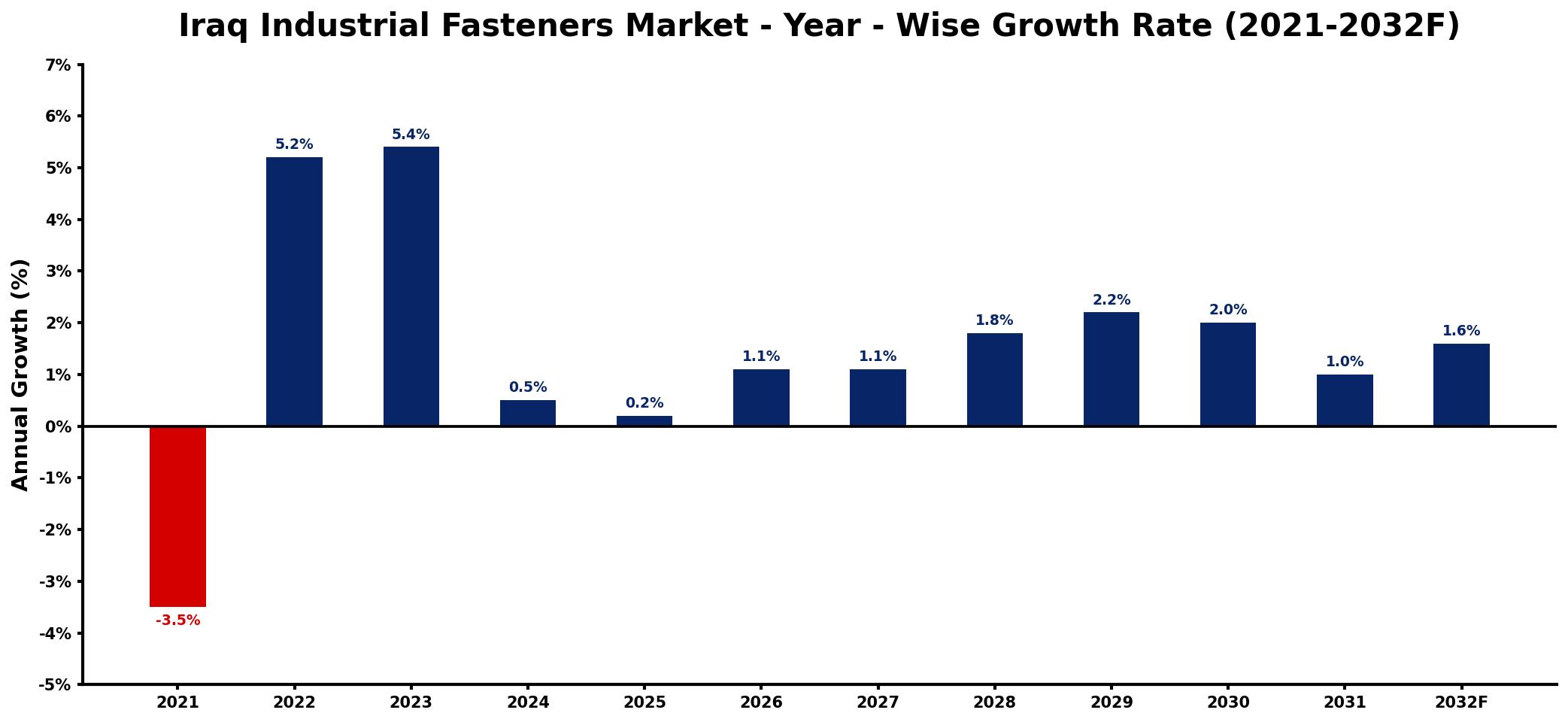
The table below presents the year‑wise growth rates along with the key drivers influencing the market
| Year | Growth Rate | Major Drivers |
| 2021 | -3.5% | decreased construction project investments |
| 2022 | 5.2% | rising construction sector activities |
| 2023 | 5.4% | increased manufacturing sector demand |
| 2024 | 0.5% | growing infrastructure development projects |
| 2025 | 0.2% | expansion of renewable energy initiatives |
| 2026 | 1.1% | enhanced automotive production requirements |
| 2027 | 1.1% | increased residential building activities |
| 2028 | 1.8% | growing oil and gas exploration |
| 2029 | 2.2% | rising demand for transportation solutions |
| 2030 | 2.0% | increased domestic production output |
| 2031 | 1.0% | increased focus on sustainable construction |
| 2032 | 1.6% | growing investment in public utilities |
Note: Market size estimations and growth projections presented in this report are based on 6Wresearch's proprietary forecasting methodology, utilizing the latest available industry data, government publications, and primary research inputs.
Iraq Industrial Fasteners Market Synopsis
Recent momentum in the Iraq Industrial Fasteners Market has been fueled by a surge in construction and infrastructure projects, positioning it as a vital sector within the broader economy. However, the market is poised for transition as it faces challenges related to supply chain limitations and material quality, which may impede consistent growth.
Looking ahead, the industrial fasteners market is set to evolve, shaped by advancements in manufacturing practices and quality assurance. With government policies promoting the use of high-quality fasteners, the market is expected to align more closely with international standards, potentially increasing trust among local and foreign investors.
Iraq Industrial Fasteners Market Key Takeaways
- The market is expected to achieve a steady growth rate, reflecting an increasing dependency on industrial fasteners across various sectors.
- Significant construction and infrastructure development projects are primary drivers of market expansion in Iraq.
- Government policies are gradually improving quality standards for industrial fasteners, enhancing their reliability.
- Emerging challenges related to supply chain disruptions must be addressed to maintain growth momentum.
- Investment in high-quality materials and skilled labor is crucial for market stability and competitiveness.
Evaluation of Restraints in Iraq Industrial Fasteners Market
Despite the positive growth outlook, several factors are constraining the Iraq Industrial Fasteners Market. Infrastructure limitations remain a significant barrier, often leading to delays and inefficiencies in production and distribution processes. Supply chain disruptions further exacerbate these challenges, hindering access to high-quality raw materials essential for fastener production. Additionally, the lack of skilled labor can affect the quality assurance processes, leading to inconsistencies that may undermine market confidence in local products.
Iraq Industrial Fasteners Market Trends
Current trends in the Iraq Industrial Fasteners Market indicate a growing preference for innovative fastening solutions that enhance mechanical strength and ease of assembly. There is an increasing shift toward automation and advanced manufacturing technologies, allowing for more efficient production processes. Furthermore, sustainability considerations are becoming more prominent, with a rising demand for eco-friendly materials and manufacturing methods that minimize environmental impact.
Iraq Industrial Fasteners Market Opportunities
Significant growth and investment opportunities lie in the integration of advanced manufacturing technologies, including automation and quality control systems. By enhancing production capabilities, local manufacturers can meet international standards, thereby expanding their market reach. Additionally, the focus on infrastructure development by the government opens avenues for partnerships with construction firms, creating a strong demand for reliable industrial fasteners.
Government Initiatives in the Iraq Industrial Fasteners Market
The Iraqi government has implemented several initiatives aimed at improving the standards and quality of industrial fasteners. Through policy enforcement and regulations, the government is emphasizing safety and efficiency in manufacturing practices. Public spending on infrastructure projects is also expected to boost demand for fasteners, encouraging local firms to enhance their production capabilities and align with the growing expectations of both domestic and international markets.
Future Insights of the Iraq Industrial Fasteners Market
Looking toward 2026-2032, the Iraq Industrial Fasteners Market is set for gradual yet stable growth. Factors such as a strengthening economy, increased investment in manufacturing, and ongoing infrastructure projects will play pivotal roles in shaping the market landscape. Enhanced quality control measures and a focus on advanced manufacturing technologies will further support this growth, solidifying Iraq's position in the regional fasteners market.
Iraq Industrial Fasteners Market Latest Developments (2025 - 2026)
Recent developments in the Iraq Industrial Fasteners Market have highlighted a shift toward improved quality assurance practices among manufacturers. Collaborative efforts between local firms and international partners are increasingly fostering knowledge transfer, enhancing production techniques. Additionally, there has been a notable increase in government investment focused on infrastructure, creating a burgeoning environment for fastener demand.
Iraq Industrial Fasteners Market - Key Attractiveness of the Report
- 10 Years of Market Numbers
- Historical Data Starting from 2022 to 2025
- Base Year: 2025
- Forecast Data until 2032
- Key Performance Indicators Impacting the Market
- Major Upcoming Developments and Projects
Key Highlights of the Report:
- Iraq Industrial Fasteners Market Outlook
- Market Size of Iraq Industrial Fasteners Market, 2025
- Forecast of Iraq Industrial Fasteners Market, 2032
- Historical Data and Forecast of Iraq Industrial Fasteners Revenues & Volume for the Period 2022-2032F
- Iraq Industrial Fasteners Market Trend Evolution
- Iraq Industrial Fasteners Market Drivers and Challenges
- Iraq Industrial Fasteners Price Trends
- Iraq Industrial Fasteners Porter's Five Forces
- Iraq Industrial Fasteners Industry Life Cycle
- Historical Data and Forecast of Iraq Industrial Fasteners Market Revenues & Volume By Raw Material for the Period 2022-2032F
- Historical Data and Forecast of Iraq Industrial Fasteners Market Revenues & Volume By Plastic for the Period 2022-2032F
- Historical Data and Forecast of Iraq Industrial Fasteners Market Revenues & Volume By Metal for the Period 2022-2032F
- Historical Data and Forecast of Iraq Industrial Fasteners Market Revenues & Volume By Product for the Period 2022-2032F
- Historical Data and Forecast of Iraq Industrial Fasteners Market Revenues & Volume By Externally Threaded for the Period 2022-2032F
- Historical Data and Forecast of Iraq Industrial Fasteners Market Revenues & Volume By Internally Threaded for the Period 2022-2032F
- Historical Data and Forecast of Iraq Industrial Fasteners Market Revenues & Volume By Non-threaded for the Period 2022-2032F
- Historical Data and Forecast of Iraq Industrial Fasteners Market Revenues & Volume By Aerospace Grade for the Period 2022-2032F
- Historical Data and Forecast of Iraq Industrial Fasteners Market Revenues & Volume By Application for the Period 2022-2032F
- Historical Data and Forecast of Iraq Industrial Fasteners Market Revenues & Volume By Automotive for the Period 2022-2032F
- Historical Data and Forecast of Iraq Industrial Fasteners Market Revenues & Volume By Aerospace for the Period 2022-2032F
- Historical Data and Forecast of Iraq Industrial Fasteners Market Revenues & Volume By Building & Construction for the Period 2022-2032F
- Historical Data and Forecast of Iraq Industrial Fasteners Market Revenues & Volume By Industrial Machinery for the Period 2022-2032F
- Historical Data and Forecast of Iraq Industrial Fasteners Market Revenues & Volume By Lawn and Garden for the Period 2022-2032F
- Historical Data and Forecast of Iraq Industrial Fasteners Market Revenues & Volume By Plumbing Products for the Period 2022-2032F
- Historical Data and Forecast of Iraq Industrial Fasteners Market Revenues & Volume By Others for the Period 2022-2032F
- Iraq Industrial Fasteners Import Export Trade Statistics
- Market Opportunity Assessment By Raw Material
- Market Opportunity Assessment By Product
- Market Opportunity Assessment By Application
- Iraq Industrial Fasteners Top Companies Market Share
- Iraq Industrial Fasteners Competitive Benchmarking By Technical and Operational Parameters
- Iraq Industrial Fasteners Company Profiles
- Iraq Industrial Fasteners Key Strategic Recommendations






































