Iraq Industrial Hose Market Size, Share & Growth Rate
The Iraq Industrial Hose Market was estimated at USD 233 Million in 2025 and is projected to reach USD 254 Million by 2032, growing at a CAGR of 1.2% from 2026 to 2032. This growth trajectory is primarily driven by Iraq's expanding oil and gas sector, which remains a cornerstone of the economy and requires robust fluid transfer solutions. Additionally, increasing construction activities and chemical processing are contributing to heightened demand for durable and efficient industrial hoses.
Iraq Industrial Hose Market Year-wise Growth Rate and Key Drivers
This graph highlights how the Iraq Industrial Hose Market has steadily grown over the years, supported by major growth factors.
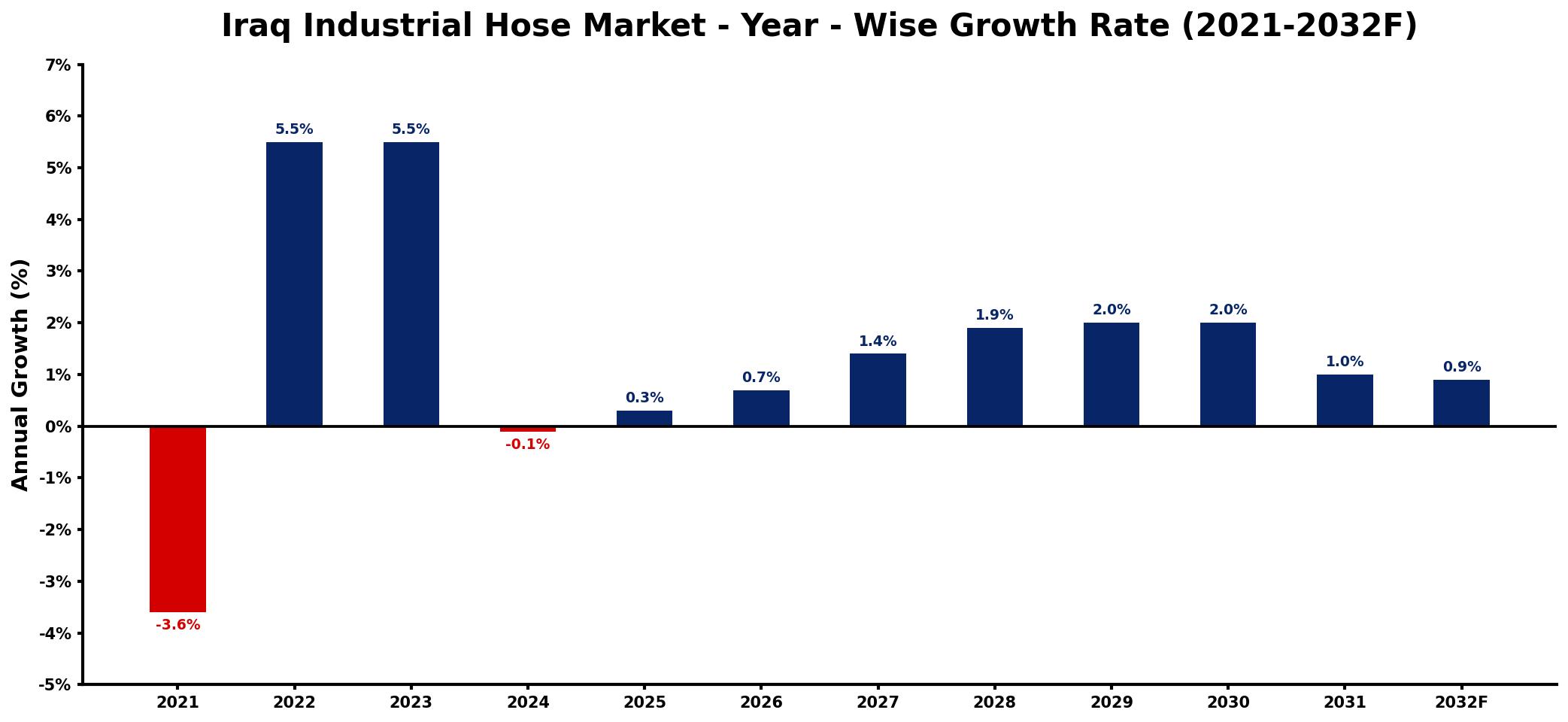
The table below presents the year‑wise growth rates along with the key drivers influencing the market
| Year | Growth Rate | Major Drivers |
| 2021 | -3.6% | decreased construction project investments |
| 2022 | 5.5% | growing energy sector projects |
| 2023 | 5.5% | increased manufacturing facility expansions |
| 2024 | -0.1% | less government infrastructure funding |
| 2025 | 0.3% | rising agricultural irrigation needs |
| 2026 | 0.7% | expanding oil and gas operations |
| 2027 | 1.4% | increased mining activity investments |
| 2028 | 1.9% | growing demand for transportation services |
| 2029 | 2.0% | rising construction material requirements |
| 2030 | 2.0% | increased focus on renewable energy |
| 2031 | 1.0% | growing interest in automation technologies |
| 2032 | 0.9% | rising urban development projects |
Note: Market size estimations and growth projections presented in this report are based on 6Wresearch's proprietary forecasting methodology, utilizing the latest available industry data, government publications, and primary research inputs.
Iraq Industrial Hose Market Synopsis
In Iraq, the industrial hose market is characterized by a diverse range of applications including fluid transfer in manufacturing and agriculture. Notably, the oil and gas industry significantly drives demand, as companies seek hoses that can withstand extreme conditions while ensuring safety and reliability.
The market is also shaped by the need for high-quality materials like rubber and PVC, critical for ensuring longevity and performance. As industrial operations scale up, the focus on safe and efficient conveyance of liquids and gases becomes increasingly pertinent, further stimulating market growth.
Iraq Industrial Hose Market Key Takeaways
- The market is heavily influenced by the oil and gas sector, crucial for fluid transfer and operational efficiency.
- Increasing construction activities are pushing demand for durable industrial hoses in various applications.
- Regulatory policies aim to improve product quality and safety across the industrial hose market.
- Limited access to high-quality materials poses ongoing challenges for manufacturers in Iraq.
- Emerging technologies and innovations in hose manufacturing are expected to drive future market growth.
Evaluation of Restraints in Iraq Industrial Hose Market
Despite its growth potential, the Iraq Industrial Hose Market faces several significant restraints. Regulatory constraints can complicate manufacturing processes and compliance standards, leading to delays and increased costs. Additionally, supply chain disruptions have been exacerbated by regional instability, limiting access to high-quality hose materials. The ongoing skills gap in the workforce further impedes the availability of reliable industrial hoses, threatening to affect overall market efficiency.
Iraq Industrial Hose Market Trends
Recent trends indicate a growing preference for hoses that offer superior durability and flexibility, particularly in harsh operational environments. Technological advancements are also leading to innovations in material science, allowing for the development of hoses that can withstand extreme temperatures and pressures. Furthermore, the rise of eco-friendly materials is gaining traction as industries seek sustainable options in their operations.
Iraq Industrial Hose Market Opportunities
The Iraq Industrial Hose Market presents several opportunities for investment and growth. As infrastructure development accelerates, particularly in the oil, gas, and construction sectors, companies that can provide innovative solutions will find significant demand. Furthermore, there is potential for expanding the market for specialized hoses tailored to specific industrial applications, which can enhance operational efficiencies and safety.
Government Initiatives in the Iraq Industrial Hose Market
The Iraqi government is actively pursuing policies aimed at enhancing product quality and ensuring safety within the industrial hose market. This includes the enforcement of strict manufacturing standards and support for local manufacturers to elevate their production capabilities. Government initiatives also focus on public spending in infrastructure projects, indirectly benefiting the industrial hose market as demand increases.
Future Insights of the Iraq Industrial Hose Market
Looking ahead to 2026-2032, the Iraq Industrial Hose Market is poised for steady growth, driven by ongoing developments in the oil and gas industry and infrastructure expansion. As companies prioritize safety and efficiency, the demand for high-quality industrial hoses will continue to rise. Additionally, advancements in manufacturing processes and materials technology will enable suppliers to meet the evolving needs of various sectors, further solidifying the market's potential.
Iraq Industrial Hose Market Latest Developments (2025 - 2026)
In the recent months leading up to mid-2026, there have been noteworthy advancements in the industry regarding the adoption of cutting-edge technologies in hose manufacturing. The focus has been on improving the durability and performance of hoses to meet the rigorous demands of the oil and gas sectors. Additionally, companies are increasingly investing in training programs for skilled labor, aiming to bolster workforce capabilities in line with market needs.
Iraq Industrial Hose Market - Key Attractiveness of the Report
- 10 Years of Market Numbers
- Historical Data Starting from 2022 to 2025
- Base Year: 2025
- Forecast Data until 2032
- Key Performance Indicators Impacting the Market
- Major Upcoming Developments and Projects
Key Highlights of the Report:
- Iraq Industrial Hose Market Outlook
- Market Size of Iraq Industrial Hose Market, 2025
- Forecast of Iraq Industrial Hose Market, 2032
- Historical Data and Forecast of Iraq Industrial Hose Revenues & Volume for the Period 2022-2032F
- Iraq Industrial Hose Market Trend Evolution
- Iraq Industrial Hose Market Drivers and Challenges
- Iraq Industrial Hose Price Trends
- Iraq Industrial Hose Porter's Five Forces
- Iraq Industrial Hose Industry Life Cycle
- Historical Data and Forecast of Iraq Industrial Hose Market Revenues & Volume By Material for the Period 2022-2032F
- Historical Data and Forecast of Iraq Industrial Hose Market Revenues & Volume By Natural Rubber for the Period 2022-2032F
- Historical Data and Forecast of Iraq Industrial Hose Market Revenues & Volume By Nitrile Rubber for the Period 2022-2032F
- Historical Data and Forecast of Iraq Industrial Hose Market Revenues & Volume By PVC for the Period 2022-2032F
- Historical Data and Forecast of Iraq Industrial Hose Market Revenues & Volume By Silicone for the Period 2022-2032F
- Historical Data and Forecast of Iraq Industrial Hose Market Revenues & Volume By Polyurethane for the Period 2022-2032F
- Historical Data and Forecast of Iraq Industrial Hose Market Revenues & Volume By Others (EPDM, UPE) for the Period 2022-2032F
- Historical Data and Forecast of Iraq Industrial Hose Market Revenues & Volume By Media Type for the Period 2022-2032F
- Historical Data and Forecast of Iraq Industrial Hose Market Revenues & Volume By Water for the Period 2022-2032F
- Historical Data and Forecast of Iraq Industrial Hose Market Revenues & Volume By Oil for the Period 2022-2032F
- Historical Data and Forecast of Iraq Industrial Hose Market Revenues & Volume By Hot Water and Steam for the Period 2022-2032F
- Historical Data and Forecast of Iraq Industrial Hose Market Revenues & Volume By Air and Gas for the Period 2022-2032F
- Historical Data and Forecast of Iraq Industrial Hose Market Revenues & Volume By Food and Beverage for the Period 2022-2032F
- Historical Data and Forecast of Iraq Industrial Hose Market Revenues & Volume By Chemical for the Period 2022-2032F
- Historical Data and Forecast of Iraq Industrial Hose Market Revenues & Volume By Industry for the Period 2022-2032F
- Historical Data and Forecast of Iraq Industrial Hose Market Revenues & Volume By Automotive for the Period 2022-2032F
- Historical Data and Forecast of Iraq Industrial Hose Market Revenues & Volume By Infrastructure for the Period 2022-2032F
- Historical Data and Forecast of Iraq Industrial Hose Market Revenues & Volume By Oil & Gas for the Period 2022-2032F
- Historical Data and Forecast of Iraq Industrial Hose Market Revenues & Volume By Pharmaceuticals for the Period 2022-2032F
- Historical Data and Forecast of Iraq Industrial Hose Market Revenues & Volume By Food & Beverages for the Period 2022-2032F
- Historical Data and Forecast of Iraq Industrial Hose Market Revenues & Volume By Water & Wastewater for the Period 2022-2032F
- Historical Data and Forecast of Iraq Industrial Hose Market Revenues & Volume By Others for the Period 2022-2032F
- Iraq Industrial Hose Import Export Trade Statistics
- Market Opportunity Assessment By Material
- Market Opportunity Assessment By Media Type
- Market Opportunity Assessment By Industry
- Iraq Industrial Hose Top Companies Market Share
- Iraq Industrial Hose Competitive Benchmarking By Technical and Operational Parameters
- Iraq Industrial Hose Company Profiles
- Iraq Industrial Hose Key Strategic Recommendations






































