Iraq Insulated Glass Market Size, Share & Growth Rate
The Iraq Insulated Glass Market was estimated at USD 323 Million in 2025 and is projected to reach USD 430 Million by 2032, growing at a CAGR of 4.2% from 2026 to 2032. This growth trajectory is primarily fueled by a robust increase in construction activities driven by rapid urbanization and a strong governmental push towards sustainable building practices. The demand for insulated glass, recognized for its superior thermal insulation capabilities, is on the rise as more stakeholders prioritize energy efficiency in both residential and commercial buildings.
Iraq Insulated Glass Market Year-wise Growth Rate and Key Drivers
This graph highlights how the Iraq Insulated Glass Market has steadily grown over the years, supported by major growth factors.
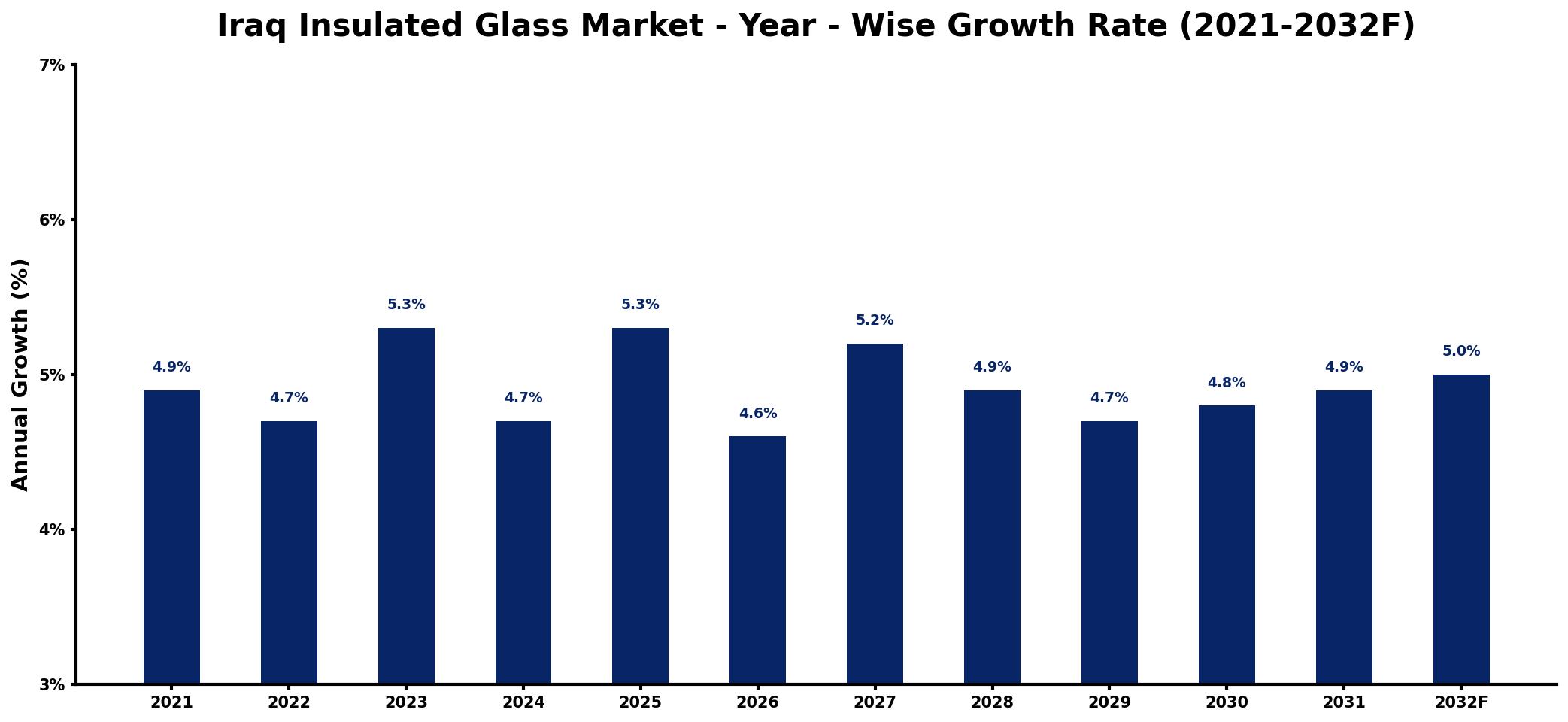
The table below presents the year‑wise growth rates along with the key drivers influencing the market
| Year | Growth Rate | Major Drivers |
| 2021 | 4.9% | Rising construction sector investments |
| 2022 | 4.7% | Increased energy efficiency standards |
| 2023 | 5.3% | Growing demand for sustainable architecture |
| 2024 | 4.7% | Expansion of commercial real estate |
| 2025 | 5.3% | Surge in residential construction projects |
| 2026 | 4.6% | Advancements in building technologies |
| 2027 | 5.2% | Higher consumer awareness on insulation |
| 2028 | 4.9% | growing automotive sector requirements |
| 2029 | 4.7% | Increased focus on environmental regulations |
| 2030 | 4.8% | rising end-use demand growth |
| 2031 | 4.9% | Rising popularity of green building |
| 2032 | 5.0% | Enhanced government infrastructure programs |
Note: Market size estimations and growth projections presented in this report are based on 6Wresearch's proprietary forecasting methodology, utilizing the latest available industry data, government publications, and primary research inputs.
Iraq Insulated Glass Market Synopsis
The strongest force shaping the Iraq Insulated Glass Market right now is the increasing emphasis on energy efficiency. As Iraq embarks on numerous construction projects, stakeholders are increasingly opting for insulated glass solutions to minimize energy costs and enhance building performance. This shift is not only a response to economic considerations but also reflects a growing awareness of sustainability within the countrys construction sector.
Government initiatives to support local production have further bolstered market growth, enabling manufacturers to innovate and improve product offerings. With advancements in technology, such as enhanced coatings and gas fills, the thermal performance of insulated glass is continually improving, making it a preferred choice among architects and builders across Iraq.
Iraq Insulated Glass Market Key Takeaways
- The market is currently driven by a surge in construction activities and a focus on energy efficiency.
- Increased urbanization is significantly contributing to the demand for insulated glass solutions.
- Technological advancements are playing a key role in improving the thermal performance of products.
- Government policies are aimed at promoting local manufacturing and reducing import reliance.
- The market presents substantial investment opportunities amidst ongoing real estate development.
Evaluation of Restraints in Iraq Insulated Glass Market
Despite its promising outlook, the Iraq Insulated Glass Market encounters several notable restraints. Political instability and security concerns remain critical issues, often disrupting supply chains and affecting operational efficiency. Additionally, the lack of well-established infrastructure complicates logistics for manufacturers and distributors, inhibiting growth potential. Fluctuating raw material prices coupled with economic uncertainties also pose challenges to maintaining competitive pricing and profitability in the market.
Iraq Insulated Glass Market Trends
Emerging trends in the Iraq Insulated Glass Market reveal a distinct shift towards more energy-efficient and sustainable building practices. The adoption of insulated glass for both residential and commercial constructions is gaining traction, driven by rising awareness of energy savings and comfort enhancement. Furthermore, advancements in glass technology, including innovative coatings and gas-filled panes, are revolutionizing product offerings, catering to a more discerning customer base.
Iraq Insulated Glass Market Opportunities
Significant investment opportunities abound in the Iraq Insulated Glass Market as construction activities continue to rise. With a pronounced focus on sustainability and energy-efficient solutions, businesses that manufacture, distribute, or install insulated glass products are well-positioned to capitalize on this growing trend. The market's trajectory indicates an evolving demand for advanced technological solutions to meet the specific needs of the construction sector.
Government Initiatives in the Iraq Insulated Glass Market
Government policies play a crucial role in shaping the Iraq Insulated Glass Market, with a strong focus on fostering local production. Initiatives designed to provide financial incentives and streamline regulatory processes are promoting the growth of domestic manufacturers. There is also an emphasis on quality assurance and safety standards, alongside encouragement for research and development efforts aimed at fostering innovation within the industry.
Future Insights of the Iraq Insulated Glass Market
Looking ahead to 2026-2032, the Iraq Insulated Glass Market is poised for steady expansion. Factors such as the booming construction sector, increasing demand for energy-efficient buildings, and ongoing government infrastructure initiatives will contribute significantly to market growth. As consumers and businesses alike prioritize sustainability, insulated glass will remain a key component of modern construction, ensuring that the market evolves in line with global trends.
Iraq Insulated Glass Market Latest Developments (2025 - 2026)
The recent industry direction in the Iraq Insulated Glass Market indicates a heightened focus on sustainability and energy efficiency. Companies are actively seeking partnerships to enhance production capabilities and improve product quality. There is an observable trend towards investing in innovative technologies aimed at reducing production costs while improving the thermal performance of insulated glass products. Moreover, industry stakeholders are engaging in dialogue with the government to align on policies that support local manufacturing and meet rising demand.
Iraq Insulated Glass Market - Key Attractiveness of the Report
- 10 Years of Market Numbers
- Historical Data Starting from 2022 to 2025
- Base Year: 2025
- Forecast Data until 2032
- Key Performance Indicators Impacting the Market
- Major Upcoming Developments and Projects
Key Highlights of the Report:
- Iraq Insulated Glass Market Outlook
- Market Size of Iraq Insulated Glass Market, 2025
- Forecast of Iraq Insulated Glass Market, 2032
- Historical Data and Forecast of Iraq Insulated Glass Revenues & Volume for the Period 2022-2032F
- Iraq Insulated Glass Market Trend Evolution
- Iraq Insulated Glass Market Drivers and Challenges
- Iraq Insulated Glass Price Trends
- Iraq Insulated Glass Porter's Five Forces
- Iraq Insulated Glass Industry Life Cycle
- Historical Data and Forecast of Iraq Insulated Glass Market Revenues & Volume By Type for the Period 2022-2032F
- Historical Data and Forecast of Iraq Insulated Glass Market Revenues & Volume By Heated Insulating Glass for the Period 2022-2032F
- Historical Data and Forecast of Iraq Insulated Glass Market Revenues & Volume By Tempering Insulating Glass for the Period 2022-2032F
- Historical Data and Forecast of Iraq Insulated Glass Market Revenues & Volume By Custom Insulated Glass for the Period 2022-2032F
- Historical Data and Forecast of Iraq Insulated Glass Market Revenues & Volume By Other Glasses for the Period 2022-2032F
- Historical Data and Forecast of Iraq Insulated Glass Market Revenues & Volume By Application for the Period 2022-2032F
- Historical Data and Forecast of Iraq Insulated Glass Market Revenues & Volume By Doors & Partitions for the Period 2022-2032F
- Historical Data and Forecast of Iraq Insulated Glass Market Revenues & Volume By Kitchen Appliances & Cabinets for the Period 2022-2032F
- Historical Data and Forecast of Iraq Insulated Glass Market Revenues & Volume By Floors & Ceilings for the Period 2022-2032F
- Historical Data and Forecast of Iraq Insulated Glass Market Revenues & Volume By Furniture & Curtain Walls for the Period 2022-2032F
- Historical Data and Forecast of Iraq Insulated Glass Market Revenues & Volume By Railings & Bolted Structures for the Period 2022-2032F
- Historical Data and Forecast of Iraq Insulated Glass Market Revenues & Volume By Automotive Glasses for the Period 2022-2032F
- Historical Data and Forecast of Iraq Insulated Glass Market Revenues & Volume By End User for the Period 2022-2032F
- Historical Data and Forecast of Iraq Insulated Glass Market Revenues & Volume By Residential Buildings for the Period 2022-2032F
- Historical Data and Forecast of Iraq Insulated Glass Market Revenues & Volume By Commercial & Institutional Buildings for the Period 2022-2032F
- Historical Data and Forecast of Iraq Insulated Glass Market Revenues & Volume By Industrial Users for the Period 2022-2032F
- Iraq Insulated Glass Import Export Trade Statistics
- Market Opportunity Assessment By Type
- Market Opportunity Assessment By Application
- Market Opportunity Assessment By End User
- Iraq Insulated Glass Top Companies Market Share
- Iraq Insulated Glass Competitive Benchmarking By Technical and Operational Parameters
- Iraq Insulated Glass Company Profiles
- Iraq Insulated Glass Key Strategic Recommendations






































