Iraq Insulation Products Market Size, Share & Growth Rate
The Iraq Insulation Products Market was estimated at USD 158 Million in 2025 and is projected to reach USD 209 Million by 2032, growing at a CAGR of 4.1% from 2026 to 2032. This growth is largely fueled by an uptick in construction activities across both residential and commercial sectors, as well as stricter energy efficiency regulations. The growing recognition of insulations role in enhancing indoor comfort and reducing energy costs is expected to further stimulate demand for various insulation materials, including fiberglass and foam board.
Iraq Insulation Products Market Year-wise Growth Rate and Key Drivers
This graph highlights how the Iraq Insulation Products Market has steadily grown over the years, supported by major growth factors.
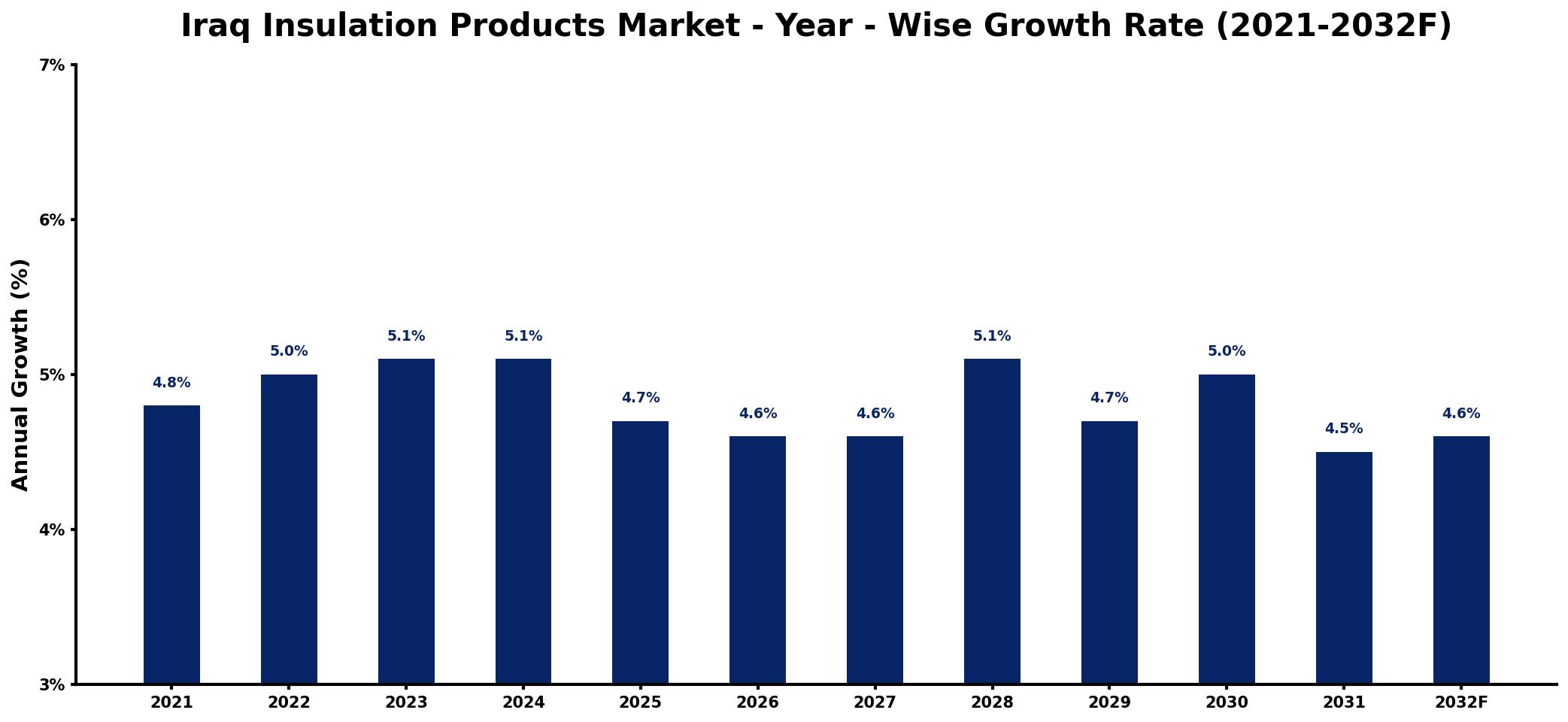
The table below presents the year‑wise growth rates along with the key drivers influencing the market
| Year | Growth Rate | Major Drivers |
| 2021 | 4.8% | Rising construction sector investments |
| 2022 | 5.0% | Increased energy efficiency regulations |
| 2023 | 5.1% | Growing demand for sustainable materials |
| 2024 | 5.1% | Expansion of residential projects |
| 2025 | 4.7% | Emerging renewable energy initiatives |
| 2026 | 4.6% | Improved supply chain logistics |
| 2027 | 4.6% | Technological advancements in manufacturing |
| 2028 | 5.1% | Boost in commercial building projects |
| 2029 | 4.7% | Government incentives for renovations |
| 2030 | 5.0% | Rising public awareness of efficiency |
| 2031 | 4.5% | Strengthening foreign direct investments |
| 2032 | 4.6% | Growing focus on climate resilience |
Note: Market size estimations and growth projections presented in this report are based on 6Wresearch's proprietary forecasting methodology, utilizing the latest available industry data, government publications, and primary research inputs.
Iraq Insulation Products Market Synopsis
The demand for insulation materials in Iraq is increasingly being influenced by a heightened awareness of energy conservation and environmental sustainability. As new construction projects commence and existing structures undergo renovations, the need for high-performance insulation products becomes evident, paving the way for innovative solutions that address local climate conditions.
Moreover, the Iraqi governments initiatives to regulate and promote energy efficiency standards are catalyzing the uptake of insulation products. This regulatory environment fosters innovation and encourages manufacturers to develop sustainable solutions tailored specifically to the unique challenges of the Iraqi market.
Iraq Insulation Products Market Key Takeaways
- The market is projected to grow steadily due to increased construction and energy efficiency regulations.
- Key products include fiberglass, foam board, and mineral wool, all essential for thermal and acoustic performance.
- Government regulations are shaping the quality and standards of insulation products in the region.
- The emphasis on sustainability is pushing manufacturers towards eco-friendly insulation solutions.
- Climate conditions in Iraq necessitate durable materials capable of withstanding extreme temperatures.
Evaluation of Restraints in Iraq Insulation Products Market
While the Iraq insulation products market presents numerous opportunities, it is not without its challenges. Competition from imported products remains a significant concern, as these often offer established quality and brand recognition. Additionally, ensuring product durability and quality across varying climatic conditions poses a challenge for local manufacturers. The necessity to meet diverse industry needs—from construction to automotive—complicates product offerings, requiring continuous innovation. Furthermore, addressing regulatory compliance and environmental considerations will be critical for companies to maintain a competitive edge in the market.
Iraq Insulation Products Market Trends
The market is witnessing several trends that are shaping the demand for insulation products. A notable trend is the increasing shift towards environmentally friendly materials, with manufacturers exploring bio-based and recycled insulation options. Additionally, the integration of smart technologies into insulation solutions is gaining traction, enabling enhanced energy monitoring and control in buildings. This is complemented by a growing emphasis on fire-resistant materials, driven by safety regulations and consumer preferences.
Iraq Insulation Products Market Opportunities
There is a wealth of growth opportunities within the Iraq insulation products market. With rising construction activities, manufacturers can capitalize on the demand for advanced insulation solutions that offer superior thermal and acoustic performance. The push for energy-efficient buildings presents opportunities for innovative product development, particularly in light of government regulations encouraging sustainability. Additionally, expanding into untapped regions and targeting specific industrial sectors could further enhance market presence and profitability.
Government Initiatives in the Iraq Insulation Products Market
The Iraqi government has established various regulations to ensure the quality and effectiveness of insulation products in the market. These policies focus on manufacturing standards, testing protocols, and the application of insulation materials to promote energy efficiency and safety. Moreover, government initiatives aimed at increasing awareness and adoption of innovative insulation technologies further support market development. Through these measures, the government is actively working to foster a sustainable construction environment in Iraq.
Future Insights of the Iraq Insulation Products Market
Looking ahead to the period from 2026 to 2032, the Iraq insulation products market is poised for a transformative phase. With anticipated advancements in insulation technology and heightened demand for energy-efficient solutions, manufacturers will need to adapt and innovate continuously. The growing construction landscape, coupled with ongoing governmental support for sustainable practices, is likely to bolster market growth. As local manufacturers strive to enhance product quality and meet regulatory demands, they will play a pivotal role in shaping the future of insulation in Iraq.
Iraq Insulation Products Market Latest Developments (2025 - 2026)
Recent developments in the Iraq insulation products market highlight a trend toward collaborative initiatives aimed at enhancing product standards and industry practices. These initiatives often involve partnerships between local manufacturers and international experts, focusing on knowledge sharing and technology transfer. Additionally, there is a noticeable increase in trade exhibitions and seminars aimed at promoting awareness of innovative insulation solutions, which can drive consumer demand and expand market horizons.
Iraq Insulation Products Market - Key Attractiveness of the Report
- 10 Years of Market Numbers
- Historical Data Starting from 2022 to 2025
- Base Year: 2025
- Forecast Data until 2032
- Key Performance Indicators Impacting the Market
- Major Upcoming Developments and Projects
Key Highlights of the Report:
- Iraq Insulation Products Market Outlook
- Market Size of Iraq Insulation Products Market, 2025
- Forecast of Iraq Insulation Products Market, 2032
- Historical Data and Forecast of Iraq Insulation Products Revenues & Volume for the Period 2022-2032F
- Iraq Insulation Products Market Trend Evolution
- Iraq Insulation Products Market Drivers and Challenges
- Iraq Insulation Products Price Trends
- Iraq Insulation Products Porter's Five Forces
- Iraq Insulation Products Industry Life Cycle
- Historical Data and Forecast of Iraq Insulation Products Market Revenues & Volume By Insulation Type for the Period 2022-2032F
- Historical Data and Forecast of Iraq Insulation Products Market Revenues & Volume By Thermal for the Period 2022-2032F
- Historical Data and Forecast of Iraq Insulation Products Market Revenues & Volume By Acoustic & others for the Period 2022-2032F
- Historical Data and Forecast of Iraq Insulation Products Market Revenues & Volume By Material Type for the Period 2022-2032F
- Historical Data and Forecast of Iraq Insulation Products Market Revenues & Volume By Mineral Wool for the Period 2022-2032F
- Historical Data and Forecast of Iraq Insulation Products Market Revenues & Volume By Fiberglass for the Period 2022-2032F
- Historical Data and Forecast of Iraq Insulation Products Market Revenues & Volume By Stone wool for the Period 2022-2032F
- Historical Data and Forecast of Iraq Insulation Products Market Revenues & Volume By Polyurethane Foam (PUF) for the Period 2022-2032F
- Historical Data and Forecast of Iraq Insulation Products Market Revenues & Volume By Flexible Elastomeric Foam (FEF) for the Period 2022-2032F
- Historical Data and Forecast of Iraq Insulation Products Market Revenues & Volume By Other Insulations for the Period 2022-2032F
- Historical Data and Forecast of Iraq Insulation Products Market Revenues & Volume By End Use for the Period 2022-2032F
- Historical Data and Forecast of Iraq Insulation Products Market Revenues & Volume By Building & Construction for the Period 2022-2032F
- Historical Data and Forecast of Iraq Insulation Products Market Revenues & Volume By Industrial for the Period 2022-2032F
- Historical Data and Forecast of Iraq Insulation Products Market Revenues & Volume By Transportation for the Period 2022-2032F
- Historical Data and Forecast of Iraq Insulation Products Market Revenues & Volume By Consumer for the Period 2022-2032F
- Iraq Insulation Products Import Export Trade Statistics
- Market Opportunity Assessment By Insulation Type
- Market Opportunity Assessment By Material Type
- Market Opportunity Assessment By End Use
- Iraq Insulation Products Top Companies Market Share
- Iraq Insulation Products Competitive Benchmarking By Technical and Operational Parameters
- Iraq Insulation Products Company Profiles
- Iraq Insulation Products Key Strategic Recommendations






































