Singapore Insulation Products Market: Import Trend Analysis
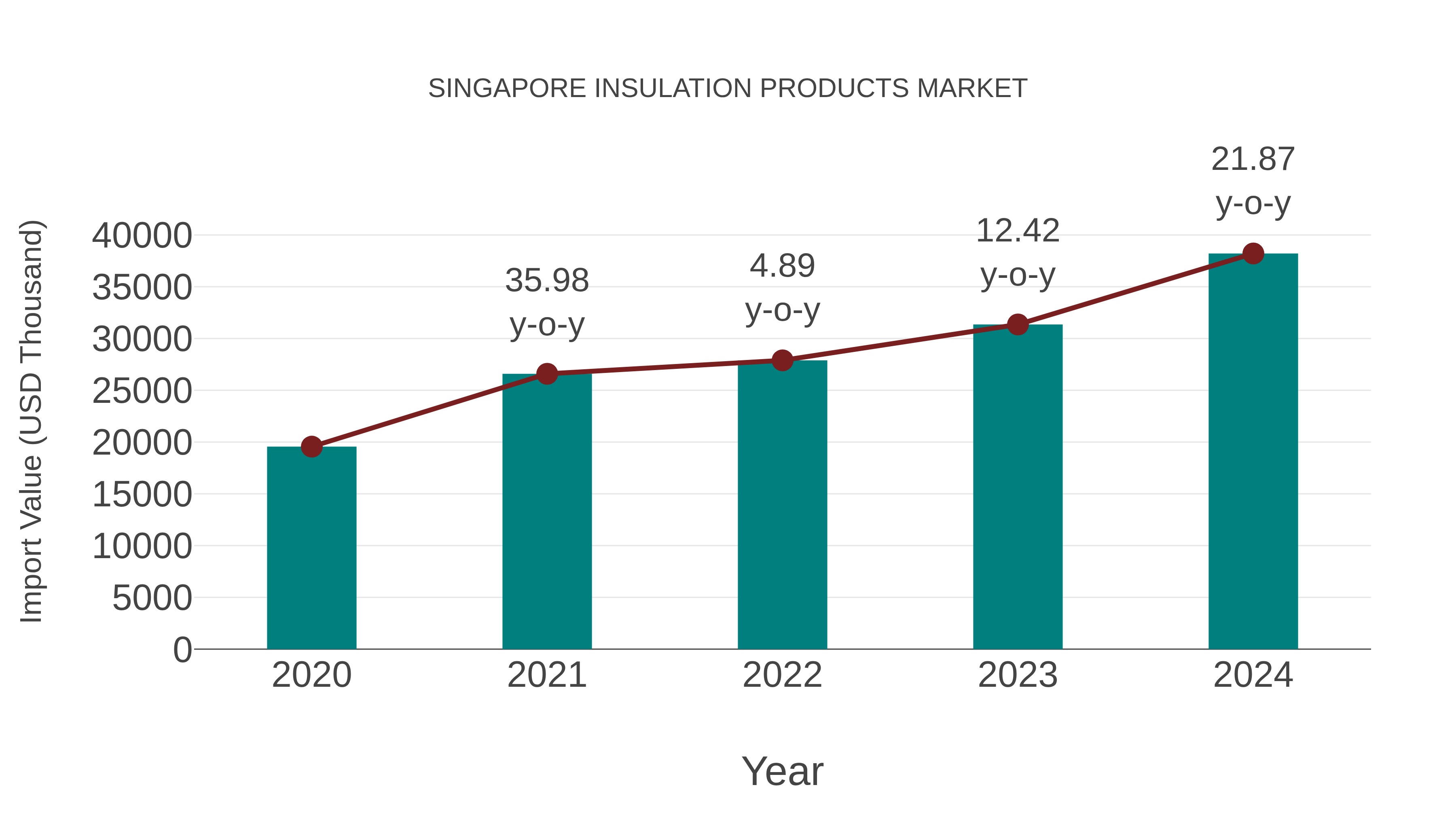
In the Singapore insulation products market, the import trend showed a notable growth rate of 21.87% from 2023 to 2024, with a compound annual growth rate (CAGR) of 18.23% for the period 2020-2024. This surge in imports can be attributed to the increasing demand for energy-efficient solutions and the market`s stability in response to evolving building regulations.
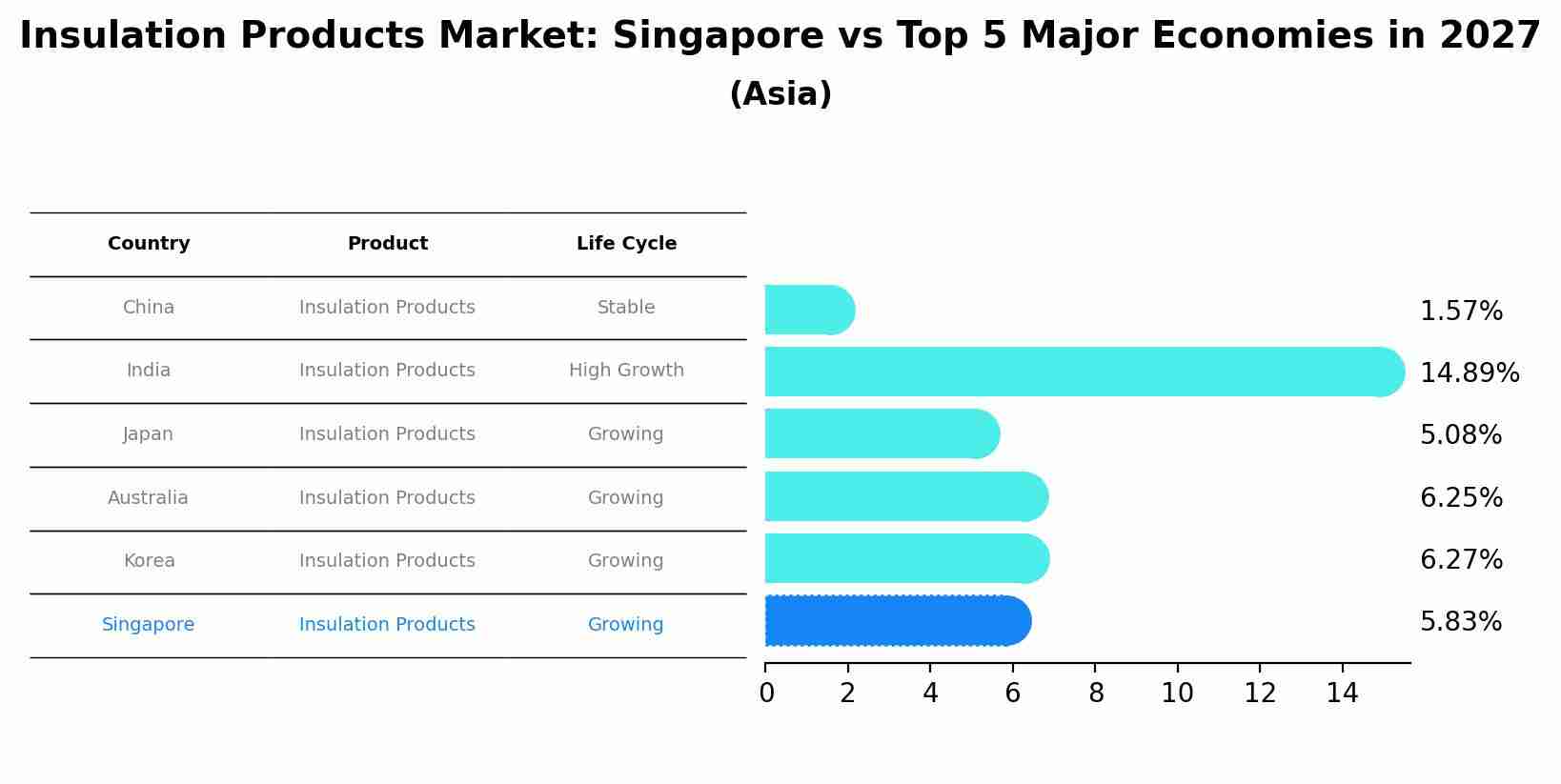
Insulation Products Market: Singapore vs Top 5 Major Economies in 2027 (Asia)
By 2027, Singapore's Insulation Products market is forecasted to achieve a growing growth rate of 5.83%, with China leading the Asia region, followed by India, Japan, Australia and South Korea.
Topics Covered in Singapore Insulation Products Market Report
Singapore Insulation Products Market Report thoroughly covers the market by insulation type, material type and end-use. Singapore Insulation Products Market Outlook report provides an unbiased and detailed analysis of the ongoing Singapore Insulation Products Market trends, opportunities/high growth areas, and market drivers. This would help stakeholders devise and align their market strategies according to the current and future market dynamics.
Singapore Insulation Products Market Synopsis
The Singapore insulation products market has been experiencing growth, driven by the country's infrastructure development, increasing demand for energy-efficient buildings, and strict government regulations promoting sustainability. As one of the most developed economies in Asia, Singapore continues to prioritize “Green Building Initiatives”, particularly with the “Singapore Green Building Masterplan 2030 launched in Mar 2021”, which aims to make most of the buildings in Singapore green by 2030. This has been propelling the demand for insulation products, which play a vital role in improving energy efficiency and reducing environmental footprints. Additionally, in 2023, the construction sector in Singapore grew tremendously, reflecting a steady growth trajectory driven by both public and private investments in real estate and commercial infrastructure. Also, residential and commercial building projects, particularly those certified under the Building and Construction Authority (BCA) Green Mark Scheme, have seen a marked increase in the integration of advanced insulation technologies. These buildings often require materials that not only provide thermal comfort but also meet stringent noise and fire safety standards.
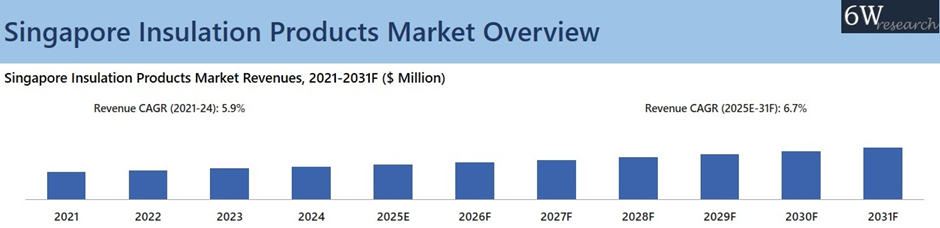
According to 6Wresearch, the Singapore Insulation Products Market is projected to grow at a CAGR of 6.7% from 2025 to 2031, driven by the increasing adoption of green building standards, as well as the ongoing urbanization and expansion of industrial infrastructure. As of 2024, Singapore’s real estate market remains resilient, with certain residential units expected to be sold by 2025, alongside several commercial and mixed-use developments. This surge in construction projects, coupled with a growing awareness of the long-term cost savings associated with insulation, would continue to drive the market forward.
Also, the government’s efforts, such as the Jurong Lake District (JLD) master plan and developments as Springleaf, further boost the market. The JLD aims to transform the area into Singapore's largest business district outside the CBD, while Springleaf would offer an ecologically-sensitive residential estate with green spaces, reflecting the country’s emphasis on sustainable, nature-integrated urban planning. Additionally, Singapore’s industrial and manufacturing sectors, particularly the semiconductor and electronics industries, are undergoing significant expansions. This growth is accompanied by an increased demand for insulated solutions to meet the stringent requirements for temperature control, noise reduction, and fire safety in production environments. The government’s Industry Transformation Map (ITM) for manufacturing and the Smart Industry Readiness Index (SIRI) continue to focus on sustainability and resource efficiency, further promoting the use of advanced insulation materials in industrial applications.
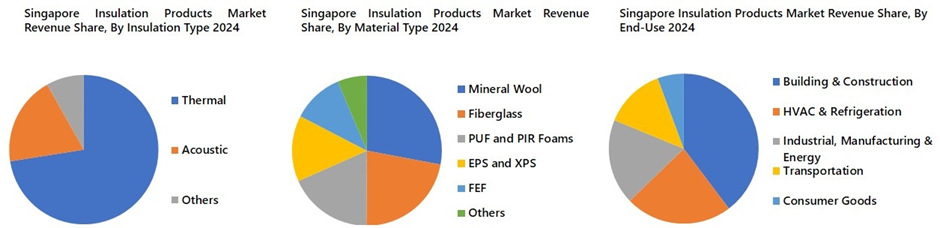
Market Segmentation By Insulation Type
Thermal is expected to garner maximum revenue size in 2031 and would also witness fastest growth during 2025-2031 due to Singapore’s push for net-zero carbon emissions, growing demand for sustainable building materials, and massive cold storage investments for pharmaceuticals and food logistics. Government incentives for low-carbon construction and green retrofitting of existing buildings would further drive adoption. The fastest-growing areas within thermal insulation would be next-gen aerogel and vacuum insulation panels, EV battery thermal management, and high-performance insulation for semiconductor fabs. Stricter green financing criteria and new carbon taxation policies would accelerate the transition to advanced insulation solutions.
Market Segmentation By Material Type
Mineral wool would continue to dominate Singapore’s insulation products market by revenue size in 2031 as fire safety codes are expected to become even more stringent, particularly in public infrastructure and data centers as well as the material’s non-combustibility and recyclability aligns with Singapore’s sustainability goals, Moreover, its rising use in energy-efficient facades and acoustic insulation for urban environments would boost the demand even more.
However, PUF and PIR foams would witness fastest growth during 2025 to 2031 due to rising adoption in cold chain logistics and lightweight construction panels. Their superior thermal efficiency, moisture resistance, and space-saving properties would make them ideal for refrigeration units, pharmaceutical storage, and modular buildings, driving their rapid market expansion.
Thus, it is advised to focus on both these segments to gain maximum competitive advantage in the coming years.
Market Segmentation By End-Use
Building & construction segment is expected to garner maximum revenue size in 2031 driven by next-generation sustainable and high-performance facade technologies, higher thermal efficiency standards in retrofitted structures, and expanding underground developments for instance mass rapid transit (MRT) stations and subterranean malls, requiring advanced insulation. The push for mass engineered timber (MET) and sustainable prefabricated materials in construction would further increase insulation demand, particularly for modular and low-carbon buildings.
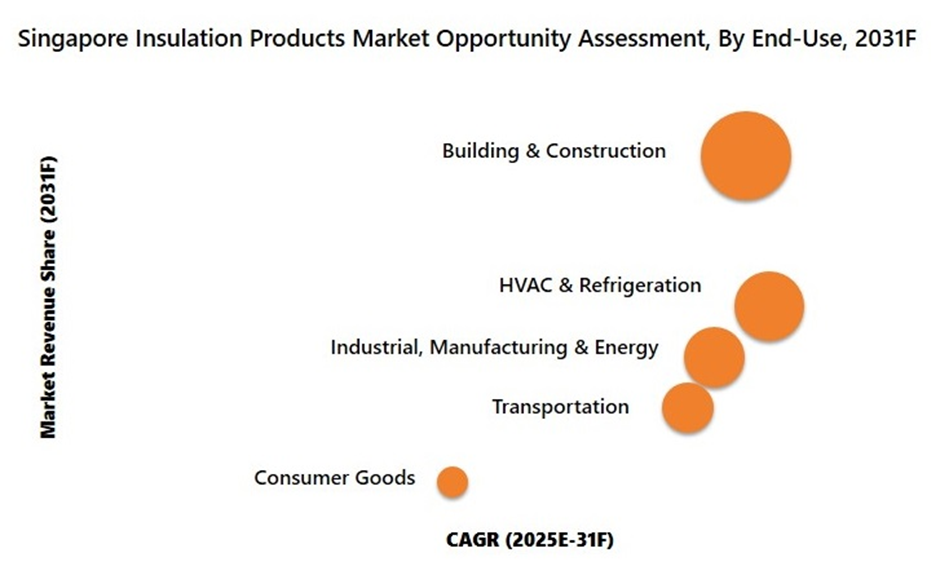
However, HVAC & refrigeration would witness fastest growth during 2025 to 2031 due to advancements in phase-change materials (PCMs) for thermal storage, high-efficiency duct insulation in smart buildings, and Singapore’s push for integrated cooling in urban planning for instance smart estates such as Tengah. Moreover, rise of decentralized cooling units in mixed-use developments would accelerate its adoption. Thus, players must focus on both these segments to gain competitive edge in the coming years.
Key Attractiveness of the Report
- 10 Years Market Numbers.
- Historical Data Starting from 2021 to 2024
- Base Year: 2024
- Forecast Data until 2031
- Key Performance Indicators Impacting the Market.
- Major Upcoming Developments and Projects.
Key Highlights of the Report:
- Singapore Insulation Products Market Overview
- Singapore Insulation Products Market Outlook
- Singapore Insulation Products Market Forecast
- Historical Data and Forecast of Singapore Insulation Products Market Revenues for the Period 2022-2032F
- Historical Data and Forecast of Market Revenues, By Insulation Type, for the Period 2022-2032F
- Historical Data and Forecast of Market Revenues, By Material Type, for the Period 2022-2032F
- Historical Data and Forecast of Market Revenues, By End-Use, for the Period 2022-2032F
- Singapore Insulation Products Market Drivers and Restraints
- Industry Life Cycle
- Porter’s Five Force Analysis
- Singapore Insulation Products Market Trends & Evolution
- Market Opportunity Assessment
- Singapore Insulation Products Market Revenue Ranking, By Companies
- Competitive Benchmarking
- Company Profiles
- Key Strategic Recommendations
Market Scope and Segmentation
Thereportprovides a detailed analysis of the following market segments:
By Insulation Type
- Thermal
- Acoustic
- Others (includes fireproofing, moisture resistance, electrical insulation, and chemical resistance)
By Material Type
- Mineral Wool
- Fiberglass
- PUF (Polyurethane) and PIR (Polyisocyanurate) Foams
- EPS (Expanded Polystyrene) and XPS (Extruded Polystyrene)
- FEF (Elastomeric Foam)
- Others (includes Calcium Silicate, Aerogel Insulation, etc.)
By End-Use
- Building & Construction
- HVAC & Refrigeration
- Industrial, Manufacturing & Energy
- Transportation
- Consumer Goods






































