Iraq Jewellery Market Summary
The iraq jewellery market was estimated at USD 274 Million in 2025 and is projected to reach USD 361 Million by 2032, growing at a CAGR of 4.8% from 2026 to 2032.
Iraq Jewellery Market Year-wise Growth Rate and Key Drivers
This graph highlights how the Iraq Jewellery Market has steadily grown over the past five years, supported by major growth factors.
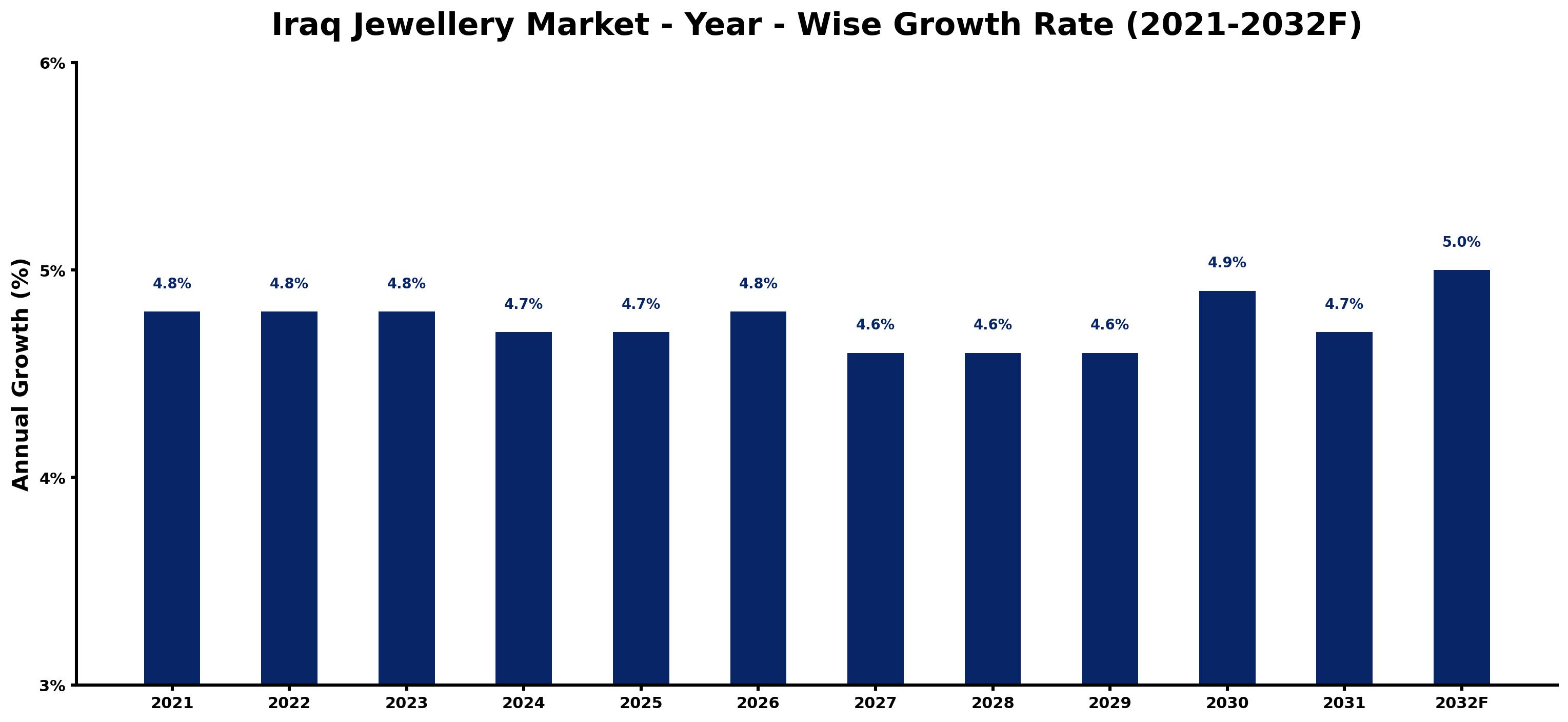
The table below presents the year wise growth rates along with the key drivers influencing the market
| Year | Growth Rate | Major Drivers |
| 2021 | 4.8% | Local artisans showcased unique designs, tapping into traditional craftsmanship and heritage. |
| 2022 | 4.8% | E-commerce platforms began attracting younger consumers interested in online jewellery shopping. |
| 2023 | 4.8% | Economic recovery post-pandemic boosted disposable income, enhancing luxury goods spending. |
| 2024 | 4.7% | Increased tourism fueled demand for authentic Iraqi jewellery as souvenirs. |
| 2025 | 4.7% | Emerging middle class prioritized luxury purchases, significantly impacting market dynamics. |
| 2026 | 4.8% | Collaborations between designers and international brands introduced fresh influences and styles. |
| 2027 | 4.6% | Digital marketing strategies effectively engaged consumers, improving brand visibility and reach. |
| 2028 | 4.6% | Customisation trends made personalised jewellery appealing, attracting more customers to boutiques. |
| 2029 | 4.6% | Sustainable practices in sourcing and production began resonating with environmentally-conscious buyers. |
| 2030 | 4.9% | Social media platforms showcased local jewellers, enhancing their visibility and consumer connection. |
| 2031 | 4.7% | Economic stability led to increased investments in luxury markets, driving competition among brands. |
| 2032 | 5.0% | Cultural events highlighting Iraqi heritage sparked renewed interest in traditional jewellery designs. |
Note - Market size estimations and growth projections presented in this report are based on 6Wresearch's advanced forecasting approach, validated with industry datasets as of June 2026.
Iraq Jewellery Market Synopsis
The Iraq Jewellery Market is projected to reach 4.8% and witness significant growth during the forecast period (2026-2032). This market is steeped in a rich historical legacy showcasing unique craftsmanship and innovative designs, making it a noteworthy sector not only within Iraq but on a global platform. The inherent characteristics of Iraqi jewellery, largely influenced by its cultural heritage and abundant natural resources, have cemented its reputation for quality and artistry.
Iraq Jewellery Market Growth Drivers
Several factors are propelling growth in the Iraq Jewellery Market. Firstly, Iraq's vast reserves of natural resources, including gold, silver, and precious stones, provide an ideal foundation for jewellery production. Secondly, the revival of traditional craftsmanship due to increasing consumer interest in artisanal products has bolstered local artisans and goldsmiths. Thirdly, international markets are increasingly seeking unique jewellery designs that reflect cultural diversity, positioning Iraqi jewellery as a desirable choice globally. Moreover, the strategic location of Iraq within the Middle East facilitates trade with neighboring countries, enhancing the market's export potential. Lastly, a growing middle class with disposable income is contributing to a surge in demand for luxury goods, including bespoke jewellery items.
Iraq Jewellery Market Trends and Opportunities
The Iraq Jewellery Market is experiencing several notable trends. A shift towards sustainable and ethically sourced materials is gaining traction among consumers who are increasingly conscious of the impact of their purchases. This trend presents a significant opportunity for local producers to adapt their sourcing practices and appeal to a broader audience. Furthermore, the rise of e-commerce platforms has transformed how consumers engage with jewellery, allowing Iraqi artisans to reach international markets directly. Additionally, collaborations between local artists and global designers are fostering innovative jewellery lines that blend traditional and contemporary styles. The increasing popularity of custom-made and personalized jewellery is also driving demand, as consumers seek to express individuality through their adornments. These trends indicate a dynamic market landscape with significant growth potential.
Iraq Jewellery Market Challenges and Restraints
Despite its strengths, the Iraq Jewellery Market faces several challenges. Ongoing geopolitical tensions and security concerns can disrupt trade and manufacturing processes, impacting supply chains and market stability. Furthermore, fluctuating economic conditions can diminish consumer purchasing power, particularly in times of crisis. The lack of robust regulatory frameworks and inadequate infrastructure may hinder the development of the jewellery sector, posing obstacles to both local producers and international investors. Competition from established markets also presents a challenge, as consumers may gravitate towards well-known brands over local offerings. Lastly, the rise of counterfeit products threatens the overall market integrity, necessitating heightened consumer awareness and protective measures from local authorities.
Iraq Jewellery Market Government Investment and Initiatives
The Iraqi government has recognized the significance of the jewellery industry as a potential driver of economic growth and cultural preservation. Initiatives aimed at revitalizing this sector include investment in vocational training programs to enhance the skills of local artisans, ensuring the continuation of traditional craftsmanship. Additionally, the government is exploring partnerships with international organizations to promote Iraqi jewellery on global platforms, thereby attracting foreign investment. Public spending plans also focus on improving infrastructure, such as transportation and logistics, to facilitate smoother trade operations. Furthermore, regulatory reforms are being developed to protect local artisans against counterfeiting and to establish standards that enhance the reputation of Iraqi jewellery in international markets. These governmental initiatives are vital for fostering a sustainable environment for the growth of the Iraq Jewellery Market in the coming years.
Iraq Jewellery Market Latest Developments (May 2025 - June 2026)
In the period from May 2025 to June 2026, the Iraq Jewellery Market has witnessed a notable upward trajectory, driven by increased interest from both local and international buyers. This period has observed a surge in participation in trade shows and exhibitions, which has played a crucial role in showcasing the craftsmanship and unique designs of Iraqi jewellery. Additionally, the collaboration between artisans and designers from different cultural backgrounds has resulted in innovative pieces that resonate well with global consumer trends. The rise of online platforms has further expanded market reach during this period, allowing artisans to tap into international demand. Despite facing challenges such as fluctuating gold prices and supply chain disruptions, the overall sentiment in the market remains optimistic, buoyed by both governmental support and increasing consumer interest in authentic and culturally significant jewellery.
Iraq Jewellery Market - Key Attractiveness of the Report
- 10 Years of Market Numbers
- Historical Data Starting from 2022 to 2025
- Base Year: 2025
- Forecast Data until 2032
- Key Performance Indicators Impacting the Market
- Major Upcoming Developments and Projects
Key Highlights of the Report:
- Iraq Jewellery Market Outlook
- Market Size of Iraq Jewellery Market, 2025
- Forecast of Iraq Jewellery Market, 2032F
- Historical Data and Forecast of Iraq Jewellery Revenues & Volume for the Period 2022-2032F
- Iraq Jewellery Market Trend Evolution
- Iraq Jewellery Market Drivers and Challenges
- Iraq Jewellery Price Trends
- Iraq Jewellery Porter's Five Forces
- Iraq Jewellery Industry Life Cycle
- Historical Data and Forecast of Iraq Jewellery Market Revenues & Volume By Product for the Period 2022-2032F
- Historical Data and Forecast of Iraq Jewellery Market Revenues & Volume By Necklace for the Period 2022-2032F
- Historical Data and Forecast of Iraq Jewellery Market Revenues & Volume By Ring for the Period 2022-2032F
- Historical Data and Forecast of Iraq Jewellery Market Revenues & Volume By Earrings for the Period 2022-2032F
- Historical Data and Forecast of Iraq Jewellery Market Revenues & Volume By Bracelet for the Period 2022-2032F
- Historical Data and Forecast of Iraq Jewellery Market Revenues & Volume By Others for the Period 2022-2032F
- Historical Data and Forecast of Iraq Jewellery Market Revenues & Volume By Material for the Period 2022-2032F
- Historical Data and Forecast of Iraq Jewellery Market Revenues & Volume By Gold for the Period 2022-2032F
- Historical Data and Forecast of Iraq Jewellery Market Revenues & Volume By Platinum for the Period 2022-2032F
- Historical Data and Forecast of Iraq Jewellery Market Revenues & Volume By Diamond for the Period 2022-2032F
- Historical Data and Forecast of Iraq Jewellery Market Revenues & Volume By Others for the Period 2022-2032F
- Iraq Jewellery Import Export Trade Statistics
- Market Opportunity Assessment By Product
- Market Opportunity Assessment By Material
- Iraq Jewellery Top Companies Market Share
- Iraq Jewellery Competitive Benchmarking By Technical and Operational Parameters
- Iraq Jewellery Company Profiles
- Iraq Jewellery Key Strategic Recommendations






































