Iraq Kitchen Appliances Market Summary
The iraq kitchen appliances market was estimated at USD 679 Million in 2025 and is projected to reach USD 985 Million by 2032, growing at a CAGR of 6.4% from 2026 to 2032.
Iraq Kitchen Appliances Market Year-wise Growth Rate and Key Drivers
This graph highlights how the Iraq Kitchen Appliances Market has steadily grown over the past five years, supported by major growth factors.
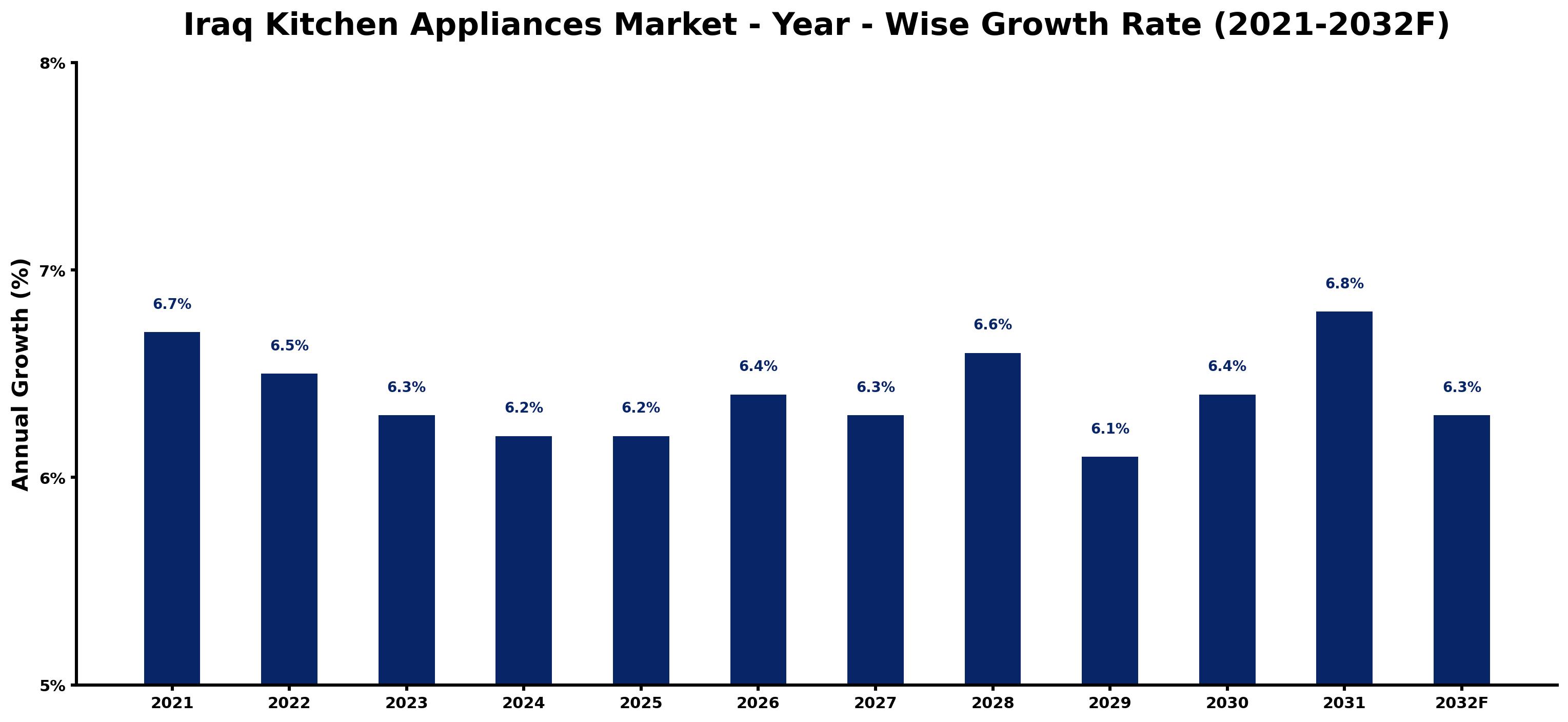
The table below presents the year wise growth rates along with the key drivers influencing the market
| Year | Growth Rate | Major Drivers |
| 2021 | 6.7% | Post-conflict reconstruction projects expanded the local manufacturing of kitchen appliances. |
| 2022 | 6.5% | Urbanization trends drove a visible increase in new housing developments across cities. |
| 2023 | 6.3% | Consumer preferences shifted towards energy-efficient appliances amid rising electricity costs. |
| 2024 | 6.2% | Retail expansion in major cities enhanced access to diverse kitchen appliance brands. |
| 2025 | 6.2% | Increased disposable income encouraged middle-class families to upgrade their kitchen equipment. |
| 2026 | 6.4% | Technological integration in appliances became a focal point for innovative startups entering the market. |
| 2027 | 6.3% | Regional trade agreements improved import conditions, facilitating a wider product range. |
| 2028 | 6.6% | Significant interest in smart home solutions propelled investments in advanced kitchen technologies. |
| 2029 | 6.1% | Local manufacturers collaborated with international brands to boost product quality perceptions. |
| 2030 | 6.4% | Consumer awareness of sustainability drove purchases of eco-friendly kitchen appliances. |
| 2031 | 6.8% | Changing culinary trends influenced demand for specialized appliances like air fryers and mixers. |
| 2032 | 6.3% | Major urban centers experienced a shift towards modern kitchen designs, increasing appliance sales. |
Note - Market size estimations and growth projections presented in this report are based on 6Wresearch's advanced forecasting approach, validated with industry datasets as of June 2026.
Iraq Kitchen Appliances Market Synopsis
The Iraq Kitchen Appliances Market is projected to reach 6.4% and witness significant growth during the forecast period (2026-2032). The ongoing modernization of households, alongside a shift towards convenience-driven lifestyles, is significantly influencing the landscape of kitchen appliances in Iraq. Consumers are increasingly investing in various kitchen appliances designed to enhance efficiency and streamline culinary processes. The market is characterized by a growing demand for refrigerators, ovens, dishwashers, and other essential kitchen technologies that cater to contemporary cooking needs.
Iraq Kitchen Appliances Market Growth Drivers
Several factors are propelling the Iraq kitchen appliances market forward. Urbanization is one of the primary drivers, as more families move to cities where modern amenities are prioritized. With an increasing number of urban households, the demand for sophisticated kitchen appliances is on the rise. In addition, the modernization of households plays a crucial role, with more consumers seeking to upgrade their home appliances to improve energy efficiency and convenience.
- Rising disposable incomes are enabling consumers to invest in higher-quality kitchen appliances, reflecting a shift towards greater consumer spending and a desire for improved home living standards.
- As households adopt contemporary kitchen designs, the integration of advanced appliances becomes essential to maintain functionality and aesthetic appeal.
- Changing consumer lifestyles, where time management and convenience are priorities, fuel the need for time-saving kitchen solutions like dishwashers and multi-functional cooking systems.
- The development of housing projects that incorporate modern infrastructures and kitchen designs is amplifying the demand for diverse kitchen appliances in the market.
- Increased awareness of energy-efficient appliances aligns with global trends toward sustainability, pushing consumers to opt for products that offer long-term savings and environmental benefits.
Iraq Kitchen Appliances Market Challenges and Restraints
Despite the promising growth trajectory, the Iraq kitchen appliances market faces several challenges that need to be addressed for sustained expansion. Affordability remains a significant concern, particularly in lower-income regions where price-sensitive consumers may be unable to invest in modern appliances. Limited access to electricity in certain areas also hampers the market's growth potential, as reliable power supply is crucial for the effective functioning of electric kitchen appliances.
- Many consumers express concerns about the reliability and safety of kitchen appliances, emphasizing the need for stringent quality control measures in manufacturing processes.
- Energy efficiency is becoming a priority; however, the availability of high-quality energy-efficient products can be limited due to market constraints.
- The absence of efficient after-sales service and support could deter consumers from making purchases, as they seek assurance of product performance and maintenance.
- Competition from low-cost, non-branded products may undermine market growth by creating a perception that high-quality appliances are unaffordable.
- The need for consumer education regarding the benefits and usage of advanced kitchen technologies is essential to stimulate demand.
Iraq Kitchen Appliances Market Government Investment and Initiatives
The Iraqi government is actively promoting the adoption of energy-efficient kitchen appliances through various initiatives aimed at sustainable development. Policy frameworks are being established to regulate energy consumption and ensure compliance with safety standards. Such regulations are significant in setting benchmarks for manufacturers and ensuring that kitchen appliances in the market provide both efficiency and reliability.
- Incentives are being provided for manufacturers to develop innovative kitchen appliances that emphasize energy efficiency and sustainability in their design and functionality.
- The government is focusing on public awareness campaigns to educate consumers on the benefits of energy-efficient appliances, which aligns with global sustainability goals.
- Investment in infrastructure improvements, including electrical grids, is essential to support the widespread adoption of modern kitchen appliances throughout the country.
- Support for local manufacturers is being prioritized, fostering a competitive environment that encourages innovation while meeting consumer needs.
- The government's recognition of the kitchen appliances sector's growth potential is driving policy changes that facilitate market entry and encourage foreign investment.
Iraq Kitchen Appliances Market Latest Developments (May 2025 - June 2026)
Recent developments in the Iraq kitchen appliances market indicate a continued focus on modernization and consumer needs. There has been a marked increase in the availability of energy-efficient models, as manufacturers respond to growing consumer awareness and demand for sustainable products. Additionally, the government has enhanced its support framework for local manufacturers, which has led to an increase in the diversity of available products.
- Consumer feedback mechanisms are being integrated into product development cycles, allowing manufacturers to tailor their offerings to meet changing preferences.
- Public-private partnerships are emerging to address infrastructure challenges, particularly in enhancing electrical accessibility for households in urban and rural areas.
- Investment in marketing and outreach strategies has been observed, emphasizing the advantages of adopting modern kitchen technologies among diverse consumer demographics.
- Regional trade events and exhibitions are being organized to showcase the latest innovations and trends in kitchen appliances, creating opportunities for knowledge exchange and collaboration.
- Research and development initiatives are gaining traction, with efforts directed towards creating smart kitchen appliances that integrate connectivity features for enhanced user experience.
Iraq Kitchen Appliances Market - Key Attractiveness of the Report
- 10 Years of Market Numbers
- Historical Data Starting from 2022 to 2025
- Base Year: 2025
- Forecast Data until 2032
- Key Performance Indicators Impacting the Market
- Major Upcoming Developments and Projects
Key Highlights of the Report:
- Iraq Kitchen Appliances Market Outlook
- Market Size of Iraq Kitchen Appliances Market, 2025
- Forecast of Iraq Kitchen Appliances Market, 2032
- Historical Data and Forecast of Iraq Kitchen Appliances Revenues & Volume for the Period 2022-2032F
- Iraq Kitchen Appliances Market Trend Evolution
- Iraq Kitchen Appliances Market Drivers and Challenges
- Iraq Kitchen Appliances Price Trends
- Iraq Kitchen Appliances Porter's Five Forces
- Iraq Kitchen Appliances Industry Life Cycle
- Historical Data and Forecast of Iraq Kitchen Appliances Market Revenues & Volume By Product Type for the Period 2022-2032F
- Historical Data and Forecast of Iraq Kitchen Appliances Market Revenues & Volume By Refrigerator for the Period 2022-2032F
- Historical Data and Forecast of Iraq Kitchen Appliances Market Revenues & Volume By Cooking Appliances for the Period 2022-2032F
- Historical Data and Forecast of Iraq Kitchen Appliances Market Revenues & Volume By Dishwasher for the Period 2022-2032F
- Historical Data and Forecast of Iraq Kitchen Appliances Market Revenues & Volume By Others for the Period 2022-2032F
- Historical Data and Forecast of Iraq Kitchen Appliances Market Revenues & Volume By Product Structure for the Period 2022-2032F
- Historical Data and Forecast of Iraq Kitchen Appliances Market Revenues & Volume By Built-in for the Period 2022-2032F
- Historical Data and Forecast of Iraq Kitchen Appliances Market Revenues & Volume By Free Stand for the Period 2022-2032F
- Historical Data and Forecast of Iraq Kitchen Appliances Market Revenues & Volume By Fuel Type for the Period 2022-2032F
- Historical Data and Forecast of Iraq Kitchen Appliances Market Revenues & Volume By Electric for the Period 2022-2032F
- Historical Data and Forecast of Iraq Kitchen Appliances Market Revenues & Volume By Cooking Gas for the Period 2022-2032F
- Historical Data and Forecast of Iraq Kitchen Appliances Market Revenues & Volume By Others for the Period 2022-2032F
- Historical Data and Forecast of Iraq Kitchen Appliances Market Revenues & Volume By Distribution Channel for the Period 2022-2032F
- Historical Data and Forecast of Iraq Kitchen Appliances Market Revenues & Volume By Online for the Period 2022-2032F
- Historical Data and Forecast of Iraq Kitchen Appliances Market Revenues & Volume By Offline for the Period 2022-2032F
- Historical Data and Forecast of Iraq Kitchen Appliances Market Revenues & Volume By User Applications for the Period 2022-2032F
- Historical Data and Forecast of Iraq Kitchen Appliances Market Revenues & Volume By Commercial for the Period 2022-2032F
- Historical Data and Forecast of Iraq Kitchen Appliances Market Revenues & Volume By Household for the Period 2022-2032F
- Iraq Kitchen Appliances Import Export Trade Statistics
- Market Opportunity Assessment By Product Type
- Market Opportunity Assessment By Product Structure
- Market Opportunity Assessment By Fuel Type
- Market Opportunity Assessment By Distribution Channel
- Market Opportunity Assessment By User Applications
- Iraq Kitchen Appliances Top Companies Market Share
- Iraq Kitchen Appliances Competitive Benchmarking By Technical and Operational Parameters
- Iraq Kitchen Appliances Company Profiles
- Iraq Kitchen Appliances Key Strategic Recommendations






































