Iraq Logistics Automation Market Size & Growth Rate (2026-2032)
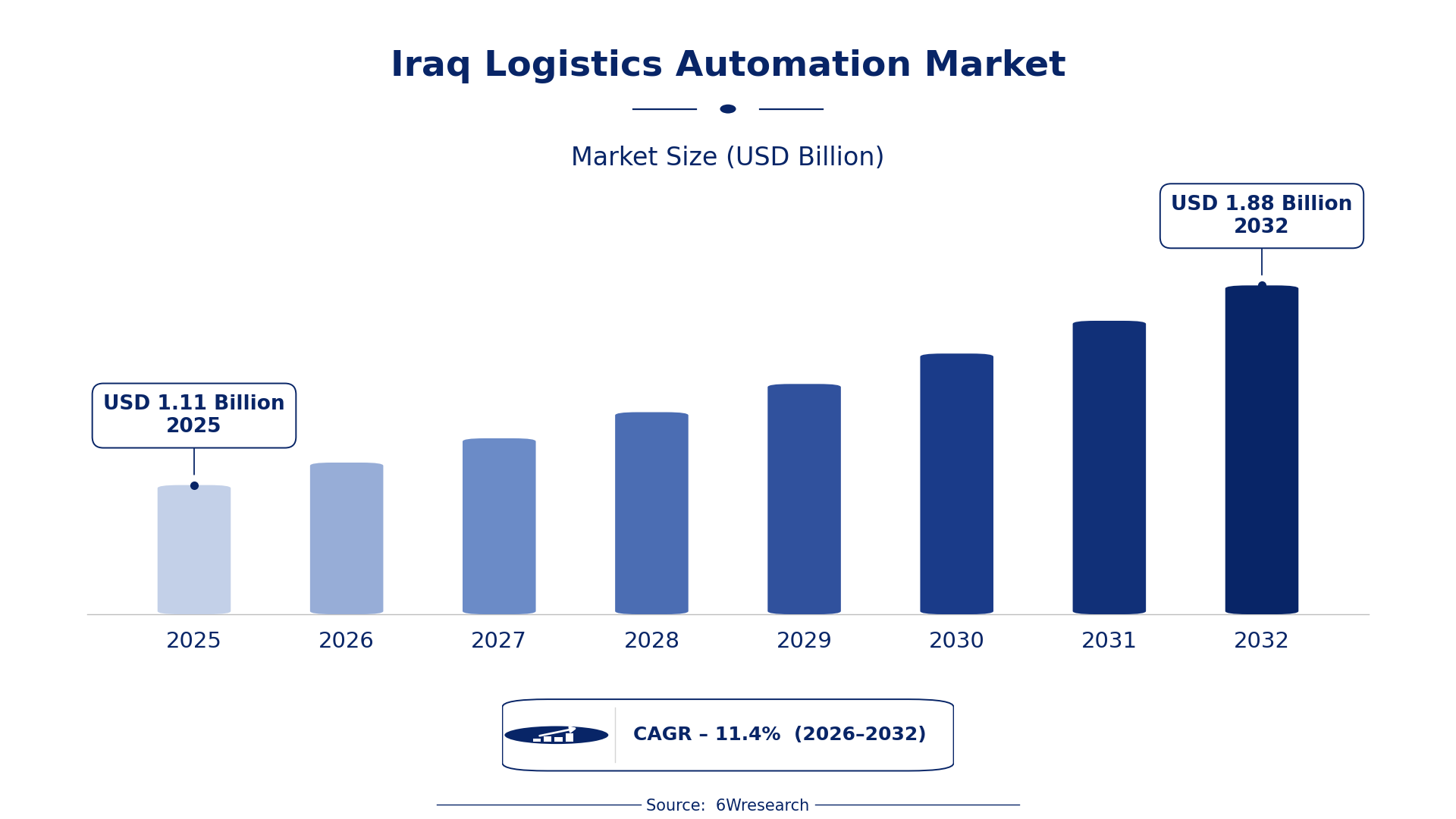
The Iraq Logistics Automation Market was estimated at USD 1110 Million in 2025 and is projected to reach USD 1882 Million by 2032, growing at a CAGR of 11.4% from 2026 to 2032.
Iraq Logistics Automation Market Synopsis
The logistics automation sector in Iraq is currently experiencing a surge in interest, driven by the pressing need for enhanced supply chain efficiency. As businesses grapple with the challenges of modern logistics, the market is transitioning from traditional methods to automated solutions that promise greater agility and responsiveness.
Looking ahead, the Iraq Logistics Automation Market is on track for substantial growth, propelled by advancements in technology and increasing e-commerce activities. The demand for automated warehousing and intelligent transportation systems is expected to expand, indicating a transformative phase for logistics operations in the region.
Iraq Logistics Automation Market Year-wise Growth Rate and Key Drivers
This graph illustrates the annual growth rates of the Iraq Logistics Automation Market from 2021 to 2032, highlighting a steady upward trajectory and projected expansion over the forecast period.
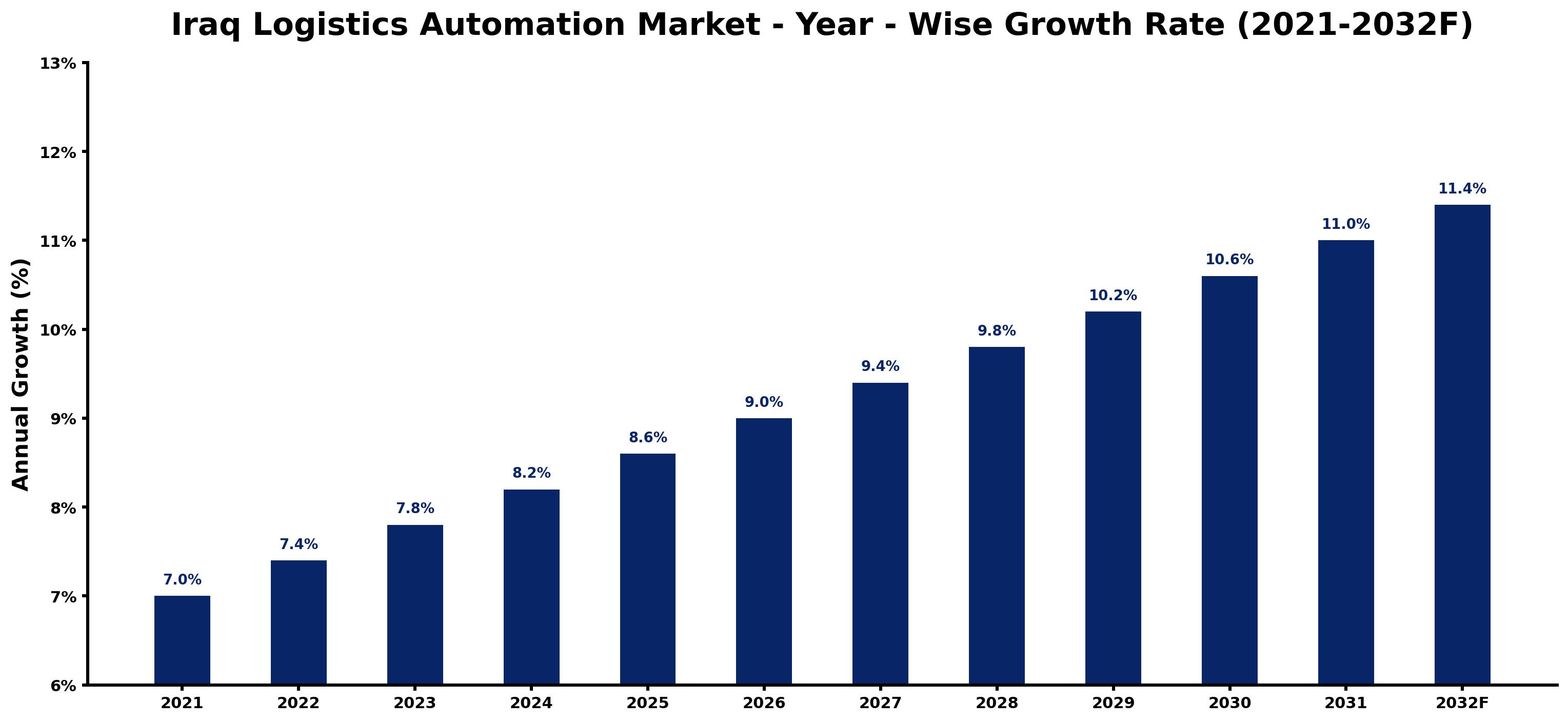
The table below presents the year‑wise growth rates along with the key drivers influencing the market
| Year | Growth Rate | Major Drivers |
| 2021 | 7.0% | Government investments in digital infrastructure improving logistics automation. |
| 2022 | 7.4% | Increased oil exports boosting transportation and logistics efficiency. |
| 2023 | 7.8% | Emergence of e-commerce platforms requiring advanced logistics solutions. |
| 2024 | 8.2% | New customs regulations streamlining cross-border logistics operations. |
| 2025 | 8.6% | Rising urban population driving demand for efficient transportation. |
| 2026 | 9.0% | International partnerships enhancing logistics technology adoption. |
| 2027 | 9.4% | Local startups innovating in supply chain management technology. |
| 2028 | 9.8% | Increased foreign investments in regional logistics infrastructure. |
| 2029 | 10.2% | Government incentives promoting automation in transportation sectors. |
| 2030 | 10.6% | Growing focus on reducing logistics costs driving automation. |
| 2031 | 11.0% | Shifts in consumer behavior favoring faster delivery options. |
| 2032 | 11.4% | National logistics strategy prioritizing smart warehousing solutions. |
Note: Market size estimations and growth projections presented in this report are based on 6Wresearch's proprietary forecasting methodology, utilizing the latest available industry data, government publications, and primary research inputs.
Iraq Logistics Automation Market Key Takeaways
Below are some of the specific key takeaways from the market, including:
- The market is driven by the rise of e-commerce and the necessity for supply chain optimization.
- Technologies such as AI, IoT, and robotics are increasingly integrated into logistics operations.
- Labor shortages and rising operational costs are catalysts for the adoption of automation.
- Government policies are likely to encourage investments in logistics automation technologies.
- Challenges like initial investment and workforce skill gaps remain hurdles for broader adoption.
Evaluation of Restraints in Iraq Logistics Automation Market
Despite the promising growth prospects, the Iraq Logistics Automation Market faces several restraints. High initial investment costs can deter small and medium enterprises from adopting automation solutions, limiting market expansion. Additionally, the complexity of integrating new technologies with existing systems poses a challenge, often requiring specialized expertise that may not be readily available. Finally, promoting the benefits of logistics automation to a workforce that may be apprehensive about technology is essential for overcoming these barriers.
Iraq Logistics Automation Market Trends
Several trends are currently shaping the Iraq Logistics Automation Market. Increasing demand for real-time tracking and data analytics is pushing logistics providers to adopt smart technologies. on top of that, as consumers expect faster delivery times, automation solutions that enhance order fulfillment processes are gaining traction. The emphasis on sustainable logistics practices is also prompting companies to explore energy-efficient automation technologies, reflecting a shift towards more environmentally friendly operations.
Iraq Logistics Automation Market Opportunities
Opportunities for growth in the Iraq Logistics Automation Market are abundant. The expanding e-commerce sector presents a fertile ground for automation as businesses seek to enhance their supply chain efficiency. on top of that, investments in infrastructure modernization and the development of smart logistics hubs can further drive the adoption of automation technologies. There is also potential for public-private partnerships to foster innovation and accelerate the deployment of advanced logistics solutions.
Government Initiatives in the Iraq Logistics Automation Market
Government initiatives play a crucial role in shaping the Iraq Logistics Automation Market. The Iraqi government recognizes that efficient logistics operations are vital for economic competitiveness and trade facilitation. By promoting policies that encourage the adoption of automation technologies, the government aims to streamline supply chain processes and improve overall efficiency in the logistics sector.
- A recently completed initiative focused on establishing incentives for investment in automated warehouse technologies.
- A current program aims to modernize transportation infrastructure to support automated logistics systems.
- Plans are in place for a national policy framework to address regulatory barriers associated with logistics automation.
- An ongoing project seeks to promote workforce training programs that enhance skills relevant to logistics automation.
- Future initiatives may include tax incentives for companies investing in robotics and AI for logistics operations.
Future Insights of the Iraq Logistics Automation Market
The outlook for the Iraq Logistics Automation Market from 2026 to 2032 is promising. As technological advancements continue to accelerate, businesses will increasingly turn to automation to meet customer demands for efficiency and speed. The integration of AI and IoT into logistics processes will likely become more prevalent, leading to more intelligent and responsive supply chains. As the market matures, the focus will shift towards enhancing system interoperability and ensuring workforce readiness to maximize the benefits of automation.
Iraq Logistics Automation Market Latest Developments
Recent activity in the Iraq Logistics Automation Market indicates a strong momentum towards innovation and expansion. Companies are actively exploring new technologies to enhance their logistics operations, signaling a shift in how logistics is approached in the region.
- A major technology vendor launched an innovative warehouse management system in early 2025, enhancing inventory tracking capabilities.
- An ongoing partnership between logistics firms and technology providers aims to implement AI-driven solutions for route optimization, which began in mid-2025.
- A planned initiative to upgrade existing logistics infrastructure with automated solutions is expected to commence in late 2026.
- A leading regional operator has started testing autonomous delivery vehicles, with trials ongoing throughout 2025.
- A new research and development center focused on logistics automation technologies is set to open in Q1 2026.
Iraq Logistics Automation Market - Key Attractiveness of the Report
- 10 Years of Market Numbers
- Historical Data Starting from 2022 to 2025
- Base Year: 2025
- Forecast Data until 2032
- Key Performance Indicators Impacting the Market
- Major Upcoming Developments and Projects
Key Highlights of the Report:
- Iraq Logistics Automation Market Outlook
- Market Size of Iraq Logistics Automation Market, 2025
- Forecast of Iraq Logistics Automation Market, 2032
- Historical Data and Forecast of Iraq Logistics Automation Revenues & Volume for the Period 2022-2032F
- Iraq Logistics Automation Market Trend Evolution
- Iraq Logistics Automation Market Drivers and Challenges
- Iraq Logistics Automation Price Trends
- Iraq Logistics Automation Porter's Five Forces
- Iraq Logistics Automation Industry Life Cycle
- Historical Data and Forecast of Iraq Logistics Automation Market Revenues & Volume By Function for the Period 2022-2032F
- Historical Data and Forecast of Iraq Logistics Automation Market Revenues & Volume By Inventory and Storage Management for the Period 2022-2032F
- Historical Data and Forecast of Iraq Logistics Automation Market Revenues & Volume By Transportation logistics for the Period 2022-2032F
- Historical Data and Forecast of Iraq Logistics Automation Market Revenues & Volume By Vertical for the Period 2022-2032F
- Historical Data and Forecast of Iraq Logistics Automation Market Revenues & Volume By Retail & eCommerce for the Period 2022-2032F
- Historical Data and Forecast of Iraq Logistics Automation Market Revenues & Volume By Manufacturing for the Period 2022-2032F
- Historical Data and Forecast of Iraq Logistics Automation Market Revenues & Volume By Healthcare & Pharmaceuticals for the Period 2022-2032F
- Historical Data and Forecast of Iraq Logistics Automation Market Revenues & Volume By Food & Beverages for the Period 2022-2032F
- Historical Data and Forecast of Iraq Logistics Automation Market Revenues & Volume By Automotive for the Period 2022-2032F
- Historical Data and Forecast of Iraq Logistics Automation Market Revenues & Volume By Aerospace and Defense for the Period 2022-2032F
- Historical Data and Forecast of Iraq Logistics Automation Market Revenues & Volume By Chemicals for the Period 2022-2032F
- Historical Data and Forecast of Iraq Logistics Automation Market Revenues & Volume By Other Verticals (paper and printing, and textiles and clothing) for the Period 2022-2032F
- Historical Data and Forecast of Iraq Logistics Automation Market Revenues & Volume By Organization Size for the Period 2022-2032F
- Historical Data and Forecast of Iraq Logistics Automation Market Revenues & Volume By SMES for the Period 2022-2032F
- Historical Data and Forecast of Iraq Logistics Automation Market Revenues & Volume By Large Enterprises for the Period 2022-2032F
- Historical Data and Forecast of Iraq Logistics Automation Market Revenues & Volume By Logistics Type for the Period 2022-2032F
- Historical Data and Forecast of Iraq Logistics Automation Market Revenues & Volume By Sales Logistics for the Period 2022-2032F
- Historical Data and Forecast of Iraq Logistics Automation Market Revenues & Volume By Production Logistics for the Period 2022-2032F
- Historical Data and Forecast of Iraq Logistics Automation Market Revenues & Volume By Recovery Logistics for the Period 2022-2032F
- Historical Data and Forecast of Iraq Logistics Automation Market Revenues & Volume By Procurement Logistics for the Period 2022-2032F
- Historical Data and Forecast of Iraq Logistics Automation Market Revenues & Volume By Software Application for the Period 2022-2032F
- Historical Data and Forecast of Iraq Logistics Automation Market Revenues & Volume By Inventory Management for the Period 2022-2032F
- Historical Data and Forecast of Iraq Logistics Automation Market Revenues & Volume By Order Management for the Period 2022-2032F
- Historical Data and Forecast of Iraq Logistics Automation Market Revenues & Volume By Yard Management for the Period 2022-2032F
- Historical Data and Forecast of Iraq Logistics Automation Market Revenues & Volume By Shipping Management for the Period 2022-2032F
- Historical Data and Forecast of Iraq Logistics Automation Market Revenues & Volume By Labor Management for the Period 2022-2032F
- Historical Data and Forecast of Iraq Logistics Automation Market Revenues & Volume By Vendor Management for the Period 2022-2032F
- Historical Data and Forecast of Iraq Logistics Automation Market Revenues & Volume By Customer Support for the Period 2022-2032F
- Iraq Logistics Automation Import Export Trade Statistics
- Market Opportunity Assessment By Function
- Market Opportunity Assessment By Vertical
- Market Opportunity Assessment By Organization Size
- Market Opportunity Assessment By Logistics Type
- Market Opportunity Assessment By Software Application
- Iraq Logistics Automation Top Companies Market Share
- Iraq Logistics Automation Competitive Benchmarking By Technical and Operational Parameters
- Iraq Logistics Automation Company Profiles
- Iraq Logistics Automation Key Strategic Recommendations






































