Iraq Mobile Security Market Size & Growth Rate (2026-2032)
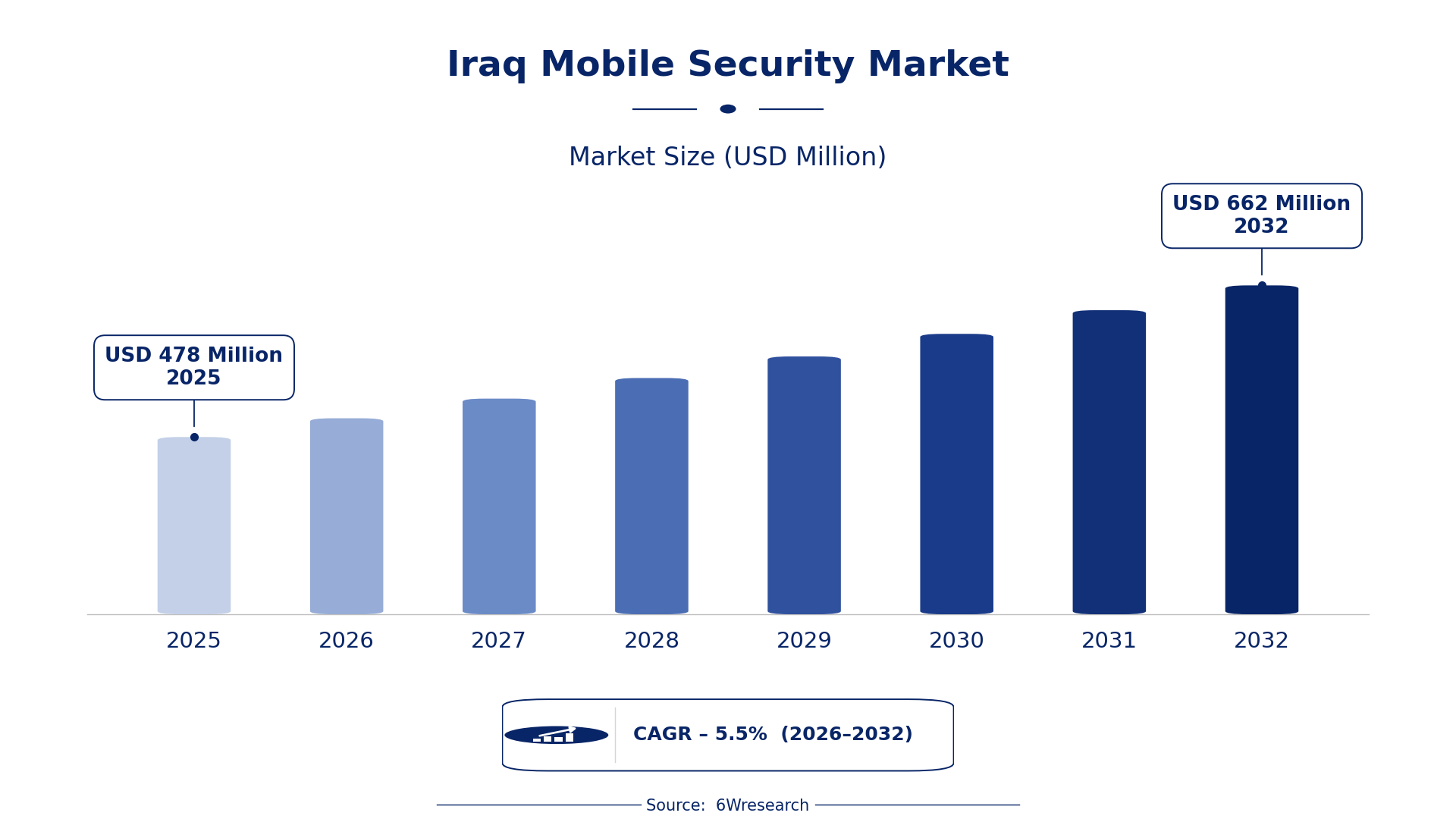
The Iraq Mobile Security Market was estimated at USD 478 Million in 2025 and is projected to reach USD 662 Million by 2032, growing at a CAGR of 5.5% from 2026 to 2032.
Iraq Mobile Security Market Synopsis
The Iraq Mobile Security Market is undergoing significant transformation as it grapples with rising cybersecurity threats amidst an increasing reliance on mobile technology. In recent years, the demand for security solutions has surged due to heightened awareness of vulnerabilities associated with mobile devices.
Looking ahead, this market is set to expand further as businesses and government entities recognize the need for advanced protective measures against sophisticated cyber threats. Investments in technologies such as mobile threat detection and identity authentication will become critical components of security strategies in Iraq.
Iraq Mobile Security Market Year-wise Growth Rate and Key Drivers
This graph illustrates the annual growth rates of the Iraq Mobile Security Market from 2021 to 2032, highlighting a steady upward trajectory and projected expansion over the forecast period.
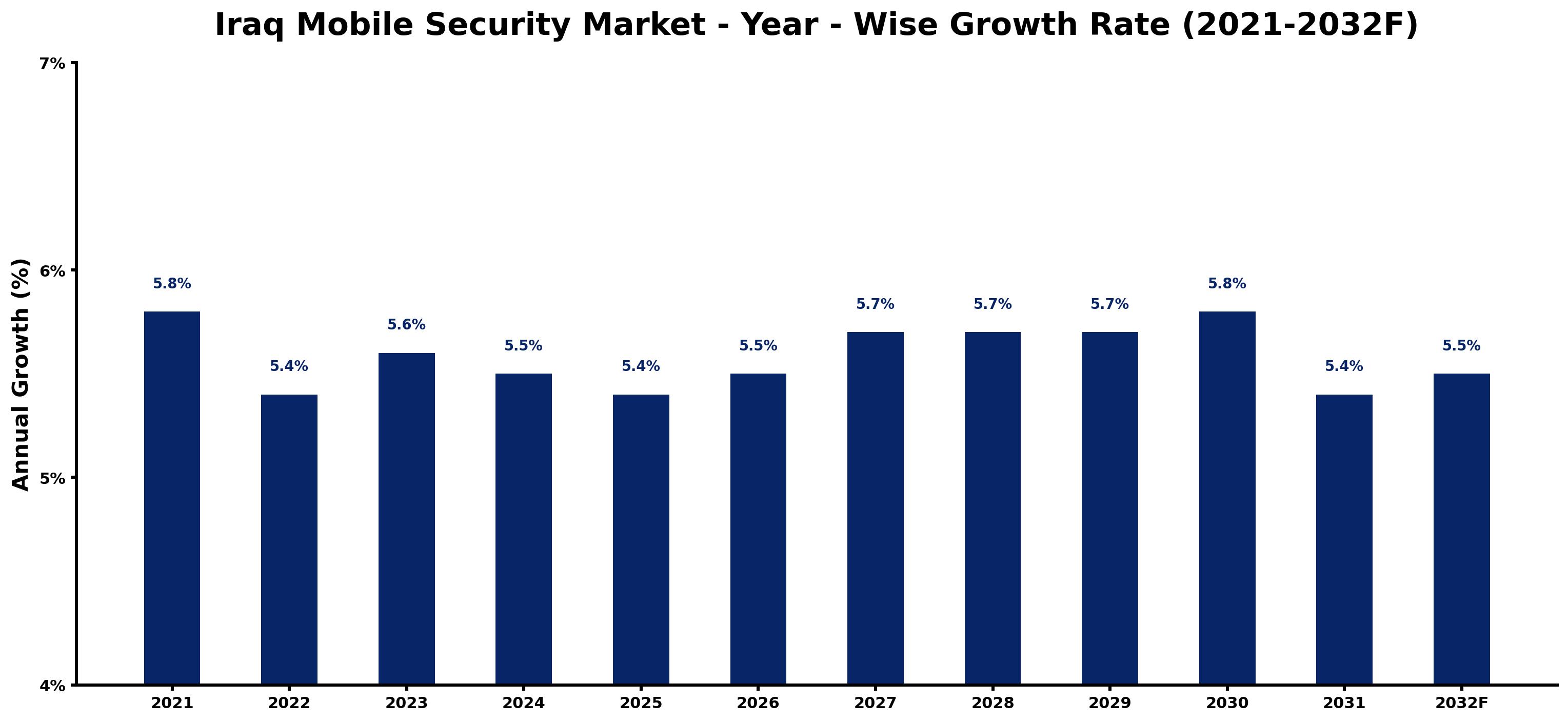
The table below presents the year‑wise growth rates along with the key drivers influencing the market
| Year | Growth Rate | Major Drivers |
| 2021 | 5.8% | Increased mobile device adoption among urban youth demographics. |
| 2022 | 5.4% | Government initiatives promoting cybersecurity education in schools. |
| 2023 | 5.6% | Surge in e-commerce platforms demanding robust mobile security. |
| 2024 | 5.5% | Regulatory requirements for telecommunications providers enhancing security measures. |
| 2025 | 5.4% | Rising smartphone penetration rates in rural areas stimulating demand. |
| 2026 | 5.5% | Local startups innovating mobile security solutions for businesses. |
| 2027 | 5.7% | Strong demand for secure communication tools amid political instability. |
| 2028 | 5.7% | Implementation of national cybersecurity strategy boosting investor confidence. |
| 2029 | 5.7% | Increased cyber threats driving demand for protective technologies. |
| 2030 | 5.8% | Legislative focus on personal data protection enhancing security spend. |
| 2031 | 5.4% | Corporate sector investing in mobile security to protect assets. |
| 2032 | 5.5% | Partnerships between tech firms and government for security improvement. |
Note: Market size estimations and growth projections presented in this report are based on 6Wresearch's proprietary forecasting methodology, utilizing the latest available industry data, government publications, and primary research inputs.
Iraq Mobile Security Market Key Takeaways
Below are some of the specific key takeaways from the market, including:
- The market is driven by the escalating threats of cyberattacks and data breaches targeting mobile devices.
- Growing adoption of mobile banking and business-critical applications is intensifying the demand for mobile security solutions.
- Regulatory pressures are prompting businesses to implement mobile security measures to comply with data protection standards.
- There is a noticeable gap in cybersecurity awareness among users and organizations, which poses a challenge to market growth.
- Investment in advanced technologies is crucial for addressing the evolving landscape of mobile security threats.
Evaluation of Restraints in Iraq Mobile Security Market
The Iraq Mobile Security Market faces notable constraints that hinder its growth trajectory. A primary concern is the ever-present threat of sophisticated cyberattacks, which target both individual users and organizations. Compounding this issue is the regulatory landscape, which often lacks comprehensiveness, leaving gaps in accountability for cybersecurity practices.
on top of that, many businesses in Iraq exhibit a striking lack of awareness regarding the importance of robust security measures. This deficit leads to underinvestment in necessary cybersecurity infrastructure and personnel. To overcome these barriers, it is essential for stakeholders to prioritize education, policy reform, and technological investment.
Iraq Mobile Security Market Trends
Key trends in the Iraq Mobile Security Market include a shift towards more sophisticated threat detection technologies that leverage artificial intelligence and machine learning. This development aims to provide proactive security measures against evolving mobile threats.
Additionally, the integration of biometric authentication tools is becoming commonplace, enhancing security for mobile transactions. Organizations are also increasingly adopting comprehensive mobile security frameworks that encompass endpoint protection and data encryption to safeguard sensitive information.
Iraq Mobile Security Market Opportunities
The market presents substantial growth opportunities in various sectors, notably in financial services and telecommunications. As mobile banking continues to proliferate, there is an urgent demand for secure transaction frameworks. Additionally, government and public sector initiatives aimed at upgrading digital infrastructure will create new avenues for investment in mobile security solutions.
Local startups focusing on cybersecurity innovations can also tap into this growing demand by offering tailored solutions that meet specific Iraqi needs. This represents a fertile ground for technological partnerships that can help elevate overall security standards.
Government Initiatives in the Iraq Mobile Security Market
Government policy is playing a crucial role in shaping the Iraq Mobile Security Market. Emphasizing the protection of critical infrastructure, the Iraqi government has introduced various measures to bolster cybersecurity across mobile networks and devices. Enhanced regulatory frameworks aim to create a safer digital environment, which is vital for both public and private sectors.
- A regulatory framework mandating encryption and authentication protocols was introduced in early 2025 to enhance mobile security standards.
- Ongoing collaborations with international cybersecurity firms are underway, aimed at improving incident response capabilities and fostering knowledge transfer.
- Recently completed initiatives have focused on public-sector training programs to elevate cybersecurity awareness among government employees.
- A national digital infrastructure upgrade programme is planned for 2026, expected to improve network resilience and security measures across mobile platforms.
- Future proposals include the establishment of a dedicated cybersecurity agency to oversee mobile security regulations and compliance, anticipated to roll out by late 2027.
Future Insights of the Iraq Mobile Security Market
The Iraq Mobile Security Market is likely to experience sustained growth through 2032, driven by increasing investment in security technologies and regulatory compliance. As cyber threats evolve, businesses will prioritize comprehensive mobile security strategies that adapt to new challenges. This proactive approach will not only strengthen individual organizational defenses but also enhance overall national cybersecurity posture, establishing a more secure digital future for Iraq.
Iraq Mobile Security Market Latest Developments
Over the past year, the Iraq Mobile Security Market has seen several noteworthy developments. Companies are actively enhancing their security offerings, fueled by the urgent need to combat rising cyber threats in the region. This momentum reflects a growing recognition of mobile security as a critical priority.
- A major technology vendor launched a new mobile threat detection solution in early 2025, aimed at providing advanced protection against evolving malware.
- In mid-2025, a leading regional operator began an initiative focused on upgrading its mobile security protocols to meet international standards.
- A collaboration agreement was reached between local universities and cybersecurity firms to advance research in mobile security technologies, ongoing since Q1 2025.
- Plans for a public-private partnership to develop a national cybersecurity awareness campaign are underway, expected to commence in late 2026.
- An upcoming product launch scheduled for mid-2026 will introduce enhanced identity authentication tools tailored for mobile banking applications.
Iraq Mobile Security Market - Key Attractiveness of the Report
- 10 Years of Market Numbers
- Historical Data Starting from 2022 to 2025
- Base Year: 2025
- Forecast Data until 2032
- Key Performance Indicators Impacting the Market
- Major Upcoming Developments and Projects
Key Highlights of the Report:
- Iraq Mobile Security Market Outlook
- Market Size of Iraq Mobile Security Market, 2025
- Forecast of Iraq Mobile Security Market, 2032
- Historical Data and Forecast of Iraq Mobile Security Revenues & Volume for the Period 2022-2032F
- Iraq Mobile Security Market Trend Evolution
- Iraq Mobile Security Market Drivers and Challenges
- Iraq Mobile Security Price Trends
- Iraq Mobile Security Porter's Five Forces
- Iraq Mobile Security Industry Life Cycle
- Historical Data and Forecast of Iraq Mobile Security Market Revenues & Volume By End User for the Period 2022-2032F
- Historical Data and Forecast of Iraq Mobile Security Market Revenues & Volume By Individual for the Period 2022-2032F
- Historical Data and Forecast of Iraq Mobile Security Market Revenues & Volume By Enterprise (Solution (Authentication, Application Security, & Device Security), Service) for the Period 2022-2032F
- Historical Data and Forecast of Iraq Mobile Security Market Revenues & Volume By Deployment Mode for the Period 2022-2032F
- Historical Data and Forecast of Iraq Mobile Security Market Revenues & Volume By On-premises for the Period 2022-2032F
- Historical Data and Forecast of Iraq Mobile Security Market Revenues & Volume By Cloud for the Period 2022-2032F
- Historical Data and Forecast of Iraq Mobile Security Market Revenues & Volume By Organization Size for the Period 2022-2032F
- Historical Data and Forecast of Iraq Mobile Security Market Revenues & Volume By Small and Medium-Sized Enterprises (SMEs) for the Period 2022-2032F
- Historical Data and Forecast of Iraq Mobile Security Market Revenues & Volume By Large Enterprises for the Period 2022-2032F
- Historical Data and Forecast of Iraq Mobile Security Market Revenues & Volume By Vertical for the Period 2022-2032F
- Historical Data and Forecast of Iraq Mobile Security Market Revenues & Volume By BFSI for the Period 2022-2032F
- Historical Data and Forecast of Iraq Mobile Security Market Revenues & Volume By Telecom & IT for the Period 2022-2032F
- Historical Data and Forecast of Iraq Mobile Security Market Revenues & Volume By Retail for the Period 2022-2032F
- Historical Data and Forecast of Iraq Mobile Security Market Revenues & Volume By Healthcare for the Period 2022-2032F
- Historical Data and Forecast of Iraq Mobile Security Market Revenues & Volume By Government & Defense for the Period 2022-2032F
- Historical Data and Forecast of Iraq Mobile Security Market Revenues & Volume By Manufacturing for the Period 2022-2032F
- Historical Data and Forecast of Iraq Mobile Security Market Revenues & Volume By Others for the Period 2022-2032F
- Historical Data and Forecast of Iraq Mobile Security Market Revenues & Volume By Operating System for the Period 2022-2032F
- Historical Data and Forecast of Iraq Mobile Security Market Revenues & Volume By iOS for the Period 2022-2032F
- Historical Data and Forecast of Iraq Mobile Security Market Revenues & Volume By Android for the Period 2022-2032F
- Iraq Mobile Security Import Export Trade Statistics
- Market Opportunity Assessment By End User
- Market Opportunity Assessment By Deployment Mode
- Market Opportunity Assessment By Organization Size
- Market Opportunity Assessment By Vertical
- Market Opportunity Assessment By Operating System
- Iraq Mobile Security Top Companies Market Share
- Iraq Mobile Security Competitive Benchmarking By Technical and Operational Parameters
- Iraq Mobile Security Company Profiles
- Iraq Mobile Security Key Strategic Recommendations






































