Iraq Mushroom Market Size, Share & Growth Rate
The Iraq Mushroom Market was estimated at USD 235 Million in 2025 and is projected to reach USD 258 Million by 2032, growing at a CAGR of 1.3% from 2026 to 2032. This growth is primarily fueled by increasing consumer awareness regarding the health benefits of mushrooms, which are becoming more prominent in Iraqi cuisine. The rise in disposable incomes and a shift towards healthier dietary choices are also contributing to this upward trajectory.
Iraq Mushroom Market Year-wise Growth Rate and Key Drivers
This graph highlights how the Iraq Mushroom Market has steadily grown over the years, supported by major growth factors.
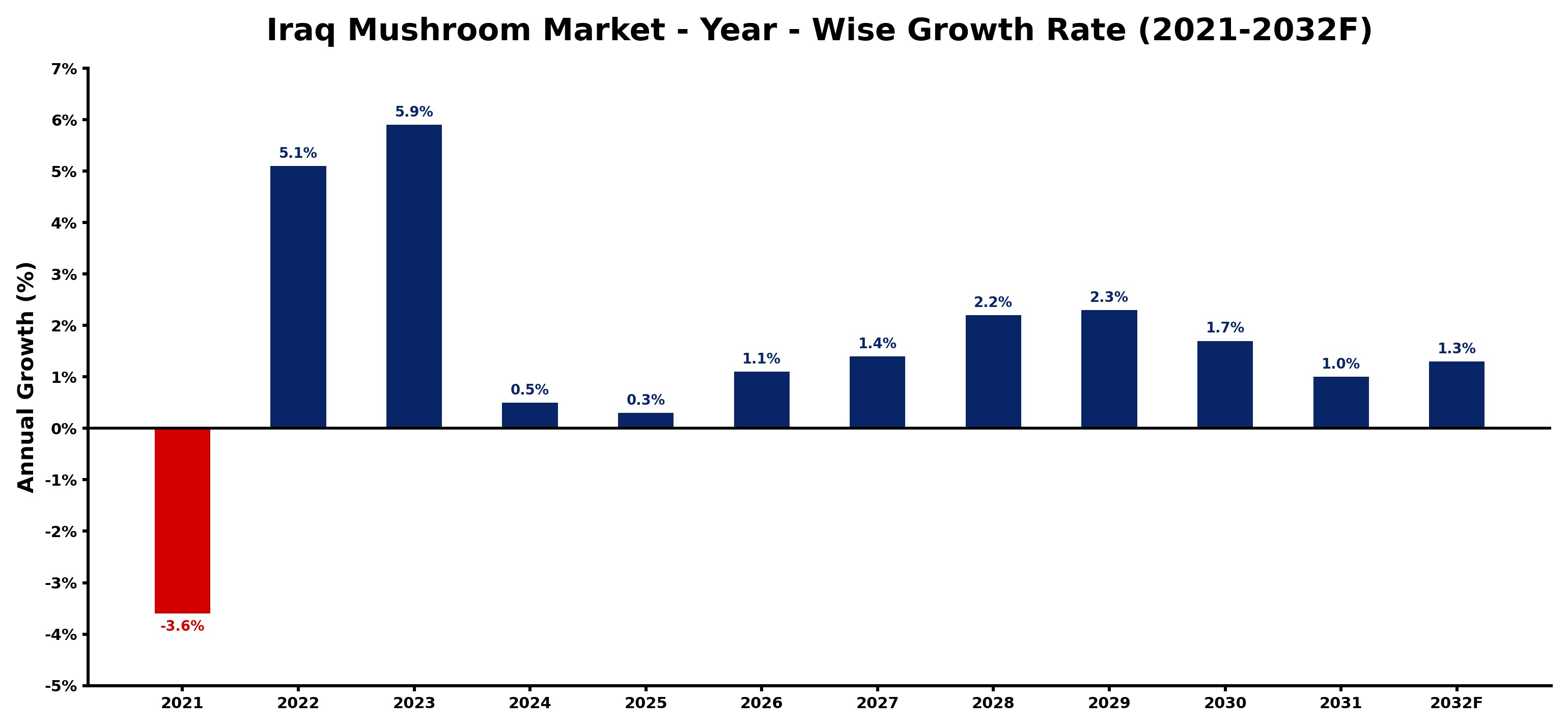
The table below presents the year‑wise growth rates along with the key drivers influencing the market
| Year | Growth Rate | Major Drivers |
| 2021 | -3.6% | Supply chain disruptions limited availability |
| 2022 | 5.1% | Consumer interest in mushrooms increased |
| 2023 | 5.9% | Health benefits awareness expanded rapidly |
| 2024 | 0.5% | Local production initiatives gained momentum |
| 2025 | 0.3% | Culinary trends embraced mushroom varieties |
| 2026 | 1.1% | Export opportunities opened new markets |
| 2027 | 1.4% | Sustainable farming practices gained traction |
| 2028 | 2.2% | Mushroom-based products diversified offerings |
| 2029 | 2.3% | Food innovation encouraged new recipes |
| 2030 | 1.7% | E-commerce platforms enhanced accessibility |
| 2031 | 1.0% | Cultural acceptance of mushrooms grew |
| 2032 | 1.3% | Nutritional education promoted mushroom consumption |
Note - Market size estimations and growth projections presented in this report are based on 6Wresearch’s advanced forecasting approach, validated with industry datasets as of June 2026.
Iraq Mushroom Market Synopsis
Recently, the Iraq mushroom market has seen significant momentum, driven by an increasing demand for local produce and a growing interest in healthy eating. However, as it heads into a new phase of development, the market is expected to further embrace innovation in cultivation and diversification of mushroom varieties.
This evolving landscape presents both opportunities and challenges. As traditional cultivation practices give way to more sophisticated agricultural techniques, the market is poised for expansion. Nonetheless, overcoming infrastructural limitations and enhancing consumer awareness will be crucial for sustaining this growth.
Iraq Mushroom Market Key Takeaways
- The market is characterized by a rise in consumer demand for healthy and locally-sourced mushrooms.
- Oyster and button mushrooms dominate the cultivation scene, yet gourmet varieties are gaining traction.
- Investment opportunities are present in both production and processing sectors.
- Government initiatives are aimed at enhancing domestic production and food safety.
- Challenges such as distribution inefficiencies and regulatory hurdles must be addressed to unlock further growth.
Evaluation of Restraints in Iraq Mushroom Market
Despite its promising potential, the Iraq mushroom market grapples with several restraints. Limited consumer awareness hinders appreciation for mushrooms as a staple food, thereby stifling demand. Additionally, inadequate infrastructure for cultivation and distribution undermines the ability of local producers to meet rising consumer needs. Quality inconsistencies further complicate market dynamics, as consumers often gravitate towards more traditional food items, overshadowing the health benefits mushrooms offer.
Iraq Mushroom Market Trends
Current trends indicate a surge in the popularity of gourmet mushroom varieties such as shiitake and enoki. Consumers are not only seeking these exotic options for their unique flavors but also for their associated health benefits. Additionally, the market is witnessing a shift towards value-added mushroom products, including dried mushrooms and mushroom-based snacks, appealing to the growing demand for convenient, health-oriented food options.
Iraq Mushroom Market Opportunities
Investment opportunities abound in the Iraq mushroom market, particularly in the realms of cultivation, processing, and distribution. As consumer preferences pivot towards organic and locally sourced produce, investors can explore ventures in mushroom farming and innovative cultivation methods. Collaborations with local farmers and the development of value-added products like mushroom extracts and ready-to-eat meals present significant avenues for growth.
Government Initiatives in the Iraq Mushroom Market
The Iraqi government is actively promoting initiatives aimed at bolstering domestic mushroom production. Various support programs and subsidies are in place to encourage local farmers to enhance their cultivation practices, which helps reduce reliance on imports. Furthermore, regulations have been established to maintain food safety standards, ensuring that the quality of mushrooms in the market aligns with consumer expectations.
Future Insights of the Iraq Mushroom Market
Looking ahead to the period from 2026 to 2032, the future of the Iraq mushroom market appears encouraging. With a continuous rise in awareness of the health benefits associated with mushrooms, along with advancements in agricultural technology, production efficiency is expected to improve. This trend will likely lead to a broader acceptance of mushrooms in the Iraqi diet, supporting the market's sustainable growth. As plant-based diets gain traction, mushrooms are set to play an integral role in this dietary evolution.
Iraq Mushroom Market Latest Developments (May 2025 - June 2026)
Recent developments in the Iraq mushroom market indicate a growing trend towards modern agricultural practices, with an increasing number of farmers adopting advanced cultivation techniques. There is also a noticeable uptick in community awareness campaigns aimed at educating consumers about the nutritional value of mushrooms. Efforts to improve distribution networks are underway, enhancing the availability of both fresh and processed mushroom products in urban areas.
Iraq Mushroom Market - Key Attractiveness of the Report
- 10 Years of Market Numbers
- Historical Data Starting from 2022 to 2025
- Base Year: 2025
- Forecast Data until 2032
- Key Performance Indicators Impacting the Market
- Major Upcoming Developments and Projects
Key Highlights of the Report:
- Iraq Mushroom Market Outlook
- Market Size of Iraq Mushroom Market, 2025
- Forecast of Iraq Mushroom Market, 2032
- Historical Data and Forecast of Iraq Mushroom Revenues & Volume for the Period 2022-2032F
- Iraq Mushroom Market Trend Evolution
- Iraq Mushroom Market Drivers and Challenges
- Iraq Mushroom Price Trends
- Iraq Mushroom Porter's Five Forces
- Iraq Mushroom Industry Life Cycle
- Historical Data and Forecast of Iraq Mushroom Market Revenues & Volume By Product for the Period 2022-2032F
- Historical Data and Forecast of Iraq Mushroom Market Revenues & Volume By Button for the Period 2022-2032F
- Historical Data and Forecast of Iraq Mushroom Market Revenues & Volume By Shiitake for the Period 2022-2032F
- Historical Data and Forecast of Iraq Mushroom Market Revenues & Volume By Oyster for the Period 2022-2032F
- Historical Data and Forecast of Iraq Mushroom Market Revenues & Volume By Matsutake for the Period 2022-2032F
- Historical Data and Forecast of Iraq Mushroom Market Revenues & Volume By Truffles for the Period 2022-2032F
- Historical Data and Forecast of Iraq Mushroom Market Revenues & Volume By Others for the Period 2022-2032F
- Historical Data and Forecast of Iraq Mushroom Market Revenues & Volume By Form for the Period 2022-2032F
- Historical Data and Forecast of Iraq Mushroom Market Revenues & Volume By Fresh for the Period 2022-2032F
- Historical Data and Forecast of Iraq Mushroom Market Revenues & Volume By Processed for the Period 2022-2032F
- Historical Data and Forecast of Iraq Mushroom Market Revenues & Volume By Distribution Channel for the Period 2022-2032F
- Historical Data and Forecast of Iraq Mushroom Market Revenues & Volume By Direct to Customer for the Period 2022-2032F
- Historical Data and Forecast of Iraq Mushroom Market Revenues & Volume By Grocery Stores for the Period 2022-2032F
- Historical Data and Forecast of Iraq Mushroom Market Revenues & Volume By Supermarkets & Hypermarkets for the Period 2022-2032F
- Historical Data and Forecast of Iraq Mushroom Market Revenues & Volume By Convenience Store for the Period 2022-2032F
- Historical Data and Forecast of Iraq Mushroom Market Revenues & Volume By Online Stores for the Period 2022-2032F
- Historical Data and Forecast of Iraq Mushroom Market Revenues & Volume By Application for the Period 2022-2032F
- Historical Data and Forecast of Iraq Mushroom Market Revenues & Volume By Food for the Period 2022-2032F
- Historical Data and Forecast of Iraq Mushroom Market Revenues & Volume By Pharmaceuticals for the Period 2022-2032F
- Historical Data and Forecast of Iraq Mushroom Market Revenues & Volume By Cosmetics for the Period 2022-2032F
- Iraq Mushroom Import Export Trade Statistics
- Market Opportunity Assessment By Product
- Market Opportunity Assessment By Form
- Market Opportunity Assessment By Distribution Channel
- Market Opportunity Assessment By Application
- Iraq Mushroom Top Companies Market Share
- Iraq Mushroom Competitive Benchmarking By Technical and Operational Parameters
- Iraq Mushroom Company Profiles
- Iraq Mushroom Key Strategic Recommendations






































