Iraq Organic Coffee Market Size, Share & Growth Rate
The Iraq Organic Coffee Market was estimated at USD 634 Million in 2025 and is projected to reach USD 905 Million by 2032, growing at a CAGR of 5.2% from 2026 to 2032. This upward trajectory can be attributed to a shifting consumer mindset favoring health-conscious and environmentally sustainable products. As awareness about the benefits of organic farming increases, more Iraqi consumers are seeking ethically sourced and chemical-free coffee options, propelling growth in this niche market.
Iraq Organic Coffee Market Year-wise Growth Rate and Key Drivers
This graph highlights how the Iraq Organic Coffee Market has steadily grown over the years, supported by major growth factors.
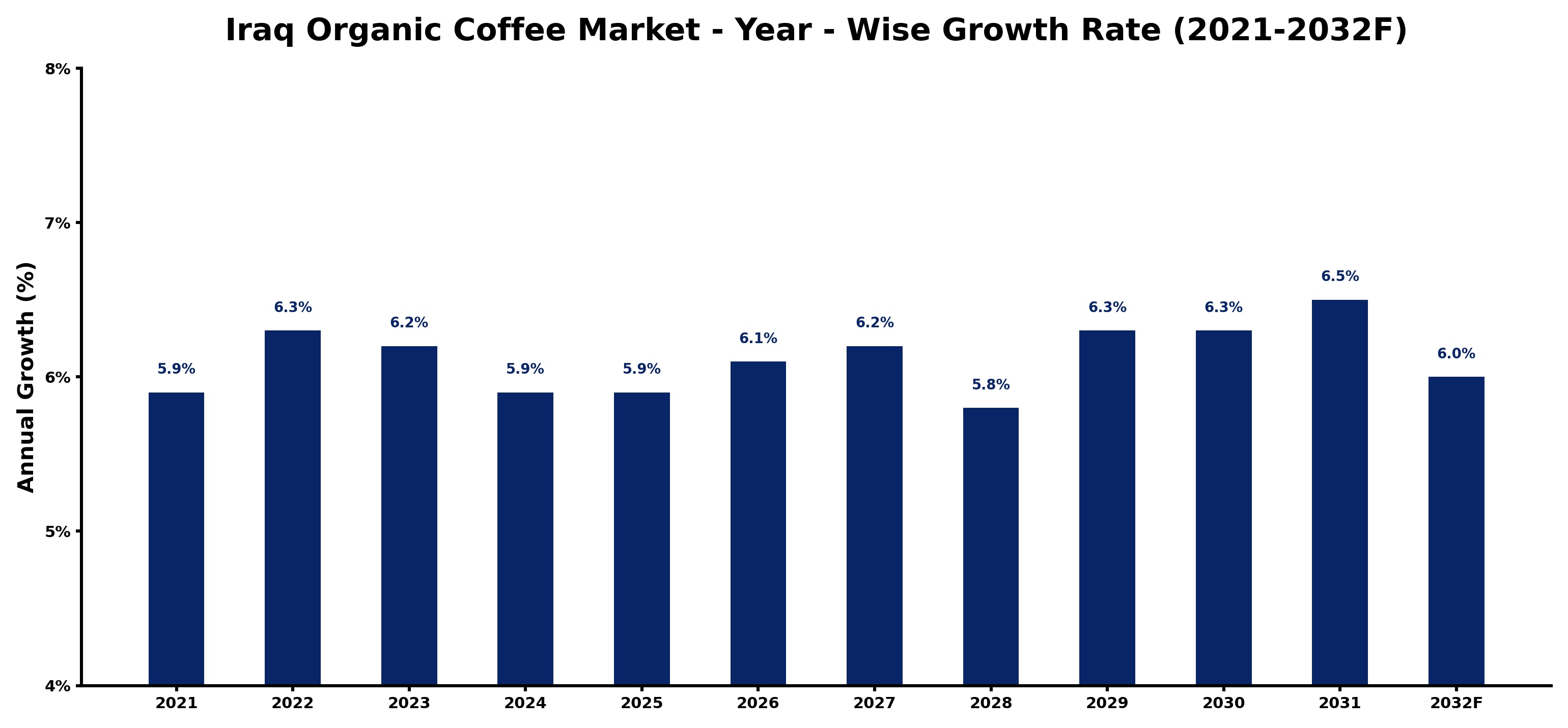
The table below presents the year‑wise growth rates along with the key drivers influencing the market
| Year | Growth Rate | Major Drivers |
| 2021 | 5.9% | Consumer awareness of organic benefits |
| 2022 | 6.3% | Rise in specialty coffee shops |
| 2023 | 6.2% | Increased demand for sustainable sourcing |
| 2024 | 5.9% | Growth in local coffee production |
| 2025 | 5.9% | Expansion of organic certification programs |
| 2026 | 6.1% | Emergence of coffee subscription services |
| 2027 | 6.2% | Cultural shift towards premium beverages |
| 2028 | 5.8% | Industrial activity supported growth |
| 2029 | 6.3% | Collaborations with local farmers increased |
| 2030 | 6.3% | Health-conscious consumer trends accelerated |
| 2031 | 6.5% | Investment in coffee processing technology |
| 2032 | 6.0% | Diverse flavor profiles attracted interest |
Note - Market size estimations and growth projections presented in this report are based on 6Wresearch's advanced forecasting approach, validated with industry datasets as of June 2026.
Iraq Organic Coffee Market Synopsis
The Iraq Organic Coffee Market is witnessing a notable shift in consumer preferences towards organic and sustainably sourced products. With growing health concerns and environmental awareness, Iraqi consumers are increasingly drawn to organic coffee, seeking transparency in sourcing and production processes.
Despite being predominantly an import-driven market, the rise of specialty coffee consumption highlights an evolving palate among Iraqi coffee drinkers. Consumers are not only seeking quality but also unique flavor profiles, fostering opportunities for premium organic coffee brands.
Iraq Organic Coffee Market Key Takeaways
- The market is becoming a hub for ethically sourced and sustainable coffee products.
- Increasing health consciousness among consumers drives demand for organic offerings.
- Specialty coffee consumption is rising, influencing purchasing behaviors.
- Challenges include limited local production and inconsistent supply chain management.
- Government initiatives are supporting the transition to organic farming practices.
Evaluation of Restraints in Iraq Organic Coffee Market
Several key restraints are hindering the growth of the Iraq Organic Coffee Market. A lack of widespread awareness about organic products often leads to consumer skepticism regarding their benefits. Moreover, the absence of a robust organic certification framework complicates the verification of product authenticity, causing potential buyers to hesitate. Political and economic instability in Iraq further exacerbates these issues, affecting the market dynamics and creating uncertainties for producers. The competition posed by non-organic alternatives, which are more readily available and typically less expensive, also limits the organic segment's market presence.
Iraq Organic Coffee Market Trends
A definitive trend in the Iraq Organic Coffee Market is the growing preference for sustainability among consumers. This increasing demand for organic products aligns with a broader global movement towards health-conscious and environmentally friendly consumption. Specialty coffee offerings are becoming increasingly popular, as consumers seek distinct flavor profiles and high-quality beans that tell a story about their origin.
Additionally, more consumers are gravitating towards brands that promote fair trade practices, emphasizing ethical sourcing and sustainable farming methods. This shift in consumer behavior is likely to shape future offerings in the market, driving retailers to adapt their product lines accordingly.
Iraq Organic Coffee Market Opportunities
Investment opportunities in the Iraq Organic Coffee Market are rich and varied, particularly as local production develops. Potential growth avenues include establishing organic coffee plantations and aiding local farmers in transitioning to organic methodologies. Furthermore, developing processing facilities can enhance quality and expand the product range available to consumers. By creating robust distribution channels, both domestic and international markets can be accessed, aligning with the rising global interest in organic coffee.
Government Initiatives in the Iraq Organic Coffee Market
The government of Iraq is taking significant strides to promote the organic coffee sector through various initiatives. Efforts include providing training and resources for local farmers to adopt organic farming practices, thereby enhancing the quality of coffee production. Financial incentives for organic certification have also been introduced to support farmers in transitioning to sustainable practices. By facilitating market access for local producers and promoting domestic consumption of organic coffee, government policies are fostering a favorable environment for market growth.
Future Insights of the Iraq Organic Coffee Market
Looking ahead to 2026-2032, the future of the Iraq Organic Coffee Market is poised for optimistic growth. As consumer awareness of organic products expands and health consciousness continues to rise, the demand for organic coffee is expected to increase significantly. Iraq's rich history in coffee cultivation, combined with a commitment to organic farming practices, positions the nation to benefit from this global trend. However, infrastructure improvements and market competition will be critical to fully realizing the market's potential, particularly as international interest in Iraq's organic offerings grows.
Iraq Organic Coffee Market Latest Developments (May 2025 - June 2026)
Recent developments in the Iraq Organic Coffee Market indicate a positive trajectory, with an increase in initiatives aimed at bolstering local coffee production. Programs designed to educate farmers about sustainable practices are gaining traction, leading to more coffee produced under organic standards. Simultaneously, international interest in sourcing organic coffee from Iraq is beginning to take shape, opening avenues for export opportunities and enhancing the country's reputation in the global coffee landscape.
Iraq Organic Coffee Market - Key Attractiveness of the Report
- 10 Years of Market Numbers
- Historical Data Starting from 2022 to 2025
- Base Year: 2025
- Forecast Data until 2032
- Key Performance Indicators Impacting the Market
- Major Upcoming Developments and Projects
Key Highlights of the Report:
- Iraq Organic Coffee Market Outlook
- Market Size of Iraq Organic Coffee Market, 2025
- Forecast of Iraq Organic Coffee Market, 2032
- Historical Data and Forecast of Iraq Organic Coffee Revenues & Volume for the Period 2022-2032F
- Iraq Organic Coffee Market Trend Evolution
- Iraq Organic Coffee Market Drivers and Challenges
- Iraq Organic Coffee Price Trends
- Iraq Organic Coffee Porter's Five Forces
- Iraq Organic Coffee Industry Life Cycle
- Historical Data and Forecast of Iraq Organic Coffee Market Revenues & Volume By Type for the Period 2022-2032F
- Historical Data and Forecast of Iraq Organic Coffee Market Revenues & Volume By Arabica for the Period 2022-2032F
- Historical Data and Forecast of Iraq Organic Coffee Market Revenues & Volume By Robusta for the Period 2022-2032F
- Historical Data and Forecast of Iraq Organic Coffee Market Revenues & Volume By Package Type for the Period 2022-2032F
- Historical Data and Forecast of Iraq Organic Coffee Market Revenues & Volume By Stand Up Pouches for the Period 2022-2032F
- Historical Data and Forecast of Iraq Organic Coffee Market Revenues & Volume By Jars & Bottles for the Period 2022-2032F
- Historical Data and Forecast of Iraq Organic Coffee Market Revenues & Volume By Others for the Period 2022-2032F
- Historical Data and Forecast of Iraq Organic Coffee Market Revenues & Volume By Sales Channel for the Period 2022-2032F
- Historical Data and Forecast of Iraq Organic Coffee Market Revenues & Volume By Hypermarkets/Supermarkets for the Period 2022-2032F
- Historical Data and Forecast of Iraq Organic Coffee Market Revenues & Volume By Departmental and convenience stores for the Period 2022-2032F
- Historical Data and Forecast of Iraq Organic Coffee Market Revenues & Volume By Specialty Stores for the Period 2022-2032F
- Historical Data and Forecast of Iraq Organic Coffee Market Revenues & Volume By Online Sales Channels for the Period 2022-2032F
- Historical Data and Forecast of Iraq Organic Coffee Market Revenues & Volume By Others for the Period 2022-2032F
- Iraq Organic Coffee Import Export Trade Statistics
- Market Opportunity Assessment By Type
- Market Opportunity Assessment By Package Type
- Market Opportunity Assessment By Sales Channel
- Iraq Organic Coffee Top Companies Market Share
- Iraq Organic Coffee Competitive Benchmarking By Technical and Operational Parameters
- Iraq Organic Coffee Company Profiles
- Iraq Organic Coffee Key Strategic Recommendations






































