Iraq Outdoor LED Lighting Market Summary
The iraq outdoor led lighting market was estimated at USD 286 Million in 2025 and is projected to reach USD 384 Million by 2032, growing at a CAGR of 5.1% from 2026 to 2032.
Iraq Outdoor LED Lighting Market Year-wise Growth Rate and Key Drivers
This graph highlights how the Iraq Outdoor LED Lighting Market has steadily grown over the past five years, supported by major growth factors.
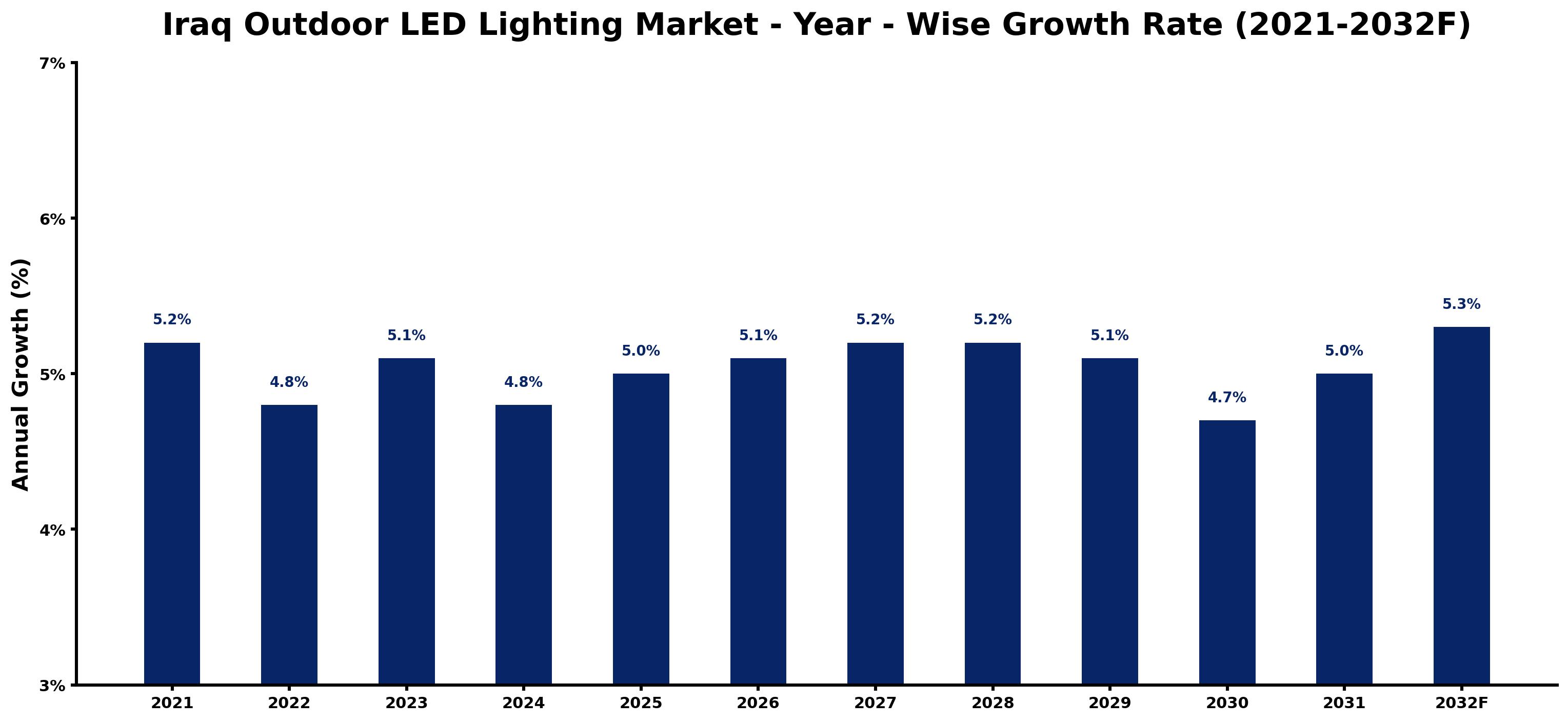
The table below presents the year wise growth rates along with the key drivers influencing the market
| Year | Growth Rate | Major Drivers |
| 2021 | 5.2% | Post-conflict reconstruction efforts prompted infrastructure investments across public spaces. |
| 2022 | 4.8% | Urbanization trends increased the focus on efficient and sustainable outdoor lighting solutions. |
| 2023 | 5.1% | Energy efficiency mandates encouraged businesses to explore innovative LED technologies. |
| 2024 | 4.8% | Local manufacturers began collaborating with international firms to enhance product offerings. |
| 2025 | 5.0% | Continued urban development projects highlighted the necessity for reliable outdoor lighting systems. |
| 2026 | 5.1% | Rural electrification initiatives expanded access to modern lighting solutions in remote areas. |
| 2027 | 5.2% | Increased tourism projected to boost demand for aesthetically pleasing outdoor lighting designs. |
| 2028 | 5.2% | Technological advancements lowered production costs, making LED lighting more accessible. |
| 2029 | 5.1% | Public safety concerns led municipalities to upgrade lighting in high-crime areas. |
| 2030 | 4.7% | Corporate sustainability goals prompted investment in environmentally friendly lighting solutions. |
| 2031 | 5.0% | Community events and festivals created seasonal spikes in outdoor lighting requirements. |
| 2032 | 5.3% | Integration of smart city technologies transformed traditional lighting into interactive systems. |
Note - Market size estimations and growth projections presented in this report are based on 6Wresearch's advanced forecasting approach, validated with industry datasets as of June 2026.
Key Highlights of the Report:
- Iraq Outdoor LED Lighting Market Outlook
- Market Size of Iraq Outdoor LED Lighting Market, 2025
- Forecast of Iraq Outdoor LED Lighting Market, 2023F
- Historical Data and Forecast of Iraq Outdoor LED Lighting Revenues & Volume for the Period 2022-2032F
- Iraq Outdoor LED Lighting Market Trend Evolution
- Iraq Outdoor LED Lighting Market Drivers and Challenges
- Iraq Outdoor LED Lighting Price Trends
- Iraq Outdoor LED Lighting Porter's Five Forces
- Iraq Outdoor LED Lighting Industry Life Cycle
- Historical Data and Forecast of Iraq Outdoor LED Lighting Market Revenues & Volume By Installation Type for the Period 2022-2032F
- Historical Data and Forecast of Iraq Outdoor LED Lighting Market Revenues & Volume By New for the Period 2022-2032F
- Historical Data and Forecast of Iraq Outdoor LED Lighting Market Revenues & Volume By Retrofit for the Period 2022-2032F
- Historical Data and Forecast of Iraq Outdoor LED Lighting Market Revenues & Volume By Wattage Type for the Period 2022-2032F
- Historical Data and Forecast of Iraq Outdoor LED Lighting Market Revenues & Volume By Less than 50W for the Period 2022-2032F
- Historical Data and Forecast of Iraq Outdoor LED Lighting Market Revenues & Volume By 50W to 100W for the Period 2022-2032F
- Historical Data and Forecast of Iraq Outdoor LED Lighting Market Revenues & Volume By More than 100W for the Period 2022-2032F
- Iraq Outdoor LED Lighting Import Export Trade Statistics
- Market Opportunity Assessment By Installation Type
- Market Opportunity Assessment By Wattage Type
- Iraq Outdoor LED Lighting Top Companies Market Share
- Iraq Outdoor LED Lighting Competitive Benchmarking By Technical and Operational Parameters
- Iraq Outdoor LED Lighting Company Profiles
- Iraq Outdoor LED Lighting Key Strategic Recommendations






































