Iraq Pest Control Market Size, Share & Growth Rate
The Iraq Pest Control Market was estimated at USD 934 Million in 2025 and is projected to reach USD 1332 Million by 2032, growing at a CAGR of 5.2% from 2026 to 2032. This growth trajectory is primarily driven by the increasing urbanization in Iraq, which has heightened the demand for effective pest control solutions in both residential and commercial sectors. Furthermore, rising health awareness concerning pest-related risks fuels the need for professional services and eco-friendly options, promoting market expansion.
Iraq Pest Control Market Year-wise Growth Rate and Key Drivers
This graph highlights how the Iraq Pest Control Market has steadily grown over the years, supported by major growth factors.
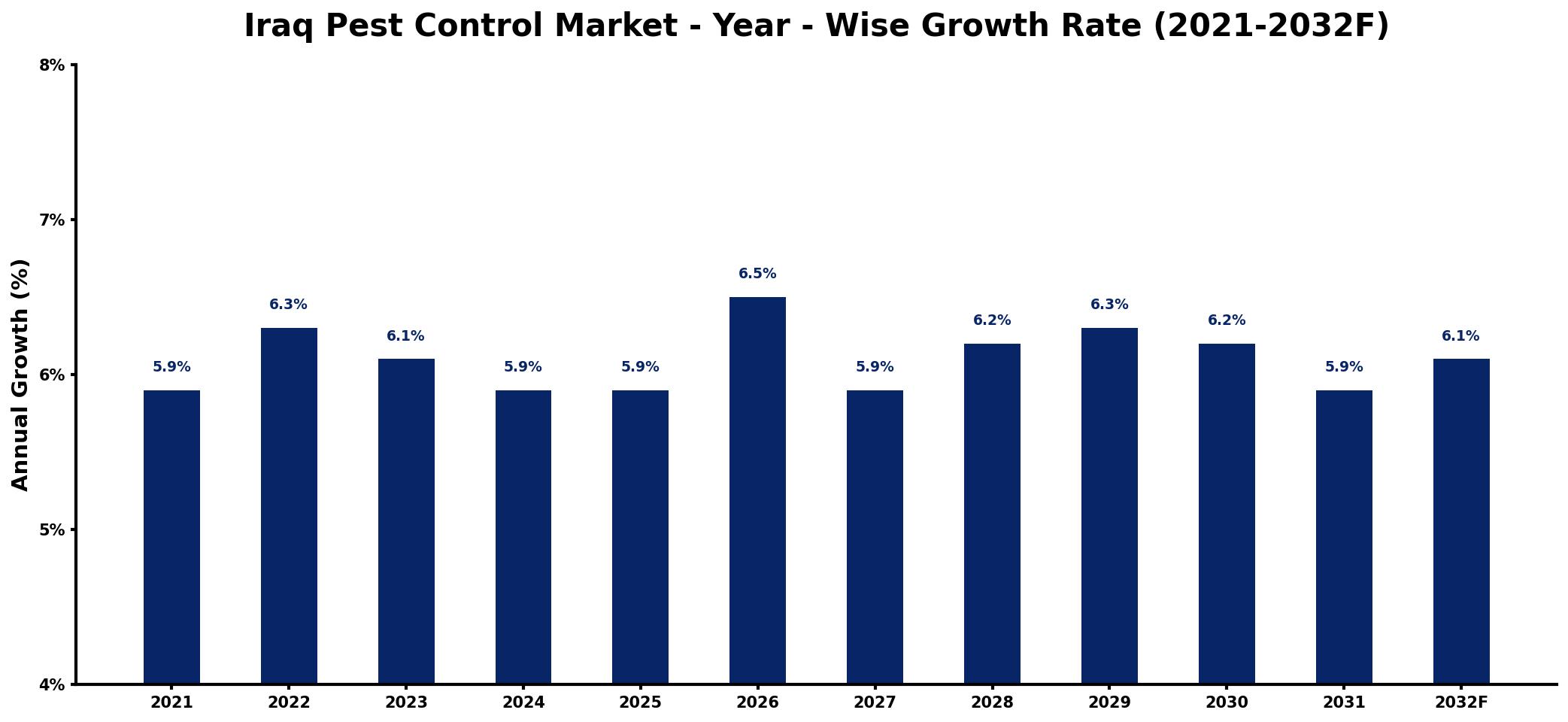
The table below presents the year‑wise growth rates along with the key drivers influencing the market
| Year | Growth Rate | Major Drivers |
| 2021 | 5.9% | Rising urban population growth |
| 2022 | 6.3% | Increase in agricultural activities |
| 2023 | 6.1% | Expansion of tourism sector |
| 2024 | 5.9% | Investment in infrastructure projects |
| 2025 | 5.9% | Growing awareness of hygiene |
| 2026 | 6.5% | Surge in residential developments |
| 2027 | 5.9% | Boost in commercial properties |
| 2028 | 6.2% | Strengthening of health regulations |
| 2029 | 6.3% | Enhancement of environmental standards |
| 2030 | 6.2% | Growth in food processing industry |
| 2031 | 5.9% | growing regional consumption patterns |
| 2032 | 6.1% | Demand for sustainable practices |
Note: Market size estimations and growth projections presented in this report are based on 6Wresearch's proprietary forecasting methodology, utilizing the latest available industry data, government publications, and primary research inputs.
Iraq Pest Control Market Synopsis
The most significant force currently shaping the Iraq Pest Control Market is the escalating focus on health and hygiene, particularly in urban settings. As public awareness regarding the health risks associated with pests grows, both consumers and businesses are actively seeking effective pest management strategies.
In addition, the shift towards environmentally sustainable pest control methods is gaining traction. Consumers are increasingly inclined to opt for integrated pest management (IPM) practices that minimize chemical usage, thereby aligning pest control measures with broader environmental concerns.
Iraq Pest Control Market Key Takeaways
- Urbanization is a primary driver of demand for pest control services in both residential and commercial spaces.
- Eco-friendly pest control solutions are becoming increasingly sought after as environmental awareness rises.
- Advanced technology, such as IoT-enabled monitoring systems, is being integrated into pest management strategies.
- Health and hygiene concerns, intensified by the COVID-19 pandemic, have led to an increased demand for professional pest control services.
- Investment opportunities are robust in sectors like agriculture and healthcare, necessitating effective pest management solutions.
Evaluation of Restraints in Iraq Pest Control Market
Despite its growth potential, the Iraq Pest Control Market is hampered by several key challenges. A pervasive lack of awareness about the significance of pest control services among consumers limits market penetration. Additionally, access to advanced pest control technologies remains inconsistent, particularly in remote areas, hindering service delivery. The ongoing political instability further complicates business operations, making it difficult for companies to establish a foothold and expand effectively.
Iraq Pest Control Market Trends
Current trends indicate a significant shift towards eco-friendly and sustainable pest control solutions as consumers become more environmentally conscious. The popularity of Integrated Pest Management (IPM) is on the rise, emphasizing preventive methods and non-toxic approaches. Furthermore, advancements in digital technologies, including IoT applications and data analytics, are optimizing pest control strategies and improving service efficiency. Professional pest control services are gaining traction as sanitation and hygiene become paramount in both residential and commercial settings.
Iraq Pest Control Market Opportunities
The Iraq Pest Control Market offers a wealth of investment opportunities, particularly in sectors such as agriculture and food processing, where effective pest management is critical for ensuring crop safety and public health. The expanding urban population is driving demand for residential pest control services, which presents an attractive avenue for businesses. Additionally, there is a clear opportunity to innovate in eco-friendly product offerings and integrated pest management services, allowing companies to differentiate themselves in a competitive landscape.
Government Initiatives in the Iraq Pest Control Market
Government policies regarding the Iraq Pest Control Market focus on ensuring the safety and efficacy of pest control products and services. The Ministry of Health plays a crucial role in the registration and licensing of pest control companies and products, emphasizing compliance with safety standards. Moreover, initiatives promoting integrated pest management practices are being supported, highlighting the governments commitment to environmentally sustainable pest control approaches that protect public health and the ecosystem.
Future Insights of the Iraq Pest Control Market
Looking ahead to 2026-2032, the future of the Iraq Pest Control Market appears bright. The anticipated growth will be fueled by continued urbanization and a heightened focus on hygiene and health safety, particularly in the wake of the COVID-19 pandemic. The expanding agricultural sector will further drive demand for pest management solutions, ensuring food security. As technology continues to advance and sustainable practices gain traction, the market is poised for steady growth, presenting ample opportunities for both local and international companies to engage and expand.
Iraq Pest Control Market Latest Developments (2025 - 2026)
In the most recent months, the Iraq Pest Control Market has witnessed a notable shift towards the adoption of digital technologies. Companies are increasingly implementing IoT-enabled pest monitoring systems, enhancing their service efficiency and effectiveness. Additionally, there is a growing emphasis on training programs aimed at developing a skilled workforce in pest management. This focus on education is critical for overcoming current market challenges and ensuring long-term growth.
Iraq Pest Control Market - Key Attractiveness of the Report
- 10 Years of Market Numbers
- Historical Data Starting from 2022 to 2025
- Base Year: 2025
- Forecast Data until 2032
- Key Performance Indicators Impacting the Market
- Major Upcoming Developments and Projects
Key Highlights of the Report:
- Iraq Pest Control Market Outlook
- Market Size of Iraq Pest Control Market, 2025
- Forecast of Iraq Pest Control Market, 2032
- Historical Data and Forecast of Iraq Pest Control Revenues & Volume for the Period 2022-2032F
- Iraq Pest Control Market Trend Evolution
- Iraq Pest Control Market Drivers and Challenges
- Iraq Pest Control Price Trends
- Iraq Pest Control Porter's Five Forces
- Iraq Pest Control Industry Life Cycle
- Historical Data and Forecast of Iraq Pest Control Market Revenues & Volume By Pest Type for the Period 2022-2032F
- Historical Data and Forecast of Iraq Pest Control Market Revenues & Volume By Insects for the Period 2022-2032F
- Historical Data and Forecast of Iraq Pest Control Market Revenues & Volume By Termites for the Period 2022-2032F
- Historical Data and Forecast of Iraq Pest Control Market Revenues & Volume By Rodents for the Period 2022-2032F
- Historical Data and Forecast of Iraq Pest Control Market Revenues & Volume By Wildlife for the Period 2022-2032F
- Historical Data and Forecast of Iraq Pest Control Market Revenues & Volume By Other pest types (birds, reptiles, and mollusks) for the Period 2022-2032F
- Historical Data and Forecast of Iraq Pest Control Market Revenues & Volume By Control Method for the Period 2022-2032F
- Historical Data and Forecast of Iraq Pest Control Market Revenues & Volume By Chemical for the Period 2022-2032F
- Historical Data and Forecast of Iraq Pest Control Market Revenues & Volume By Biological for the Period 2022-2032F
- Historical Data and Forecast of Iraq Pest Control Market Revenues & Volume By Mechanical for the Period 2022-2032F
- Historical Data and Forecast of Iraq Pest Control Market Revenues & Volume By Software & services for the Period 2022-2032F
- Historical Data and Forecast of Iraq Pest Control Market Revenues & Volume By Mode of Application for the Period 2022-2032F
- Historical Data and Forecast of Iraq Pest Control Market Revenues & Volume By Powder for the Period 2022-2032F
- Historical Data and Forecast of Iraq Pest Control Market Revenues & Volume By Sprays for the Period 2022-2032F
- Historical Data and Forecast of Iraq Pest Control Market Revenues & Volume By Pellets for the Period 2022-2032F
- Historical Data and Forecast of Iraq Pest Control Market Revenues & Volume By Traps for the Period 2022-2032F
- Historical Data and Forecast of Iraq Pest Control Market Revenues & Volume By Baits for the Period 2022-2032F
- Historical Data and Forecast of Iraq Pest Control Market Revenues & Volume By Application: for the Period 2022-2032F
- Historical Data and Forecast of Iraq Pest Control Market Revenues & Volume By Residential for the Period 2022-2032F
- Historical Data and Forecast of Iraq Pest Control Market Revenues & Volume By Commercial for the Period 2022-2032F
- Historical Data and Forecast of Iraq Pest Control Market Revenues & Volume By Livestock for the Period 2022-2032F
- Historical Data and Forecast of Iraq Pest Control Market Revenues & Volume By Industrial for the Period 2022-2032F
- Historical Data and Forecast of Iraq Pest Control Market Revenues & Volume By Other applications (non-commercial institutions, storage & transport facilities, and public landscapes) for the Period 2022-2032F
- Iraq Pest Control Import Export Trade Statistics
- Market Opportunity Assessment By Pest Type
- Market Opportunity Assessment By Control Method
- Market Opportunity Assessment By Mode of Application
- Market Opportunity Assessment By Application:
- Iraq Pest Control Top Companies Market Share
- Iraq Pest Control Competitive Benchmarking By Technical and Operational Parameters
- Iraq Pest Control Company Profiles
- Iraq Pest Control Key Strategic Recommendations






































