Iraq Ploughing and Cultivating Machinery Market Size, Share & Growth Rate
The Iraq Ploughing and Cultivating Machinery Market was estimated at USD 372 Million in 2025 and is projected to reach USD 531 Million by 2032, growing at a CAGR of 5.2% from 2026 to 2032. This growth trajectory is largely driven by the increasing adoption of mechanized farming practices, which are essential for enhancing agricultural productivity. Furthermore, government initiatives aimed at boosting food security and supporting local farmers are also playing a pivotal role in fostering market expansion.
Iraq Ploughing and Cultivating Machinery Market Year-wise Growth Rate and Key Drivers
This graph highlights how the Iraq Ploughing and Cultivating Machinery Market has steadily grown over the years, supported by major growth factors.
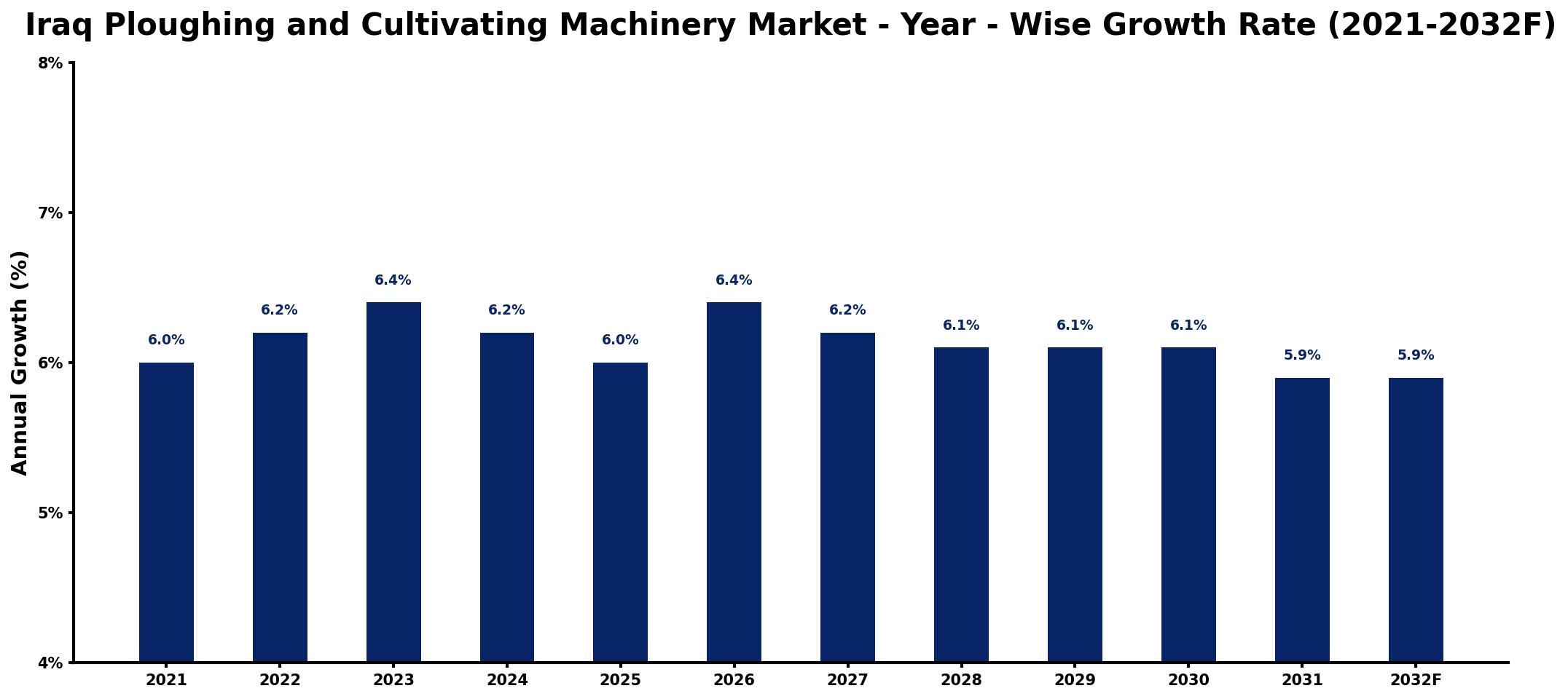
The table below presents the year‑wise growth rates along with the key drivers influencing the market
| Year | Growth Rate | Major Drivers |
| 2021 | 6.0% | increased agricultural investment initiatives |
| 2022 | 6.2% | growing demand for sustainable practices |
| 2023 | 6.4% | expansion of farming cooperatives |
| 2024 | 6.2% | rising export opportunities for crops |
| 2025 | 6.0% | enhanced governmental support programs |
| 2026 | 6.4% | increased mechanization in agriculture |
| 2027 | 6.2% | growing popularity of eco-friendly solutions |
| 2028 | 6.1% | development of rural infrastructure projects |
| 2029 | 6.1% | increased access to financing options |
| 2030 | 6.1% | rising awareness of food security |
| 2031 | 5.9% | growing adoption of precision agriculture |
| 2032 | 5.9% | increased collaboration with research institutions |
Note: Market size estimations and growth projections presented in this report are based on 6Wresearch's proprietary forecasting methodology, utilizing the latest available industry data, government publications, and primary research inputs.
Iraq Ploughing and Cultivating Machinery Market Synopsis
Currently, the Iraq Ploughing and Cultivating Machinery Market is on an upward trend, characterized by a shift towards modern farming techniques. The growing mechanization of agriculture is enabling farmers to significantly increase their yield, thereby attracting attention from various stakeholders within the sector.
Moreover, with an expanding base of agricultural practitioners eager to improve efficiency, there is a notable demand for advanced machinery such as tractors, ploughs, and cultivators. This evolution in farming practices aligns well with the Iraqi government's strategic initiatives to enhance agricultural outputs, making it an opportune time for market players to engage.
Iraq Ploughing and Cultivating Machinery Market Key Takeaways
- The market is transitioning towards mechanization, driven by the need for higher agricultural productivity.
- Government support in the form of subsidies and incentives is enhancing local manufacturing capabilities.
- Investment in eco-friendly machinery is gaining traction among farmers looking for sustainable solutions.
- Smart farming technologies are starting to shape how equipment is utilized in the field.
- Challenges related to financing and infrastructure remain critical for the markets growth.
Evaluation of Restraints in Iraq Ploughing and Cultivating Machinery Market
The market is hindered by several systemic constraints that limit its potential. Outdated farming practices are still prevalent among a significant portion of the farming community, which slows the transition to modern techniques. Access to financing is another critical barrier; many small-scale farmers struggle to secure the necessary funds for purchasing advanced machinery. Additionally, infrastructural shortcomings, including poor road conditions and limited access to markets, complicate the distribution of agricultural products and machinery alike. These factors collectively create an environment where the adoption of mechanized farming is not as swift as it could be.
Iraq Ploughing and Cultivating Machinery Market Trends
The landscape of the Iraq Ploughing and Cultivating Machinery Market is evolving, with several noteworthy trends emerging. Firstly, there is an increasing shift toward precision agriculture, with farmers investing in machinery equipped with GPS and data analytics technologies to optimize their operations. Additionally, a rising demand for sustainable agricultural practices is prompting manufacturers to develop eco-friendly machinery. The trend toward automation is also reshaping the market, as farmers seek to reduce labor costs and improve efficiency through advanced machinery solutions. This collective push toward modernization is significantly influencing the markets dynamics.
Iraq Ploughing and Cultivating Machinery Market Opportunities
As the agricultural sector in Iraq continues to modernize, numerous investment opportunities are emerging within the ploughing and cultivating machinery market. Local distributors and dealers are in high demand as partnerships can offer valuable market access. Furthermore, innovation in machinery that caters to the unique needs of Iraqi farmers presents a significant growth opportunity. There is also potential for advancements in smart farming technologies, positioning investors to capitalize on the digital transformation of agriculture in the region.
Government Initiatives in the Iraq Ploughing and Cultivating Machinery Market
The Iraqi government has undertaken several initiatives to boost the Ploughing and Cultivating Machinery Market. These policies include implementing import tariffs designed to promote domestic manufacturing, thereby reducing reliance on foreign machinery. Additionally, various subsidies and incentives for local manufacturers aim to enhance production quality and capacity. There is also a focused effort on technology transfer and fostering research and development to advance the sector. Together, these initiatives create a supportive framework for growth and innovation in the market.
Future Insights of the Iraq Ploughing and Cultivating Machinery Market
Looking ahead to 2026-2032, the future of the Iraq Ploughing and Cultivating Machinery Market appears robust. The ongoing shift towards mechanization, combined with governmental efforts to modernize agriculture, will likely sustain market growth. The integration of smart technologies and precision agriculture practices is set to revolutionize farming in Iraq. However, for this growth to be fully realized, challenges such as financing accessibility and infrastructure development must be addressed. By overcoming these obstacles, the market can seize its full potential.
Iraq Ploughing and Cultivating Machinery Market Latest Developments (2025 - 2026)
Recent developments in the Iraq Ploughing and Cultivating Machinery Market indicate a growing interest in innovative machinery solutions. The trend toward adopting precision agriculture practices is gaining momentum, with farmers increasingly seeking technologically advanced equipment that enhances productivity. Additionally, local manufacturers are responding to the market demand by improving the quality and variety of machinery offered. There is also a notable shift towards sustainability, as eco-friendly practices become a priority among agricultural stakeholders.
Iraq Ploughing and Cultivating Machinery Market - Key Attractiveness of the Report
- 10 Years of Market Numbers
- Historical Data Starting from 2022 to 2025
- Base Year: 2025
- Forecast Data until 2032
- Key Performance Indicators Impacting the Market
- Major Upcoming Developments and Projects
Key Highlights of the Report:
- Iraq Ploughing and Cultivating Machinery Market Outlook
- Market Size of Iraq Ploughing and Cultivating Machinery Market, 2025
- Forecast of Iraq Ploughing and Cultivating Machinery Market, 2032
- Historical Data and Forecast of Iraq Ploughing and Cultivating Machinery Revenues & Volume for the Period 2022-2032F
- Iraq Ploughing and Cultivating Machinery Market Trend Evolution
- Iraq Ploughing and Cultivating Machinery Market Drivers and Challenges
- Iraq Ploughing and Cultivating Machinery Price Trends
- Iraq Ploughing and Cultivating Machinery Porter's Five Forces
- Iraq Ploughing and Cultivating Machinery Industry Life Cycle
- Historical Data and Forecast of Iraq Ploughing and Cultivating Machinery Market Revenues & Volume By Type for the Period 2022-2032F
- Historical Data and Forecast of Iraq Ploughing and Cultivating Machinery Market Revenues & Volume By Ploughs for the Period 2022-2032F
- Historical Data and Forecast of Iraq Ploughing and Cultivating Machinery Market Revenues & Volume By Harrows for the Period 2022-2032F
- Historical Data and Forecast of Iraq Ploughing and Cultivating Machinery Market Revenues & Volume By Others for the Period 2022-2032F
- Historical Data and Forecast of Iraq Ploughing and Cultivating Machinery Market Revenues & Volume By Application for the Period 2022-2032F
- Historical Data and Forecast of Iraq Ploughing and Cultivating Machinery Market Revenues & Volume By Soil Loosening for the Period 2022-2032F
- Historical Data and Forecast of Iraq Ploughing and Cultivating Machinery Market Revenues & Volume By Clod Size Reduction for the Period 2022-2032F
- Historical Data and Forecast of Iraq Ploughing and Cultivating Machinery Market Revenues & Volume By Clod Sorting for the Period 2022-2032F
- Historical Data and Forecast of Iraq Ploughing and Cultivating Machinery Market Revenues & Volume By Others for the Period 2022-2032F
- Iraq Ploughing and Cultivating Machinery Import Export Trade Statistics
- Market Opportunity Assessment By Type
- Market Opportunity Assessment By Application
- Iraq Ploughing and Cultivating Machinery Top Companies Market Share
- Iraq Ploughing and Cultivating Machinery Competitive Benchmarking By Technical and Operational Parameters
- Iraq Ploughing and Cultivating Machinery Company Profiles
- Iraq Ploughing and Cultivating Machinery Key Strategic Recommendations






































