Iraq Polymers Market Summary
The iraq polymers market was estimated at USD 447 Million in 2025 and is projected to reach USD 586 Million by 2032, growing at a CAGR of 4.3% from 2026 to 2032.
Iraq Polymers Market Year-wise Growth Rate and Key Drivers
This graph highlights how the Iraq Polymers Market has steadily grown over the past five years, supported by major growth factors.
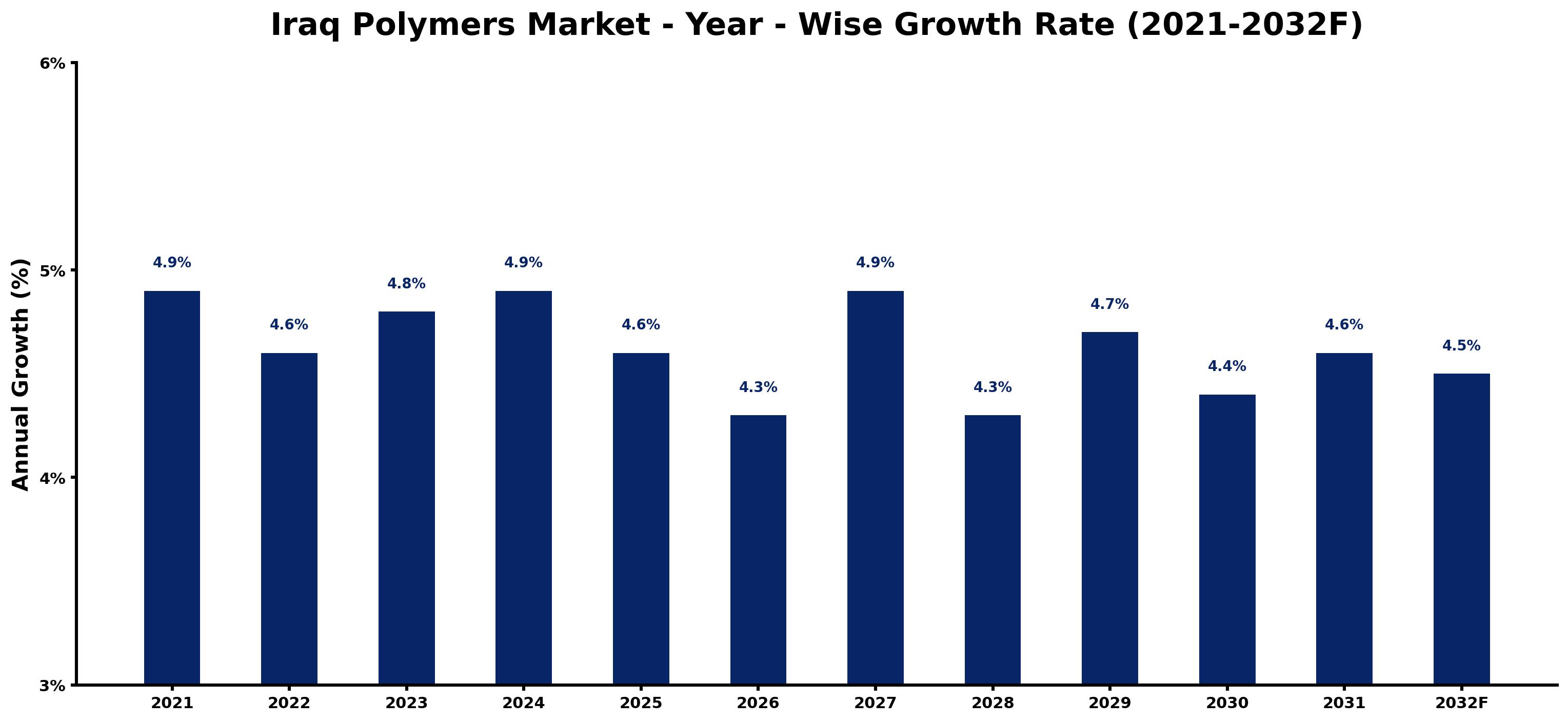
The table below presents the year wise growth rates along with the key drivers influencing the market
| Year | Growth Rate | Major Drivers |
| 2021 | 4.9% | The aftermath of conflict has sparked interest in revitalizing local manufacturing capabilities. |
| 2022 | 4.6% | Investment in infrastructure projects begins to favor polymer usage in construction materials. |
| 2023 | 4.8% | Emerging consumer trends lean towards sustainable packaging solutions, boosting polymer demand. |
| 2024 | 4.9% | Technological upgrades in local factories enhance the production capacity of polymers significantly. |
| 2025 | 4.6% | An influx of foreign investment promotes competitive pricing across the polymer market. |
| 2026 | 4.3% | Local entrepreneurs target niche markets, promoting innovative polymer-based products and applications. |
| 2027 | 4.9% | Increased regional trade agreements enhance access to bulk polymer resources for manufacturers. |
| 2028 | 4.3% | Environmental concerns shape product designs, urging manufacturers to use biodegradable polymers. |
| 2029 | 4.7% | The automotive sector begins incorporating more polymer components, fueling industrial growth. |
| 2030 | 4.4% | A construction boom across urban centers contributes to soaring polymer material requirements. |
| 2031 | 4.6% | Collaborations between local firms and international brands elevate the polymer market's global presence. |
| 2032 | 4.5% | Dynamic shifts in consumer preferences lead to diversification in polymer applications and designs. |
Note - Market size estimations and growth projections presented in this report are based on 6Wresearch's advanced forecasting approach, validated with industry datasets as of June 2026.
Iraq Polymers Market Synopsis
The Iraq Polymers Market is projected to reach 4.3% and witness significant growth during the forecast period (2026-2032). This growth is largely driven by the increasing demand from sectors like packaging, automotive, construction, and consumer goods. The rising population, urbanization, and government initiatives aimed at industrial development and attracting foreign investments play pivotal roles in shaping the demand dynamics of the polymers market in Iraq. Meanwhile, the predominance of polyethylene and polypropylene reflects their critical applications across various industries, making them staples in the local market.
Iraq Polymers Market Growth Drivers
Several factors are contributing to the growth of the Iraq Polymers Market. The following key drivers are noteworthy:
- The burgeoning population in Iraq generates higher demand for consumer goods, which subsequently boosts the need for versatile packaging solutions made from polymers.
- Rapid urbanization and infrastructure development projects necessitate the use of polymers in construction, leading to increased consumption of materials such as polyethylene and PVC.
- Government initiatives focused on industrialization are attracting foreign investments, fostering an environment conducive to market expansion.
- The automotive sector's growth is stimulating demand for polymers used in manufacturing vehicle components, thereby enhancing the market's prospects.
- Growing awareness regarding sustainable practices is leading manufacturers to invest in eco-friendly polymer formulations, which align with the global trend of reducing environmental footprints.
Iraq Polymers Market Trends and Opportunities
The Iraq Polymers Market is witnessing significant trends that present opportunities for growth:
- A marked shift towards sustainable and eco-friendly polymer solutions is emerging, as industries increasingly prioritize recycling and minimizing their environmental impact.
- High-performance polymers are gaining traction, as manufacturers seek materials that offer enhanced durability and properties for specialized applications.
- Investment in research and development is on the rise, with companies aiming to create innovative polymer formulations that cater to specific industry requirements and enhance product quality.
- There is a growing preference for locally sourced materials, which is encouraging investment in domestic polymer production capabilities and reducing reliance on imports.
- The expanding middle class in Iraq is changing consumption patterns, driving demand for versatile packaging and consumer goods that utilize polymers effectively.
Iraq Polymers Market Challenges and Restraints
The Iraq Polymers Market faces several significant challenges that could impede its growth:
- Political instability and ongoing security concerns are critical factors that contribute to uncertainty in investment and market operations, potentially disrupting supply chains.
- Inadequate infrastructure poses severe limitations on transportation and logistics, which can lead to increased costs and delays in polymer distribution across the country.
- The lack of skilled workforce limits the industry's ability to maintain quality standards and adopt technological advancements in polymer production.
- Market players may encounter regulatory challenges that can complicate compliance with local standards and international norms in polymer manufacturing.
- Market volatility driven by regional conflicts can deter foreign investments, reducing the influx of capital needed for expansion and innovation.
Iraq Polymers Market Investment Opportunities
Investment opportunities in the Iraq Polymers Market are becoming increasingly attractive:
- The growing manufacturing sector and rising demand for polymers present lucrative opportunities for investors looking to establish production facilities in Iraq.
- Government incentives aimed at promoting industrial development, including tax breaks and subsidies for polymer manufacturers, encourage new entrants into the market.
- Infrastructure reconstruction efforts signal a long-term need for polymer materials in construction, enhancing the market's attractiveness for potential investors.
- Partnerships with local suppliers and manufacturers can help investors navigate the complexities of the Iraqi market while capitalizing on emerging consumer trends.
- Investing in advanced production technologies can lead to significant efficiency gains and cost reductions in the polymer manufacturing process.
Iraq Polymers Market Government Investment and Initiatives
The Iraqi government has initiated several policies to bolster the polymers market, focusing on industrial growth and environmental sustainability. These initiatives include:
- The implementation of tax incentives and subsidies aimed at attracting investment in polymer manufacturing, which helps stimulate industrial activity within the country.
- Regulatory frameworks established to control polymer production and disposal, ensuring compliance with environmental standards and promoting sustainable practices.
- Public spending on infrastructure development projects that create demand for polymers in construction and packaging industries.
- Support for research and development initiatives within the polymers sector, encouraging innovation in product quality and market competitiveness.
- Facilitation of partnerships between local manufacturers and foreign investors to enhance knowledge transfer and technological advancement.
Iraq Polymers Market Latest Developments (May 2025 - June 2026)
Recent developments in the Iraq Polymers Market from May 2025 to June 2026 indicate a progressive direction towards market maturity and innovation:
- Industry stakeholders have reported a notable increase in investments directed towards sustainable polymer production, reflecting global environmental concerns.
- Emerging collaborations between public and private sectors are fostering advancements in polymer technologies and materials, enhancing overall product offerings.
- Government engagement in promoting local production has gained momentum, reducing reliance on imports and increasing domestic market stability.
- The rise of e-commerce and changing consumer preferences have driven demand for innovative packaging solutions, presenting growth opportunities for the polymers sector.
- In response to regulatory shifts, companies are adapting their supply chains to ensure compliance with newly implemented environmental standards.
Iraq Polymers Market - Key Attractiveness of the Report
- 10 Years of Market Numbers
- Historical Data Starting from 2022 to 2025
- Base Year: 2025
- Forecast Data until 2032
- Key Performance Indicators Impacting the Market
- Major Upcoming Developments and Projects
Key Highlights of the Report:
- Iraq Polymers Market Outlook
- Market Size of Iraq Polymers Market, 2025
- Forecast of Iraq Polymers Market, 2032F
- Historical Data and Forecast of Iraq Polymers Revenues & Volume for the Period 2022-2032F
- Iraq Polymers Market Trend Evolution
- Iraq Polymers Market Drivers and Challenges
- Iraq Polymers Price Trends
- Iraq Polymers Porter's Five Forces
- Iraq Polymers Industry Life Cycle
- Historical Data and Forecast of Iraq Polymers Market Revenues & Volume By Type for the Period 2022-2032F
- Historical Data and Forecast of Iraq Polymers Market Revenues & Volume By Thermoplastics for the Period 2022-2032F
- Historical Data and Forecast of Iraq Polymers Market Revenues & Volume By Thermosets for the Period 2022-2032F
- Historical Data and Forecast of Iraq Polymers Market Revenues & Volume By Elastomers for the Period 2022-2032F
- Historical Data and Forecast of Iraq Polymers Market Revenues & Volume By Product for the Period 2022-2032F
- Historical Data and Forecast of Iraq Polymers Market Revenues & Volume By Polyethylene for the Period 2022-2032F
- Historical Data and Forecast of Iraq Polymers Market Revenues & Volume By Polyvinyl Chloride for the Period 2022-2032F
- Historical Data and Forecast of Iraq Polymers Market Revenues & Volume By Polypropylene for the Period 2022-2032F
- Historical Data and Forecast of Iraq Polymers Market Revenues & Volume By Polystyrene for the Period 2022-2032F
- Historical Data and Forecast of Iraq Polymers Market Revenues & Volume By Polyamide for the Period 2022-2032F
- Historical Data and Forecast of Iraq Polymers Market Revenues & Volume By Polyurethane for the Period 2022-2032F
- Historical Data and Forecast of Iraq Polymers Market Revenues & Volume By Polyacrylamide for the Period 2022-2032F
- Historical Data and Forecast of Iraq Polymers Market Revenues & Volume By Application for the Period 2022-2032F
- Historical Data and Forecast of Iraq Polymers Market Revenues & Volume By Packaging for the Period 2022-2032F
- Historical Data and Forecast of Iraq Polymers Market Revenues & Volume By Electronics for the Period 2022-2032F
- Historical Data and Forecast of Iraq Polymers Market Revenues & Volume By Food for the Period 2022-2032F
- Historical Data and Forecast of Iraq Polymers Market Revenues & Volume By Petrochemicals for the Period 2022-2032F
- Historical Data and Forecast of Iraq Polymers Market Revenues & Volume By Healthcare for the Period 2022-2032F
- Historical Data and Forecast of Iraq Polymers Market Revenues & Volume By Building & Construction for the Period 2022-2032F
- Historical Data and Forecast of Iraq Polymers Market Revenues & Volume By Electronics & Communication for the Period 2022-2032F
- Historical Data and Forecast of Iraq Polymers Market Revenues & Volume By Transportation for the Period 2022-2032F
- Iraq Polymers Import Export Trade Statistics
- Market Opportunity Assessment By Type
- Market Opportunity Assessment By Product
- Market Opportunity Assessment By Application
- Iraq Polymers Top Companies Market Share
- Iraq Polymers Competitive Benchmarking By Technical and Operational Parameters
- Iraq Polymers Company Profiles
- Iraq Polymers Key Strategic Recommendations






































