Iraq Polypropylene Market Size, Share & Growth Rate
The Iraq Polypropylene Market was estimated at USD 194 Million in 2025 and is projected to reach USD 271 Million by 2032, growing at a CAGR of 4.9% from 2026 to 2032. This growth trajectory is primarily driven by the increasing demand across various sectors such as packaging, automotive, and construction, which are rapidly expanding due to Iraqs burgeoning manufacturing landscape. The unique properties of polypropylene, including its lightweight and durability, further solidify its status as a preferred material in these applications.
Iraq Polypropylene Market Year-wise Growth Rate and Key Drivers
This graph highlights how the Iraq Polypropylene Market has steadily grown over the years, supported by major growth factors.
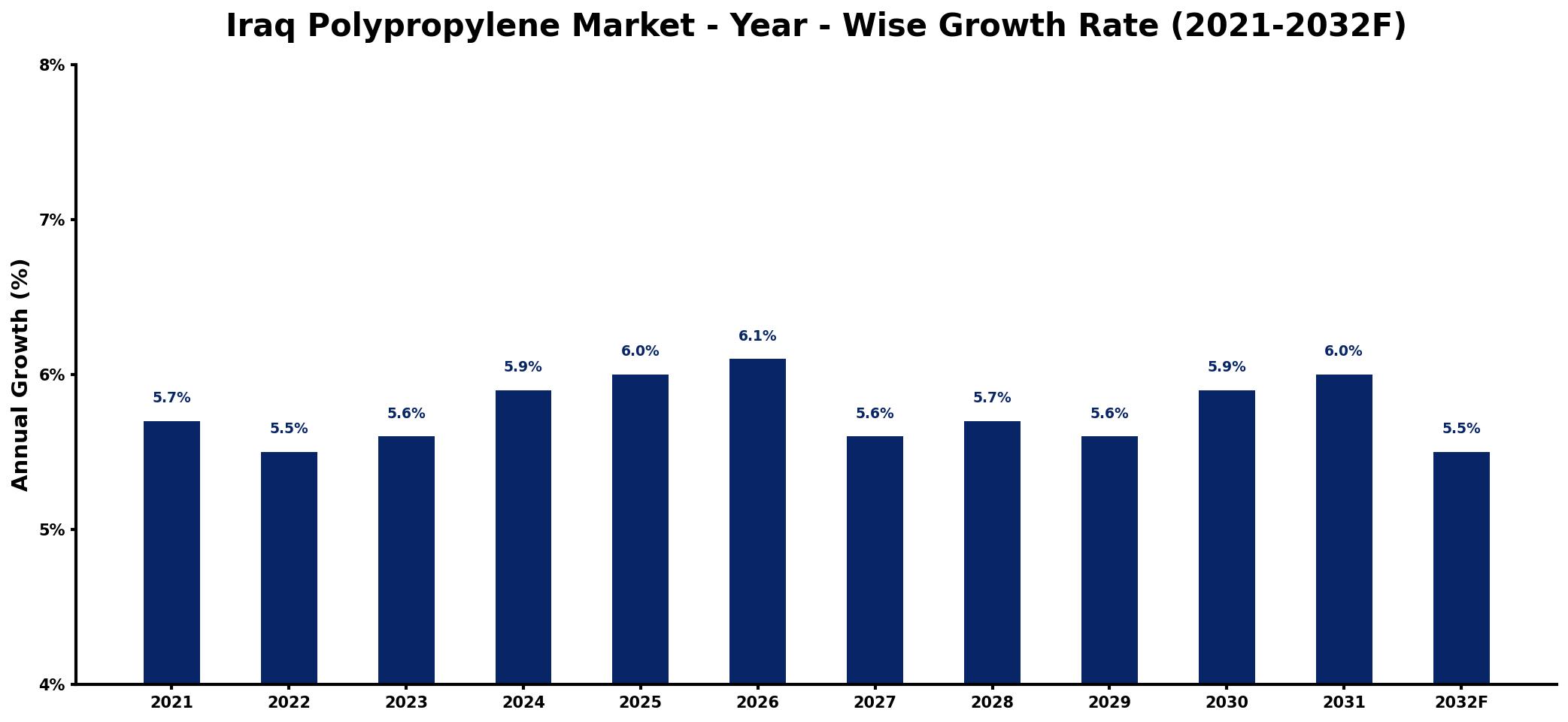
The table below presents the year‑wise growth rates along with the key drivers influencing the market
| Year | Growth Rate | Major Drivers |
| 2021 | 5.7% | Rising demand from packaging sector |
| 2022 | 5.5% | Increased investments in manufacturing |
| 2023 | 5.6% | Growth in automotive industry applications |
| 2024 | 5.9% | Expanding construction sector projects |
| 2025 | 6.0% | Surge in consumer goods production |
| 2026 | 6.1% | Enhanced recycling initiatives adoption |
| 2027 | 5.6% | Growing agricultural film usage |
| 2028 | 5.7% | Innovations in sustainable materials |
| 2029 | 5.6% | Strengthening export market opportunities |
| 2030 | 5.9% | Development of new applications |
| 2031 | 6.0% | expanding healthcare application demand |
| 2032 | 5.5% | Increasing focus on circular economy |
Note: Market size estimations and growth projections presented in this report are based on 6Wresearch's proprietary forecasting methodology, utilizing the latest available industry data, government publications, and primary research inputs.
Iraq Polypropylene Market Synopsis
The rise of urbanization in Iraq is leading to a significant uptick in demand for polypropylene-based products, particularly in construction and packaging. As infrastructure development accelerates, the need for reliable and versatile materials like polypropylene becomes even more critical, marking a turning point for the local manufacturing industry.
Moreover, the automotive sector is witnessing a shift towards lighter materials, enhancing fuel efficiency and performance. As a result, there is a growing adoption of polypropylene components in vehicles, underscoring the markets diverse potential and appealing growth prospects.
Iraq Polypropylene Market Key Takeaways
- The market is poised for significant growth with projected revenues reaching USD 271 Million by 2032.
- Urbanization and infrastructure development are key drivers influencing demand for polypropylene.
- Government policies supporting the petrochemical sector are bolstering industry confidence.
- Challenges related to raw material price fluctuations could affect pricing strategies.
- Technological advancements and investment in local production facilities are essential for market competitiveness.
Evaluation of Restraints in Iraq Polypropylene Market
While the Iraq polypropylene market exhibits promising growth, it is not without its restraints. A significant concern remains the volatility in raw material prices, especially given their close ties to the ever-fluctuating oil markets. This unpredictability can hinder long-term planning for manufacturers and may influence pricing strategies. Furthermore, limitations in infrastructure and technological advancements present substantial barriers to enhancing competitiveness on a global scale, potentially impacting the sector's ability to meet rising local and international demand.
Iraq Polypropylene Market Trends
Currently, there is a noticeable trend towards sustainability within the polypropylene market. As environmental concerns grow, manufacturers are increasingly exploring biopolymers and recycling initiatives to meet global standards. Moreover, innovative applications of polypropylene in sectors such as medical and agricultural products are emerging, reflecting a shift towards leveraging its versatility beyond traditional uses. These trends are positioning the Iraqi market to adapt and thrive in an evolving global landscape.
Iraq Polypropylene Market Opportunities
Investment opportunities abound within the Iraq polypropylene market, particularly in enhancing local production capabilities. With favorable government policies encouraging the development of petrochemical facilities, foreign investment can lead to technological upgrades and improved production efficiencies. Additionally, expanding applications in the automotive and construction sectors present avenues for innovation and market expansion, paving the way for a more robust local industry poised for future success.
Government Initiatives in the Iraq Polypropylene Market
The Iraqi government is actively promoting the growth of the polypropylene market through various initiatives aimed at enhancing domestic production capabilities. These initiatives focus on improving infrastructure, facilitating access to financing, and supporting technology upgrades for local manufacturers. By fostering an environment conducive to investment and innovation, the government is positioning the Iraqi polypropylene sector to better compete in the global marketplace while ensuring that products meet international quality standards.
Future Insights of the Iraq Polypropylene Market
Looking ahead to the period from 2026 to 2032, the Iraq polypropylene market is expected to evolve significantly. As the nation continues to recover and develop economically, the demand for polypropylene in construction and packaging will likely escalate. Additionally, the anticipated technological advancements and improved production processes will contribute to enhanced quality and reduced costs. This progression will not only enable local manufacturers to capture a larger market share but also position Iraq as a competitive player within the broader regional and global polypropylene markets.
Iraq Polypropylene Market Latest Developments (2025 - 2026)
In recent months, the Iraqi polypropylene industry has seen a variety of developments aimed at revitalizing the sector. New partnerships have emerged to bolster investments in polymer production, highlighting a collective commitment to expanding capacity and improving technological capabilities. Additionally, ongoing discussions regarding regulatory reforms indicate a push towards better aligning the local market with international standards, potentially enhancing the competitiveness of Iraqi polypropylene products on the global stage.
Iraq Polypropylene Market - Key Attractiveness of the Report
- 10 Years of Market Numbers
- Historical Data Starting from 2022 to 2025
- Base Year: 2025
- Forecast Data until 2032
- Key Performance Indicators Impacting the Market
- Major Upcoming Developments and Projects
Key Highlights of the Report:
- Iraq Polypropylene Market Outlook
- Market Size of Iraq Polypropylene Market, 2025
- Forecast of Iraq Polypropylene Market, 2032
- Historical Data and Forecast of Iraq Polypropylene Revenues & Volume for the Period 2022-2032F
- Iraq Polypropylene Market Trend Evolution
- Iraq Polypropylene Market Drivers and Challenges
- Iraq Polypropylene Price Trends
- Iraq Polypropylene Porter's Five Forces
- Iraq Polypropylene Industry Life Cycle
- Historical Data and Forecast of Iraq Polypropylene Market Revenues & Volume By Type for the Period 2022-2032F
- Historical Data and Forecast of Iraq Polypropylene Market Revenues & Volume By Homopolymer for the Period 2022-2032F
- Historical Data and Forecast of Iraq Polypropylene Market Revenues & Volume By Copolymer for the Period 2022-2032F
- Historical Data and Forecast of Iraq Polypropylene Market Revenues & Volume By Application for the Period 2022-2032F
- Historical Data and Forecast of Iraq Polypropylene Market Revenues & Volume By Injection Molding for the Period 2022-2032F
- Historical Data and Forecast of Iraq Polypropylene Market Revenues & Volume By Fiber & Raffia for the Period 2022-2032F
- Historical Data and Forecast of Iraq Polypropylene Market Revenues & Volume By Film & Sheet for the Period 2022-2032F
- Historical Data and Forecast of Iraq Polypropylene Market Revenues & Volume By Blow Molding for the Period 2022-2032F
- Historical Data and Forecast of Iraq Polypropylene Market Revenues & Volume By End-use Industry for the Period 2022-2032F
- Historical Data and Forecast of Iraq Polypropylene Market Revenues & Volume By Packaging for the Period 2022-2032F
- Historical Data and Forecast of Iraq Polypropylene Market Revenues & Volume By Automotive for the Period 2022-2032F
- Historical Data and Forecast of Iraq Polypropylene Market Revenues & Volume By Building & Construction for the Period 2022-2032F
- Historical Data and Forecast of Iraq Polypropylene Market Revenues & Volume By Electrical & Electronics for the Period 2022-2032F
- Historical Data and Forecast of Iraq Polypropylene Market Revenues & Volume By Medical for the Period 2022-2032F
- Iraq Polypropylene Import Export Trade Statistics
- Market Opportunity Assessment By Type
- Market Opportunity Assessment By Application
- Market Opportunity Assessment By End-use Industry
- Iraq Polypropylene Top Companies Market Share
- Iraq Polypropylene Competitive Benchmarking By Technical and Operational Parameters
- Iraq Polypropylene Company Profiles
- Iraq Polypropylene Key Strategic Recommendations






































