Iraq Prepaid Cards Market Size, Share & Growth Rate
The Iraq Prepaid Cards Market was estimated at USD 1411 Million in 2025 and is projected to reach USD 2540 Million by 2032, growing at a CAGR of 8.8% from 2026 to 2032. This promising trajectory is underpinned by the increasing consumer preference for digital transactions and a significant push from the government to enhance financial inclusion across the nation. The rise of e-commerce platforms and the expanding retail sector further amplify the demand for prepaid card solutions, making them an integral part of the evolving payment landscape.
Iraq Prepaid Cards Market Year-wise Growth Rate and Key Drivers
This graph highlights how the Iraq Prepaid Cards Market has steadily grown over the years, supported by major growth factors.
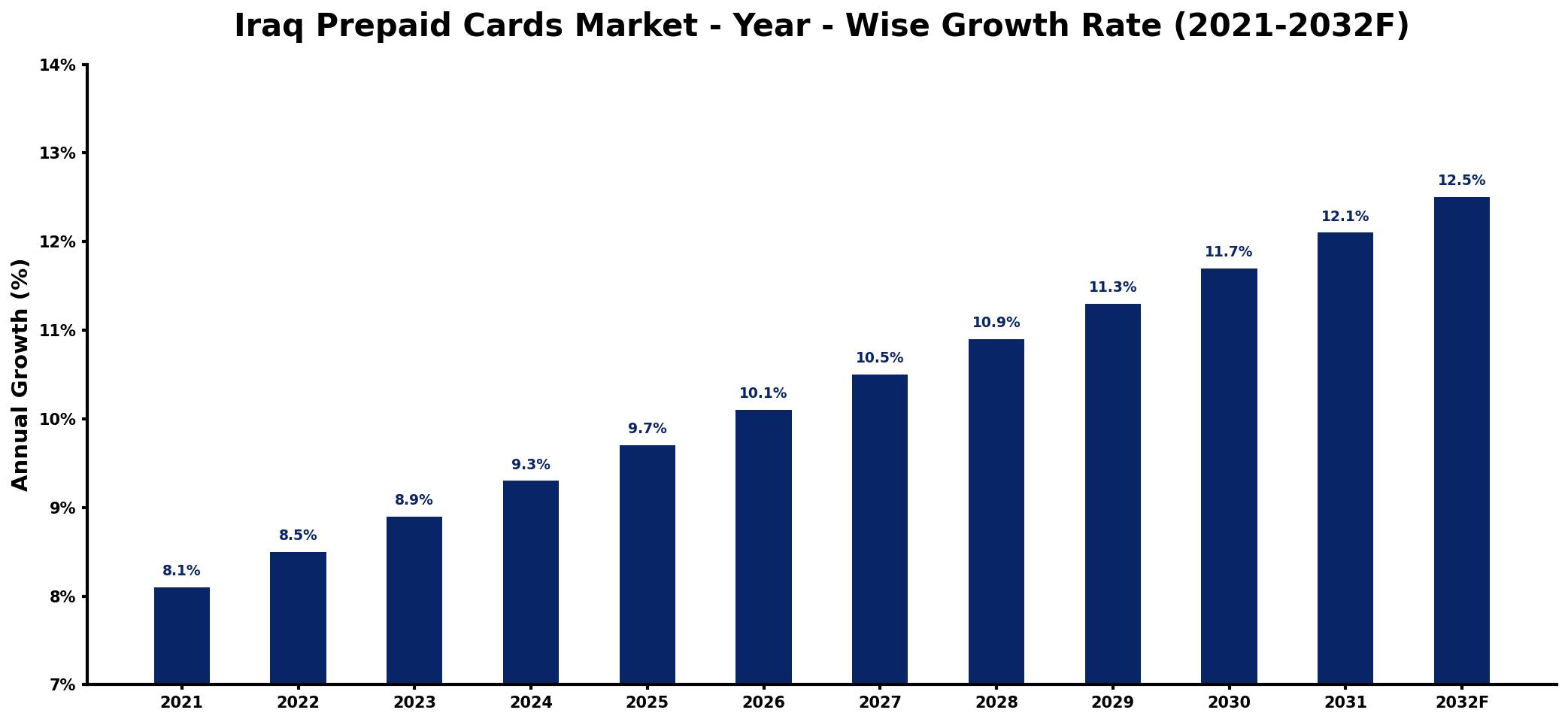
The table below presents the year‑wise growth rates along with the key drivers influencing the market
| Year | Growth Rate | Major Drivers |
| 2021 | 8.1% | Rising digital payment adoption |
| 2022 | 8.5% | Increased consumer spending power |
| 2023 | 8.9% | Expansion of retail infrastructure |
| 2024 | 9.3% | Growth in e-commerce transactions |
| 2025 | 9.7% | Investment in fintech solutions |
| 2026 | 10.1% | Enhanced mobile payment options |
| 2027 | 10.5% | Adoption of contactless technologies |
| 2028 | 10.9% | Surge in international remittances |
| 2029 | 11.3% | Growing popularity of online services |
| 2030 | 11.7% | Development of financial literacy programs |
| 2031 | 12.1% | Increased partnerships with merchants |
| 2032 | 12.5% | Rising demand for financial inclusion |
Note: Market size estimations and growth projections presented in this report are based on 6Wresearch's proprietary forecasting methodology, utilizing the latest available industry data, government publications, and primary research inputs.
Iraq Prepaid Cards Market Synopsis
In Iraq, prepaid cards are emerging as a crucial tool for financial transactions, particularly in areas with limited banking infrastructure. Their convenience and ability to facilitate online shopping are pivotal in attracting a tech-savvy consumer base.
Moreover, as government initiatives encourage digital payment methods, more citizens, particularly from unbanked backgrounds, are beginning to adopt prepaid cards for everyday transactions. This shift is not only about convenience; it's a step towards broader financial accessibility for the population.
Iraq Prepaid Cards Market Key Takeaways
- The market is projected to grow substantially, with a CAGR of 8.8% from 2026 to 2032.
- Government initiatives are key drivers of financial inclusion and prepaid card adoption.
- Security concerns and limited awareness still present hurdles to broader market uptake.
- E-commerce growth is driving increased demand for prepaid card transactions.
- The convenience of cashless payments is reshaping consumer spending habits in Iraq.
Evaluation of Restraints in Iraq Prepaid Cards Market
Despite promising growth potential, the Iraq Prepaid Cards Market faces significant restraints. A lack of comprehensive awareness campaigns has left many segments of the population, particularly the unbanked, uninformed about the benefits and functionality of prepaid cards. Additionally, concerns surrounding fraud and security may dissuade potential users from adopting these payment solutions. Regulatory complexities further complicate the landscape, creating barriers for prepaid card issuers. Overcoming these challenges will require a concerted effort to educate consumers and streamline regulatory frameworks, ultimately fostering a more supportive environment for prepaid card adoption.
Iraq Prepaid Cards Market Trends
Current trends in the Iraq Prepaid Cards Market reflect a broader shift toward digital financial solutions. The integration of advanced technology into prepaid card platforms, such as enhanced security features and user-friendly interfaces, is becoming increasingly common. Additionally, the rise of mobile banking applications is fostering a more seamless payment experience, appealing to younger consumers who favor convenience and speed.
Moreover, loyalty programs and incentives tied to prepaid cards are gaining traction, encouraging users to opt for these alternatives over traditional cash payments. This trend aligns well with the growing e-commerce sector, where prepaid cards can facilitate quicker and safer transactions.
Iraq Prepaid Cards Market Opportunities
The Iraq Prepaid Cards Market holds numerous growth opportunities driven by expanding digital payment ecosystems and an increasing inclination towards cashless transactions. As more consumers recognize the advantages of prepaid cards—such as safety, convenience, and control over spending—issuers can tap into a burgeoning customer base. The ongoing government initiatives aimed at financial inclusion represent a fertile ground for partnerships with financial institutions, paving the way for innovative product offerings tailored to local needs.
Furthermore, as e-commerce continues to flourish, the demand for secure and efficient payment solutions will only intensify, presenting ample opportunities for stakeholders to invest and innovate within the prepaid card space.
Government Initiatives in the Iraq Prepaid Cards Market
The Iraqi government has recognized the critical importance of digital financial solutions and is actively promoting the adoption of prepaid cards as a means to enhance financial inclusion. By collaborating with various financial institutions, the government aims to broaden the accessibility of prepaid card services across the country. This effort includes implementing consumer protection regulations and launching public awareness campaigns to educate citizens on the benefits of using prepaid cards. Such initiatives are essential in fostering a more inclusive financial environment where digital transactions become the norm.
Future Insights of the Iraq Prepaid Cards Market
Looking ahead to the period from 2026 to 2032, the Iraq Prepaid Cards Market is poised for significant transformation. The shift towards cashless transactions is expected to accelerate as consumer preferences evolve and more people become comfortable with digital payment methods. Additionally, improvements in infrastructure, security, and educational outreach will likely enhance consumer confidence in using prepaid cards.
Moreover, as technology continues to advance, innovations such as virtual prepaid cards and improved integration with mobile payment platforms may further drive adoption. The market is set to thrive as both consumers and businesses recognize the inherent advantages of adopting prepaid card solutions in their financial transactions.
Iraq Prepaid Cards Market Latest Developments (2025 - 2026)
Recent developments in the Iraq Prepaid Cards Market reflect a shift towards more integrated and user-friendly financial solutions. There has been a noticeable increase in partnerships between fintech companies and local banks to expand the reach of prepaid card services. Additionally, there are ongoing discussions surrounding regulatory reforms aimed at simplifying the issuance and management of prepaid cards, which are likely to foster greater consumer trust. Overall, these developments highlight a burgeoning market poised for further growth and innovation in the coming years.
Iraq Prepaid Cards Market - Key Attractiveness of the Report
- 10 Years of Market Numbers
- Historical Data Starting from 2022 to 2025
- Base Year: 2025
- Forecast Data until 2032
- Key Performance Indicators Impacting the Market
- Major Upcoming Developments and Projects
Key Highlights of the Report:
- Iraq Prepaid Cards Market Outlook
- Market Size of Iraq Prepaid Cards Market, 2025
- Forecast of Iraq Prepaid Cards Market, 2032
- Historical Data and Forecast of Iraq Prepaid Cards Revenues & Volume for the Period 2022-2032F
- Iraq Prepaid Cards Market Trend Evolution
- Iraq Prepaid Cards Market Drivers and Challenges
- Iraq Prepaid Cards Price Trends
- Iraq Prepaid Cards Porter's Five Forces
- Iraq Prepaid Cards Industry Life Cycle
- Historical Data and Forecast of Iraq Prepaid Cards Market Revenues & Volume By Offering for the Period 2022-2032F
- Historical Data and Forecast of Iraq Prepaid Cards Market Revenues & Volume By General Purpose Card for the Period 2022-2032F
- Historical Data and Forecast of Iraq Prepaid Cards Market Revenues & Volume By Gift Card for the Period 2022-2032F
- Historical Data and Forecast of Iraq Prepaid Cards Market Revenues & Volume By Government Benefit/Disbursement Card for the Period 2022-2032F
- Historical Data and Forecast of Iraq Prepaid Cards Market Revenues & Volume By Incentive/Payroll Card for the Period 2022-2032F
- Historical Data and Forecast of Iraq Prepaid Cards Market Revenues & Volume By Others for the Period 2022-2032F
- Historical Data and Forecast of Iraq Prepaid Cards Market Revenues & Volume By Card Type for the Period 2022-2032F
- Historical Data and Forecast of Iraq Prepaid Cards Market Revenues & Volume By Closed Loop Card for the Period 2022-2032F
- Historical Data and Forecast of Iraq Prepaid Cards Market Revenues & Volume By Open Loop Card for the Period 2022-2032F
- Historical Data and Forecast of Iraq Prepaid Cards Market Revenues & Volume By End User for the Period 2022-2032F
- Historical Data and Forecast of Iraq Prepaid Cards Market Revenues & Volume By Retail for the Period 2022-2032F
- Historical Data and Forecast of Iraq Prepaid Cards Market Revenues & Volume By Corporate for the Period 2022-2032F
- Historical Data and Forecast of Iraq Prepaid Cards Market Revenues & Volume By Government/Public Sector for the Period 2022-2032F
- Iraq Prepaid Cards Import Export Trade Statistics
- Market Opportunity Assessment By Offering
- Market Opportunity Assessment By Card Type
- Market Opportunity Assessment By End User
- Iraq Prepaid Cards Top Companies Market Share
- Iraq Prepaid Cards Competitive Benchmarking By Technical and Operational Parameters
- Iraq Prepaid Cards Company Profiles
- Iraq Prepaid Cards Key Strategic Recommendations






































