Iraq Propane Market Size, Share & Growth Rate
The Iraq Propane Market was estimated at USD 456 Million in 2025 and is projected to reach USD 602 Million by 2032, growing at a CAGR of 4.0% from 2026 to 2032. This growth trajectory is primarily driven by the increasing consumption of propane across various sectors, including residential, commercial, and industrial applications. As the government prioritizes clean energy solutions and infrastructure for propane distribution expands, the market's potential for development continues to strengthen.
Iraq Propane Market Year-wise Growth Rate and Key Drivers
This graph highlights how the Iraq Propane Market has steadily grown over the years, supported by major growth factors.
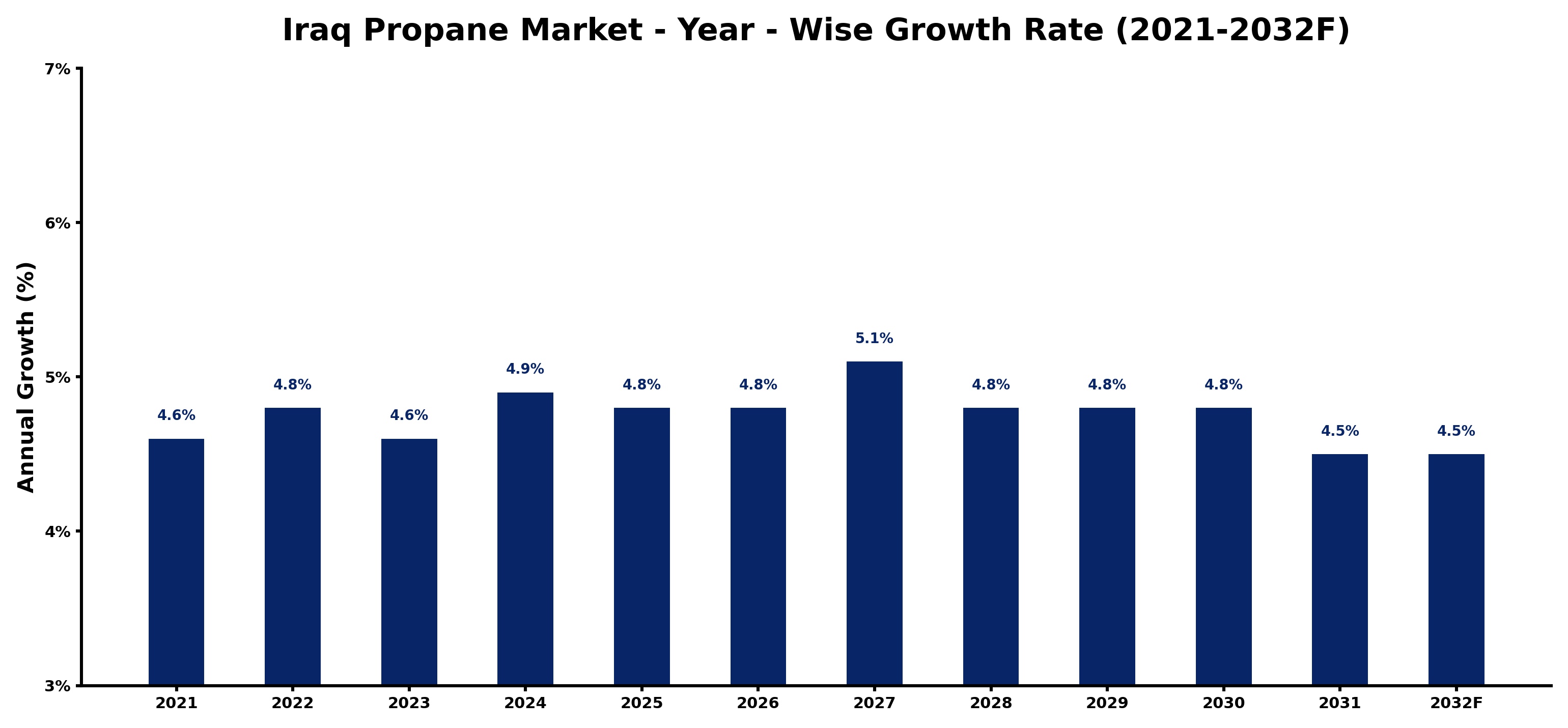
The table below presents the year‑wise growth rates along with the key drivers influencing the market
| Year | Growth Rate | Major Drivers |
| 2021 | 4.6% | New propane processing facilities enhance regional supply capabilities |
| 2022 | 4.8% | Increased domestic propane distribution centers boost local manufacturing investments |
| 2023 | 4.6% | New storage facilities enhanced propane distribution efficiency across Iraq |
| 2024 | 4.9% | Technology integration in logistics boosted propane distribution efficiency |
| 2025 | 4.8% | Increased residential construction projects boosted propane distribution logistics demand |
| 2026 | 4.8% | Modernized pipeline infrastructure boosts propane distribution efficiency in Iraq |
| 2027 | 5.1% | New refinery projects boost propane production capacity and exports |
| 2028 | 4.8% | Propane infrastructure upgrades boost local distribution and market efficiency |
| 2029 | 4.8% | Propane storage facilities expansion enhances regional distribution efficiency |
| 2030 | 4.8% | Smart meters integration boosts propane distribution efficiency and monitoring |
| 2031 | 4.5% | Increased residential construction activity boosted propane distribution infrastructure investments |
| 2032 | 4.5% | Higher refinery throughput boosted demand for propane storage solutions |
Note - Market size estimations and growth projections presented in this report are based on 6Wresearch's advanced forecasting approach, validated with industry datasets as of June 2026.
Iraq Propane Market Synopsis
The propane market in Iraq is experiencing a notable transformation, characterized by a growing acceptance of propane as a clean and efficient energy source. The recent expansion of LPG infrastructure has enhanced accessibility, making propane an attractive alternative for cooking, heating, and power generation among various consumer segments.
Furthermore, public awareness campaigns and government incentives are encouraging the adoption of propane, particularly in rural areas. This shift not only supports energy sustainability but also facilitates improved energy security, contributing to the overall market dynamics.
Iraq Propane Market Key Takeaways
- Propane is gaining traction as a versatile fuel source across Iraq's residential, commercial, and industrial sectors.
- Government initiatives are pivotal in promoting the adoption of propane and reducing reliance on traditional fuels.
- Investment in infrastructure and storage facilities is crucial for facilitating market growth and innovation.
- Environmental sustainability remains a key driver, influencing both consumer behavior and corporate strategies.
- Challenges related to infrastructure and regulatory frameworks continue to impact market development.
Evaluation of Restraints in Iraq Propane Market
Despite the positive outlook, the Iraq propane market contends with significant constraints. A historical reliance on conventional energy sources, particularly oil and natural gas, poses challenges to the widespread adoption of propane. Moreover, logistical hurdles and infrastructure limitations, especially in remote areas, can severely restrict access and availability. The regulatory landscape, marked by stringent licensing requirements, often hinders new entrants from gaining a foothold in the market. These factors collectively dampen competition and innovation, impacting the overall growth potential of the propane sector.
Iraq Propane Market Trends
The propane market in Iraq is shaped by several key trends. First, there is a marked increase in consumer preference for cleaner fuel options, driven by heightened awareness of environmental issues. This trend aligns with global movements towards sustainability. Furthermore, advancements in propane technology, including enhanced storage solutions and safety standards, are becoming increasingly prominent. Digitalization in distribution networks is also gaining traction, allowing for more efficient management and supply chain optimization.
Iraq Propane Market Opportunities
Investment opportunities abound in the Iraq propane market, particularly in expanding infrastructure to improve accessibility in underserved areas. The increasing focus on energy diversification and sustainability creates a fertile ground for innovative storage and distribution technologies. Additionally, partnerships between government entities and private sector players can spur development, ensuring a robust supply chain while also enhancing safety and efficiency standards.
Government Initiatives in the Iraq Propane Market
The Iraqi government plays a crucial role in shaping the propane market through regulatory oversight and policy frameworks. Initiatives aimed at promoting the use of liquefied petroleum gas (LPG) include setting safety standards for storage and handling, thus ensuring consumer protection and environmental compliance. Furthermore, the government frequently monitors propane prices to mitigate manipulative practices, aiming to maintain a fair market environment that encourages competition and supports consumers.
Future Insights of the Iraq Propane Market
Looking ahead to the period from 2026 to 2032, the Iraq propane market is set to enter a phase of substantial growth. The increasing emphasis on environmental responsibility will likely drive greater consumer acceptance of propane as a cleaner alternative to traditional fuels. As investments in infrastructure mature, availability will improve, further enhancing market dynamics. In addition, collaboration between government and private sectors is expected to usher in innovative solutions that address existing challenges, paving the way for a more competitive and sustainable propane landscape.
Iraq Propane Market Latest Developments (May 2025 - June 2026)
Recent developments within the Iraq propane market reflect a commitment to enhancing safety and efficiency. There have been noteworthy advancements in infrastructure projects aimed at improving distribution channels, particularly in underserved regions. Alongside this, there is a growing focus on implementing stricter safety protocols to align with international standards. These initiatives highlight the proactive measures being taken to foster a secure and accessible propane market.
Iraq Propane Market - Key Attractiveness of the Report
- 10 Years of Market Numbers
- Historical Data Starting from 2022 to 2025
- Base Year: 2025
- Forecast Data until 2032
- Key Performance Indicators Impacting the Market
- Major Upcoming Developments and Projects
Key Highlights of the Report:
- Iraq Propane Market Outlook
- Market Size of Iraq Propane Market, 2025
- Forecast of Iraq Propane Market, 2032
- Historical Data and Forecast of Iraq Propane Revenues & Volume for the Period 2022-2032F
- Iraq Propane Market Trend Evolution
- Iraq Propane Market Drivers and Challenges
- Iraq Propane Price Trends
- Iraq Propane Porter's Five Forces
- Iraq Propane Industry Life Cycle
- Historical Data and Forecast of Iraq Propane Market Revenues & Volume By Applications for the Period 2022-2032F
- Historical Data and Forecast of Iraq Propane Market Revenues & Volume By Industrial for the Period 2022-2032F
- Historical Data and Forecast of Iraq Propane Market Revenues & Volume By Commercial for the Period 2022-2032F
- Historical Data and Forecast of Iraq Propane Market Revenues & Volume By Residential for the Period 2022-2032F
- Historical Data and Forecast of Iraq Propane Market Revenues & Volume By Transportation for the Period 2022-2032F
- Historical Data and Forecast of Iraq Propane Market Revenues & Volume By Agriculture for the Period 2022-2032F
- Historical Data and Forecast of Iraq Propane Market Revenues & Volume By Chemicals and Refineries for the Period 2022-2032F
- Iraq Propane Import Export Trade Statistics
- Market Opportunity Assessment By Applications
- Iraq Propane Top Companies Market Share
- Iraq Propane Competitive Benchmarking By Technical and Operational Parameters
- Iraq Propane Company Profiles
- Iraq Propane Key Strategic Recommendations






































