Iraq Spaghetti Market Size, Share & Growth Rate
The Iraq Spaghetti Market was estimated at USD 1256 Million in 2025 and is projected to reach USD 1798 Million by 2032, growing at a CAGR of 5.3% from 2026 to 2032. This growth trajectory is primarily fueled by a burgeoning middle class with increasing disposable incomes and a greater appetite for convenience foods influenced by Western dietary trends. Furthermore, the rising interest in healthier, premium, and organic pasta options among urban consumers is set to bolster market expansion.
Iraq Spaghetti Market Year-wise Growth Rate and Key Drivers
This graph highlights how the Iraq Spaghetti Market has steadily grown over the years, supported by major growth factors.
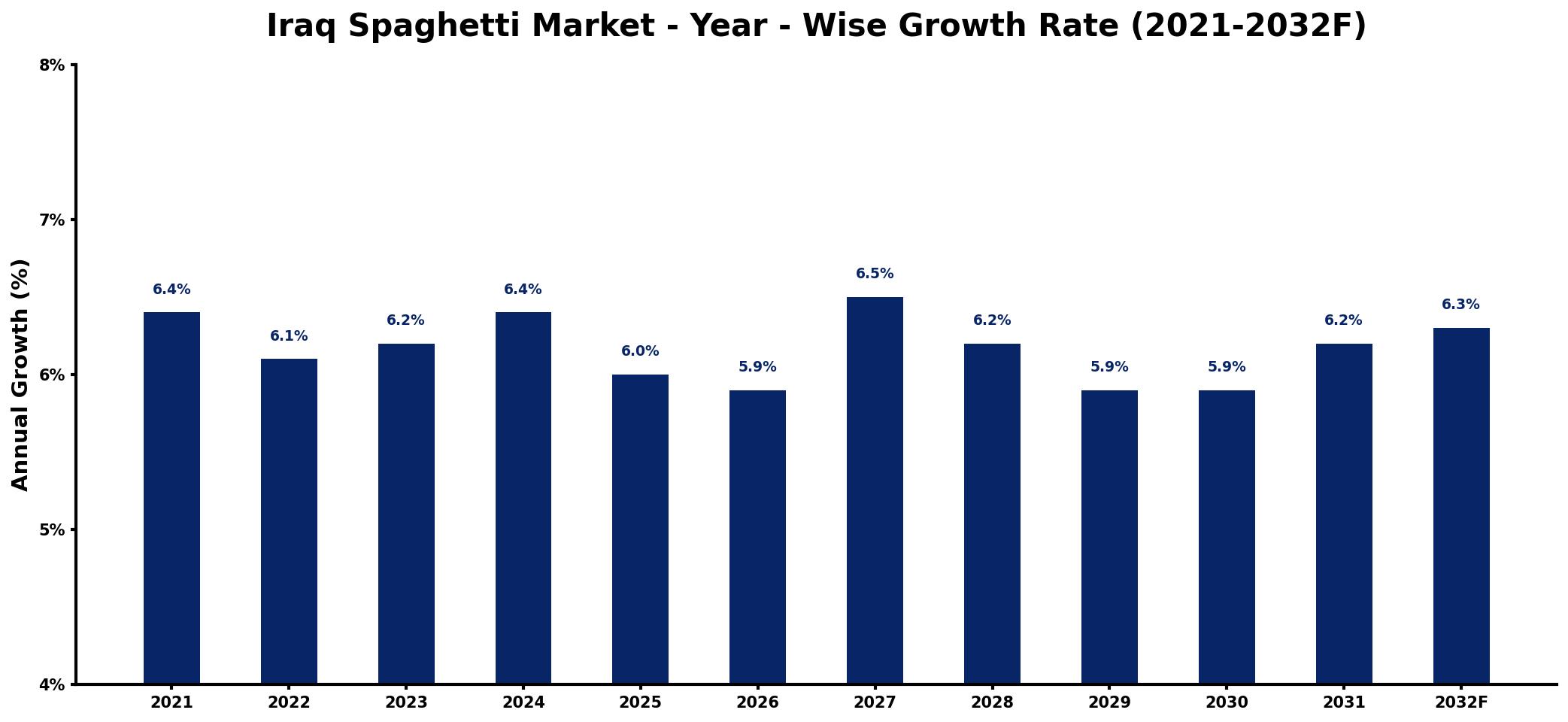
The table below presents the year‑wise growth rates along with the key drivers influencing the market
| Year | Growth Rate | Major Drivers |
| 2021 | 6.4% | Rise in consumer dining preferences |
| 2022 | 6.1% | Increase in local production capacity |
| 2023 | 6.2% | Growth in urban population density |
| 2024 | 6.4% | Expansion of retail distribution networks |
| 2025 | 6.0% | Investment in food processing technology |
| 2026 | 5.9% | Boost in online grocery shopping |
| 2027 | 6.5% | Surge in culinary tourism interest |
| 2028 | 6.2% | Strengthening of food service sector |
| 2029 | 5.9% | growing downstream application demand |
| 2030 | 5.9% | expanding manufacturing base activity |
| 2031 | 6.2% | growing commercial sector adoption |
| 2032 | 6.3% | Rising popularity of convenience foods |
Note: Market size estimations and growth projections presented in this report are based on 6Wresearch's proprietary forecasting methodology, utilizing the latest available industry data, government publications, and primary research inputs.
Iraq Spaghetti Market Synopsis
The escalating popularity of pasta dishes among Iraqi consumers is the strongest force currently shaping the Iraq Spaghetti Market. This trend is not only altering eating habits but also creating a notable shift in food preferences, with more individuals gravitating toward varied pasta options.
In addition to taste preferences, health consciousness is playing a crucial role in market dynamics. As more consumers look for nutritious alternatives, the demand for whole wheat, gluten-free, and organic spaghetti products continues to rise, altering how manufacturers position their offerings.
Iraq Spaghetti Market Key Takeaways
- Growing demand for healthier and premium pasta varieties is reshaping the market landscape.
- Urban consumers are increasingly gravitating towards organic and locally-sourced products.
- The expansion of distribution channels, including e-commerce, is improving product accessibility.
- Investment opportunities are on the rise, driven by a developing food processing industry.
- Political and economic factors pose challenges to market stability and growth.
Evaluation of Restraints in Iraq Spaghetti Market
While the Iraq Spaghetti Market shows strong potential, several restraints are limiting its growth. Economic instability and fluctuating political conditions can adversely affect consumer purchasing power, which in turn impacts demand for imported spaghetti products. Additionally, inadequate infrastructure and logistical challenges complicate supply chains and can lead to higher operational costs. As domestic brands gain traction, competition for market share intensifies, making it crucial for imported products to differentiate themselves amidst these hurdles.
Iraq Spaghetti Market Trends
Current trends in the Iraq Spaghetti Market highlight an increasing consumer shift towards healthier options, including whole grain and gluten-free pasta. There is also a growing interest in innovative products, such as colored and flavored spaghetti, appealing to younger consumers and those seeking variety in their meals. As the retail landscape evolves, more brands are focusing on online platforms to reach a broader audience, reflecting a significant shift in shopping behaviors.
Iraq Spaghetti Market Opportunities
The Iraq Spaghetti Market presents numerous investment opportunities, particularly for brands that can cater to the demand for convenience and quality. The burgeoning middle class seeks ready-to-eat and packaged meal solutions, suggesting a robust market for pre-prepared spaghetti products. Furthermore, local production facilities in partnership with international brands could capitalize on growing health trends while ensuring product accessibility and affordability.
Government Initiatives in the Iraq Spaghetti Market
Government policies concerning the Iraq Spaghetti Market focus on import regulations, quality standards, and price stabilization measures. These policies aim to create a balanced market by protecting local producers while ensuring that consumers have access to affordable spaghetti options. Additionally, various public programs are being initiated to promote food safety and quality, which could further enhance consumer confidence in pasta products.
Future Insights of the Iraq Spaghetti Market
Looking ahead to 2026-2032, the Iraq Spaghetti Market is poised for continued growth as urbanization trends and lifestyle changes further influence consumer preferences. The expanding middle class is expected to drive demand for more diverse and premium food products, including an assortment of pasta types. Retail innovations, particularly in online grocery shopping, will also enhance market reach and accessibility, providing an ideal backdrop for growth and new investments.
Iraq Spaghetti Market Latest Developments (2025 - 2026)
Recent developments in the Iraq Spaghetti Market indicate a proactive response from manufacturers to evolving consumer preferences. There has been an uptick in the introduction of health-oriented spaghetti products, as well as enhanced packaging solutions aimed at improving convenience. Additionally, the continued expansion of online grocery services is facilitating easier access to a wider variety of spaghetti products, thereby supporting overall market growth.
Iraq Spaghetti Market - Key Attractiveness of the Report
- 10 Years of Market Numbers
- Historical Data Starting from 2022 to 2025
- Base Year: 2025
- Forecast Data until 2032
- Key Performance Indicators Impacting the Market
- Major Upcoming Developments and Projects
Key Highlights of the Report:
- Iraq Spaghetti Market Outlook
- Market Size of Iraq Spaghetti Market, 2025
- Forecast of Iraq Spaghetti Market, 2032
- Historical Data and Forecast of Iraq Spaghetti Revenues & Volume for the Period 2022-2032F
- Iraq Spaghetti Market Trend Evolution
- Iraq Spaghetti Market Drivers and Challenges
- Iraq Spaghetti Price Trends
- Iraq Spaghetti Porter's Five Forces
- Iraq Spaghetti Industry Life Cycle
- Historical Data and Forecast of Iraq Spaghetti Market Revenues & Volume By Product for the Period 2022-2032F
- Historical Data and Forecast of Iraq Spaghetti Market Revenues & Volume By Fresh for the Period 2022-2032F
- Historical Data and Forecast of Iraq Spaghetti Market Revenues & Volume By Dried for the Period 2022-2032F
- Historical Data and Forecast of Iraq Spaghetti Market Revenues & Volume By End Use for the Period 2022-2032F
- Historical Data and Forecast of Iraq Spaghetti Market Revenues & Volume By Mass Market Retail for the Period 2022-2032F
- Historical Data and Forecast of Iraq Spaghetti Market Revenues & Volume By Horeca for the Period 2022-2032F
- Historical Data and Forecast of Iraq Spaghetti Market Revenues & Volume By Distribution Channel for the Period 2022-2032F
- Historical Data and Forecast of Iraq Spaghetti Market Revenues & Volume By Supermarket and Hypermarket for the Period 2022-2032F
- Historical Data and Forecast of Iraq Spaghetti Market Revenues & Volume By Convenience Store for the Period 2022-2032F
- Historical Data and Forecast of Iraq Spaghetti Market Revenues & Volume By Online for the Period 2022-2032F
- Historical Data and Forecast of Iraq Spaghetti Market Revenues & Volume By Others for the Period 2022-2032F
- Iraq Spaghetti Import Export Trade Statistics
- Market Opportunity Assessment By Product
- Market Opportunity Assessment By End Use
- Market Opportunity Assessment By Distribution Channel
- Iraq Spaghetti Top Companies Market Share
- Iraq Spaghetti Competitive Benchmarking By Technical and Operational Parameters
- Iraq Spaghetti Company Profiles
- Iraq Spaghetti Key Strategic Recommendations






































