Iraq Structural Steel Fabrication Market Size, Share & Growth Rate
The Iraq Structural Steel Fabrication Market was estimated at USD 308 Million in 2025 and is projected to reach USD 416 Million by 2032, growing at a CAGR of 4.4% from 2026 to 2032. This growth trajectory is primarily driven by a surge in construction activities, supported by substantial infrastructure development projects and an increasing appetite for modern commercial and industrial spaces throughout the country. As Iraq continues to advance in urbanization and economic diversification efforts, the demand for durable and efficient structural steel solutions is set to rise.
Iraq Structural Steel Fabrication Market Year-wise Growth Rate and Key Drivers
This graph highlights how the Iraq Structural Steel Fabrication Market has steadily grown over the years, supported by major growth factors.
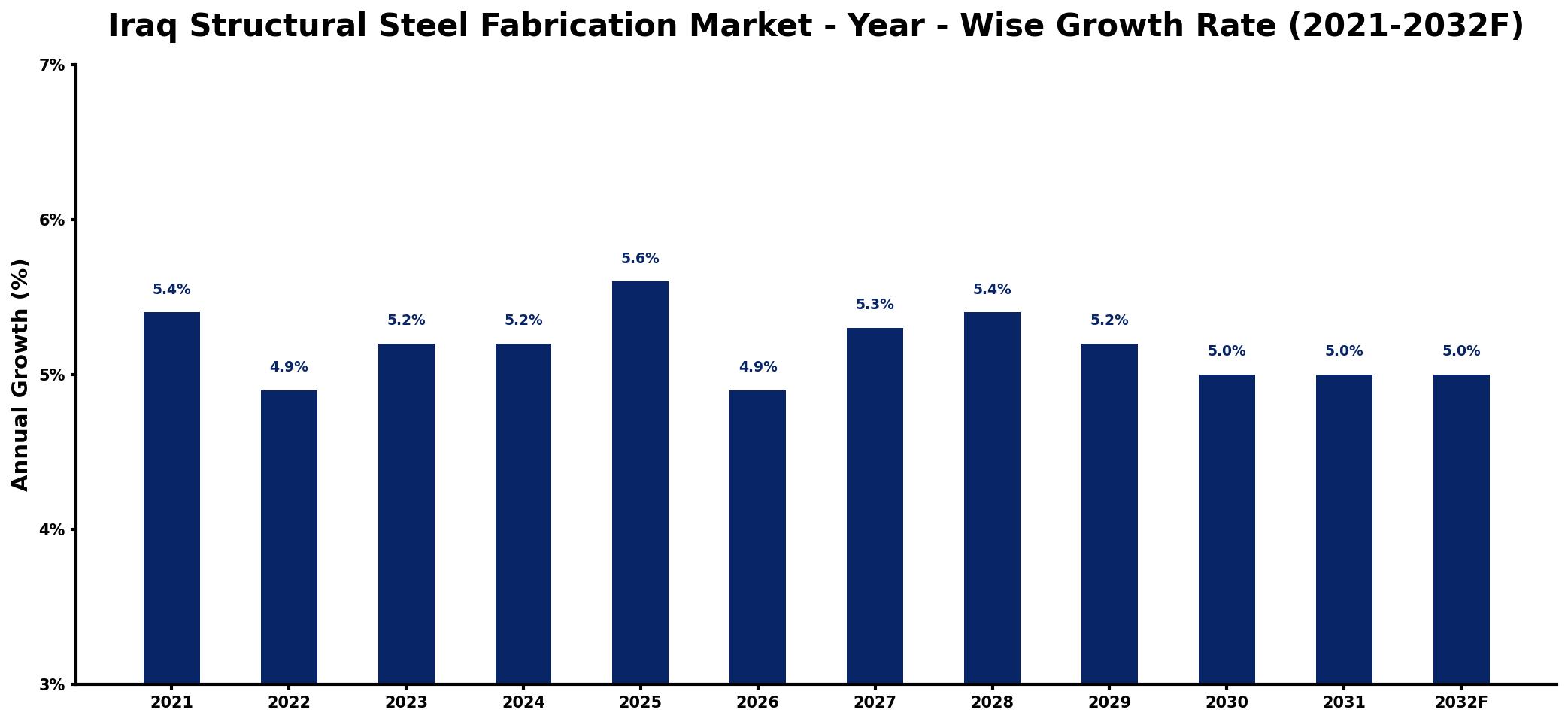
The table below presents the year‑wise growth rates along with the key drivers influencing the market
| Year | Growth Rate | Major Drivers |
| 2021 | 5.4% | Infrastructure projects gaining momentum |
| 2022 | 4.9% | Increased foreign investments influx |
| 2023 | 5.2% | Rising construction sector activities |
| 2024 | 5.2% | Government initiatives promoting development |
| 2025 | 5.6% | Growing residential housing demands |
| 2026 | 4.9% | Expansion of industrial facilities planned |
| 2027 | 5.3% | Revitalization of urban areas underway |
| 2028 | 5.4% | Boost in commercial construction projects |
| 2029 | 5.2% | Demand from renewable energy sources |
| 2030 | 5.0% | Technological advancements driving innovation |
| 2031 | 5.0% | Strengthening regional trade partnerships |
| 2032 | 5.0% | Sustainable building practices gaining traction |
Note: Market size estimations and growth projections presented in this report are based on 6Wresearch's proprietary forecasting methodology, utilizing the latest available industry data, government publications, and primary research inputs.
Iraq Structural Steel Fabrication Market Synopsis
Recent developments in Iraq have highlighted a vibrant demand for structural steel fabrication, particularly in the wake of reconstruction efforts post-conflict. The countrys economic revitalization is marked by a concerted push towards modern infrastructure, where high-quality steel components are essential to support diverse construction needs.
The competitive landscape of the Iraq Structural Steel Fabrication Market features a variety of services, ranging from design to installation of steel components. Innovative solutions and technology adoption are becoming increasingly vital as players seek to meet the market's demands for efficiency, quality, and sustainability.
Iraq Structural Steel Fabrication Market Key Takeaways
- Significant market growth fueled by reconstruction projects and increased urbanization.
- Emphasis on high-quality, corrosion-resistant steel products to meet modern construction standards.
- Technological advancements such as BIM and CAD are optimizing fabrication processes.
- Strategic partnerships are essential for navigating market complexities and expanding operational reach.
- Government initiatives aim to bolster local production and attract foreign investment in the sector.
Evaluation of Restraints in Iraq Structural Steel Fabrication Market
The Iraq Structural Steel Fabrication Market faces notable obstacles that could hamper its growth. Inconsistent government regulations and bureaucratic red tape can delay project timelines, making it challenging for companies to execute contracts efficiently. A shortage of skilled labor exacerbates this issue, resulting in potential quality concerns during the fabrication process. Furthermore, political instability continues to loom, which can deter both domestic and foreign investments in this sector, impacting overall market confidence.
Iraq Structural Steel Fabrication Market Trends
Emerging trends in the Iraq Structural Steel Fabrication Market reflect a growing inclination towards sustainability. There is an increasing preference for eco-friendly construction materials, propelling the demand for high-strength and corrosion-resistant steel products. Customization and prefabrication techniques are gaining traction as they improve efficiency and reduce overall construction time. Additionally, the integration of innovative technologies such as Building Information Modeling (BIM) and computer-aided design (CAD) is transforming fabrication processes, ensuring better project outcomes.
Iraq Structural Steel Fabrication Market Opportunities
The Iraq Structural Steel Fabrication Market presents substantial investment opportunities, especially for firms targeting the construction and infrastructure sectors. The reconstruction efforts following recent conflicts necessitate a wide array of structural steel products for bridges, industrial facilities, and high-rise buildings. Companies that invest in modernizing their fabrication facilities and embrace advanced technologies will be well-positioned to seize market growth. Forming alliances with local construction companies and government agencies can further expand market reach and facilitate long-term growth.
Government Initiatives in the Iraq Structural Steel Fabrication Market
Government policies play a critical role in shaping the Iraq Structural Steel Fabrication Market. Regulations concerning licensing, safety, and environmental compliance are essential for maintaining industry standards. The government has introduced incentives, including tax breaks and subsidies, to encourage local manufacturing and investments in the sector. Policies favoring the use of domestically sourced materials in infrastructure projects are also being prioritized, aimed at strengthening local capabilities and reducing reliance on imports.
Future Insights of the Iraq Structural Steel Fabrication Market
Looking ahead to 2026-2032, the Iraq Structural Steel Fabrication Market is expected to maintain its upward trajectory. Continued investments in infrastructure and energy sectors, along with ongoing urban development projects, will drive demand for structural steel. The government's commitment to creating a favorable investment climate and improving regulatory frameworks is likely to attract foreign investment and bolster market growth. However, the need to navigate the challenges of political instability and fluctuating oil prices will be crucial for sustainable development.
Iraq Structural Steel Fabrication Market Latest Developments (2025 - 2026)
In the period between & and June 2026, the Iraq Structural Steel Fabrication Market has seen a notable shift towards modernization and efficiency improvements. Industry players are increasingly adopting advanced technologies to streamline processes and enhance output quality. Moreover, collaborative efforts among construction firms and government entities have become more common, reflecting a strategic approach to tackling challenges and optimizing project execution.
Iraq Structural Steel Fabrication Market - Key Attractiveness of the Report
- 10 Years of Market Numbers
- Historical Data Starting from 2022 to 2025
- Base Year: 2025
- Forecast Data until 2032
- Key Performance Indicators Impacting the Market
- Major Upcoming Developments and Projects
Key Highlights of the Report:
- Iraq Structural Steel Fabrication Market Outlook
- Market Size of Iraq Structural Steel Fabrication Market, 2025
- Forecast of Iraq Structural Steel Fabrication Market, 2032
- Historical Data and Forecast of Iraq Structural Steel Fabrication Revenues & Volume for the Period 2022-2032F
- Iraq Structural Steel Fabrication Market Trend Evolution
- Iraq Structural Steel Fabrication Market Drivers and Challenges
- Iraq Structural Steel Fabrication Price Trends
- Iraq Structural Steel Fabrication Porter's Five Forces
- Iraq Structural Steel Fabrication Industry Life Cycle
- Historical Data and Forecast of Iraq Structural Steel Fabrication Market Revenues & Volume By End-user Industry for the Period 2022-2032F
- Historical Data and Forecast of Iraq Structural Steel Fabrication Market Revenues & Volume By Manufacturing for the Period 2022-2032F
- Historical Data and Forecast of Iraq Structural Steel Fabrication Market Revenues & Volume By Power and Energy for the Period 2022-2032F
- Historical Data and Forecast of Iraq Structural Steel Fabrication Market Revenues & Volume By Construction for the Period 2022-2032F
- Historical Data and Forecast of Iraq Structural Steel Fabrication Market Revenues & Volume By Oil and Gas for the Period 2022-2032F
- Historical Data and Forecast of Iraq Structural Steel Fabrication Market Revenues & Volume By Other for the Period 2022-2032F
- Historical Data and Forecast of Iraq Structural Steel Fabrication Market Revenues & Volume By Product Type for the Period 2022-2032F
- Historical Data and Forecast of Iraq Structural Steel Fabrication Market Revenues & Volume By Heavy Sectional Steel for the Period 2022-2032F
- Historical Data and Forecast of Iraq Structural Steel Fabrication Market Revenues & Volume By Light Sectional Steel for the Period 2022-2032F
- Historical Data and Forecast of Iraq Structural Steel Fabrication Market Revenues & Volume By Other for the Period 2022-2032F
- Iraq Structural Steel Fabrication Import Export Trade Statistics
- Market Opportunity Assessment By End-user Industry
- Market Opportunity Assessment By Product Type
- Iraq Structural Steel Fabrication Top Companies Market Share
- Iraq Structural Steel Fabrication Competitive Benchmarking By Technical and Operational Parameters
- Iraq Structural Steel Fabrication Company Profiles
- Iraq Structural Steel Fabrication Key Strategic Recommendations






































