Iraq Sulphur Market Size, Share & Growth Rate
The Iraq Sulphur Market was estimated at USD 223 Million in 2025 and is projected to reach USD 296 Million by 2032, growing at a CAGR of 4.1% from 2026 to 2032. This growth trajectory is primarily fueled by Iraq's position as one of the world's largest sulphur producers, with output largely stemming from its robust oil sector. Additionally, the increasing global demand for sulphur across agriculture, chemicals, and pharmaceuticals is expected to sustain the market's upward momentum.
Iraq Sulphur Market Year-wise Growth Rate and Key Drivers
This graph highlights how the Iraq Sulphur Market has steadily grown over the years, supported by major growth factors.
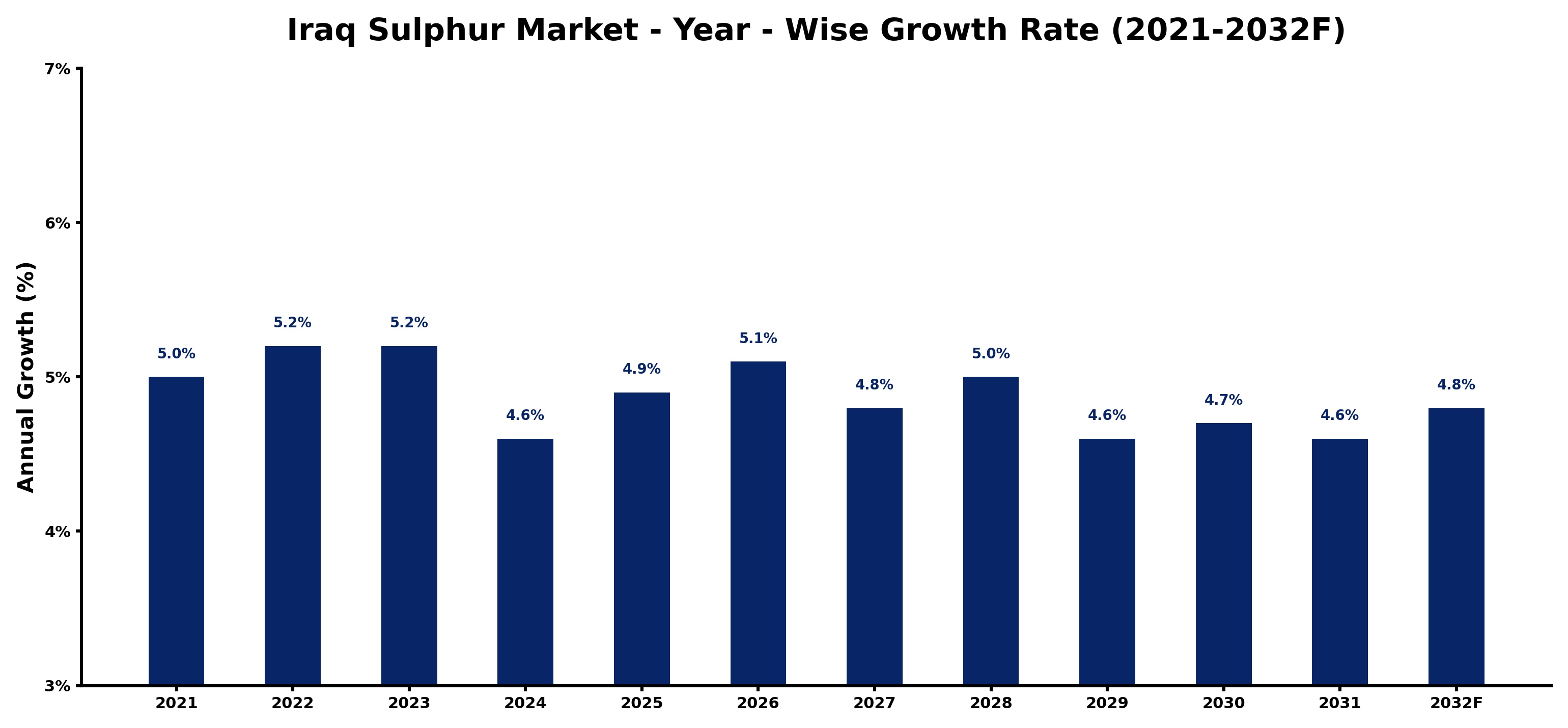
The table below presents the year‑wise growth rates along with the key drivers influencing the market
| Year | Growth Rate | Major Drivers |
| 2021 | 5.0% | Increased agricultural production demands sulphur |
| 2022 | 5.2% | Infrastructure development spurred sulphur usage |
| 2023 | 5.2% | Fertilizer industry expansion drove demand |
| 2024 | 4.6% | Industrial activity supported growth |
| 2025 | 4.9% | Chemical manufacturing sector grew rapidly |
| 2026 | 5.1% | Environmental regulations boosted sulphur recovery |
| 2027 | 4.8% | Construction growth enhanced sulphur applications |
| 2028 | 5.0% | Technological advancements improved sulphur extraction |
| 2029 | 4.6% | Export opportunities expanded market reach |
| 2030 | 4.7% | Sustainable practices increased sulphur adoption |
| 2031 | 4.6% | Research initiatives promoted sulphur innovations |
| 2032 | 4.8% | Market diversification enhanced product offerings |
Note - Market size estimations and growth projections presented in this report are based on 6Wresearch's advanced forecasting approach, validated with industry datasets as of June 2026.
Iraq Sulphur Market Synopsis
The driving force behind the Iraq Sulphur Market is the country's substantial sulphur production, which occurs as a byproduct of its thriving oil industry. This dynamic not only supports local consumption but also propels exports, making Iraq a key player in the global sulphur supply chain.
Moreover, the increasing adoption of sulphur in fertilizer production and its growing application in various industrial processes are reinforcing market stability. As international markets recover and demand accelerates, the Iraq Sulphur Market stands to benefit significantly from these trends.
Iraq Sulphur Market Key Takeaways
- Iraq ranks among the top sulphur producers globally, benefiting from extensive oil reserves.
- Growing agricultural practices and chemical manufacturing fuel demand for sulphur-based products.
- Transportation and infrastructure limitations challenge efficient sulphur distribution.
- Emerging focus on sustainability drives innovation in sulphur management and utilization.
- Political dynamics in the region affect market stability and investment potential.
Evaluation of Restraints in Iraq Sulphur Market
While the Iraq Sulphur Market is poised for growth, several restraints limit its potential. Fluctuating global oil prices can impact production costs, affecting profitability. Moreover, the existing transportation infrastructure faces limitations, complicating the distribution of sulphur to international markets. Political instability in the region poses additional risks, potentially disrupting production and impacting investor confidence. The competition from major sulphur-producing countries such as Saudi Arabia and Russia further constrains Iraq's ability to capture a larger market share.
Iraq Sulphur Market Trends
Several trends are emerging in the Iraq Sulphur Market, particularly the increasing integration of sustainable practices in sulphur production. Companies are investing in technologies that minimize environmental impact while optimizing output. Furthermore, there is a notable shift towards the production of specialty sulphur products, aimed at higher-value applications in industries like pharmaceuticals and advanced fertilizers. This evolving landscape reflects both domestic demands and global sustainability initiatives.
Iraq Sulphur Market Opportunities
Investment opportunities in the Iraq Sulphur Market are robust, primarily due to the country's vast sulphur reserves linked to its oil and gas sector. The increasing global emphasis on sustainable agriculture and industrial processes creates a fertile ground for growth in sulphur-related investments. Prospective areas for development include improvements in sulphur processing facilities, enhancements in logistics and transportation systems, and investments in innovative technologies aimed at maximizing sulphur utility and minimizing waste.
Government Initiatives in the Iraq Sulphur Market
The Iraqi government has established policies to regulate sulphur production and export to ensure environmental sustainability and economic stability. These regulations include production quotas designed to prevent overexploitation of resources and ensure the responsible management of sulphur outputs. Additionally, export controls are implemented to optimize national revenue while balancing domestic needs. Government initiatives are also focusing on promoting technological advancements that align with global sustainability goals.
Future Insights of the Iraq Sulphur Market
Looking ahead to 2026-2032, the Iraq Sulphur Market is expected to expand significantly, propelled by continuous investment in oil production and advancements in sulphur processing technologies. The strategic geographical location of Iraq enhances its export capabilities, offering a competitive edge in the global sulphur supply chain. However, to maintain this growth trajectory, stakeholders must address infrastructure challenges and navigate the complexities of geopolitical dynamics, ensuring a resilient and adaptable market landscape.
Iraq Sulphur Market Latest Developments (May 2025 - June 2026)
Recent developments in the Iraq Sulphur Market indicate a focused effort towards modernizing infrastructure to facilitate sulphur handling and export. Emerging partnerships in the logistics sector aim to improve transportation efficiency. Additionally, ongoing research into environmentally friendly sulphur management practices is gaining momentum, reflecting a broader commitment to sustainability within the industry. These trends suggest a proactive approach by stakeholders to address both domestic and international market demands.
Iraq Sulphur Market - Key Attractiveness of the Report
- 10 Years of Market Numbers
- Historical Data Starting from 2022 to 2025
- Base Year: 2025
- Forecast Data until 2032
- Key Performance Indicators Impacting the Market
- Major Upcoming Developments and Projects
Key Highlights of the Report:
- Iraq Sulphur Market Outlook
- Market Size of Iraq Sulphur Market, 2025
- Forecast of Iraq Sulphur Market, 2032
- Historical Data and Forecast of Iraq Sulphur Revenues & Volume for the Period 2022-2032F
- Iraq Sulphur Market Trend Evolution
- Iraq Sulphur Market Drivers and Challenges
- Iraq Sulphur Price Trends
- Iraq Sulphur Porter's Five Forces
- Iraq Sulphur Industry Life Cycle
- Historical Data and Forecast of Iraq Sulphur Market Revenues & Volume By Product Type for the Period 2022-2032F
- Historical Data and Forecast of Iraq Sulphur Market Revenues & Volume By Natural Gas for the Period 2022-2032F
- Historical Data and Forecast of Iraq Sulphur Market Revenues & Volume By Crude Oil for the Period 2022-2032F
- Historical Data and Forecast of Iraq Sulphur Market Revenues & Volume By Others for the Period 2022-2032F
- Historical Data and Forecast of Iraq Sulphur Market Revenues & Volume By End Users for the Period 2022-2032F
- Historical Data and Forecast of Iraq Sulphur Market Revenues & Volume By Sulfuric Acid (Fertilizers) for the Period 2022-2032F
- Historical Data and Forecast of Iraq Sulphur Market Revenues & Volume By Sulfuric Acid (Metal Manufacturing) for the Period 2022-2032F
- Historical Data and Forecast of Iraq Sulphur Market Revenues & Volume By Chemical Processing for the Period 2022-2032F
- Iraq Sulphur Import Export Trade Statistics
- Market Opportunity Assessment By Product Type
- Market Opportunity Assessment By End Users
- Iraq Sulphur Top Companies Market Share
- Iraq Sulphur Competitive Benchmarking By Technical and Operational Parameters
- Iraq Sulphur Company Profiles
- Iraq Sulphur Key Strategic Recommendations






































