Iraq Thermal Insulation Material Market Summary
The iraq thermal insulation material market was estimated at USD 156 Million in 2025 and is projected to reach USD 212 Million by 2032, growing at a CAGR of 5.2% from 2026 to 2032.
Iraq Thermal Insulation Material Market Year-wise Growth Rate and Key Drivers
This graph highlights how the Iraq Thermal Insulation Material Market has steadily grown over the past five years, supported by major growth factors.
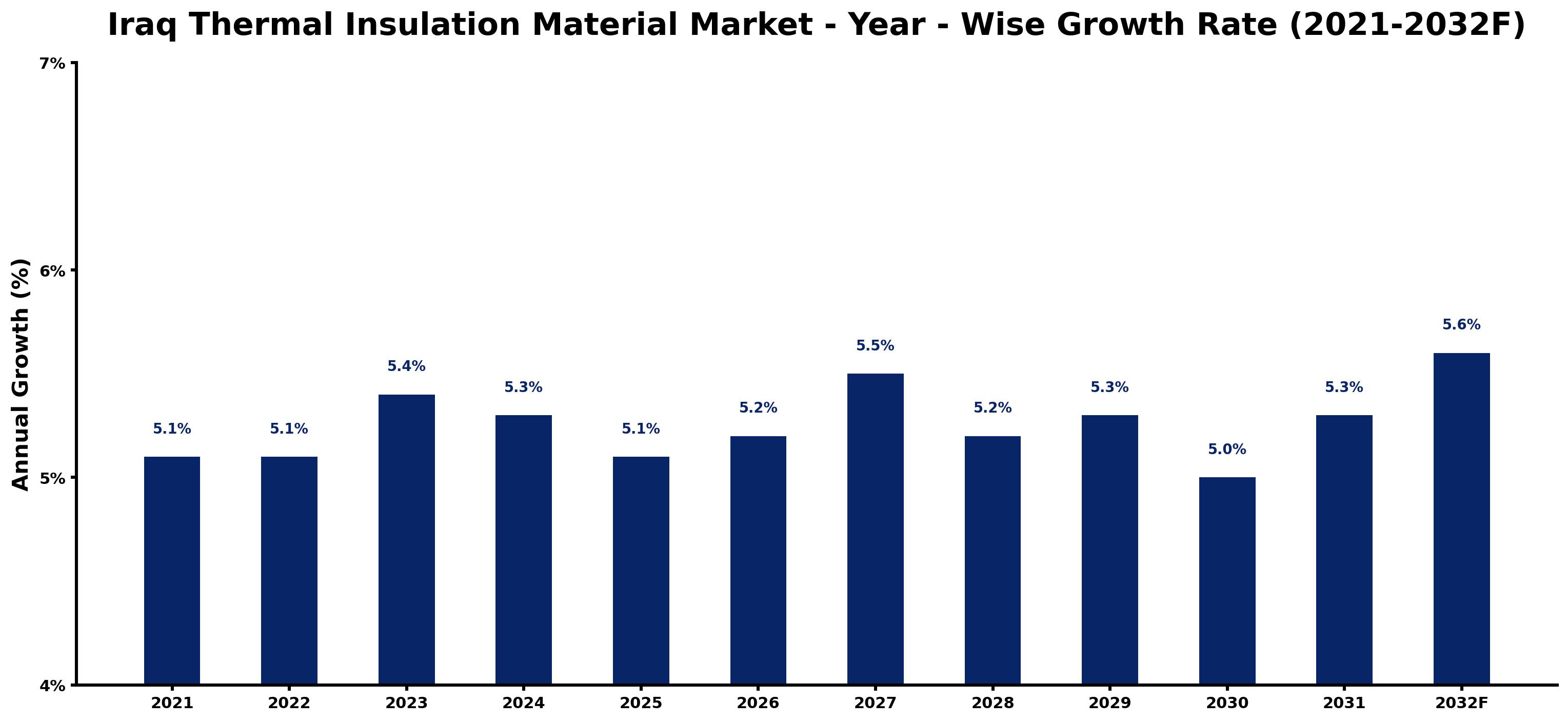
The table below presents the year wise growth rates along with the key drivers influencing the market
| Year | Growth Rate | Major Drivers |
| 2021 | 5.1% | Post-conflict rebuilding efforts have led to increased construction activity throughout Iraq. |
| 2022 | 5.1% | Local manufacturers are focusing on sustainable materials to meet environmental demands. |
| 2023 | 5.4% | The demand for energy-efficient buildings becomes essential in Iraq's hot climate. |
| 2024 | 5.3% | International partnerships enhance technology transfer for modern insulation materials. |
| 2025 | 5.1% | Urbanization trends push for innovative thermal solutions in residential projects. |
| 2026 | 5.2% | Increased awareness of energy conservation boosts thermal insulation material preferences. |
| 2027 | 5.5% | Emerging middle-class consumers seek better living standards through improved housing. |
| 2028 | 5.2% | Research on local raw materials enhances the production of cost-effective insulation. |
| 2029 | 5.3% | Construction standards evolve, prioritizing energy efficiency in public infrastructure projects. |
| 2030 | 5.0% | Investment in renewable energy initiatives expands the market for thermal applications. |
| 2031 | 5.3% | Supply chain improvements facilitate access to advanced insulation technologies. |
| 2032 | 5.6% | The thermal insulation sector experiences robust growth as Iraq rebuilds its infrastructure. |
Note - Market size estimations and growth projections presented in this report are based on 6Wresearch's advanced forecasting approach, validated with industry datasets as of June 2026.
Iraq Thermal Insulation Material Market Synopsis
The Iraq Thermal Insulation Material Market is projected to reach 5.2% and witness significant growth during the forecast period (2026-2032). This growth trajectory is fueled by a mounting emphasis on energy efficiency and sustainability within the construction sector. The demand for thermal insulation materials is increasingly important as these products significantly contribute to reducing energy consumption, lowering greenhouse gas emissions, and improving thermal comfort in buildings.
Iraq Thermal Insulation Material Market Growth Drivers
Several factors are driving the growth of the Iraq Thermal Insulation Material Market. First, the rising awareness of energy conservation among both consumers and businesses leads to an increased focus on sustainable building practices. This awareness is aligning with the global trend of reducing carbon footprints.
Second, government regulations mandating the use of thermal insulation materials are helping to institutionalize energy efficiency. Such policies encourage the adoption of effective insulation solutions in various construction projects.
- The burgeoning construction activity in urban areas has necessitated the need for advanced building materials.
- Technological advancements in insulation material development offer enhanced performance, efficiency, and durability.
- The increasing frequency of harsh weather conditions reinforces the need for effective thermal insulation to maintain comfortable indoor environments.
- Growing consumer awareness regarding the cost-saving benefits of thermal insulation, particularly in lowering heating and cooling expenses, is also a significant driver.
- The rise of eco-friendly insulation materials, like aerogel and products derived from recycled materials, is redefining market offerings.
Iraq Thermal Insulation Material Market Trends and Opportunities
The Iraq Thermal Insulation Material Market is currently undergoing notable trends that reflect a shift toward sustainable practices. One major trend is the increasing preference for eco-friendly and energy-efficient insulation solutions, as more construction projects aim for green building certifications.
Another trend is the evolving consumer expectations for high-performance insulation products. Innovations in materials technology are resulting in enhanced fire-resistance capabilities and greater durability, which are becoming essential attributes for thermal insulation materials.
- The integration of smart technology in insulation solutions is gaining traction, as it can optimize energy efficiency.
- Partnerships with local construction firms to facilitate the adoption of high-quality insulation materials present substantial opportunities.
- Furthermore, the demand for thermal insulation in retrofitting projects is increasing, as older buildings require updated materials to meet modern energy standards.
- Investors are also looking to capitalize on the growing market for reflective coatings that enhance energy savings.
- The expansion of the green building market opens avenues for specialized insulation solutions that cater to sustainability-oriented clients.
Iraq Thermal Insulation Material Market Challenges and Restraints
Despite the favorable environment for growth, the Iraq Thermal Insulation Material Market faces several challenges. A significant barrier is the prevalent lack of awareness about the benefits of thermal insulation. This knowledge gap contributes to a lower demand, particularly in regions where extreme weather fluctuations necessitate effective insulation.
The availability and quality of insulation materials also pose challenges, as not all regions have access to modern insulation solutions. This can hinder the construction sector from fully realizing the benefits of energy-efficient materials.
- The ongoing economic instability and political uncertainties in Iraq can impact investment and project continuity.
- Shortages of skilled professionals trained in proper insulation installation further complicate market advancement.
- Additionally, fluctuating prices of raw materials may affect the affordability of insulating products.
- The resistance to change among traditional construction practices can slow the adoption of modern insulation solutions.
- Lastly, the lack of cohesive standards for insulation quality can lead to inconsistent performance across different materials.
Iraq Thermal Insulation Material Market Investment Opportunities
The Iraq Thermal Insulation Material Market is well-positioned for investors due to ongoing infrastructure development initiatives and a boom in construction activities. Demand for effective thermal insulation materials is set to increase significantly, making it an attractive sector for investment.
Investors can look into supplying a diverse range of high-quality insulation materials, including mineral wool and foam boards, which are gaining popularity in the construction industry.
- Collaboration with local construction companies can enhance market penetration and meet specific regional needs.
- Participation in government-backed initiatives that promote sustainable construction practices may yield financial incentives and subsidies.
- The focus on improving energy efficiency standards in buildings provides a conducive environment for innovative insulation solutions.
- Investors can explore opportunities in the manufacture of novel insulation materials that focus on sustainability and energy savings.
- Engaging in educational campaigns to raise awareness regarding the benefits of thermal insulation can stimulate demand across various sectors.
Iraq Thermal Insulation Material Market Government Investment and Initiatives
The Iraqi government has taken proactive measures to promote energy efficiency and sustainability within the construction sector. Policies have been instituted to encourage the use of thermal insulation materials, aimed at reducing energy consumption and greenhouse gas emissions.
Regulatory standards are being established for insulation materials, ensuring they meet performance criteria aligned with modern building requirements. The government also offers incentives to support the integration of sustainable materials in construction projects, assisting builders in adopting greener practices.
- Public spending initiatives are focused on upgrading the infrastructure, which includes integrating energy-efficient building practices.
- The development plans include investments aimed at enhancing the quality and accessibility of insulation materials throughout Iraq.
- Subsidies are available for construction projects that prioritize energy-efficient technologies, encouraging builders to use thermal insulation.
- Ongoing training programs funded by the government aim to enhance the skills of workers in proper insulation installation techniques.
- Long-term strategic plans are being developed to ensure the construction sector aligns with international sustainability standards.
Iraq Thermal Insulation Material Market Latest Developments (May 2025 - June 2026)
Recent developments in the Iraq Thermal Insulation Material Market reflect a concerted effort among stakeholders to drive innovation and sustainability. Initiatives focused on increasing the awareness and adoption of thermal insulation materials have gained momentum, with public campaigns underscoring their benefits.
Moreover, technological advancements have continued to shape the industry, with new materials being introduced that promise enhanced performance characteristics, such as improved fire resistance and better insulation properties.
- The government has announced plans to expand incentives for energy-efficient construction, reflecting a commitment to sustainable practices.
- Stakeholders are exploring partnerships to enhance market access for new insulation technologies.
- Training programs aimed at skilled installers have been prioritized to address the skill gap in the market.
- Market participants are increasingly focusing on research and development to innovate and improve insulation products.
- The construction sector is witnessing a trend towards retrofitting older buildings with modern insulation materials, responding to energy efficiency goals.
Iraq Thermal Insulation Material Market - Key Attractiveness of the Report
- 10 Years of Market Numbers
- Historical Data Starting from 2022 to 2025
- Base Year: 2025
- Forecast Data until 2032
- Key Performance Indicators Impacting the Market
- Major Upcoming Developments and Projects
Key Highlights of the Report:
- Iraq Thermal Insulation Material Market Outlook
- Market Size of Iraq Thermal Insulation Material Market, 2025
- Forecast of Iraq Thermal Insulation Material Market, 2032F
- Historical Data and Forecast of Iraq Thermal Insulation Material Revenues & Volume for the Period 2022-2032F
- Iraq Thermal Insulation Material Market Trend Evolution
- Iraq Thermal Insulation Material Market Drivers and Challenges
- Iraq Thermal Insulation Material Price Trends
- Iraq Thermal Insulation Material Porter's Five Forces
- Iraq Thermal Insulation Material Industry Life Cycle
- Historical Data and Forecast of Iraq Thermal Insulation Material Market Revenues & Volume By Material Type for the Period 2022-2032F
- Historical Data and Forecast of Iraq Thermal Insulation Material Market Revenues & Volume By Plastic Foam for the Period 2022-2032F
- Historical Data and Forecast of Iraq Thermal Insulation Material Market Revenues & Volume By Stone Wool for the Period 2022-2032F
- Historical Data and Forecast of Iraq Thermal Insulation Material Market Revenues & Volume By Fiberglass for the Period 2022-2032F
- Historical Data and Forecast of Iraq Thermal Insulation Material Market Revenues & Volume By Others for the Period 2022-2032F
- Historical Data and Forecast of Iraq Thermal Insulation Material Market Revenues & Volume By Temperature Range for the Period 2022-2032F
- Historical Data and Forecast of Iraq Thermal Insulation Material Market Revenues & Volume By ?160?C to ?50?C for the Period 2022-2032F
- Historical Data and Forecast of Iraq Thermal Insulation Material Market Revenues & Volume By ? 49?C to 0?C for the Period 2022-2032F
- Historical Data and Forecast of Iraq Thermal Insulation Material Market Revenues & Volume By 1?C to 100?C for the Period 2022-2032F
- Historical Data and Forecast of Iraq Thermal Insulation Material Market Revenues & Volume By 1?C to 650?C for the Period 2022-2032F
- Iraq Thermal Insulation Material Import Export Trade Statistics
- Market Opportunity Assessment By Material Type
- Market Opportunity Assessment By Temperature Range
- Iraq Thermal Insulation Material Top Companies Market Share
- Iraq Thermal Insulation Material Competitive Benchmarking By Technical and Operational Parameters
- Iraq Thermal Insulation Material Company Profiles
- Iraq Thermal Insulation Material Key Strategic Recommendations






































