Iraq Thermostats Market Summary
The iraq thermostats market was estimated at USD 925 Million in 2025 and is projected to reach USD 1344 Million by 2032, growing at a CAGR of 6.7% from 2026 to 2032.
Iraq Thermostats Market Year-wise Growth Rate and Key Drivers
This graph highlights how the Iraq Thermostats Market has steadily grown over the past five years, supported by major growth factors.
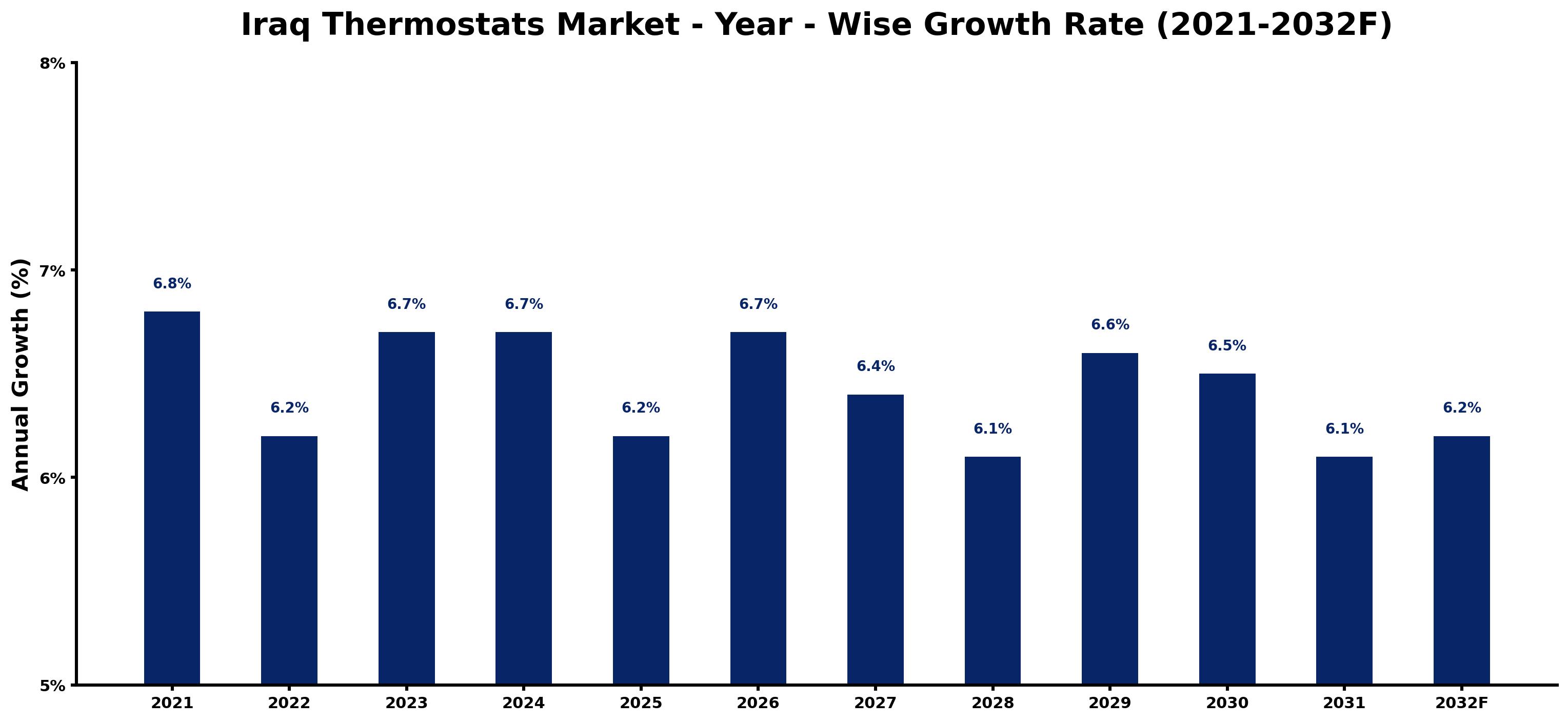
The table below presents the year wise growth rates along with the key drivers influencing the market
| Year | Growth Rate | Major Drivers |
| 2021 | 6.8% | Localized production of thermostats begins to address growing consumer needs in Iraq. |
| 2022 | 6.2% | Increased infrastructure investments stimulate demand for energy-efficient home automation solutions. |
| 2023 | 6.7% | Smart home technology trends encourage consumers to invest in intelligent thermostat systems. |
| 2024 | 6.7% | Rising temperatures push homeowners towards energy-saving climate control products increasingly. |
| 2025 | 6.2% | Urbanization in major cities enhances the market potential for advanced thermostat solutions. |
| 2026 | 6.7% | The construction boom in Iraq leads to higher demand for HVAC systems and controls. |
| 2027 | 6.4% | Consumer awareness of energy efficiency spurs interest in smart thermostat functionalities. |
| 2028 | 6.1% | Partnerships with international tech firms enhance local offerings in smart home devices. |
| 2029 | 6.6% | Improved energy grid reliability increases consumer confidence in smart thermostat investments. |
| 2030 | 6.5% | Continued economic development provides disposable income for upgrading home heating solutions. |
| 2031 | 6.1% | Government incentives for energy efficiency drive consumer interest in modern thermostat options. |
| 2032 | 6.2% | Rising population density in urban areas results in higher thermostat installation rates. |
Note - Market size estimations and growth projections presented in this report are based on 6Wresearch's advanced forecasting approach, validated with industry datasets as of June 2026.
Iraq Thermostats Market Synopsis
The Iraq Thermostats Market is projected to reach 6.7% and witness significant growth during the forecast period (2026-2032). With the increasing emphasis on energy efficiency and the expansion of the construction sector, the market is poised for substantial development. The rise in demand for smart thermostats reflects a broader consumer trend toward optimizing energy consumption and lowering utility expenses. This landscape features both domestic and international stakeholders offering diverse product ranges tailored for residential, commercial, and industrial applications, indicating a competitive and dynamic market environment.
Iraq Thermostats Market Growth Drivers
Several factors are propelling the growth of the Iraq Thermostats Market. First and foremost is the strong consumer awareness surrounding energy efficiency, which is motivating households and businesses to invest in advanced thermostat solutions. Additionally, the ongoing construction boom in urban and suburban areas is facilitating the integration of modern HVAC systems that often include smart thermostats. The Iraqi government's initiatives to promote energy conservation, including regulatory frameworks that encourage the use of energy-efficient appliances, also play a critical role. Furthermore, advancements in thermostat technology—such as integration with smart home systems and the introduction of energy-saving features—are appealing to the tech-savvy consumer base. Lastly, economic recovery efforts that stabilize the market environment can further enhance demand for these products.
Iraq Thermostats Market Trends and Opportunities
The Iraq Thermostats Market is undergoing a notable shift towards smart technology adoption. Consumers are increasingly leaning towards thermostats that offer remote access, programmability, and compatibility with smartphone applications. This trend is significantly driven by the wider acceptance of smart home technology and the increasing demand for convenient, energy-efficient solutions. The market is witnessing a growing emphasis on sustainability and energy conservation, leading to heightened interest in programmable thermostats designed to minimize energy usage. Manufacturers are also enhancing user experiences by incorporating features such as voice control and machine learning algorithms that optimize heating and cooling efficiency, thereby aligning products with contemporary consumer preferences and environmental considerations.
Iraq Thermostats Market Challenges and Restraints
Despite the positive outlook, the Iraq Thermostats Market faces several challenges that could hinder growth. Political instability and security concerns remain significant barriers, as they can disrupt supply chains and affect operational continuity for businesses. Economic uncertainties, particularly fluctuations in oil prices, can adversely influence consumer spending power and investment willingness. Additionally, there is a notable lack of awareness among consumers regarding the advantages of energy-efficient technologies, which can slow adoption rates. The limited availability of advanced thermostat products in the market further complicates access for potential buyers. Finally, the presence of unregulated or counterfeit products poses a risk to both market quality and consumer safety, necessitating increased efforts in regulation and consumer education.
Iraq Thermostats Market Investment Opportunities
The growing construction sector in Iraq presents promising investment opportunities for stakeholders in the Thermostats Market. As both residential and commercial sectors evolve, there is an increasing demand for innovative, energy-efficient solutions tailored specifically to local requirements. Investors focusing on smart thermostats and HVAC controls can capitalize on the rising consumer awareness regarding environmental sustainability. Forming strategic partnerships with local distributors and contractors will be crucial for navigating the regulatory landscape and establishing a solid foothold in the market. Overall, investing in this market is seen as a pathway for long-term growth and profitability, especially as public sentiment increasingly favors energy-efficient solutions.
Iraq Thermostats Market Government Investment and Initiatives
The Iraqi government has enacted various policies aimed at promoting energy efficiency, significantly influencing the thermostats market. These initiatives include regulations that mandate the adoption of energy-efficient appliances, along with fiscal incentives designed to encourage consumers to invest in advanced technologies such as programmable thermostats. Moreover, campaigns to raise public awareness about the benefits of energy conservation are underway, directly impacting consumer behavior. The government is also supporting local manufacturers in developing energy-efficient products, thereby enhancing domestic production capabilities and reducing reliance on imports. By fostering an environment conducive to innovation and energy conservation, these government initiatives are expected to stimulate growth within the Iraq Thermostats Market.
Iraq Thermostats Market Latest Developments (May 2025 - June 2026)
Recent developments in the Iraq Thermostats Market indicate a continued focus on enhancing energy efficiency through technological innovation. During the noted period, industry players have increasingly integrated features such as machine learning and advanced connectivity options into their thermostat products, aligning with global trends in smart home technology. Public awareness campaigns regarding energy conservation, led by government initiatives, have resulted in a discernible uptick in consumer inquiries pertaining to energy-efficient solutions. Moreover, collaborations among local entities to facilitate the distribution of advanced thermostat technologies are becoming more common, helping to address market gaps and consumer needs. As the market landscape evolves, these developments signal a robust trajectory toward integrating energy-efficient solutions into everyday living environments in Iraq.
Iraq Thermostats Market - Key Attractiveness of the Report
- 10 Years of Market Numbers
- Historical Data Starting from 2022 to 2025
- Base Year: 2025
- Forecast Data until 2032
- Key Performance Indicators Impacting the Market
- Major Upcoming Developments and Projects
Key Highlights of the Report:
- Iraq Thermostats Market Outlook
- Market Size of Iraq Thermostats Market, 2025
- Forecast of Iraq Thermostats Market, 2032F
- Historical Data and Forecast of Iraq Thermostats Revenues & Volume for the Period 2022-2032F
- Iraq Thermostats Market Trend Evolution
- Iraq Thermostats Market Drivers and Challenges
- Iraq Thermostats Price Trends
- Iraq Thermostats Porter's Five Forces
- Iraq Thermostats Industry Life Cycle
- Historical Data and Forecast of Iraq Thermostats Market Revenues & Volume By Products for the Period 2022-2032F
- Historical Data and Forecast of Iraq Thermostats Market Revenues & Volume By Smart Thermostat for the Period 2022-2032F
- Historical Data and Forecast of Iraq Thermostats Market Revenues & Volume By Mechanical Thermostat for the Period 2022-2032F
- Historical Data and Forecast of Iraq Thermostats Market Revenues & Volume By Programmable Thermostat for the Period 2022-2032F
- Historical Data and Forecast of Iraq Thermostats Market Revenues & Volume By Distribution Channel for the Period 2022-2032F
- Historical Data and Forecast of Iraq Thermostats Market Revenues & Volume By Utility for the Period 2022-2032F
- Historical Data and Forecast of Iraq Thermostats Market Revenues & Volume By Retail for the Period 2022-2032F
- Historical Data and Forecast of Iraq Thermostats Market Revenues & Volume By Security for the Period 2022-2032F
- Historical Data and Forecast of Iraq Thermostats Market Revenues & Volume By HVAC for the Period 2022-2032F
- Historical Data and Forecast of Iraq Thermostats Market Revenues & Volume By Mode of Operations for the Period 2022-2032F
- Historical Data and Forecast of Iraq Thermostats Market Revenues & Volume By Line Voltage for the Period 2022-2032F
- Historical Data and Forecast of Iraq Thermostats Market Revenues & Volume By Low Voltage for the Period 2022-2032F
- Historical Data and Forecast of Iraq Thermostats Market Revenues & Volume By Millivolt for the Period 2022-2032F
- Historical Data and Forecast of Iraq Thermostats Market Revenues & Volume By Applications for the Period 2022-2032F
- Historical Data and Forecast of Iraq Thermostats Market Revenues & Volume By Residential for the Period 2022-2032F
- Historical Data and Forecast of Iraq Thermostats Market Revenues & Volume By Commercial for the Period 2022-2032F
- Iraq Thermostats Import Export Trade Statistics
- Market Opportunity Assessment By Products
- Market Opportunity Assessment By Distribution Channel
- Market Opportunity Assessment By Mode of Operations
- Market Opportunity Assessment By Applications
- Iraq Thermostats Top Companies Market Share
- Iraq Thermostats Competitive Benchmarking By Technical and Operational Parameters
- Iraq Thermostats Company Profiles
- Iraq Thermostats Key Strategic Recommendations






































