Ireland Rolling Mill Components And Ancillary Equipment Market Size (2020-2030)
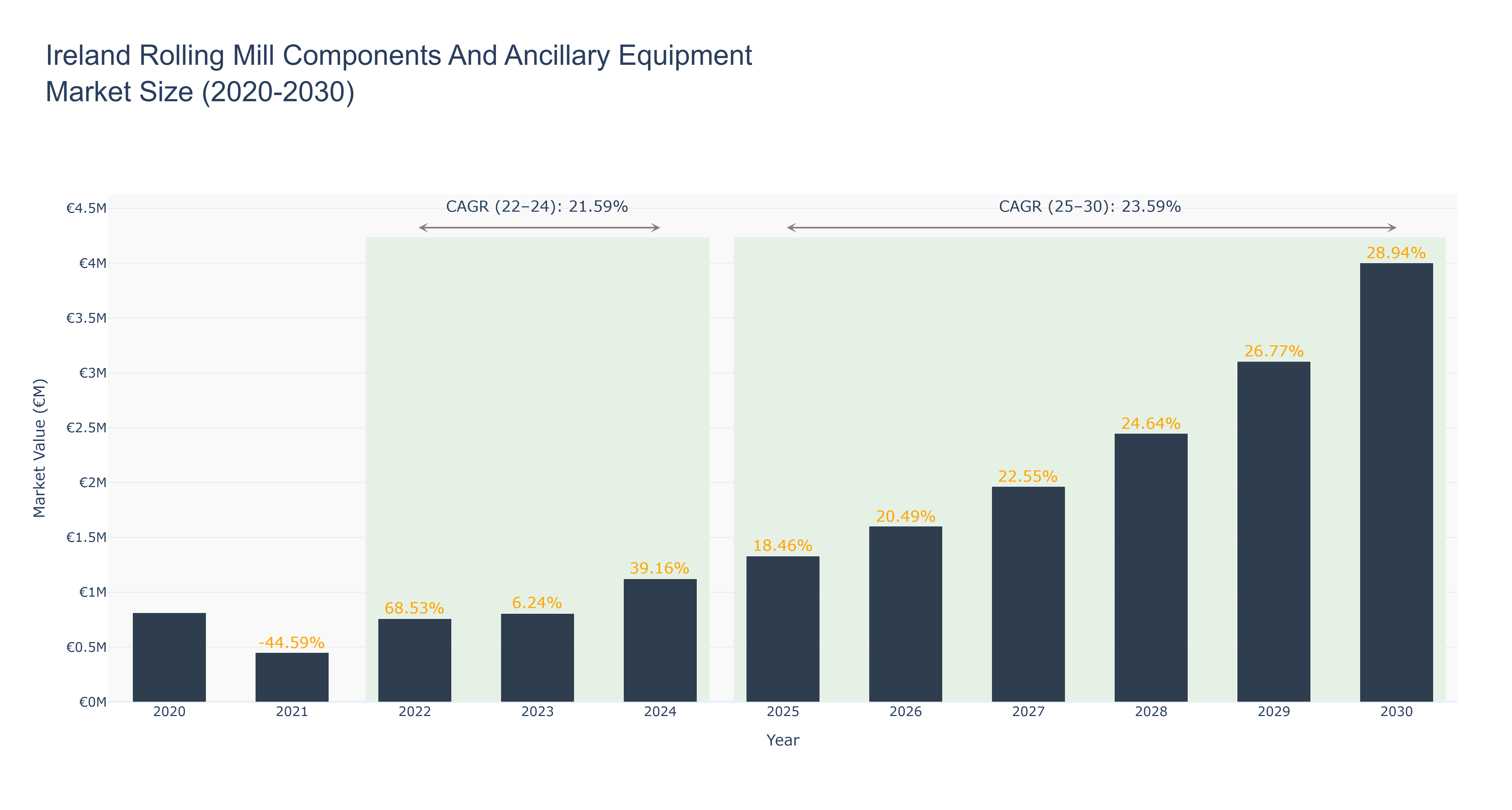
The Ireland Rolling Mill Components And Ancillary Equipment Market experienced a fluctuating trend over the past decade. The peak market size of €4.00 million was achieved in 2030, showcasing a steady growth trajectory. From 2020 to 2024, the market size increased from €0.81 million to €1.12 million, driven by technological advancements and increased demand. The forecasted market size from 2025 to 2030 is projected to reach €4.00 million, with a CAGR of 23.59%. The market saw a significant growth spurt from 2026 onwards, attributed to strategic investments in infrastructure and automation. Looking ahead, upcoming projects in renewable energy integration within the industry are expected to further propel market growth, positioning Ireland as a key player in the global market for rolling mill components and ancillary equipment.
Ireland Rolling Mill Components And Ancillary Equipment Market: Production & Trade Performance (2019-2025)
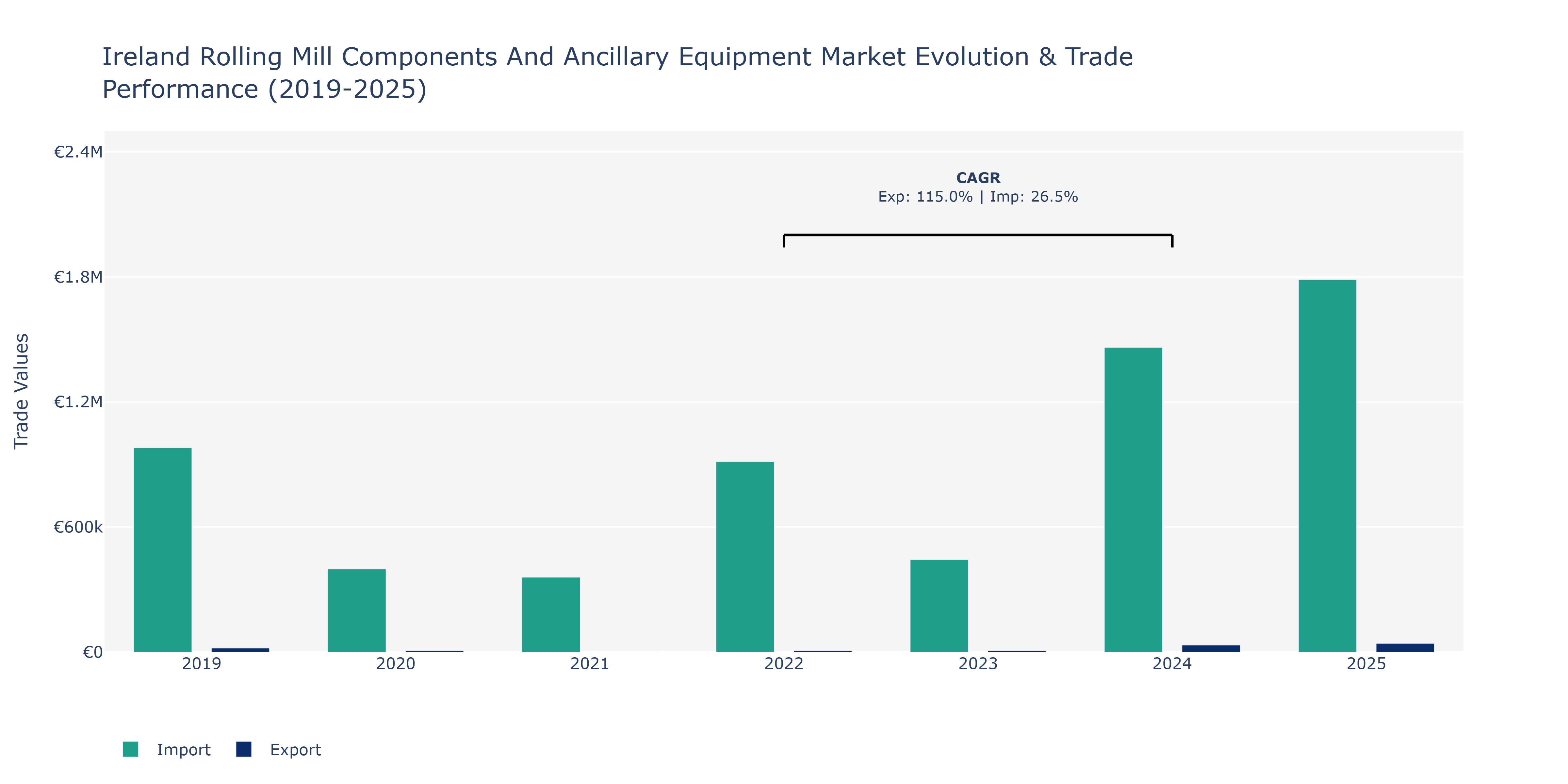
In the Ireland Rolling Mill Components And Ancillary Equipment Market, the exports saw a substantial fluctuation over the years, starting at €19.13 thousand in 2019, dropping to €7.68 thousand in 2020, before experiencing a significant surge to €33.82 thousand in 2024, and reaching €41.72 thousand in 2025. This growth trend indicates resilience and competitiveness in the market, potentially driven by advancements in technology, increased global demand for such equipment, and strategic market positioning. Conversely, imports followed a different trajectory, standing at €980.05 thousand in 2019, decreasing to €398.55 thousand in 2020, and then rising to €1.79 million in 2025. This suggests a consistent demand for foreign products to support local industry needs or bridge domestic supply gaps. The notable increase in imports by over €1.39 million from 2020 to 2025 could be attributed to expanding manufacturing capabilities, evolving consumer preferences, and efforts to enhance operational efficiency in the sector.
Key Highlights of the Report:
- Ireland Rolling Mill Components and Ancillary Equipment Market Outlook
- Market Size of Ireland Rolling Mill Components and Ancillary Equipment Market, 2025
- Forecast of Ireland Rolling Mill Components and Ancillary Equipment Market, 2032
- Historical Data and Forecast of Ireland Rolling Mill Components and Ancillary Equipment Revenues & Volume for the Period 2022 - 2032F
- Ireland Rolling Mill Components and Ancillary Equipment Market Trend Evolution
- Ireland Rolling Mill Components and Ancillary Equipment Market Drivers and Challenges
- Ireland Rolling Mill Components and Ancillary Equipment Price Trends
- Ireland Rolling Mill Components and Ancillary Equipment Porter`s Five Forces
- Ireland Rolling Mill Components and Ancillary Equipment Industry Life Cycle
- Historical Data and Forecast of Ireland Rolling Mill Components and Ancillary Equipment Market Revenues & Volume By Product for the Period 2022 - 2032F
- Historical Data and Forecast of Ireland Rolling Mill Components and Ancillary Equipment Market Revenues & Volume By Iron Rolls for the Period 2022 - 2032F
- Historical Data and Forecast of Ireland Rolling Mill Components and Ancillary Equipment Market Revenues & Volume By Steel Rolls for the Period 2022 - 2032F
- Historical Data and Forecast of Ireland Rolling Mill Components and Ancillary Equipment Market Revenues & Volume By Others for the Period 2022 - 2032F
- Historical Data and Forecast of Ireland Rolling Mill Components and Ancillary Equipment Market Revenues & Volume By End User for the Period 2022 - 2032F
- Historical Data and Forecast of Ireland Rolling Mill Components and Ancillary Equipment Market Revenues & Volume By Oil & Gas for the Period 2022 - 2032F
- Historical Data and Forecast of Ireland Rolling Mill Components and Ancillary Equipment Market Revenues & Volume By Industrial for the Period 2022 - 2032F
- Historical Data and Forecast of Ireland Rolling Mill Components and Ancillary Equipment Market Revenues & Volume By Automotive for the Period 2022 - 2032F
- Historical Data and Forecast of Ireland Rolling Mill Components and Ancillary Equipment Market Revenues & Volume By Mining for the Period 2022 - 2032F
- Historical Data and Forecast of Ireland Rolling Mill Components and Ancillary Equipment Market Revenues & Volume By Others for the Period 2022 - 2032F
- Ireland Rolling Mill Components and Ancillary Equipment Import Export Trade Statistics
- Market Opportunity Assessment By Product
- Market Opportunity Assessment By End User
- Ireland Rolling Mill Components and Ancillary Equipment Top Companies Market Share
- Ireland Rolling Mill Components and Ancillary Equipment Competitive Benchmarking By Technical and Operational Parameters
- Ireland Rolling Mill Components and Ancillary Equipment Company Profiles
- Ireland Rolling Mill Components and Ancillary Equipment Key Strategic Recommendations






































