Italy AI in IoT Market Size & Growth Rate (2026-2032)
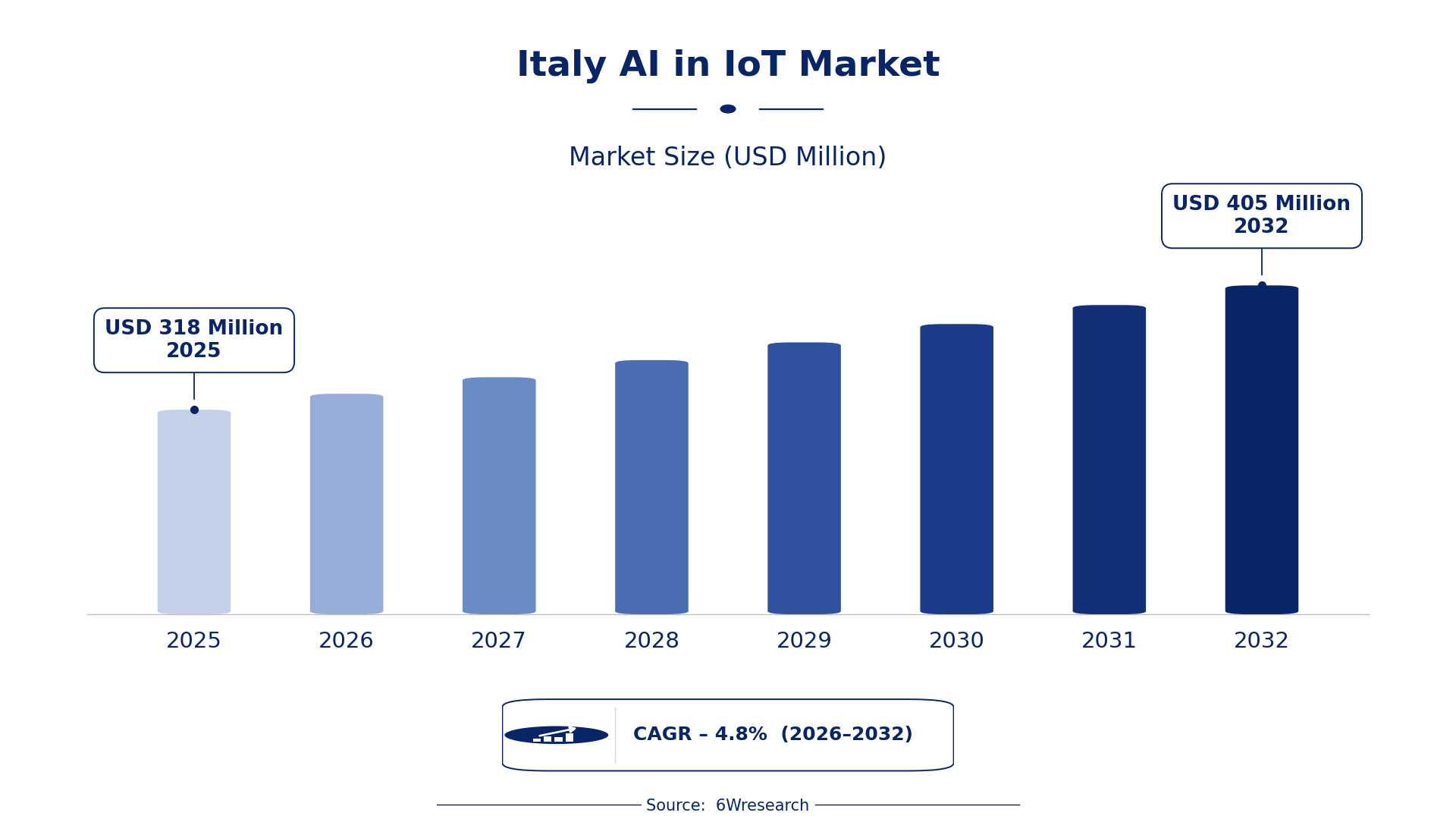
The Italy AI in IoT Market was estimated at USD 318 Million in 2025 and is projected to reach USD 405 Million by 2032, growing at a CAGR of 4.8% from 2026 to 2032.
Italy AI in IoT Market Synopsis
The integration of artificial intelligence with IoT solutions is becoming a cornerstone for industries across Italy, reshaping the operational frameworks in manufacturing, healthcare, and agriculture. As businesses increasingly recognize the benefits of AI, they are adopting advanced IoT technologies to streamline processes and innovate their product offerings.
This trend is not merely a technological shift; it reflects a broader movement towards enhanced decision-making and operational efficiency. With government initiatives supporting digital transformation, companies are motivated to invest in AI capabilities, driving a compelling narrative of growth in the Italian market.
Italy AI in IoT Market Year-wise Growth Rate and Key Drivers
This graph illustrates the annual growth rates of the Italy AI in IoT Market from 2021 to 2032, highlighting a steady upward trajectory and projected expansion over the forecast period.
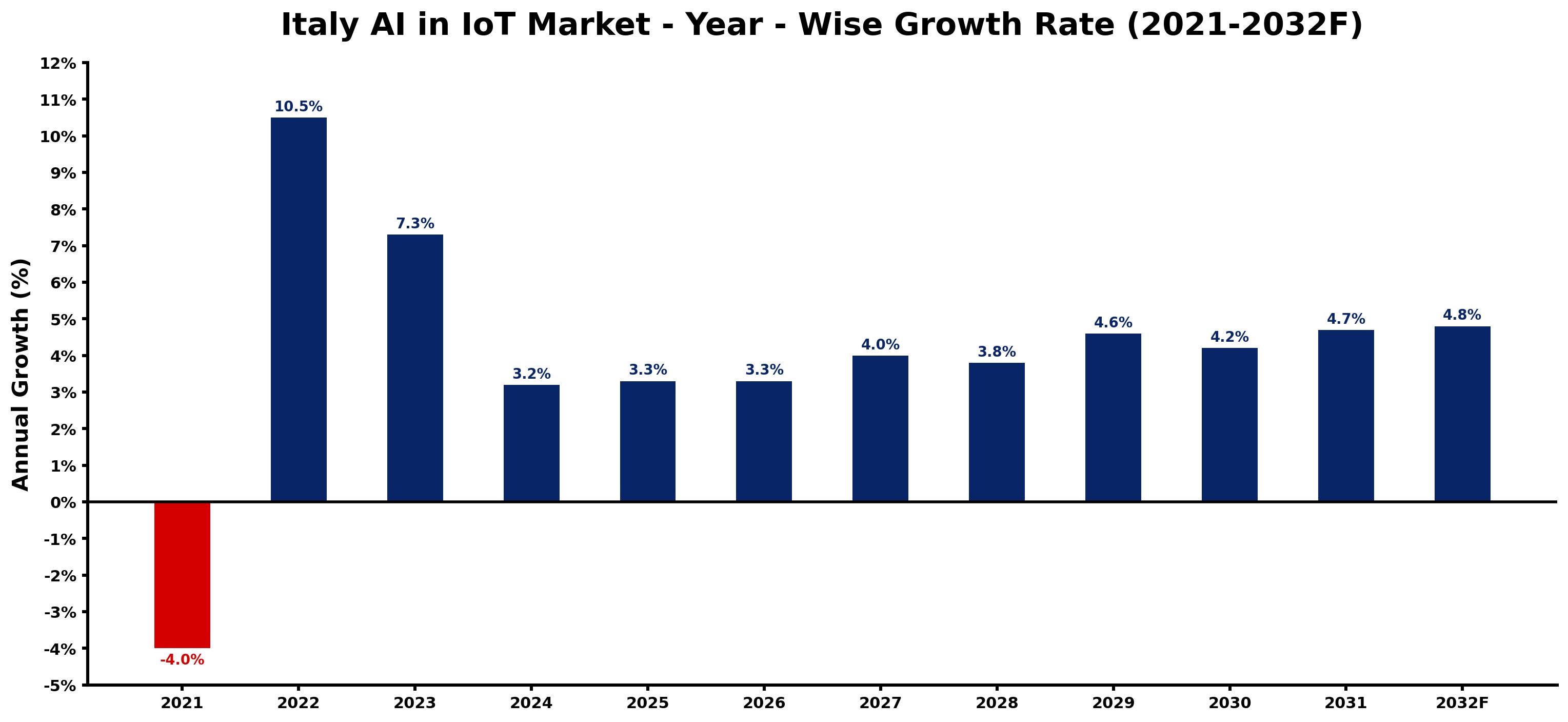
The table below presents the year‑wise growth rates along with the key drivers influencing the market
| Year | Growth Rate | Major Drivers |
| 2021 | -4.0% | Weak adoption due to strict GDPR compliance requirements. |
| 2022 | 10.5% | National digitalization plan enhancing IoT investments. |
| 2023 | 7.3% | EU funding for smart cities boosting IoT adoption. |
| 2024 | 3.2% | Increased focus on industrial automation in manufacturing. |
| 2025 | 3.3% | Regulatory support for IoT cybersecurity frameworks. |
| 2026 | 3.3% | Growing consumer demand for smart home technologies. |
| 2027 | 4.0% | Public sector initiatives for IoT in healthcare sectors. |
| 2028 | 3.8% | Rise in wearables driving IoT applications. |
| 2029 | 4.6% | Increased partnership between telcos and IoT startups. |
| 2030 | 4.2% | Government incentives for green IoT solutions. |
| 2031 | 4.7% | Pilot projects in agriculture utilizing IoT sensors. |
| 2032 | 4.8% | Enhanced data privacy laws fostering IoT trust. |
Note: Market size estimations and growth projections presented in this report are based on 6Wresearch's proprietary forecasting methodology, utilizing the latest available industry data, government publications, and primary research inputs.
Italy AI in IoT Market Key Takeaways
Below are some of the specific key takeaways from the market, including:
- The combination of AI and IoT is significantly enhancing productivity across various sectors.
- Government policies are fostering an environment conducive to technological advancements.
- Investment in AI-driven cybersecurity solutions is crucial for addressing data privacy concerns.
- Edge computing is emerging as a vital component for real-time data processing.
- The rising trend of smart city initiatives is propelling demand for innovative IoT applications.
Evaluation of Restraints in Italy AI in IoT Market
Despite the encouraging growth trajectory, several factors are limiting the potential of the Italy AI in IoT market. Data privacy concerns remain at the forefront, as the nature of IoT data can be sensitive and prone to misuse. Additionally, regulatory hurdles complicate the alignment of AI applications with existing legislation. There is also a pressing need for skilled professionals who can develop and implement these advanced solutions effectively.
Interoperability among various IoT devices presents another challenge, as different platforms may not integrate smoothly. Lastly, companies face hurdles in securing AI-powered IoT systems from cyber threats, further complicating the landscape for potential investors and innovators.
Italy AI in IoT Market Trends
The Italy AI in IoT market is characterized by several key trends that are shaping its development. AI-powered analytics is increasingly being utilized to derive actionable insights from vast amounts of IoT data, allowing companies to make informed decisions. This trend is coupled with the growing focus on edge computing, which enables real-time data processing, enhancing operational responsiveness.
on top of that, the emphasis on cybersecurity is becoming more pronounced as organizations strive to protect their IoT networks from potential threats. The push for smart city initiatives is creating a ripple effect, driving demand for AI-driven solutions that integrate seamlessly into urban infrastructure.
Italy AI in IoT Market Opportunities
Opportunities for growth in the Italy AI in IoT market are abundant, particularly in sectors that are undergoing digital transformation. There is a notable demand for AI-powered data analytics platforms that can facilitate better decision-making through predictive insights. Investment in machine learning algorithms for predictive maintenance is also gaining traction, especially within industrial IoT.
Smart city projects represent a particularly promising avenue for investment, as they require sophisticated AI integrations to improve urban living conditions. Additionally, the need for AI-driven cybersecurity solutions to safeguard IoT devices underscores an important area for innovation and growth.
Government Initiatives in the Italy AI in IoT Market
The Italian government is actively shaping the AI and IoT sectors through a variety of initiatives aimed at promoting innovation and digital transformation. With policies that support infrastructure development and regulatory alignment, the government is creating a favorable environment for the growth of these technologies. Such commitment is vital for ensuring that Italy remains competitive on a European scale.
- A National AI Strategy launched in 2018 aims to enhance AI adoption across various industries.
- The National IoT Plan is currently underway, focusing on connectivity improvements and data security enhancements.
- Italy is participating in EU initiatives to establish common standards for AI and IoT technologies.
- A public-private initiative planned for the next few years aims to expand IoT access throughout urban areas.
Future Insights of the Italy AI in IoT Market
Looking ahead to 2026-2032, the Italy AI in IoT market is set to experience substantial growth driven by the increasing integration of AI technologies into IoT frameworks. As industries continue to seek efficiency and innovation, the demand for AI-enhanced IoT solutions will rise. With ongoing governmental support and investment in R&D, the landscape is primed for expansive developments.
The collaboration between public and private sectors will play a crucial role in addressing challenges and capitalizing on emerging opportunities. This synergy is essential for fostering an environment where AI and IoT can thrive together, ultimately benefiting various sectors across Italy.
Italy AI in IoT Market Latest Developments
Recent activity in the Italy AI in IoT market indicates a dynamic environment marked by innovation and investment. Over the past year, companies have been keen to implement cutting-edge technologies that enhance operational capabilities and data security. This trend is shaping the future of the market as stakeholders adapt to new demands and opportunities.
- A leading technology vendor launched a new AI-driven analytics platform in early 2025, aimed at improving data insights for IoT applications.
- In mid-2025, a collaborative project between tech firms and local governments commenced to enhance IoT connectivity in urban areas.
- A major regional operator is currently upgrading its IoT cybersecurity measures to better protect against emerging threats.
- Upcoming in 2026, a national initiative is set to roll out AI-based solutions for predictive maintenance in industrial settings.
Italy AI in IoT Market - Key Attractiveness of the Report
- 10 Years of Market Numbers
- Historical Data Starting from 2022 to 2025
- Base Year: 2025
- Forecast Data until 2032
- Key Performance Indicators Impacting the Market
- Major Upcoming Developments and Projects
Key Highlights of the Report:
- Italy AI in IoT Market Outlook
- Market Size of Italy AI in IoT Market, 2025
- Forecast of Italy AI in IoT Market, 2032
- Historical Data and Forecast of Italy AI in IoT Revenues & Volume for the Period 2022-2032F
- Italy AI in IoT Market Trend Evolution
- Italy AI in IoT Market Drivers and Challenges
- Italy AI in IoT Price Trends
- Italy AI in IoT Porter's Five Forces
- Italy AI in IoT Industry Life Cycle
- Historical Data and Forecast of Italy AI in IoT Market Revenues & Volume By Component for the Period 2022-2032F
- Historical Data and Forecast of Italy AI in IoT Market Revenues & Volume By Platforms for the Period 2022-2032F
- Historical Data and Forecast of Italy AI in IoT Market Revenues & Volume By Software Solutions for the Period 2022-2032F
- Historical Data and Forecast of Italy AI in IoT Market Revenues & Volume By Services for the Period 2022-2032F
- Historical Data and Forecast of Italy AI in IoT Market Revenues & Volume By Vertical for the Period 2022-2032F
- Historical Data and Forecast of Italy AI in IoT Market Revenues & Volume By Manufacturing for the Period 2022-2032F
- Historical Data and Forecast of Italy AI in IoT Market Revenues & Volume By Energy and Utilities for the Period 2022-2032F
- Historical Data and Forecast of Italy AI in IoT Market Revenues & Volume By Transportation and Mobility for the Period 2022-2032F
- Historical Data and Forecast of Italy AI in IoT Market Revenues & Volume By BFSI for the Period 2022-2032F
- Historical Data and Forecast of Italy AI in IoT Market Revenues & Volume By Government and Defense for the Period 2022-2032F
- Historical Data and Forecast of Italy AI in IoT Market Revenues & Volume By Retail for the Period 2022-2032F
- Historical Data and Forecast of Italy AI in IoT Market Revenues & Volume By Healthcare and Life Sciences for the Period 2022-2032F
- Historical Data and Forecast of Italy AI in IoT Market Revenues & Volume By Telecom for the Period 2022-2032F
- Historical Data and Forecast of Italy AI in IoT Market Revenues & Volume By Technology for the Period 2022-2032F
- Historical Data and Forecast of Italy AI in IoT Market Revenues & Volume By ML and Deep Learning for the Period 2022-2032F
- Historical Data and Forecast of Italy AI in IoT Market Revenues & Volume By NLP for the Period 2022-2032F
- Italy AI in IoT Import Export Trade Statistics
- Market Opportunity Assessment By Component
- Market Opportunity Assessment By Vertical
- Market Opportunity Assessment By Technology
- Italy AI in IoT Top Companies Market Share
- Italy AI in IoT Competitive Benchmarking By Technical and Operational Parameters
- Italy AI in IoT Company Profiles
- Italy AI in IoT Key Strategic Recommendations






































