Italy Automotive Aftermarket Market Size, Share & Growth Rate
The Italy Automotive Aftermarket Market was estimated at USD 175 Million in 2025 and is projected to reach USD 193 Million by 2032, growing at a CAGR of 1.4% from 2026 to 2032. This steady growth trajectory is propelled by Italys rich automotive culture, a burgeoning vehicle fleet, and an increasing inclination among vehicle owners to seek cost-effective aftermarket alternatives. Additionally, evolving technologies and a shift towards sustainability are further fueling demand within this vibrant sector.
Italy Automotive Aftermarket Market Year-wise Growth Rate and Key Drivers
This graph highlights how the Italy Automotive Aftermarket Market has steadily grown over the years, supported by major growth factors.
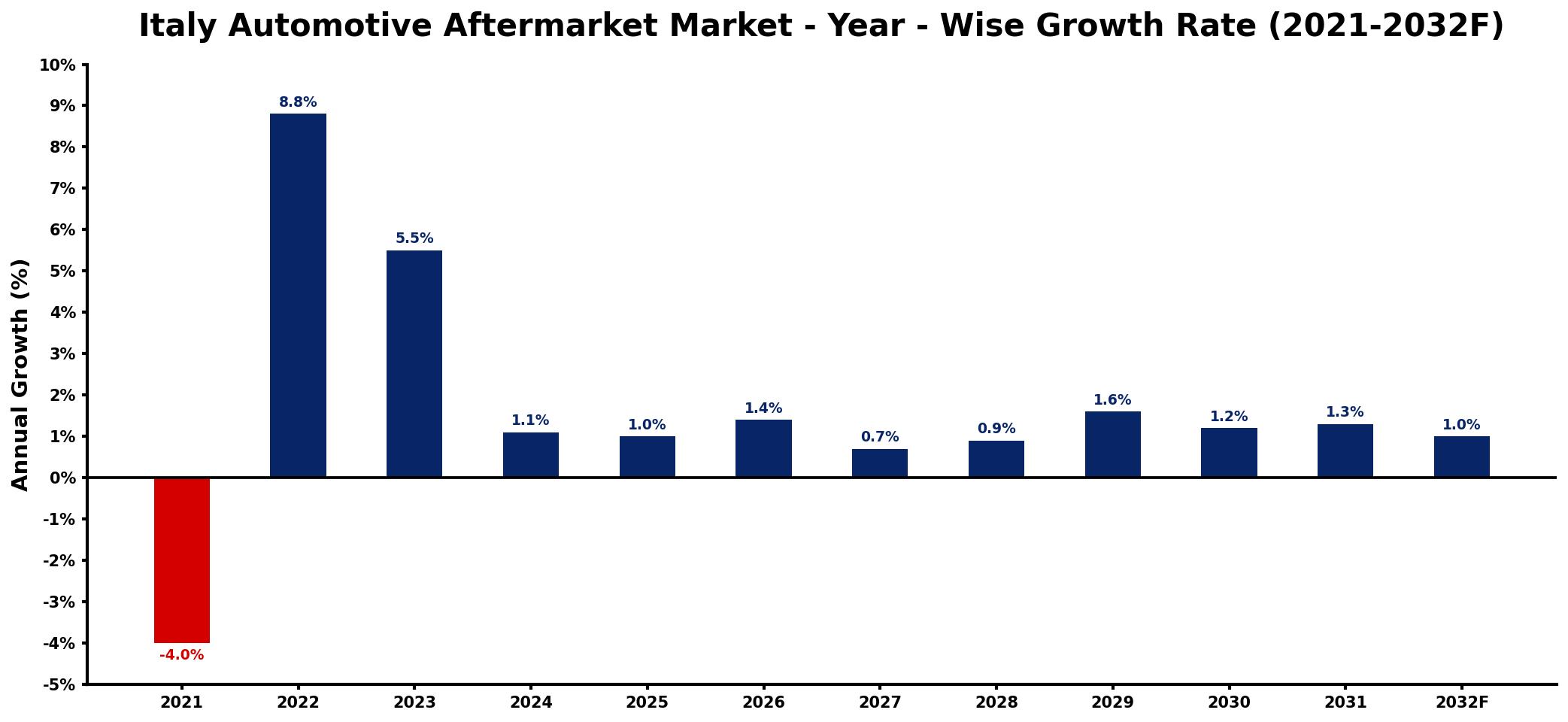
The table below presents the year‑wise growth rates along with the key drivers influencing the market
| Year | Growth Rate | Major Drivers |
| 2021 | -4.0% | decrease in consumer spending power |
| 2022 | 8.8% | rise in vehicle maintenance demand |
| 2023 | 5.5% | increased electric vehicle adoption |
| 2024 | 1.1% | growth in online parts sales |
| 2025 | 1.0% | expansion of service centers network |
| 2026 | 1.4% | advancements in repair technologies |
| 2027 | 0.7% | uptick in car ownership rates |
| 2028 | 0.9% | enhanced customer loyalty programs |
| 2029 | 1.6% | increased pharmaceutical industry usage |
| 2030 | 1.2% | increased investment in training programs |
| 2031 | 1.3% | strengthening international trade flows |
| 2032 | 1.0% | growing commercial sector adoption |
Note: Market size estimations and growth projections presented in this report are based on 6Wresearch's proprietary forecasting methodology, utilizing the latest available industry data, government publications, and primary research inputs.
Italy Automotive Aftermarket Market Synopsis
The Italian automotive aftermarket is a dynamic industry, marked by a diverse array of products and services that cater to the specific needs of vehicle owners. With a strong emphasis on quality and innovation, this sector thrives as car owners increasingly opt for non-OEM parts and maintenance solutions that provide both affordability and reliability.
A robust automotive ecosystem underpins this market, featuring independent garages and specialized workshops that deliver essential services like repair, maintenance, and the supply of aftermarket components. As the average age of vehicles on the road continues to climb, the demand for high-quality aftermarket products and services is expected to rise, reflecting changing consumer preferences.
Italy Automotive Aftermarket Market Key Takeaways
- The market is driven by a large, aging vehicle fleet that necessitates ongoing maintenance and repair.
- Growing consumer preference for sustainable and eco-friendly aftermarket solutions is shaping product offerings.
- The rise of electric vehicles is creating new opportunities in specialized aftermarket services and parts.
- Digitalization is facilitating easier access to aftermarket products through e-commerce platforms.
- Government initiatives focused on innovation and sustainability are positively impacting the market landscape.
Evaluation of Restraints in Italy Automotive Aftermarket Market
Despite its promising outlook, the Italy Automotive Aftermarket faces certain restraints that could inhibit its growth. One major concern is the intense competition among local and international players, compelling businesses to constantly innovate and enhance their customer service. Additionally, rapid technological advancements demand that aftermarket companies remain agile, adapting to new automotive technologies, particularly in electric vehicles. The regulatory landscape can also pose challenges, with compliance requirements potentially creating barriers for new entrants and established players alike.
Italy Automotive Aftermarket Market Trends
Several trends are currently shaping the Italy Automotive Aftermarket. The transition towards electric vehicles is prompting a growing need for specialized parts and services, such as battery management and charging solutions. Furthermore, the increasing emphasis on sustainability is pushing consumers towards eco-friendly options, including remanufactured and recycled components. Digitalization remains a significant trend, as e-commerce platforms transform how consumers access aftermarket products, ensuring convenience and competitive pricing. Additionally, the inclination towards DIY maintenance is fostering a greater demand for quality aftermarket tools and parts.
Italy Automotive Aftermarket Market Opportunities
Investment opportunities abound within the Italy Automotive Aftermarket. The continuous growth in vehicle numbers translates to a sustained demand for replacement parts, service providers, and innovative accessories. Moreover, as electric vehicles become more prevalent, there is an increasing need for related products and services, such as charging stations and connectivity solutions. Companies that invest in modern distribution channels and harness technology-driven solutions tailored to the Italian market can gain a significant competitive edge, positioning themselves for long-term success.
Government Initiatives in the Italy Automotive Aftermarket Market
The Italian government has implemented a range of policies designed to promote a fair and sustainable automotive aftermarket. These include regulations focused on product quality, safety standards, and emissions control, all aimed at ensuring consumer protection and environmental sustainability. The government actively supports innovation in the sector, encouraging the development of eco-friendly products and technologies. Furthermore, initiatives to combat counterfeit parts help ensure that consumers have access to reliable aftermarket solutions, fostering a trustworthy market environment.
Future Insights of the Italy Automotive Aftermarket Market
Looking ahead to 2026-2032, the future of the Italy Automotive Aftermarket appears promising. As the average vehicle age continues to rise, so too will the demand for affordable maintenance options and quality aftermarket products. With the evolution of electric vehicles and a heightened focus on sustainability, the market is poised for new opportunities that cater to environmentally conscious consumers. It will be essential for businesses to adapt to these trends and engage in collaborations that drive innovation, ensuring they meet the ever-evolving needs of the market.
Italy Automotive Aftermarket Market Latest Developments (2025 - 2026)
Recent developments in the Italy Automotive Aftermarket indicate a shift towards increased collaboration between manufacturers and service providers to enhance product offerings. The market is witnessing a greater integration of technology, with many players focusing on digitization strategies to improve customer engagement. Theres also a growing emphasis on providing sustainable and environmentally friendly products in response to consumer demand, which is shaping the future trajectory of the industry.
Italy Automotive Aftermarket Market - Key Attractiveness of the Report
- 10 Years of Market Numbers
- Historical Data Starting from 2022 to 2025
- Base Year: 2025
- Forecast Data until 2032
- Key Performance Indicators Impacting the Market
- Major Upcoming Developments and Projects
Key Highlights of the Report:
- Italy Automotive Aftermarket Market Outlook
- Market Size of Italy Automotive Aftermarket Market, 2025
- Forecast of Italy Automotive Aftermarket Market, 2032
- Historical Data and Forecast of Italy Automotive Aftermarket Revenues & Volume for the Period 2022-2032F
- Italy Automotive Aftermarket Market Trend Evolution
- Italy Automotive Aftermarket Market Drivers and Challenges
- Italy Automotive Aftermarket Price Trends
- Italy Automotive Aftermarket Porter's Five Forces
- Italy Automotive Aftermarket Industry Life Cycle
- Historical Data and Forecast of Italy Automotive Aftermarket Market Revenues & Volume By Replacement Parts for the Period 2022-2032F
- Historical Data and Forecast of Italy Automotive Aftermarket Market Revenues & Volume By Tire for the Period 2022-2032F
- Historical Data and Forecast of Italy Automotive Aftermarket Market Revenues & Volume By Battery for the Period 2022-2032F
- Historical Data and Forecast of Italy Automotive Aftermarket Market Revenues & Volume By Brake Parts for the Period 2022-2032F
- Historical Data and Forecast of Italy Automotive Aftermarket Market Revenues & Volume By Filters for the Period 2022-2032F
- Historical Data and Forecast of Italy Automotive Aftermarket Market Revenues & Volume By Body parts for the Period 2022-2032F
- Historical Data and Forecast of Italy Automotive Aftermarket Market Revenues & Volume By Lighting & Electronic Components for the Period 2022-2032F
- Historical Data and Forecast of Italy Automotive Aftermarket Market Revenues & Volume By Wheels for the Period 2022-2032F
- Historical Data and Forecast of Italy Tire Automotive Aftermarket Market Revenues & Volume By Exhaust components for the Period 2022-2032F
- Historical Data and Forecast of Italy Automotive Aftermarket Market Revenues & Volume By Distribution Channel for the Period 2022-2032F
- Historical Data and Forecast of Italy Automotive Aftermarket Market Revenues & Volume By Retailers for the Period 2022-2032F
- Historical Data and Forecast of Italy Automotive Aftermarket Market Revenues & Volume By Wholesalers & Distributors for the Period 2022-2032F
- Historical Data and Forecast of Italy Automotive Aftermarket Market Revenues & Volume By Service Channel for the Period 2022-2032F
- Historical Data and Forecast of Italy Automotive Aftermarket Market Revenues & Volume By DIY (Do it Yourself) for the Period 2022-2032F
- Historical Data and Forecast of Italy Automotive Aftermarket Market Revenues & Volume By DIFM (Do it for Me) for the Period 2022-2032F
- Historical Data and Forecast of Italy Automotive Aftermarket Market Revenues & Volume By OE (Delegating to OEM??s) for the Period 2022-2032F
- Historical Data and Forecast of Italy Automotive Aftermarket Market Revenues & Volume By Certification for the Period 2022-2032F
- Historical Data and Forecast of Italy Automotive Aftermarket Market Revenues & Volume By Genuine Parts for the Period 2022-2032F
- Historical Data and Forecast of Italy Automotive Aftermarket Market Revenues & Volume By Certified Parts for the Period 2022-2032F
- Historical Data and Forecast of Italy Automotive Aftermarket Market Revenues & Volume By Uncertified Parts for the Period 2022-2032F
- Italy Automotive Aftermarket Import Export Trade Statistics
- Market Opportunity Assessment By Replacement Parts
- Market Opportunity Assessment By Distribution Channel
- Market Opportunity Assessment By Service Channel
- Market Opportunity Assessment By Certification
- Italy Automotive Aftermarket Top Companies Market Share
- Italy Automotive Aftermarket Competitive Benchmarking By Technical and Operational Parameters
- Italy Automotive Aftermarket Company Profiles
- Italy Automotive Aftermarket Key Strategic Recommendations






































