Italy Automotive Door Latch Market Size, Share & Growth Rate
The Italy Automotive Door Latch Market was estimated at USD 248 Million in 2025 and is projected to reach USD 272 Million by 2032, growing at a CAGR of 1.3% from 2026 to 2032. This growth trajectory is fueled by the increasing production of passenger vehicles and the heightened emphasis on advanced safety and security features. Additionally, technological advancements in door latch systems are facilitating this steady market expansion, enabling manufacturers to meet evolving consumer expectations.
Italy Automotive Door Latch Market Year-wise Growth Rate and Key Drivers
This graph highlights how the Italy Automotive Door Latch Market has steadily grown over the years, supported by major growth factors.
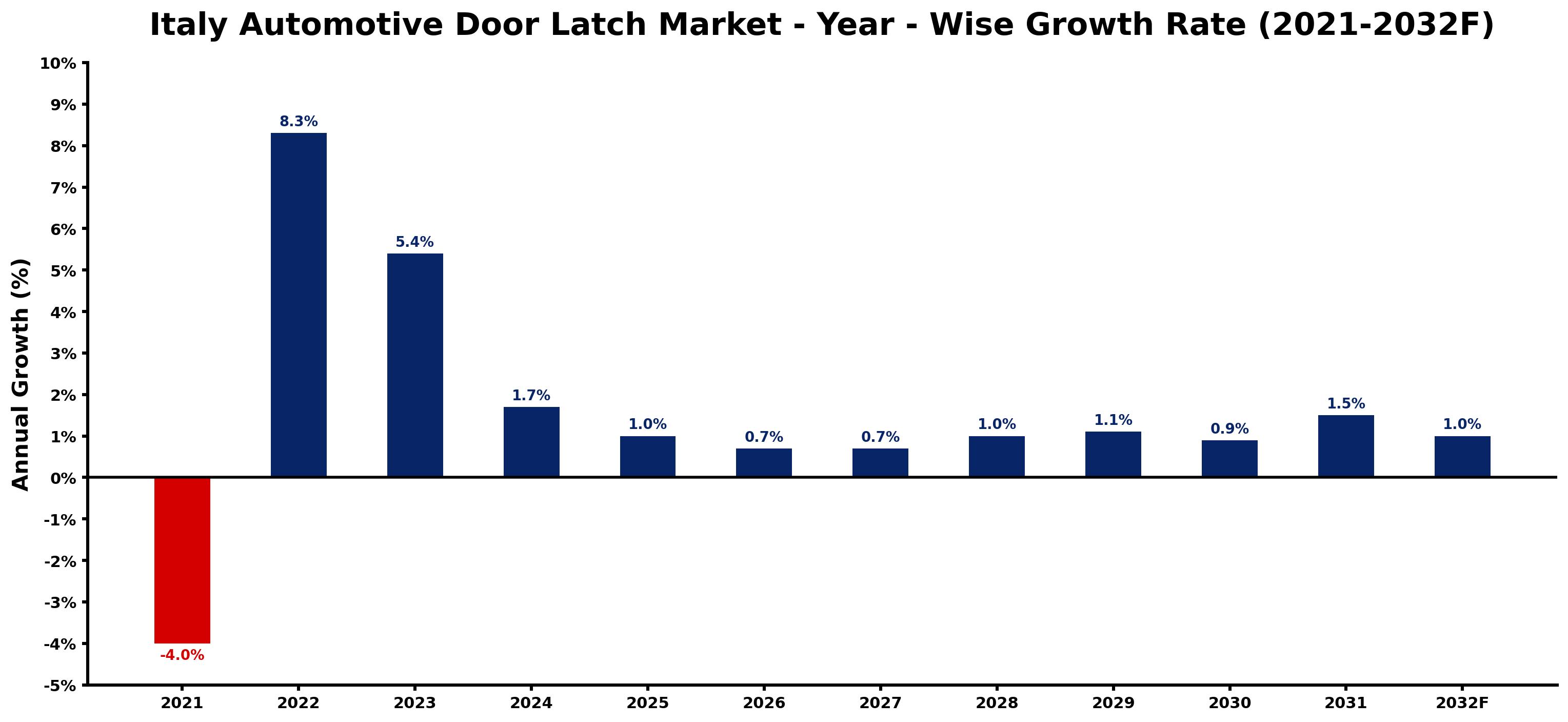
The table below presents the year‑wise growth rates along with the key drivers influencing the market
| Year | Growth Rate | Major Drivers |
| 2021 | -4.0% | Growing urbanization and commercial development |
| 2022 | 8.3% | Expansion of manufacturing activities |
| 2023 | 5.4% | Growing urbanization and commercial development |
| 2024 | 1.7% | Growing renewable energy integration projects |
| 2025 | 1.0% | Increasing adoption of advanced technologies |
| 2026 | 0.7% | Growing renewable energy integration projects |
| 2027 | 0.7% | Rising electricity demand across industries |
| 2028 | 1.0% | Increasing industrial automation investments |
| 2029 | 1.1% | Expansion of manufacturing activities |
| 2030 | 0.9% | Growing urbanization and commercial development |
| 2031 | 1.5% | Expansion of commercial construction activities |
| 2032 | 1.0% | Increasing adoption of advanced technologies |
Note - Market size estimations and growth projections presented in this report are based on 6Wresearch’s advanced forecasting approach, validated with industry datasets as of June 2026.
Italy Automotive Door Latch Market Synopsis
In Italy, the automotive sector is increasingly prioritizing enhanced safety standards, leading to a rising demand for innovative door latch solutions. This shift is reflected in the growing preference for electronic latch systems that offer advanced security features and improved convenience for users.
As consumer awareness surrounding vehicle safety escalates, automotive manufacturers are compelled to integrate state-of-the-art door latch technologies into their offerings. This demand is further supported by governmental regulations that encourage the use of high-quality, secure latching systems in all vehicles.
Italy Automotive Door Latch Market Key Takeaways
- The market is witnessing a trend toward electronic door latch systems, driven by a need for enhanced safety features.
- Lightweight materials are being favored to improve overall vehicle efficiency without compromising safety.
- Integration of smart technology is shaping consumer preferences, with features like keyless entry gaining traction.
- Sustainability practices are influencing the adoption of eco-friendly materials in door latch manufacturing processes.
- Investment opportunities abound in the market as automakers prioritize safety and technological advancements in vehicle systems.
Evaluation of Restraints in Italy Automotive Door Latch Market
The Italy Automotive Door Latch Market is not without its challenges. Competition from international players continues to intensify, placing pressure on local manufacturers to innovate rapidly. Fluctuating raw material prices can disrupt production and increase costs, affecting profit margins. Furthermore, regulatory requirements necessitate strict adherence to safety standards, adding another layer of complexity that manufacturers must navigate. The transition toward electric and autonomous vehicles also requires traditional suppliers to adapt to new technological demands, which can be a daunting task.
Italy Automotive Door Latch Market Trends
Several key trends are currently shaping the Italy Automotive Door Latch Market. Notably, the increasing demand for electronic and smart door latch systems is underscoring the significance of advanced technology in vehicles. The automotive industry is increasingly focusing on lightweight materials to enhance fuel efficiency and overall vehicle performance, a shift that is especially relevant for electric vehicles. In addition, there is an ongoing push for integrated solutions that connect with smart technologies, allowing for enhanced user convenience and connectivity.
Italy Automotive Door Latch Market Opportunities
Investment opportunities are poised to thrive in the Italy Automotive Door Latch Market, especially as manufacturers ramp up efforts to enhance vehicle safety features. Innovations in smart technologies such as keyless entry and remote access systems are expected to attract investment. Additionally, as the market pivots toward electric vehicles, there is a burgeoning opportunity for manufacturers to design door latch systems specifically tailored for these advanced vehicles. Companies that invest in research and development for cutting-edge technologies are likely to gain a competitive edge.
Government Initiatives in the Italy Automotive Door Latch Market
Government policies play a crucial role in shaping the Italy Automotive Door Latch Market, particularly those focused on safety and environmental regulations. The European Union's General Safety Regulation and Euro NCAP safety ratings are instrumental in ensuring that automotive door latches meet stringent safety standards. Furthermore, Italy's commitment to reducing emissions encourages the automotive sector to adopt eco-friendly materials and sustainable manufacturing practices. These policies not only drive compliance but also foster innovation in the automotive industry.
Future Insights of the Italy Automotive Door Latch Market
Looking ahead to the period of 2026-2032, the Italy Automotive Door Latch Market is set to evolve in response to a combination of regulatory mandates and shifting consumer preferences. The push for advanced door latch systems that enhance vehicle security and passenger safety will likely continue to gain momentum. As the automotive landscape transforms with the advent of electric and autonomous vehicles, manufacturers are expected to innovate their product offerings, focusing on lightweight materials and integrated smart technologies. This trajectory suggests a dynamic future, characterized by ongoing growth and development in the market.
Italy Automotive Door Latch Market Latest Developments (May 2025 - June 2026)
Recent developments in the Italy Automotive Door Latch Market indicate a significant shift toward adopting advanced technologies. Industry players are increasingly prioritizing the development of smart door latch solutions that enhance vehicle connectivity and safety features. Additionally, collaborations between manufacturers and technology firms are becoming more commonplace, with the aim of integrating cutting-edge innovations into door latch systems. This dynamic landscape reflects the ongoing transformation of the automotive industry, highlighting a commitment to enhancing vehicle performance and safety.
Italy Automotive Door Latch Market - Key Attractiveness of the Report
- 10 Years of Market Numbers
- Historical Data Starting from 2022 to 2025
- Base Year: 2025
- Forecast Data until 2032
- Key Performance Indicators Impacting the Market
- Major Upcoming Developments and Projects
Key Highlights of the Report:
- Italy Automotive Door Latch Market Outlook
- Market Size of Italy Automotive Door Latch Market, 2025
- Forecast of Italy Automotive Door Latch Market, 2032
- Historical Data and Forecast of Italy Automotive Door Latch Revenues & Volume for the Period 2022-2032F
- Italy Automotive Door Latch Market Trend Evolution
- Italy Automotive Door Latch Market Drivers and Challenges
- Italy Automotive Door Latch Price Trends
- Italy Automotive Door Latch Porter's Five Forces
- Italy Automotive Door Latch Industry Life Cycle
- Historical Data and Forecast of Italy Automotive Door Latch Market Revenues & Volume By Latch Type for the Period 2022-2032F
- Historical Data and Forecast of Italy Automotive Door Latch Market Revenues & Volume By Electronic for the Period 2022-2032F
- Historical Data and Forecast of Italy Automotive Door Latch Market Revenues & Volume By Non-Electronic for the Period 2022-2032F
- Historical Data and Forecast of Italy Automotive Door Latch Market Revenues & Volume By Vehicle Type for the Period 2022-2032F
- Historical Data and Forecast of Italy Automotive Door Latch Market Revenues & Volume By Passenger Car for the Period 2022-2032F
- Historical Data and Forecast of Italy Automotive Door Latch Market Revenues & Volume By Commercial Vehicle for the Period 2022-2032F
- Historical Data and Forecast of Italy Automotive Door Latch Market Revenues & Volume By Application for the Period 2022-2032F
- Historical Data and Forecast of Italy Automotive Door Latch Market Revenues & Volume By Side Door Latch for the Period 2022-2032F
- Historical Data and Forecast of Italy Automotive Door Latch Market Revenues & Volume By Hood Latch for the Period 2022-2032F
- Historical Data and Forecast of Italy Automotive Door Latch Market Revenues & Volume By Back Seat Latch for the Period 2022-2032F
- Historical Data and Forecast of Italy Automotive Door Latch Market Revenues & Volume By Others for the Period 2022-2032F
- Italy Automotive Door Latch Import Export Trade Statistics
- Market Opportunity Assessment By Latch Type
- Market Opportunity Assessment By Vehicle Type
- Market Opportunity Assessment By Application
- Italy Automotive Door Latch Top Companies Market Share
- Italy Automotive Door Latch Competitive Benchmarking By Technical and Operational Parameters
- Italy Automotive Door Latch Company Profiles
- Italy Automotive Door Latch Key Strategic Recommendations






































