Italy Cloud Compliance Market Size & Growth Rate (2026-2032)
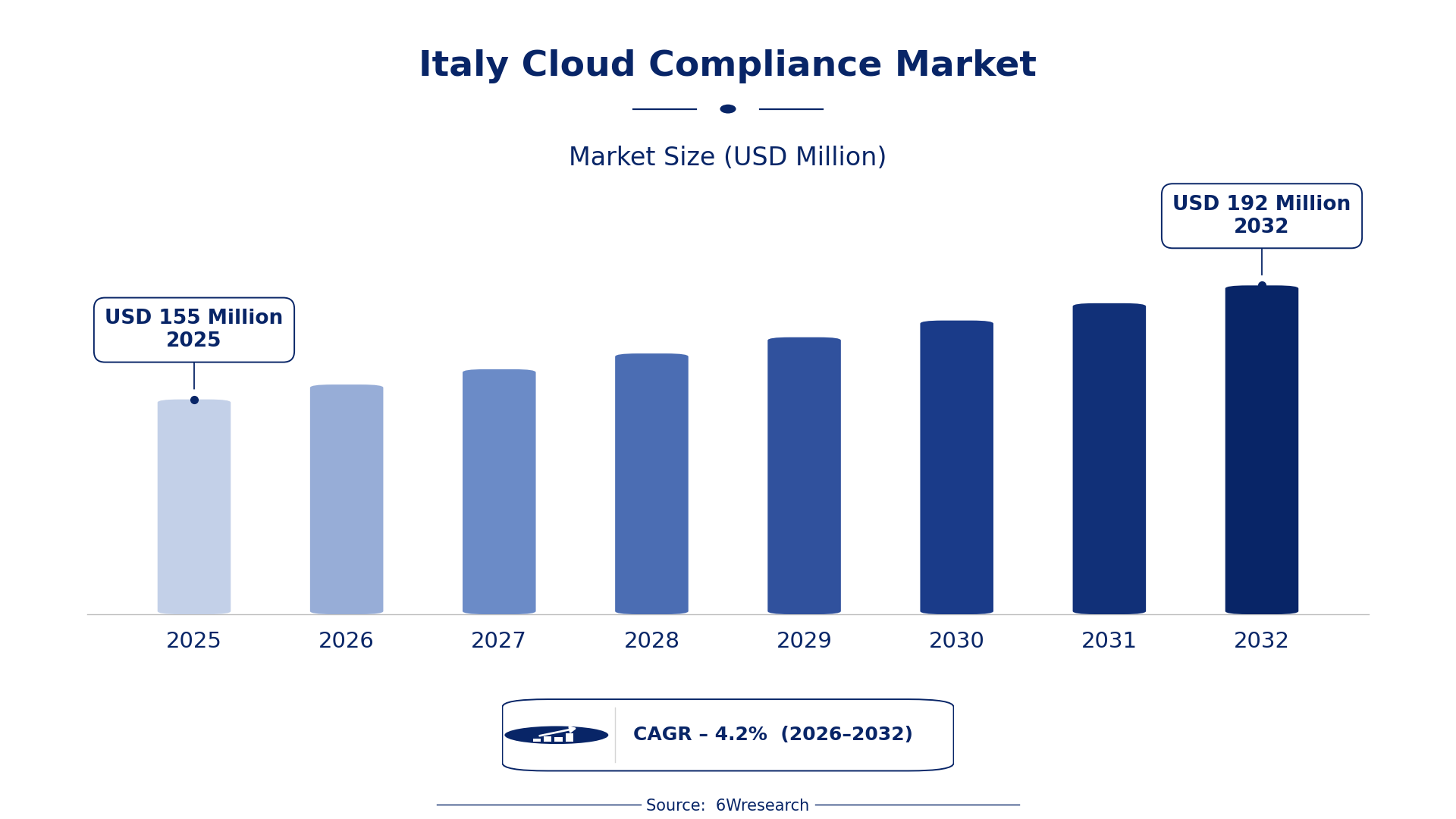
The Italy Cloud Compliance Market was estimated at USD 155 Million in 2025 and is projected to reach USD 192 Million by 2032, growing at a CAGR of 4.2% from 2026 to 2032.
Italy Cloud Compliance Market Synopsis
The driving force behind the Italy Cloud Compliance Market is the heightened focus on data protection regulations, particularly GDPR. As organizations across sectors like healthcare, finance, and retail adopt cloud services, they are compelled to align with stringent compliance standards, creating a robust demand for tailored cloud compliance solutions.
This growing regulatory scrutiny not only fosters market growth but also necessitates innovative compliance solutions. Providers are responding with an array of services, including data encryption and monitoring tools, to ensure that businesses can meet their legal obligations while maximizing the benefits of cloud technology.
Italy Cloud Compliance Market Year-wise Growth Rate and Key Drivers
This graph illustrates the annual growth rates of the Italy Cloud Compliance Market from 2021 to 2032, highlighting a steady upward trajectory and projected expansion over the forecast period.
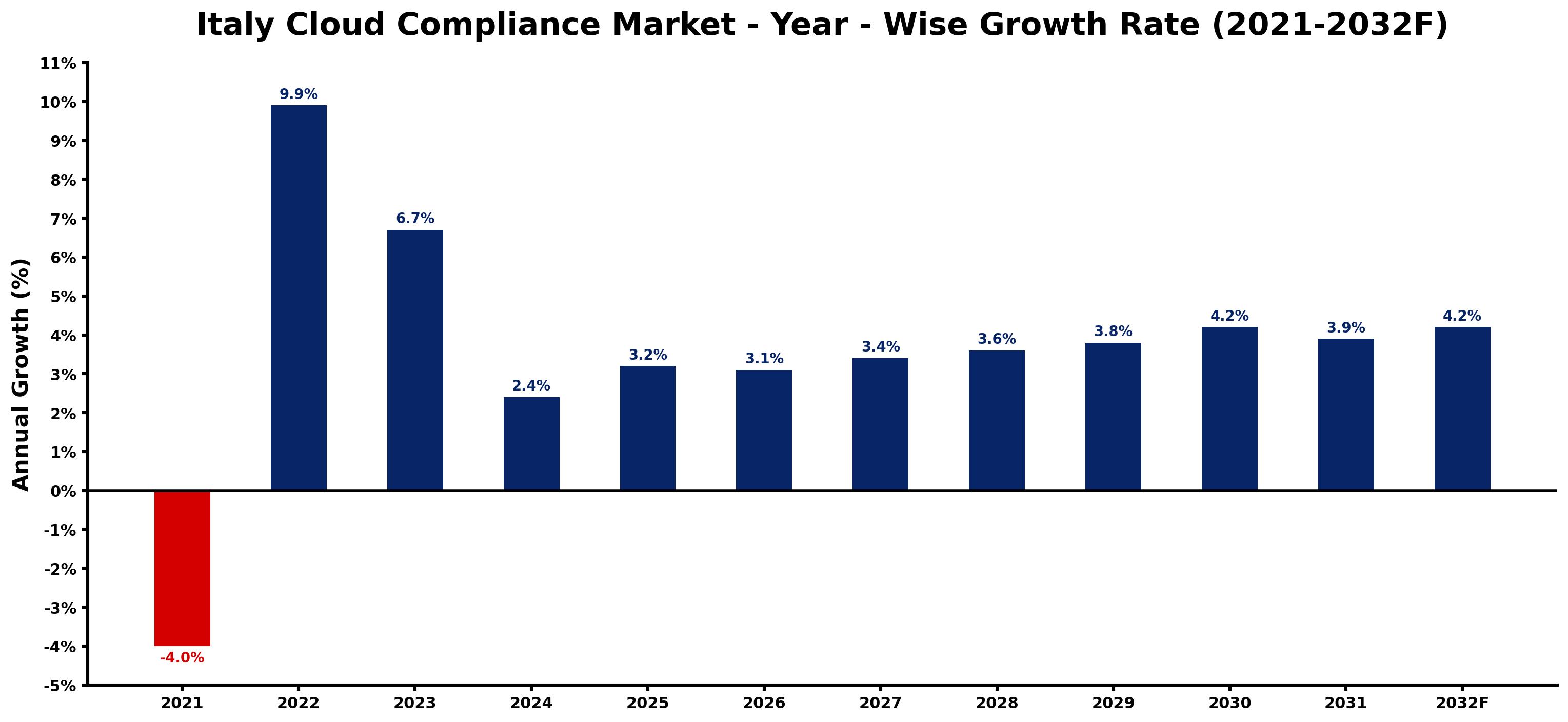
The table below presents the year‑wise growth rates along with the key drivers influencing the market
| Year | Growth Rate | Major Drivers |
| 2021 | -4.0% | Italian privacy regulations complicated cloud service compliance efforts. |
| 2022 | 9.9% | Implementation of GDPR compliance frameworks for businesses |
| 2023 | 6.7% | Increased demand for cloud audit services in enterprises |
| 2024 | 2.4% | New Italian regulations promoting digital transformation initiatives |
| 2025 | 3.2% | Adoption of eIDAS for cross-border digital transactions |
| 2026 | 3.1% | Focus on data protection solutions amid stringent regulations |
| 2027 | 3.4% | Growing investments in public cloud security compliance tools |
| 2028 | 3.6% | Rising awareness of cloud risk management among SMEs |
| 2029 | 3.8% | Government push for digitalization in public administration |
| 2030 | 4.2% | Enhanced privacy laws driving compliance software adoption |
| 2031 | 3.9% | Increased partnerships between cloud providers and compliance firms |
| 2032 | 4.2% | Adoption of AI tools for regulatory compliance automation |
Note: Market size estimations and growth projections presented in this report are based on 6Wresearch's proprietary forecasting methodology, utilizing the latest available industry data, government publications, and primary research inputs.
Italy Cloud Compliance Market Key Takeaways
Below are some of the specific key takeaways from the market, including:
- Increased investment in cloud compliance solutions to align with GDPR and other regulations.
- Growing adoption of technologies offering enhanced data encryption and monitoring capabilities.
- Demand for expert guidance in navigating complex compliance landscapes is rising.
- Companies are prioritizing comprehensive compliance strategies to protect sensitive data.
- Italy's stringent data protection laws create unique challenges and opportunities for compliance vendors.
Evaluation of Restraints in Italy Cloud Compliance Market
The Italy Cloud Compliance Market faces significant challenges due to the complexity of regulatory requirements. With GDPR setting a high bar for data protection, organizations must ensure compliance not only with EU regulations but also with Italy's own data protection code. This dual requirement complicates the operational landscape, particularly for businesses utilizing cloud services that may span multiple jurisdictions. Additionally, concerns regarding data sovereignty and security add layers of difficulty, as companies must balance the agility of cloud technology with their obligation to protect sensitive data. Navigating these complexities remains a critical hurdle for many businesses.
Italy Cloud Compliance Market Trends
A noticeable trend in the Italy Cloud Compliance Market is the shift towards integrated compliance solutions. Companies are increasingly seeking cloud compliance services that combine advanced features like encryption with monitoring tools to address regulatory needs effectively. This trend is further fueled by a growing recognition of the importance of data privacy and security, especially in light of recent high-profile data breaches.
In addition, the rise of remote work has catalyzed the demand for cloud compliance solutions that ensure security protocols are maintained outside traditional office settings. Organizations are investing in solutions that not only facilitate compliance but also enhance overall data governance in a digital-first world.
Italy Cloud Compliance Market Opportunities
Investment opportunities in the Italy Cloud Compliance Market are on the rise, primarily driven by the urgent need for compliance with data protection regulations. Companies that provide cloud compliance solutions, particularly those focused on data encryption, secure storage, and regulatory consulting, are well-positioned for growth. on top of that, as the regulatory environment continues to evolve, there is substantial potential for firms developing innovative compliance technologies that can adapt to new requirements. The ongoing digital transformation across industries also provides fertile ground for businesses that can effectively address compliance challenges in the cloud.
Government Initiatives in the Italy Cloud Compliance Market
Government policies play a critical role in shaping the Italy Cloud Compliance Market by enforcing regulations that prioritize data protection. The General Data Protection Regulation (GDPR) remains a cornerstone of compliance requirements, compelling organizations to adhere to strict data privacy standards. These regulatory frameworks not only mandate compliance but also foster a culture of accountability and transparency within the cloud services sector.
- A recently completed initiative involved the introduction of new guidelines under the Italian Data Protection Code aimed at enhancing data processing standards in cloud environments.
- Currently, an ongoing government review of compliance practices across various sectors seeks to identify gaps and improve adherence to GDPR mandates.
- Planned for 2026, a public-private partnership aims to enhance digital infrastructure, focusing on compliance and security in cloud services.
- Future policy discussions are expected to include revisions to existing data protection laws to better align with technological advancements.
- The establishment of a regulatory body dedicated to cloud compliance oversight is underway to streamline compliance processes for businesses.
Future Insights of the Italy Cloud Compliance Market
Looking ahead, the Italy Cloud Compliance Market is set for steady growth through 2032, fueled by the ongoing digital transformation across industries. As businesses increasingly adopt cloud solutions, the demand for compliance services that ensure data privacy and security will escalate. The focus on regulatory adherence will not only shape the market but also push providers to innovate continuously, creating tailored solutions that address the specific needs of various sectors. As regulatory frameworks evolve, those who can adapt swiftly will lead the charge in this competitive landscape.
Italy Cloud Compliance Market Latest Developments
In recent months, the Italy Cloud Compliance Market has seen a flurry of activity as organizations ramp up their efforts to comply with evolving regulations. Businesses are increasingly investing in comprehensive compliance solutions to address the challenges posed by GDPR and other data protection laws. This trend is not just limited to large corporations; smaller enterprises are also prioritizing compliance as a means to build trust with their clients.
- A major technology vendor launched a suite of advanced cloud compliance tools in early 2025, aimed at enhancing data security and regulatory adherence.
- An initiative began in mid-2025 to provide training programs for IT professionals focusing on best practices for cloud compliance and data protection.
- A planned rollout of a new compliance monitoring service is expected to begin in Q3 2026, designed to help organizations track their compliance status in real time.
- Currently underway, a partnership between several industry stakeholders aims to create a unified compliance framework for cloud services, enhancing clarity and consistency across sectors.
- In early 2025, a regional operator completed an upgrade of its cloud infrastructure, integrating advanced compliance features to better serve local businesses.
Italy Cloud Compliance Market - Key Attractiveness of the Report
- 10 Years of Market Numbers
- Historical Data Starting from 2022 to 2025
- Base Year: 2025
- Forecast Data until 2032
- Key Performance Indicators Impacting the Market
- Major Upcoming Developments and Projects
Key Highlights of the Report:
- Italy Cloud Compliance Market Outlook
- Market Size of Italy Cloud Compliance Market, 2025
- Forecast of Italy Cloud Compliance Market, 2032
- Historical Data and Forecast of Italy Cloud Compliance Revenues & Volume for the Period 2022-2032F
- Italy Cloud Compliance Market Trend Evolution
- Italy Cloud Compliance Market Drivers and Challenges
- Italy Cloud Compliance Price Trends
- Italy Cloud Compliance Porter's Five Forces
- Italy Cloud Compliance Industry Life Cycle
- Historical Data and Forecast of Italy Cloud Compliance Market Revenues & Volume By Component for the Period 2022-2032F
- Historical Data and Forecast of Italy Cloud Compliance Market Revenues & Volume By Software for the Period 2022-2032F
- Historical Data and Forecast of Italy Cloud Compliance Market Revenues & Volume By Services for the Period 2022-2032F
- Historical Data and Forecast of Italy Cloud Compliance Market Revenues & Volume By Cloud Model for the Period 2022-2032F
- Historical Data and Forecast of Italy Cloud Compliance Market Revenues & Volume By Infrastructure-as-a-Service (IaaS) for the Period 2022-2032F
- Historical Data and Forecast of Italy Cloud Compliance Market Revenues & Volume By Platform-as-a-Service (PaaS) for the Period 2022-2032F
- Historical Data and Forecast of Italy Cloud Compliance Market Revenues & Volume By Software-as-a-Service (SaaS) for the Period 2022-2032F
- Historical Data and Forecast of Italy Cloud Compliance Market Revenues & Volume By Application for the Period 2022-2032F
- Historical Data and Forecast of Italy Cloud Compliance Market Revenues & Volume By Audit and Compliance Management for the Period 2022-2032F
- Historical Data and Forecast of Italy Cloud Compliance Market Revenues & Volume By Threat Detection and Remediation for the Period 2022-2032F
- Historical Data and Forecast of Italy Cloud Compliance Market Revenues & Volume By Activity Monitoring and Analytics for the Period 2022-2032F
- Historical Data and Forecast of Italy Cloud Compliance Market Revenues & Volume By Visibility and Risk Assessment for the Period 2022-2032F
- Historical Data and Forecast of Italy Cloud Compliance Market Revenues & Volume By Other Applications for the Period 2022-2032F
- Historical Data and Forecast of Italy Cloud Compliance Market Revenues & Volume By Organization Size for the Period 2022-2032F
- Historical Data and Forecast of Italy Cloud Compliance Market Revenues & Volume By Large Enterprises for the Period 2022-2032F
- Historical Data and Forecast of Italy Cloud Compliance Market Revenues & Volume By Small and Medium-sized Enterprises (SMEs) for the Period 2022-2032F
- Historical Data and Forecast of Italy Cloud Compliance Market Revenues & Volume By Vertical for the Period 2022-2032F
- Historical Data and Forecast of Italy Cloud Compliance Market Revenues & Volume By Banking, Financial Services, and Insurance (BFSI) for the Period 2022-2032F
- Historical Data and Forecast of Italy Cloud Compliance Market Revenues & Volume By Government for the Period 2022-2032F
- Historical Data and Forecast of Italy Cloud Compliance Market Revenues & Volume By Healthcare for the Period 2022-2032F
- Historical Data and Forecast of Italy Cloud Compliance Market Revenues & Volume By IT and ITeS for the Period 2022-2032F
- Historical Data and Forecast of Italy Cloud Compliance Market Revenues & Volume By Retail and eCommerce for the Period 2022-2032F
- Historical Data and Forecast of Italy Cloud Compliance Market Revenues & Volume By Manufacturing for the Period 2022-2032F
- Italy Cloud Compliance Import Export Trade Statistics
- Market Opportunity Assessment By Component
- Market Opportunity Assessment By Cloud Model
- Market Opportunity Assessment By Application
- Market Opportunity Assessment By Organization Size
- Market Opportunity Assessment By Vertical
- Italy Cloud Compliance Top Companies Market Share
- Italy Cloud Compliance Competitive Benchmarking By Technical and Operational Parameters
- Italy Cloud Compliance Company Profiles
- Italy Cloud Compliance Key Strategic Recommendations






































