Italy Cloud CRM Market Size & Growth Rate (2026-2032)
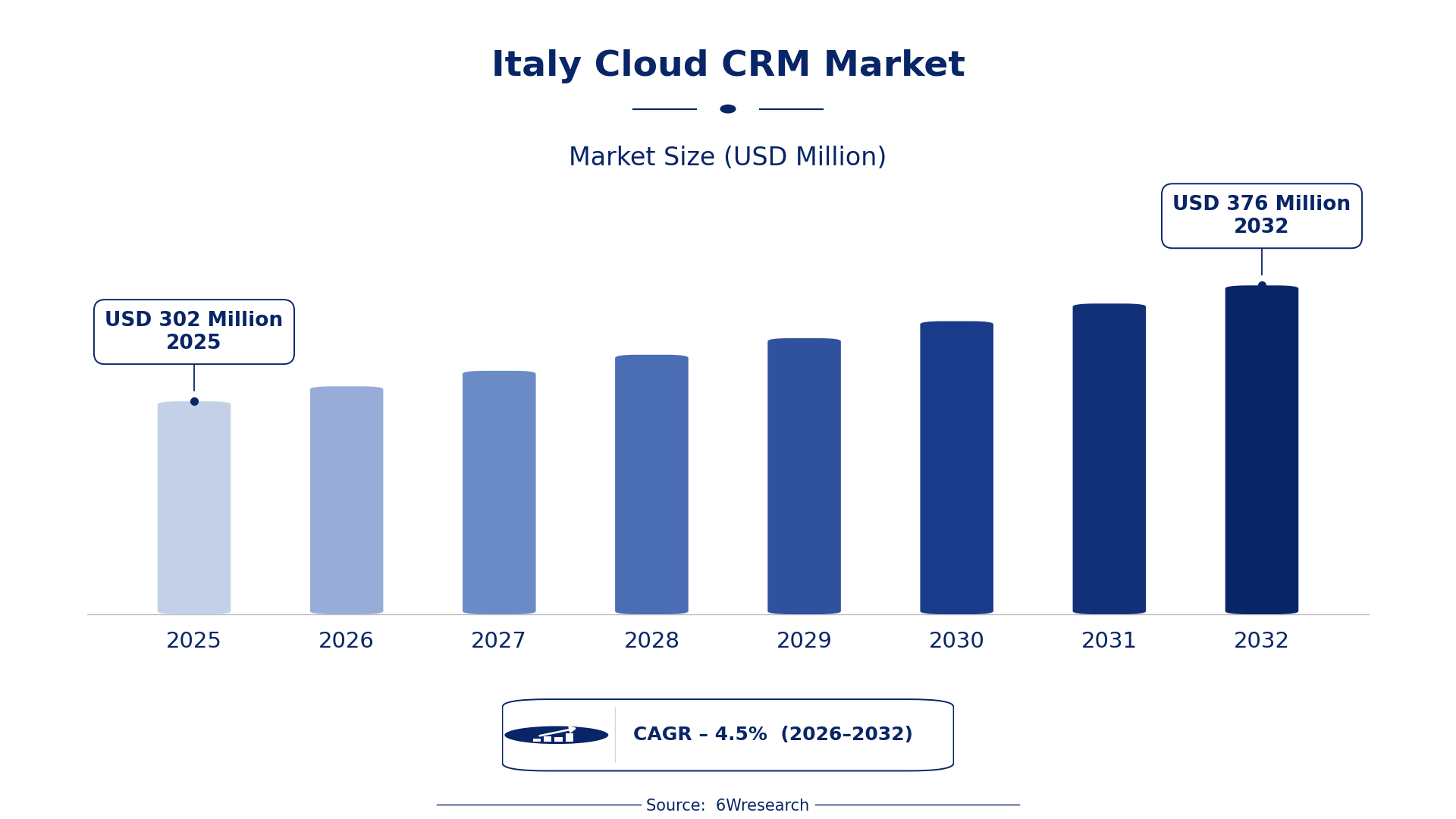
The Italy Cloud CRM Market was estimated at USD 302 Million in 2025 and is projected to reach USD 376 Million by 2032, growing at a CAGR of 4.5% from 2026 to 2032.
Italy Cloud CRM Market Synopsis
The Italy Cloud CRM market has gained momentum recently, propelled by businesses increasingly recognizing the value of cloud-based solutions for managing customer relationships. As organizations strive for improved customer engagement, the demand for efficient, scalable, and cost-effective CRM systems is surging.
Looking ahead, this market is set for significant expansion. As small and medium-sized enterprises (SMEs) adopt cloud solutions, the competitive landscape is expected to evolve, with a greater emphasis on personalized customer experiences and data-driven strategies.
Italy Cloud CRM Market Year-wise Growth Rate and Key Drivers
This graph illustrates the annual growth rates of the Italy Cloud CRM Market from 2021 to 2032, highlighting a steady upward trajectory and projected expansion over the forecast period.
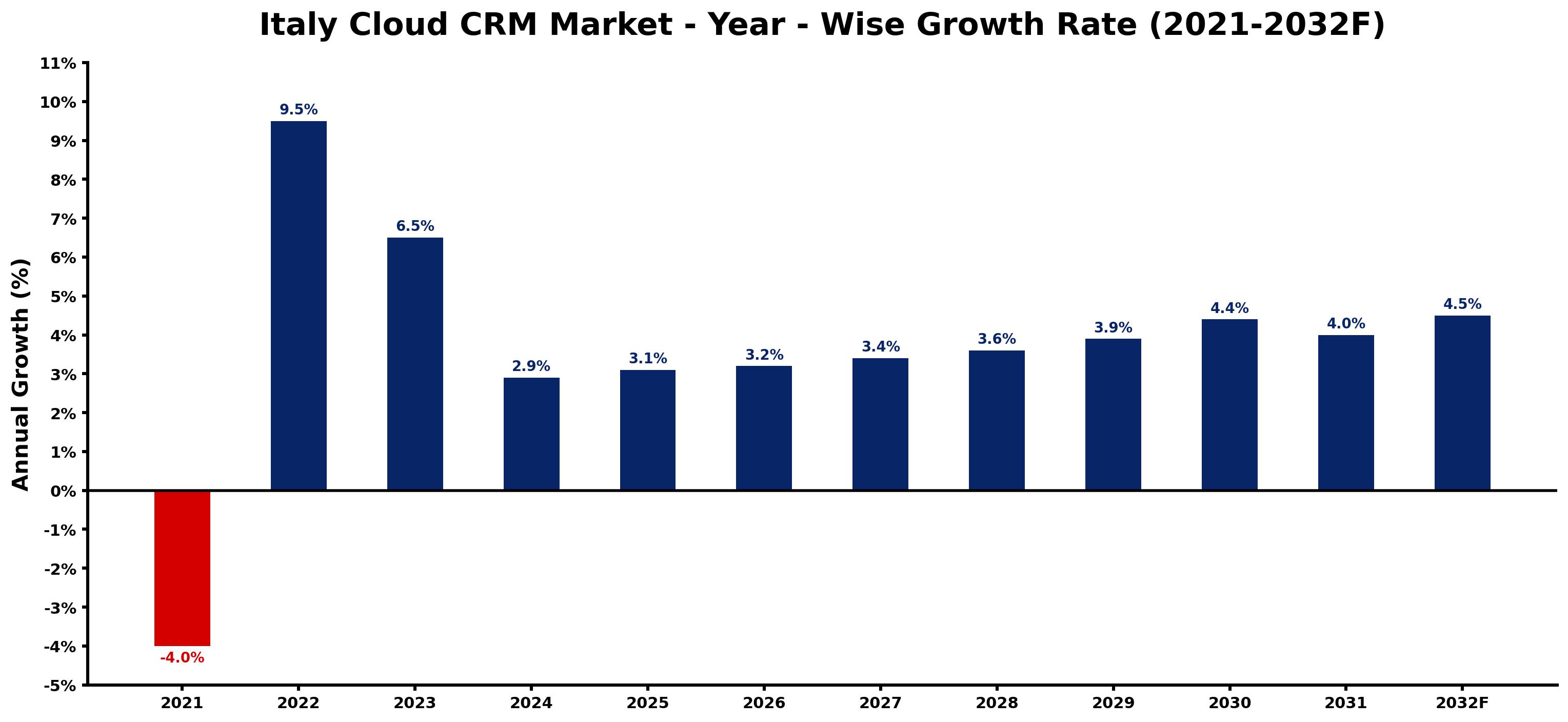
The table below presents the year‑wise growth rates along with the key drivers influencing the market
| Year | Growth Rate | Major Drivers |
| 2021 | -4.0% | Reduced spending driven by Italian pandemic recovery delays. |
| 2022 | 9.5% | Increased digital transformation investments by Italian SMEs |
| 2023 | 6.5% | Growing adoption of e-commerce platforms in Italy |
| 2024 | 2.9% | Government incentives for tech startups boosting CRM usage |
| 2025 | 3.1% | Rising focus on customer experience among Italian retailers |
| 2026 | 3.2% | Launch of 'Enterprise 4.0' initiative promoting digital tools |
| 2027 | 3.4% | Surge in remote customer service roles in Italy |
| 2028 | 3.6% | Expanding mobile internet penetration improving CRM access |
| 2029 | 3.9% | Italian enterprises migrating to subscription-based software models |
| 2030 | 4.4% | Focus on data security compliance stimulating CRM sales |
| 2031 | 4.0% | Increase in CRM integrations with Italian fintech solutions |
| 2032 | 4.5% | Growth of marketing automation driving CRM system adoption |
Note: Market size estimations and growth projections presented in this report are based on 6Wresearch's proprietary forecasting methodology, utilizing the latest available industry data, government publications, and primary research inputs.
Italy Cloud CRM Market Key Takeaways
Below are some of the specific key takeaways from the market, including:
- The market is dominated by the increasing adoption of cloud-based CRM solutions across various sectors.
- AI and machine learning technologies are becoming integral in enhancing customer interactions.
- Data security remains a critical concern, particularly in light of GDPR compliance requirements.
- Investment opportunities are on the rise as companies seek tailored CRM solutions for their unique needs.
- Government regulations are shaping the market, emphasizing data protection and cybersecurity.
Evaluation of Restraints in Italy Cloud CRM Market
Concerns about data security and compliance are among the primary restraints affecting the Italy Cloud CRM market. With stringent regulations like GDPR in place, businesses face significant challenges in ensuring that customer data is handled properly. Integration issues with legacy systems can complicate the adoption of new cloud solutions, leading to inefficiencies in data synchronization and process automation. on top of that, there is a noticeable shortage of skilled professionals equipped to implement and manage these cloud systems, which can hinder growth and innovation in the sector.
Italy Cloud CRM Market Trends
The demand for mobile CRM solutions is rising, driven by the need for remote access and real-time data insights. Integration of AI capabilities is becoming commonplace, allowing for more personalized customer interactions. The focus on data security and compliance continues to intensify, with businesses prioritizing solutions that ensure adherence to regulations. Additionally, there is a clear shift toward industry-specific CRM solutions, reflecting the unique requirements of sectors such as retail, healthcare, and finance.
Italy Cloud CRM Market Opportunities
Investment potential in the Italy Cloud CRM market is significant. Businesses are increasingly looking to streamline their customer relationship management through advanced cloud solutions. Opportunities abound in software development for innovative CRM tools tailored to local market needs, as well as consulting services that aid companies in transitioning to these platforms. Data security solutions are also in demand as organizations seek to mitigate risks associated with customer data protection.
Government Initiatives in the Italy Cloud CRM Market
Government policies in Italy are heavily focused on data protection and compliance, particularly in relation to the GDPR. This regulatory framework is vital in maintaining trust among businesses and consumers utilizing cloud CRM solutions. The Italian government is also prioritizing cybersecurity initiatives to ensure that customer information remains secure in the cloud environment.
- A national digital infrastructure upgrade programme recently completed, enhancing connectivity for cloud service providers.
- Current initiatives aimed at educating businesses about GDPR compliance and data protection standards are underway.
- Plans for a public-private partnership set to launch in 2026, targeting improvements in cybersecurity for cloud applications.
- Ongoing regulatory reviews to strengthen data handling guidelines and protect consumer privacy.
- Recent updates to the Italian Data Protection Code, aligning it further with EU regulations to enhance clarity on cloud CRM operations.
Future Insights of the Italy Cloud CRM Market
The Italy Cloud CRM market is expected to witness continued growth through 2032, driven by the increasing emphasis on customer-centric strategies. The push for digital transformation will accelerate the adoption of advanced CRM features, such as AI-driven analytics and mobile capabilities. The ongoing shift towards remote work will further reinforce the need for flexible, accessible CRM solutions. Businesses that prioritize these technologies will be well-positioned to thrive in the evolving market landscape.
Italy Cloud CRM Market Latest Developments
In the past year, the Italy Cloud CRM market has seen a surge of activity, with companies increasingly adopting innovative technologies to enhance customer engagement. As digital transformation accelerates, organizations are integrating advanced features into their CRM systems to stay competitive.
- A major technology vendor announced the launch of a new AI-powered CRM platform in early 2025, aiming to provide deeper customer insights.
- An initiative currently underway focuses on enhancing mobile CRM functionalities to meet the demands of remote work environments.
- A partnership between regional firms is expected to improve the integration of cloud CRM systems with existing legacy infrastructures by mid-2026.
- Upcoming training programs scheduled for Q3 2025 aim to address the skills gap in CRM system management.
- A leading consultancy firm is rolling out a new service aimed at helping SMEs transition to cloud-based CRM solutions, starting in early 2025.
Italy Cloud CRM Market - Key Attractiveness of the Report
- 10 Years of Market Numbers
- Historical Data Starting from 2022 to 2025
- Base Year: 2025
- Forecast Data until 2032
- Key Performance Indicators Impacting the Market
- Major Upcoming Developments and Projects
Key Highlights of the Report:
- Italy Cloud CRM Market Outlook
- Market Size of Italy Cloud CRM Market, 2025
- Forecast of Italy Cloud CRM Market, 2032
- Historical Data and Forecast of Italy Cloud CRM Revenues & Volume for the Period 2022-2032F
- Italy Cloud CRM Market Trend Evolution
- Italy Cloud CRM Market Drivers and Challenges
- Italy Cloud CRM Price Trends
- Italy Cloud CRM Porter's Five Forces
- Italy Cloud CRM Industry Life Cycle
- Historical Data and Forecast of Italy Cloud CRM Market Revenues & Volume By Vertical for the Period 2022-2032F
- Historical Data and Forecast of Italy Cloud CRM Market Revenues & Volume By Nonprofit for the Period 2022-2032F
- Historical Data and Forecast of Italy Cloud CRM Market Revenues & Volume By Higher Education for the Period 2022-2032F
- Historical Data and Forecast of Italy Cloud CRM Market Revenues & Volume By Nonprofit Sub Vertical for the Period 2022-2032F
- Historical Data and Forecast of Italy Cloud CRM Market Revenues & Volume By Education for the Period 2022-2032F
- Historical Data and Forecast of Italy Cloud CRM Market Revenues & Volume By Research and Innovation for the Period 2022-2032F
- Historical Data and Forecast of Italy Cloud CRM Market Revenues & Volume By Social Affairs for the Period 2022-2032F
- Historical Data and Forecast of Italy Cloud CRM Market Revenues & Volume By Children and Youth for the Period 2022-2032F
- Historical Data and Forecast of Italy Cloud CRM Market Revenues & Volume By Art and Culture for the Period 2022-2032F
- Historical Data and Forecast of Italy Cloud CRM Market Revenues & Volume By Others for the Period 2022-2032F
- Italy Cloud CRM Import Export Trade Statistics
- Market Opportunity Assessment By Vertical
- Market Opportunity Assessment By Nonprofit Sub Vertical
- Italy Cloud CRM Top Companies Market Share
- Italy Cloud CRM Competitive Benchmarking By Technical and Operational Parameters
- Italy Cloud CRM Company Profiles
- Italy Cloud CRM Key Strategic Recommendations






































