Italy Construction Glass Market Size Growth Rate
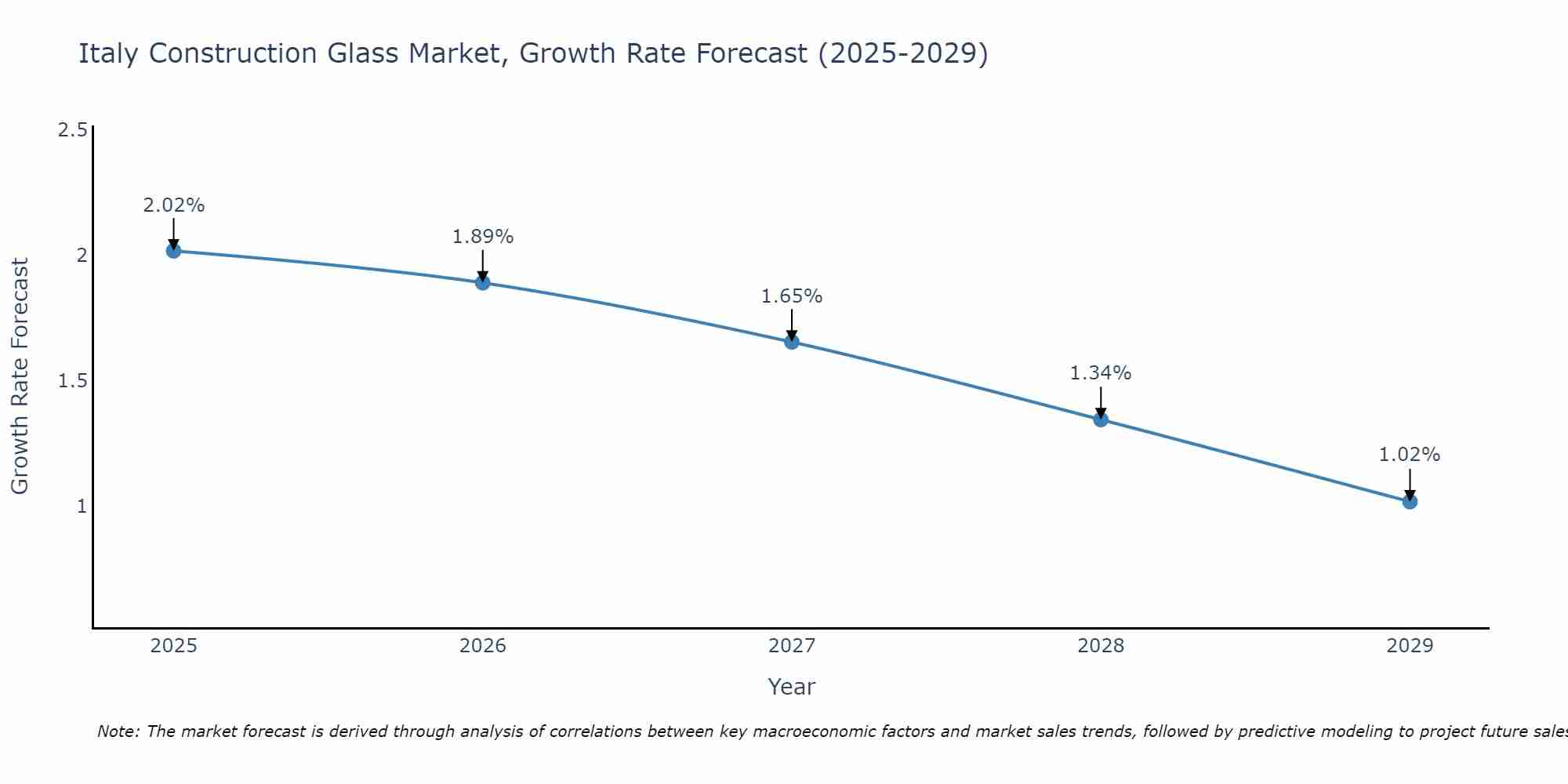
The Italy Construction Glass Market could see a tapering of growth rates over 2025 to 2029. Beginning strongly at 2.02% in 2025, growth softens to 1.02% in 2029.
Italy Construction Glass Market Synopsis
Glass is a versatile material used in construction for facades, windows, and interior design elements. In Italy, the construction glass market is driven by architectural trends, energy efficiency requirements, and advancements in glass manufacturing technology. Italy glass producers specialize in innovative glass solutions, including low-emissivity coatings, laminates, and decorative finishes, contributing to sustainable and visually appealing building designs.
Drivers of the market
The Italy construction glass market is experiencing robust growth driven by several key factors. One significant driver is the increasing demand for energy-efficient and aesthetically appealing glass products in the construction industry. With rising awareness of the environmental impact of buildings and stringent energy efficiency regulations, there is a growing preference for high-performance glass solutions that offer superior thermal insulation and daylighting properties. Additionally, the proliferation of smart building technologies and the trend towards modern architectural designs are driving the adoption of advanced glass products with features such as solar control, self-cleaning coatings, and integrated sensors. Moreover, favorable government policies promoting sustainable construction practices and energy-efficient building materials are further fueling market growth.
Challenges of the market
The construction glass market in Italy faces challenges related to energy efficiency regulations and standards. Meeting stringent energy performance requirements while maintaining aesthetic appeal and structural integrity poses technical challenges for glass manufacturers.
Government Policy of the market
Government policies in Italy aim to support the development of the construction glass market by promoting energy efficiency, safety, and innovation. Regulations focus on improving thermal insulation properties, enhancing structural strength, and ensuring product durability and safety standards. Additionally, there are incentives for research and development in glass technology and initiatives to encourage the use of recycled glass to reduce environmental footprint in the construction sector.
Key Highlights of the Report:
- Italy Construction Glass Market Outlook
- Market Size of Italy Construction Glass Market, 2024
- Forecast of Italy Construction Glass Market, 2031
- Historical Data and Forecast of Italy Construction Glass Revenues & Volume for the Period 2018 - 2031
- Italy Construction Glass Market Trend Evolution
- Italy Construction Glass Market Drivers and Challenges
- Italy Construction Glass Price Trends
- Italy Construction Glass Porter's Five Forces
- Italy Construction Glass Industry Life Cycle
- Historical Data and Forecast of Italy Construction Glass Market Revenues & Volume By Chemical Composition for the Period 2018 - 2031
- Historical Data and Forecast of Italy Construction Glass Market Revenues & Volume By Soda-lime for the Period 2018 - 2031
- Historical Data and Forecast of Italy Construction Glass Market Revenues & Volume By Potash-lime for the Period 2018 - 2031
- Historical Data and Forecast of Italy Construction Glass Market Revenues & Volume By Potash-lead for the Period 2018 - 2031
- Historical Data and Forecast of Italy Construction Glass Market Revenues & Volume By Type for the Period 2018 - 2031
- Historical Data and Forecast of Italy Construction Glass Market Revenues & Volume By Low-e Glass for the Period 2018 - 2031
- Historical Data and Forecast of Italy Construction Glass Market Revenues & Volume By Special Glass for the Period 2018 - 2031
- Historical Data and Forecast of Italy Construction Glass Market Revenues & Volume By Manufacturing Process for the Period 2018 - 2031
- Historical Data and Forecast of Italy Construction Glass Market Revenues & Volume By Float Process for the Period 2018 - 2031
- Historical Data and Forecast of Italy Construction Glass Market Revenues & Volume By Rolled/sheet Process for the Period 2018 - 2031
- Historical Data and Forecast of Italy Construction Glass Market Revenues & Volume By Application for the Period 2018 - 2031
- Historical Data and Forecast of Italy Construction Glass Market Revenues & Volume By Residential for the Period 2018 - 2031
- Historical Data and Forecast of Italy Construction Glass Market Revenues & Volume By Commercial for the Period 2018 - 2031
- Historical Data and Forecast of Italy Construction Glass Market Revenues & Volume By Others for the Period 2018 - 2031
- Italy Construction Glass Import Export Trade Statistics
- Market Opportunity Assessment By Chemical Composition
- Market Opportunity Assessment By Type
- Market Opportunity Assessment By Manufacturing Process
- Market Opportunity Assessment By Application
- Italy Construction Glass Top Companies Market Share
- Italy Construction Glass Competitive Benchmarking By Technical and Operational Parameters
- Italy Construction Glass Company Profiles
- Italy Construction Glass Key Strategic Recommendations






































