Italy Database Security Market Size & Growth Rate (2026-2032)
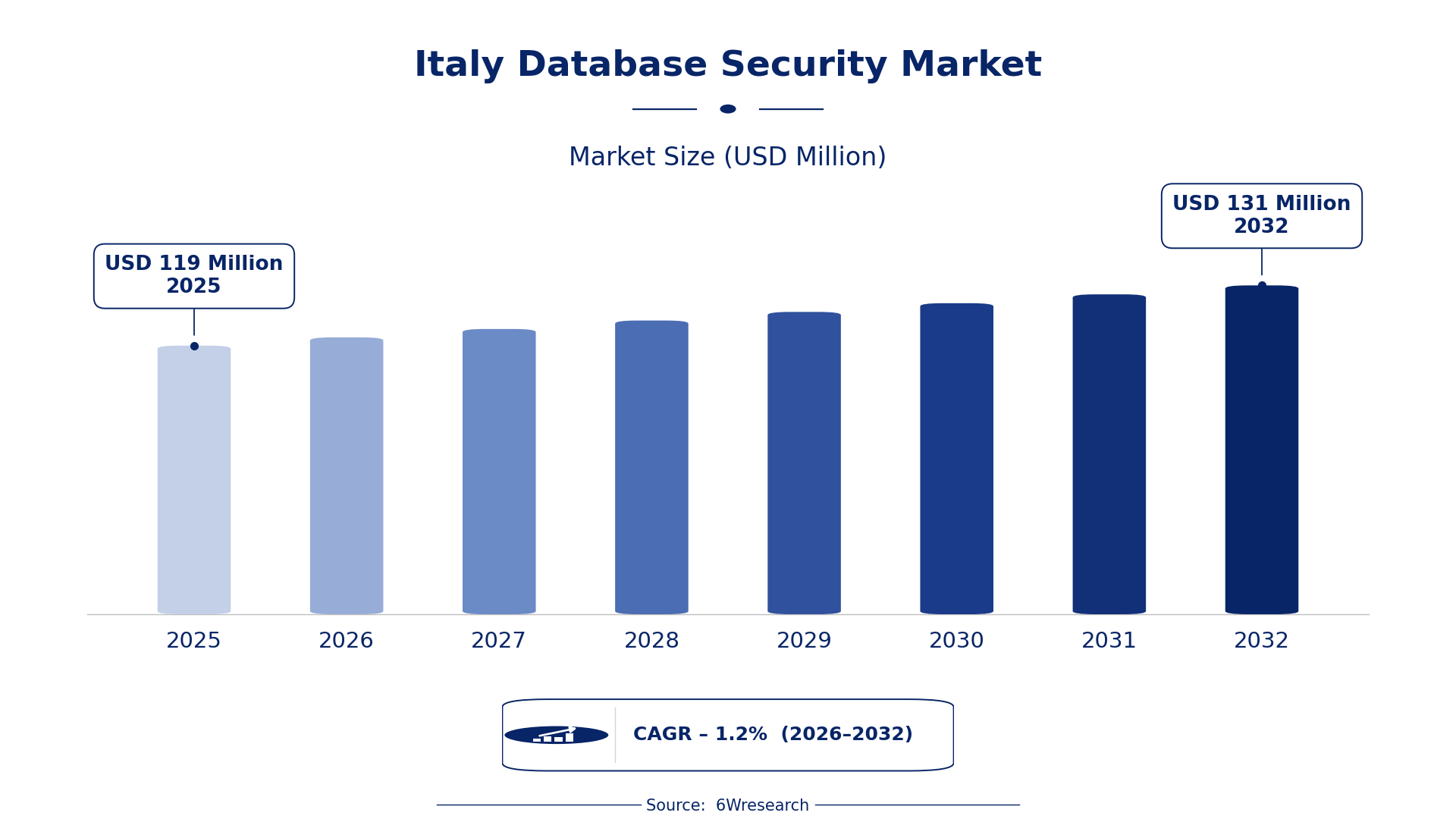
The Italy Database Security Market was estimated at USD 119 Million in 2025 and is projected to reach USD 131 Million by 2032, growing at a CAGR of 1.2% from 2026 to 2032.
Italy Database Security Market Synopsis
The rising frequency of data breaches in Italy has compelled organizations to prioritize database security as a core component of their overall IT strategy. As cyber threats evolve, businesses are focusing on implementing advanced solutions, such as encryption and activity monitoring, to protect their sensitive data from both internal and external threats.
Regulatory compliance, particularly with GDPR, has become a key driver of market growth. Companies recognize that failure to safeguard personal data can lead to severe penalties, pushing them to invest in comprehensive security measures that ensure compliance and protect customer trust.
Italy Database Security Market Year-wise Growth Rate and Key Drivers
This graph illustrates the annual growth rates of the Italy Database Security Market from 2021 to 2032, highlighting a steady upward trajectory and projected expansion over the forecast period.
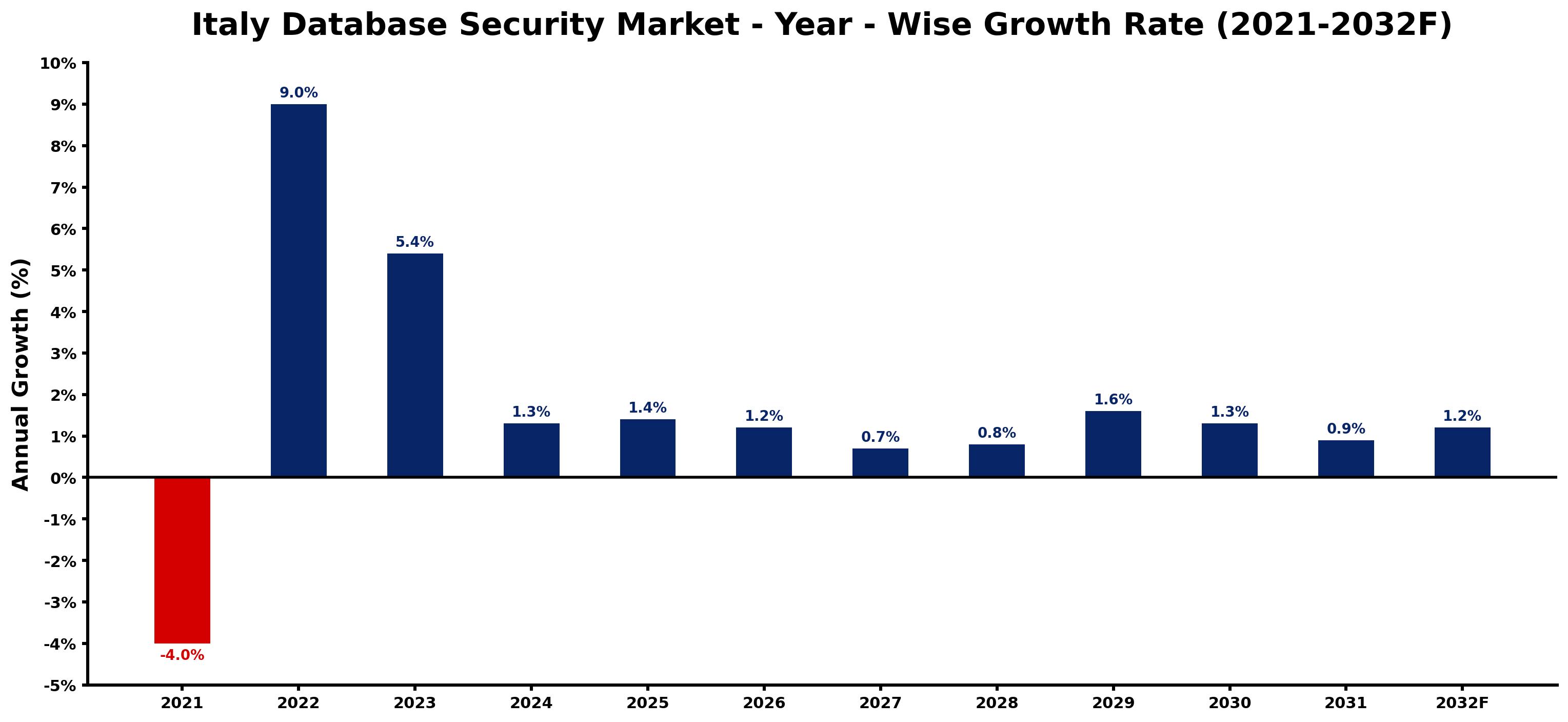
The table below presents the year‑wise growth rates along with the key drivers influencing the market
| Year | Growth Rate | Major Drivers |
| 2021 | -4.0% | GDPR compliance costs impacted small business investments. |
| 2022 | 9.0% | GDPR compliance driving demand for data protection solutions. |
| 2023 | 5.4% | Increased cybersecurity incidents prompting investment in data security. |
| 2024 | 1.3% | Government cybersecurity initiatives fostering sector growth opportunities. |
| 2025 | 1.4% | Adoption of cloud services increasing data privacy requirements. |
| 2026 | 1.2% | Digital transformation trends boosting database security investments. |
| 2027 | 0.7% | Growing focus on data breach reporting regulations influencing purchases. |
| 2028 | 0.8% | Rise in e-commerce heightening need for transaction security. |
| 2029 | 1.6% | Increasing data localization laws driving local security solutions. |
| 2030 | 1.3% | Development of advanced encryption standards enhancing market confidence. |
| 2031 | 0.9% | Collaboration between tech firms and government securing data frameworks. |
| 2032 | 1.2% | Expanding IoT device use heightening database security awareness. |
Note: Market size estimations and growth projections presented in this report are based on 6Wresearch's proprietary forecasting methodology, utilizing the latest available industry data, government publications, and primary research inputs.
Italy Database Security Market Key Takeaways
Below are some of the specific key takeaways from the market, including:
- The increasing complexity of cyber threats necessitates advanced database security solutions.
- Organizations are investing heavily in encryption technologies to protect sensitive information.
- Compliance with GDPR is driving demand for robust security measures across various sectors.
- Regular audits and monitoring are becoming standard practices for database security management.
- Integration of AI and machine learning in security solutions is emerging as a significant trend.
Evaluation of Restraints in Italy Database Security Market
Despite the growing recognition of database security's importance, various challenges hinder market progress. A major concern is the sophistication of cyber threats, which demands constant evolution of security measures. Many organizations struggle with the dual pressures of enhancing security while ensuring system performance and user productivity. Additionally, maintaining compliance across multiple regulations adds complexity and cost, which can be daunting for smaller enterprises.
Italy Database Security Market Trends
A noticeable trend in the Italy Database Security Market is the shift towards cloud-based security solutions. As organizations adopt cloud technologies, they seek integrated security frameworks that can protect databases across both on-premises and cloud environments. The use of artificial intelligence and machine learning for threat detection is also gaining traction, enabling organizations to proactively identify and mitigate risks before they materialize. on top of that, there is an increasing focus on data privacy and ethical handling of information, which aligns with stringent regulatory demands.
Italy Database Security Market Opportunities
The market presents ample opportunities for growth, particularly in the development of tailored security solutions for small and medium-sized enterprises (SMEs). As these organizations become more aware of the risks they face, they are actively seeking affordable and effective security measures. on top of that, partnerships between technology providers and businesses to develop customized security programs represent a promising avenue for innovation and market penetration.
Government Initiatives in the Italy Database Security Market
The Italian government is taking decisive action to enhance data security across various sectors. With a stringent regulatory framework in place, public policy is increasingly focused on ensuring that organizations implement adequate security measures. This emphasis on compliance, particularly with GDPR, is reshaping the database security market, fostering a culture of accountability among businesses.
- A regulatory framework was introduced in 2025 mandating enhanced data protection protocols for all sectors handling personal information.
- Currently ongoing is a national initiative aimed at increasing cybersecurity awareness and training for organizations to improve their database security practices.
- A planned public-private initiative expected to expand cybersecurity resources and infrastructure by 2028 aims to bolster the overall resilience of the country’s digital ecosystem.
- Recent updates to cybersecurity policies have led to the establishment of guidelines for regular security audits and compliance checks.
- The government launched an educational program in early 2025 to promote best practices in database security among SMEs.
Future Insights of the Italy Database Security Market
Looking ahead to 2026-2032, the Italy Database Security Market is set to experience steady growth. As digital transformation accelerates, organizations will increasingly invest in comprehensive database protection strategies. The convergence of emerging technologies, such as AI, with traditional security measures will provide organizations with innovative tools to combat cyber threats. Additionally, greater collaboration between public and private sectors will enhance the collective capability to secure sensitive data against evolving risks.
Italy Database Security Market Latest Developments
In the past year, the Italy Database Security Market has witnessed a flurry of activity, with various organizations reinforcing their database security frameworks. As the threat of cyberattacks looms large, companies are eager to stay ahead by adopting the latest security technologies and practices.
- A major technology vendor launched a new encryption solution in Q1 2025 aimed specifically at protecting sensitive customer data in compliance with GDPR.
- An initiative that began in mid-2025 and remains underway focuses on enhancing collaboration between government and private sector firms to address cybersecurity challenges effectively.
- In late 2025, a leading regional operator announced plans to integrate AI-driven analytics into its database security protocols to improve threat detection capabilities.
- A recent partnership between educational institutions and industry players was formed to create a comprehensive training program for cybersecurity professionals, expected to roll out by mid-2026.
- Upcoming legislation is being drafted to mandate stricter compliance checks and regular audits for organizations handling sensitive data, with implementation expected by 2027.
Italy Database Security Market - Key Attractiveness of the Report
- 10 Years of Market Numbers
- Historical Data Starting from 2022 to 2025
- Base Year: 2025
- Forecast Data until 2032
- Key Performance Indicators Impacting the Market
- Major Upcoming Developments and Projects
Key Highlights of the Report:
- Italy Database Security Market Outlook
- Market Size of Italy Database Security Market, 2025
- Forecast of Italy Database Security Market, 2032
- Historical Data and Forecast of Italy Database Security Revenues & Volume for the Period 2022-2032F
- Italy Database Security Market Trend Evolution
- Italy Database Security Market Drivers and Challenges
- Italy Database Security Price Trends
- Italy Database Security Porter's Five Forces
- Italy Database Security Industry Life Cycle
- Historical Data and Forecast of Italy Database Security Market Revenues & Volume By Component for the Period 2022-2032F
- Historical Data and Forecast of Italy Database Security Market Revenues & Volume By Solution for the Period 2022-2032F
- Historical Data and Forecast of Italy Database Security Market Revenues & Volume By Services for the Period 2022-2032F
- Historical Data and Forecast of Italy Database Security Market Revenues & Volume By Business function for the Period 2022-2032F
- Historical Data and Forecast of Italy Database Security Market Revenues & Volume By Marketing for the Period 2022-2032F
- Historical Data and Forecast of Italy Database Security Market Revenues & Volume By sales for the Period 2022-2032F
- Historical Data and Forecast of Italy Database Security Market Revenues & Volume By finance for the Period 2022-2032F
- Historical Data and Forecast of Italy Database Security Market Revenues & Volume By operations for the Period 2022-2032F
- Historical Data and Forecast of Italy Database Security Market Revenues & Volume By Organization Size for the Period 2022-2032F
- Historical Data and Forecast of Italy Database Security Market Revenues & Volume By Large Enterprises for the Period 2022-2032F
- Historical Data and Forecast of Italy Database Security Market Revenues & Volume By SMEs for the Period 2022-2032F
- Historical Data and Forecast of Italy Database Security Market Revenues & Volume By Deployment Mode for the Period 2022-2032F
- Historical Data and Forecast of Italy Database Security Market Revenues & Volume By Cloud for the Period 2022-2032F
- Historical Data and Forecast of Italy Database Security Market Revenues & Volume By On-premises for the Period 2022-2032F
- Historical Data and Forecast of Italy Database Security Market Revenues & Volume By Vertical for the Period 2022-2032F
- Historical Data and Forecast of Italy Database Security Market Revenues & Volume By Banking, Financial Services, And Insurance for the Period 2022-2032F
- Historical Data and Forecast of Italy Database Security Market Revenues & Volume By Telecommunication and IT for the Period 2022-2032F
- Historical Data and Forecast of Italy Database Security Market Revenues & Volume By Government and Defense for the Period 2022-2032F
- Historical Data and Forecast of Italy Database Security Market Revenues & Volume By Manufacturing for the Period 2022-2032F
- Historical Data and Forecast of Italy Database Security Market Revenues & Volume By Healthcare and life sciences for the Period 2022-2032F
- Historical Data and Forecast of Italy Database Security Market Revenues & Volume By Retail and Ecommerce for the Period 2022-2032F
- Historical Data and Forecast of Italy Database Security Market Revenues & Volume By Energy and Utilities for the Period 2022-2032F
- Italy Database Security Import Export Trade Statistics
- Market Opportunity Assessment By Component
- Market Opportunity Assessment By Business function
- Market Opportunity Assessment By Organization Size
- Market Opportunity Assessment By Deployment Mode
- Market Opportunity Assessment By Vertical
- Italy Database Security Top Companies Market Share
- Italy Database Security Competitive Benchmarking By Technical and Operational Parameters
- Italy Database Security Company Profiles
- Italy Database Security Key Strategic Recommendations






































