Italy Digital Signature Market Size & Growth Rate (2026-2032)
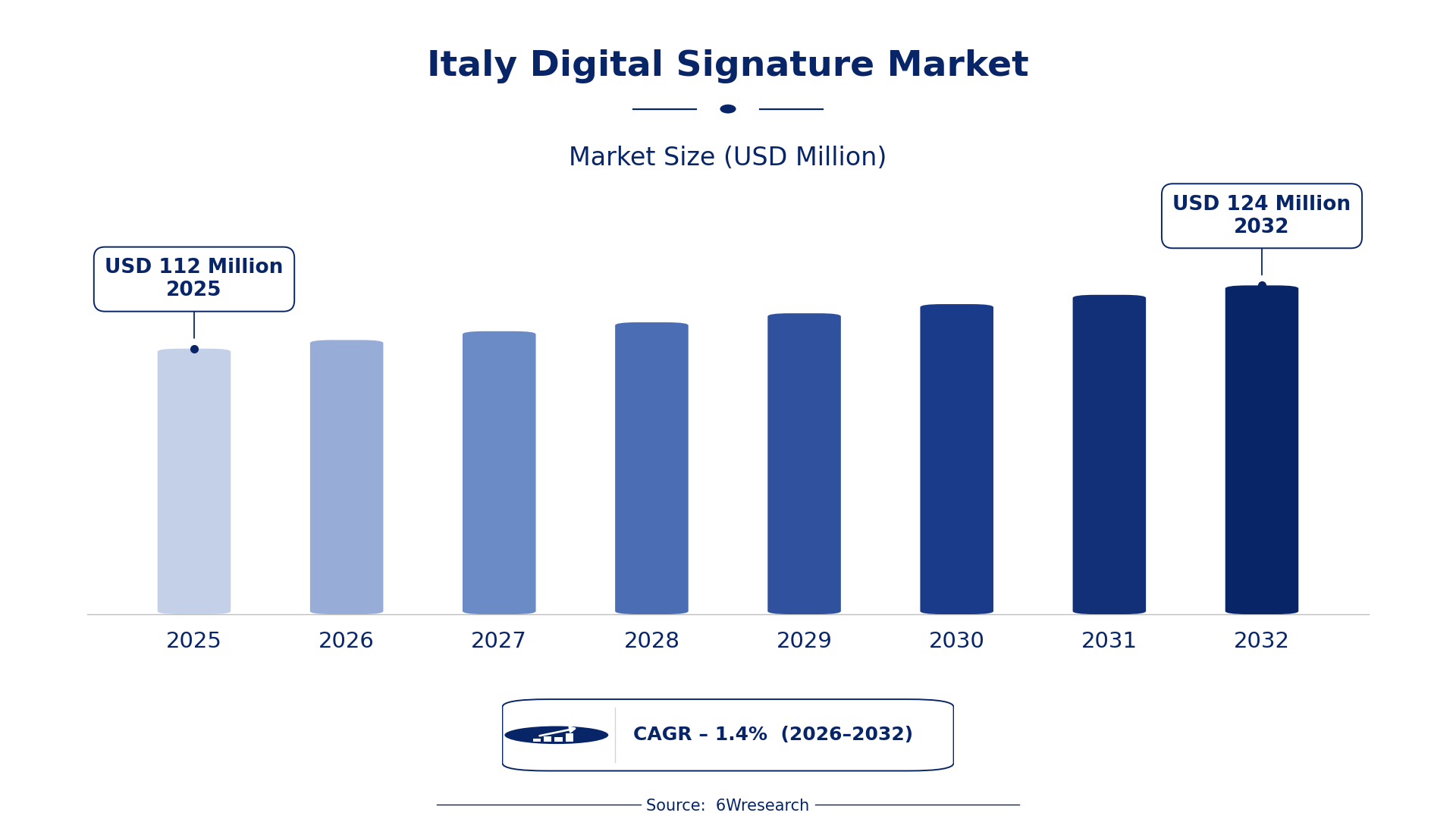
The Italy Digital Signature Market was estimated at USD 112 Million in 2025 and is projected to reach USD 124 Million by 2032, growing at a CAGR of 1.4% from 2026 to 2032.
Italy Digital Signature Market Synopsis
The shift towards digital transactions in Italy has created a robust demand for digital signature solutions that ensure secure and efficient document signing. Businesses and government entities are increasingly recognizing the legal validity and authentication provided by digital signatures, which is enhancing their appeal across various sectors.
Regulatory frameworks are playing a critical role in this market's growth, as they promote digital solutions for electronic transactions. With an emphasis on reducing paperwork and enhancing cybersecurity measures, the adoption of digital signatures is expected to continue its upward trajectory in Italy.
Italy Digital Signature Market Year-wise Growth Rate and Key Drivers
This graph illustrates the annual growth rates of the Italy Digital Signature Market from 2021 to 2032, highlighting a steady upward trajectory and projected expansion over the forecast period.
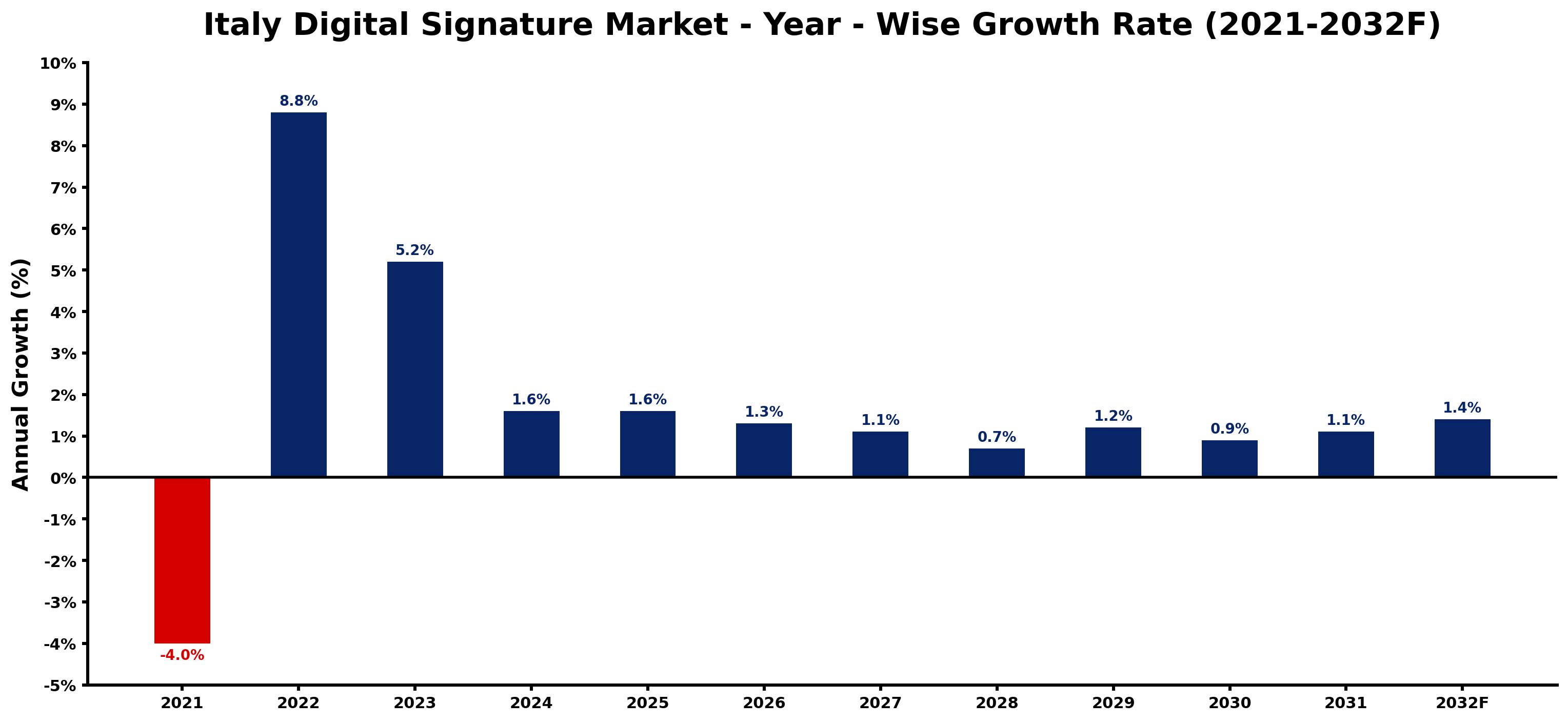
The table below presents the year‑wise growth rates along with the key drivers influencing the market
| Year | Growth Rate | Major Drivers |
| 2021 | -4.0% | EU eIDAS regulation delays hindered market adoption. |
| 2022 | 8.8% | EU Digital Identity Regulation fostering electronic signatures adoption |
| 2023 | 5.2% | Implementation of eIDAS regulation boosts cross-border signature usability |
| 2024 | 1.6% | Increased adoption of smart contracts in Italian startups |
| 2025 | 1.6% | Government initiatives promoting digital transformation in SMEs |
| 2026 | 1.3% | Significant growth in remote working driving digital signature needs |
| 2027 | 1.1% | Increased regulatory focus on data protection compliance mandates |
| 2028 | 0.7% | Rising usage of blockchain enhances security for digital signatures |
| 2029 | 1.2% | Public awareness campaigns highlighting benefits of digital signatures |
| 2030 | 0.9% | Integration of digital signature systems in government services |
| 2031 | 1.1% | Collaboration with fintech boosting innovation in digital signature tools |
| 2032 | 1.4% | Growth in legal tech sector increasing electronic document handling |
Note: Market size estimations and growth projections presented in this report are based on 6Wresearch's proprietary forecasting methodology, utilizing the latest available industry data, government publications, and primary research inputs.
Italy Digital Signature Market Key Takeaways
Below are some of the specific key takeaways from the market, including:
- The market is being driven by the legal recognition and efficiency of digital signatures across various sectors.
- Increased regulatory support is providing a favorable environment for the adoption of digital signatures.
- Challenges related to data security and system compatibility persist, requiring continuous technological advancements.
- The push for digital transformation in public and private sectors is fueling demand for secure digital authentication.
Evaluation of Restraints in Italy Digital Signature Market
Despite the growth prospects, the Italy Digital Signature Market is hampered by several challenges. One of the primary issues is the need for robust and secure digital signature solutions that can effectively operate within existing IT infrastructures. Compatibility with diverse systems is a major concern, as many organizations still rely on legacy technologies. Furthermore, high implementation costs associated with advanced solutions can deter businesses from adopting these technologies. The market requires not just technological advancement but also a culture shift towards accepting and utilizing digital signatures in everyday transactions.
Italy Digital Signature Market Trends
Current trends reflect an increasing integration of artificial intelligence and blockchain technology in digital signature solutions. These technologies enhance security and streamline processes, making digital signatures more reliable. Additionally, the rising demand for remote work solutions has led to a surge in digital signature adoption among businesses looking to maintain productivity while ensuring compliance.
Italy Digital Signature Market Opportunities
There are significant growth opportunities within sectors like finance, healthcare, and government, where secure document handling is paramount. The recent emphasis on cybersecurity has opened avenues for innovative digital signature solutions that ensure data integrity and authentication. As businesses seek to digitize their operations, investment in digital signature technology is set to increase, driven by the need for efficiency and compliance.
Government Initiatives in the Italy Digital Signature Market
The Italian government has recognized the pivotal role of digital signatures in enhancing electronic transactions and reducing bureaucratic processes. Ongoing policy measures aim to establish clear legal frameworks that encourage the adoption of digital signatures while ensuring their interoperability with international standards. This governmental commitment to promoting digital solutions is crucial for the market's growth.
- A regulatory framework introduced in 2025 aimed at mandating digital signature usage in public procurement processes.
- A national digital infrastructure upgrade program currently underway is designed to bolster cybersecurity measures.
- Plans for a public-private partnership initiative expected to expand access to digital signature technologies by 2028.
- Recent legislation to standardize digital authentication protocols across all sectors was completed in late 2023.
Future Insights of the Italy Digital Signature Market
Looking ahead to 2026-2032, the Italy Digital Signature Market is set to evolve with technological advancements and regulatory support. As businesses continue their digital transformation journeys, the integration of more sophisticated digital signature solutions will become a necessity. Anticipated growth in sectors reliant on secure document processes will drive the demand for enhanced digital authentication methods.
Italy Digital Signature Market Latest Developments
In the past year, the Italy Digital Signature Market has seen an uptick in activity, reflecting a growing interest in digital transformation among businesses. Companies are focusing on developing more user-friendly and secure digital signature solutions, while government policies are increasingly supportive of this trend.
- A new user-friendly digital signature platform was launched in early 2025, targeting small and medium-sized enterprises.
- An initiative to integrate blockchain technology into existing digital signature frameworks is currently underway.
- By mid-2026, several regional seminars focused on educating businesses about digital signature benefits are planned.
- Ongoing partnerships between tech providers and legal firms to enhance the compliance of digital signatures are fostering innovation.
Italy Digital Signature Market - Key Attractiveness of the Report
- 10 Years of Market Numbers
- Historical Data Starting from 2022 to 2025
- Base Year: 2025
- Forecast Data until 2032
- Key Performance Indicators Impacting the Market
- Major Upcoming Developments and Projects
Key Highlights of the Report:
- Italy Digital Signature Market Outlook
- Market Size of Italy Digital Signature Market, 2025
- Forecast of Italy Digital Signature Market, 2032
- Historical Data and Forecast of Italy Digital Signature Revenues & Volume for the Period 2022-2032F
- Italy Digital Signature Market Trend Evolution
- Italy Digital Signature Market Drivers and Challenges
- Italy Digital Signature Price Trends
- Italy Digital Signature Porter's Five Forces
- Italy Digital Signature Industry Life Cycle
- Historical Data and Forecast of Italy Digital Signature Market Revenues & Volume By Component for the Period 2022-2032F
- Historical Data and Forecast of Italy Digital Signature Market Revenues & Volume By Solutions for the Period 2022-2032F
- Historical Data and Forecast of Italy Digital Signature Market Revenues & Volume By Services for the Period 2022-2032F
- Historical Data and Forecast of Italy Digital Signature Market Revenues & Volume By Solution for the Period 2022-2032F
- Historical Data and Forecast of Italy Digital Signature Market Revenues & Volume By Software for the Period 2022-2032F
- Historical Data and Forecast of Italy Digital Signature Market Revenues & Volume By Hardware for the Period 2022-2032F
- Historical Data and Forecast of Italy Digital Signature Market Revenues & Volume By Vertical for the Period 2022-2032F
- Historical Data and Forecast of Italy Digital Signature Market Revenues & Volume By BFSI for the Period 2022-2032F
- Historical Data and Forecast of Italy Digital Signature Market Revenues & Volume By Government for the Period 2022-2032F
- Historical Data and Forecast of Italy Digital Signature Market Revenues & Volume By Defense for the Period 2022-2032F
- Historical Data and Forecast of Italy Digital Signature Market Revenues & Volume By Legal for the Period 2022-2032F
- Historical Data and Forecast of Italy Digital Signature Market Revenues & Volume By Real Estate for the Period 2022-2032F
- Historical Data and Forecast of Italy Digital Signature Market Revenues & Volume By Organization Size for the Period 2022-2032F
- Historical Data and Forecast of Italy Digital Signature Market Revenues & Volume By Large Enterprises for the Period 2022-2032F
- Historical Data and Forecast of Italy Digital Signature Market Revenues & Volume By Small and Medium-Sized Enterprises (SMEs) for the Period 2022-2032F
- Historical Data and Forecast of Italy Digital Signature Market Revenues & Volume By Deployment Mode for the Period 2022-2032F
- Historical Data and Forecast of Italy Digital Signature Market Revenues & Volume By Cloud for the Period 2022-2032F
- Historical Data and Forecast of Italy Digital Signature Market Revenues & Volume By On-Premises for the Period 2022-2032F
- Italy Digital Signature Import Export Trade Statistics
- Market Opportunity Assessment By Component
- Market Opportunity Assessment By Solution
- Market Opportunity Assessment By Vertical
- Market Opportunity Assessment By Organization Size
- Market Opportunity Assessment By Deployment Mode
- Italy Digital Signature Top Companies Market Share
- Italy Digital Signature Competitive Benchmarking By Technical and Operational Parameters
- Italy Digital Signature Company Profiles
- Italy Digital Signature Key Strategic Recommendations






































