Italy Dill Seed Oil Market Size, Share & Growth Rate
The Italy Dill Seed Oil Market was estimated at USD 219 Million in 2025 and is projected to reach USD 242 Million by 2032, growing at a CAGR of 1.4% from 2026 to 2032. This trajectory is fueled by a notable shift in consumer preferences towards natural and organic products across various industries, including food, pharmaceuticals, and cosmetics. The increasing awareness of health benefits associated with dill seed oil, such as its anti-inflammatory properties, is further propelling its adoption in both culinary and therapeutic applications.
Italy Dill Seed Oil Market Year-wise Growth Rate and Key Drivers
This graph highlights how the Italy Dill Seed Oil Market has steadily grown over the years, supported by major growth factors.
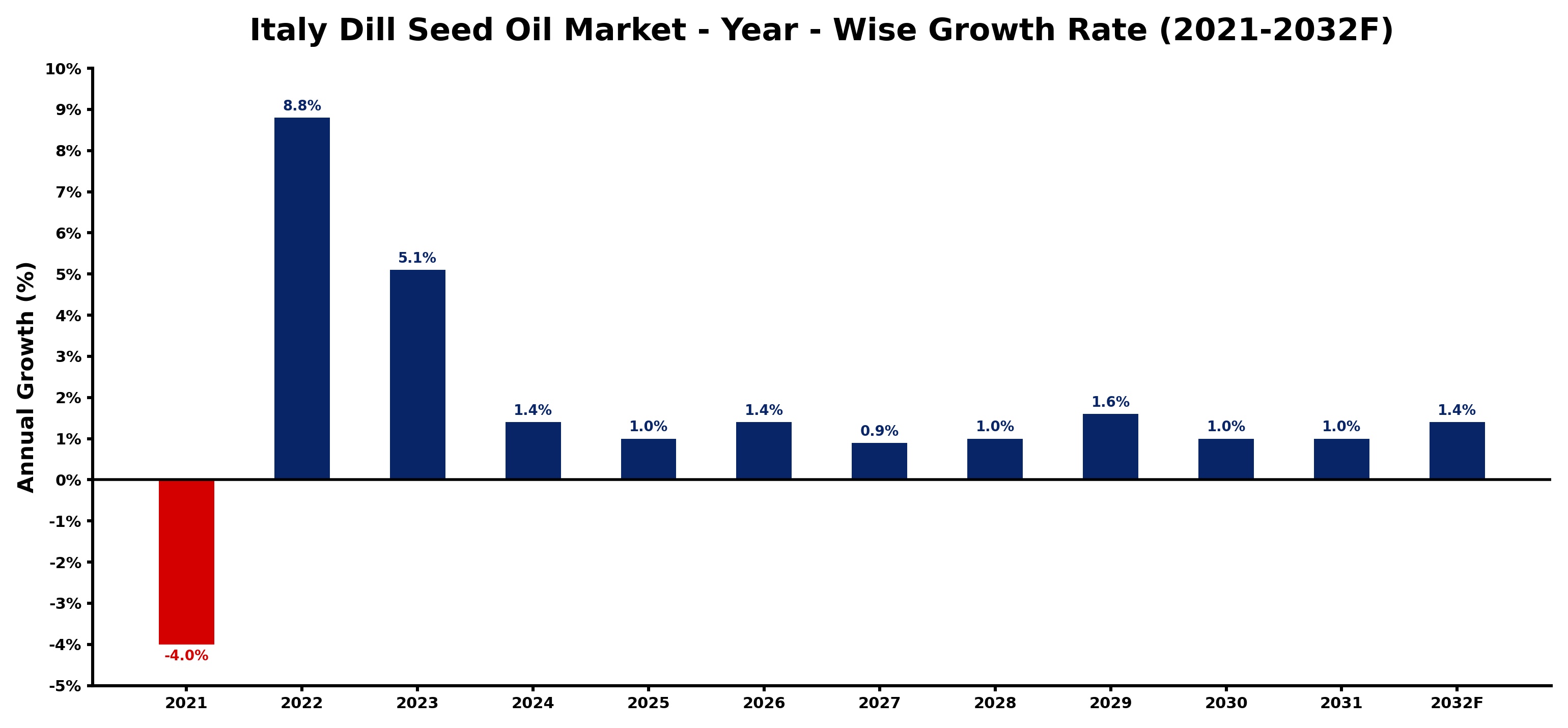
The table below presents the year‑wise growth rates along with the key drivers influencing the market
| Year | Growth Rate | Major Drivers |
| 2021 | -4.0% | Rapid growth in telecom and data center sectors |
| 2022 | 8.8% | Growing renewable energy integration projects |
| 2023 | 5.1% | Government infrastructure modernization initiatives |
| 2024 | 1.4% | Increasing industrial automation investments |
| 2025 | 1.0% | Increasing adoption of advanced technologies |
| 2026 | 1.4% | Growing urbanization and commercial development |
| 2027 | 0.9% | Increasing industrial automation investments |
| 2028 | 1.0% | Expansion of commercial construction activities |
| 2029 | 1.6% | Expansion of manufacturing activities |
| 2030 | 1.0% | Expansion of manufacturing activities |
| 2031 | 1.0% | Increasing adoption of advanced technologies |
| 2032 | 1.4% | Expansion of manufacturing activities |
Note - Market size estimations and growth projections presented in this report are based on 6Wresearch's advanced forecasting approach, validated with industry datasets as of June 2026.
Italy Dill Seed Oil Market Synopsis
The Italy Dill Seed Oil Market has witnessed significant momentum recently, driven by rising consumer demand for organic and natural solutions. As health-conscious choices become a priority for many, the market is adapting to cater to these evolving preferences, making it a focal point for product innovation.
Looking ahead, the market is poised for expansion, particularly with the growing interest in sustainable sourcing and ethical practices. Companies that prioritize environmentally friendly methods stand to gain a competitive edge, aligning their offerings with the values of discerning consumers in Italy.
Italy Dill Seed Oil Market Key Takeaways
- The market is anticipated to grow steadily, driven by a trend toward organic and natural products.
- Product innovation and sustainability are pivotal factors influencing market dynamics.
- Key applications span across food, cosmetics, and pharmaceuticals, showcasing dill seed oil's versatility.
- Consumer awareness regarding health benefits is a primary driver of market demand.
- Collaboration with local farmers for sourcing dill seeds can enhance supply chain efficiency and product quality.
Evaluation of Restraints in Italy Dill Seed Oil Market
Despite its promising growth, the Italy Dill Seed Oil Market faces several restraints that could impact its trajectory. Fluctuations in raw material prices, often influenced by unpredictable weather conditions and seasonal variations, pose a significant challenge for producers, affecting production costs and pricing strategies. Additionally, the market's competitive landscape, with various essential oils vying for consumer attention, necessitates robust marketing strategies to establish brand differentiation.
Producers must also navigate stringent regulatory requirements to ensure compliance with quality standards, which adds another layer of complexity. Balancing these factors while maintaining product quality will be crucial for sustaining market growth.
Italy Dill Seed Oil Market Trends
Emerging trends within the Italy Dill Seed Oil Market highlight an increasing focus on organic and cold-pressed oil varieties as consumers seek high-quality, chemical-free options. This trend is complemented by a growing interest in the therapeutic applications of dill seed oil, particularly in aromatherapy, where its calming properties are being embraced more widely.
Additionally, brands are prioritizing sustainable sourcing and production practices, appealing to eco-conscious consumers. This emphasis on environmental responsibility is shaping consumer preferences and driving brand loyalty, as companies are challenged to innovate while adhering to sustainability principles.
Italy Dill Seed Oil Market Opportunities
Significant investment opportunities exist in the Italy Dill Seed Oil Market, particularly in the realms of production and distribution. As demand for natural products grows, investors can capitalize on establishing production facilities and adopting advanced extraction technologies to enhance efficiency and quality.
Furthermore, innovative product development strategies, focusing on the health benefits of dill seed oil, can attract a discerning clientele. Collaboration with local farmers and implementing sustainable practices can solidify a company's market position while contributing positively to the community and environment.
Government Initiatives in the Italy Dill Seed Oil Market
The Italian government plays a pivotal role in regulating the dill seed oil market, enforcing stringent standards for quality and safety to protect consumers. Policies are also in place to promote sustainable agricultural practices, which are increasingly essential in today's eco-conscious market. Additionally, various support mechanisms are available for local farmers, aimed at enhancing production capabilities and encouraging the sustainable development of the dill seed oil sector.
Future Insights of the Italy Dill Seed Oil Market
As we look toward 2026-2032, the Italy Dill Seed Oil Market is expected to experience sustained growth, backed by the expanding consumer base seeking natural remedies and flavor enhancers. The rising trend of incorporating essential oils into personal care and wellness products will further drive market demand.
However, attention must be paid to the challenges of raw material availability and pricing. Companies that can navigate these challenges while focusing on innovation, sustainability, and quality will be well-positioned for success in this evolving landscape.
Italy Dill Seed Oil Market Latest Developments (May 2025 - June 2026)
In recent months, the Italy Dill Seed Oil Market has seen a variety of initiatives aimed at enhancing product quality and sustainability. Industry stakeholders are increasingly collaborating to establish best practices in production methods, ensuring that environmental standards are upheld. Additionally, marketing campaigns focusing on the health benefits and culinary versatility of dill seed oil have gained traction, helping to educate consumers and stimulate demand across multiple sectors.
Italy Dill Seed Oil Market - Key Attractiveness of the Report
- 10 Years of Market Numbers
- Historical Data Starting from 2022 to 2025
- Base Year: 2025
- Forecast Data until 2032
- Key Performance Indicators Impacting the Market
- Major Upcoming Developments and Projects
Key Highlights of the Report:
- Italy Dill Seed Oil Market Outlook
- Market Size of Italy Dill Seed Oil Market, 2025
- Forecast of Italy Dill Seed Oil Market, 2032
- Historical Data and Forecast of Italy Dill Seed Oil Revenues & Volume for the Period 2022-2032F
- Italy Dill Seed Oil Market Trend Evolution
- Italy Dill Seed Oil Market Drivers and Challenges
- Italy Dill Seed Oil Price Trends
- Italy Dill Seed Oil Porter's Five Forces
- Italy Dill Seed Oil Industry Life Cycle
- Historical Data and Forecast of Italy Dill Seed Oil Market Revenues & Volume By Type for the Period 2022-2032F
- Historical Data and Forecast of Italy Dill Seed Oil Market Revenues & Volume By Anethum Graveolens Seed Oil for the Period 2022-2032F
- Historical Data and Forecast of Italy Dill Seed Oil Market Revenues & Volume By Anethum Sowa Seed Oil for the Period 2022-2032F
- Historical Data and Forecast of Italy Dill Seed Oil Market Revenues & Volume By Application for the Period 2022-2032F
- Historical Data and Forecast of Italy Dill Seed Oil Market Revenues & Volume By Flavor for the Period 2022-2032F
- Historical Data and Forecast of Italy Dill Seed Oil Market Revenues & Volume By Fragrance for the Period 2022-2032F
- Historical Data and Forecast of Italy Dill Seed Oil Market Revenues & Volume By Pharmaceutical for the Period 2022-2032F
- Historical Data and Forecast of Italy Dill Seed Oil Market Revenues & Volume By Skincare for the Period 2022-2032F
- Historical Data and Forecast of Italy Dill Seed Oil Market Revenues & Volume By Aromatherapy for the Period 2022-2032F
- Italy Dill Seed Oil Import Export Trade Statistics
- Market Opportunity Assessment By Type
- Market Opportunity Assessment By Application
- Italy Dill Seed Oil Top Companies Market Share
- Italy Dill Seed Oil Competitive Benchmarking By Technical and Operational Parameters
- Italy Dill Seed Oil Company Profiles
- Italy Dill Seed Oil Key Strategic Recommendations






































