Italy Government Cloud Market Size & Growth Rate (2026-2032)
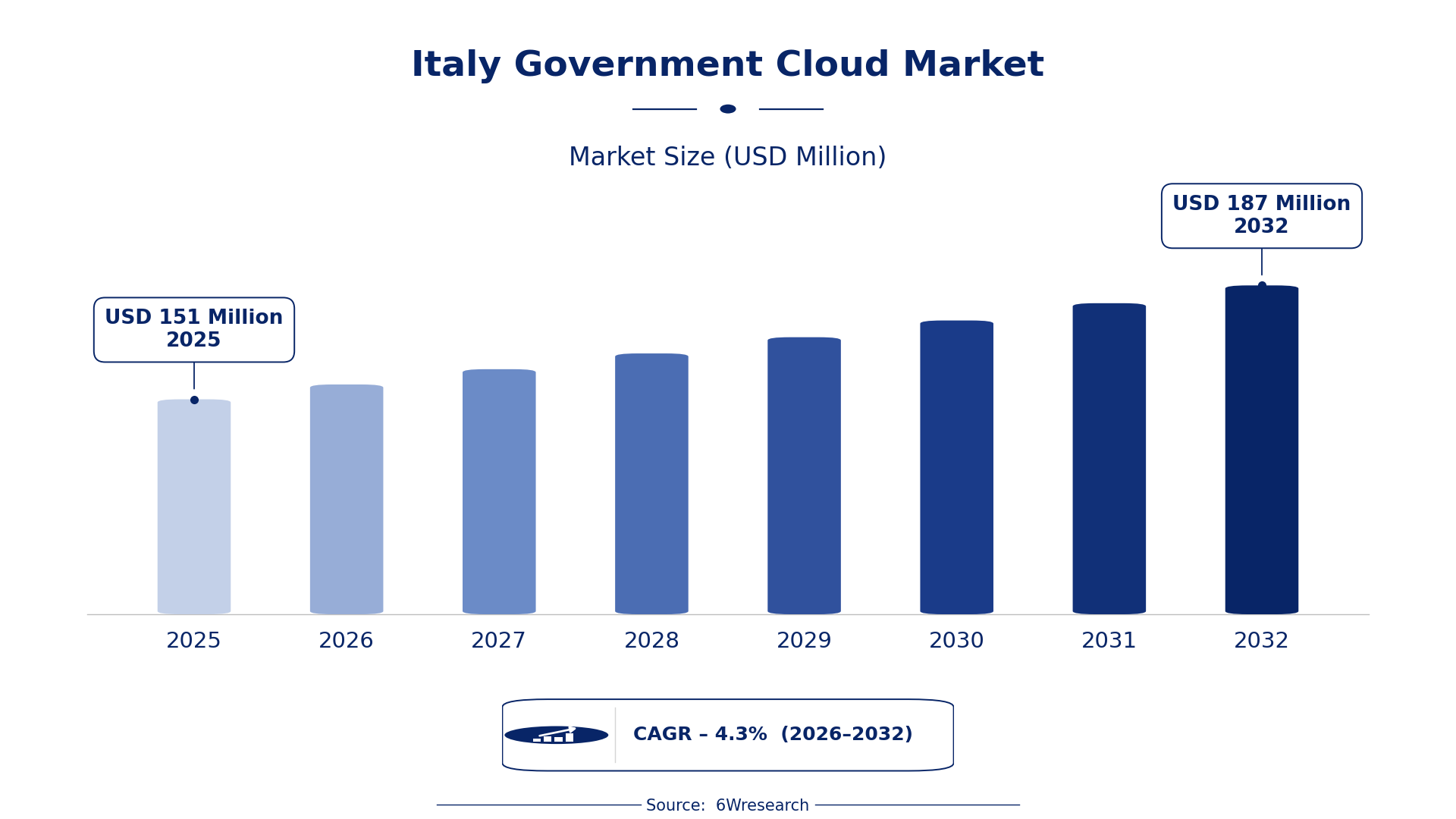
The Italy Government Cloud Market was estimated at USD 151 Million in 2025 and is projected to reach USD 187 Million by 2032, growing at a CAGR of 4.3% from 2026 to 2032.
Italy Government Cloud Market Synopsis
The Italy Government Cloud Market is witnessing a surge in interest as public sector organizations increasingly embrace cloud technologies. This shift is driven by the necessity for improved operational efficiency, cost savings, and enhanced service delivery to citizens. As agencies modernize their infrastructures, the demand for tailored cloud solutions has become paramount.
Security and compliance are at the forefront of this transformation, with agencies prioritizing data sovereignty and regulatory adherence. The government's Digital Transformation Agenda further underscores the urgency for cloud adoption, presenting both challenges and opportunities for cloud service providers looking to partner with public entities.
Italy Government Cloud Market Year-wise Growth Rate and Key Drivers
This graph illustrates the annual growth rates of the Italy Government Cloud Market from 2021 to 2032, highlighting a steady upward trajectory and projected expansion over the forecast period.
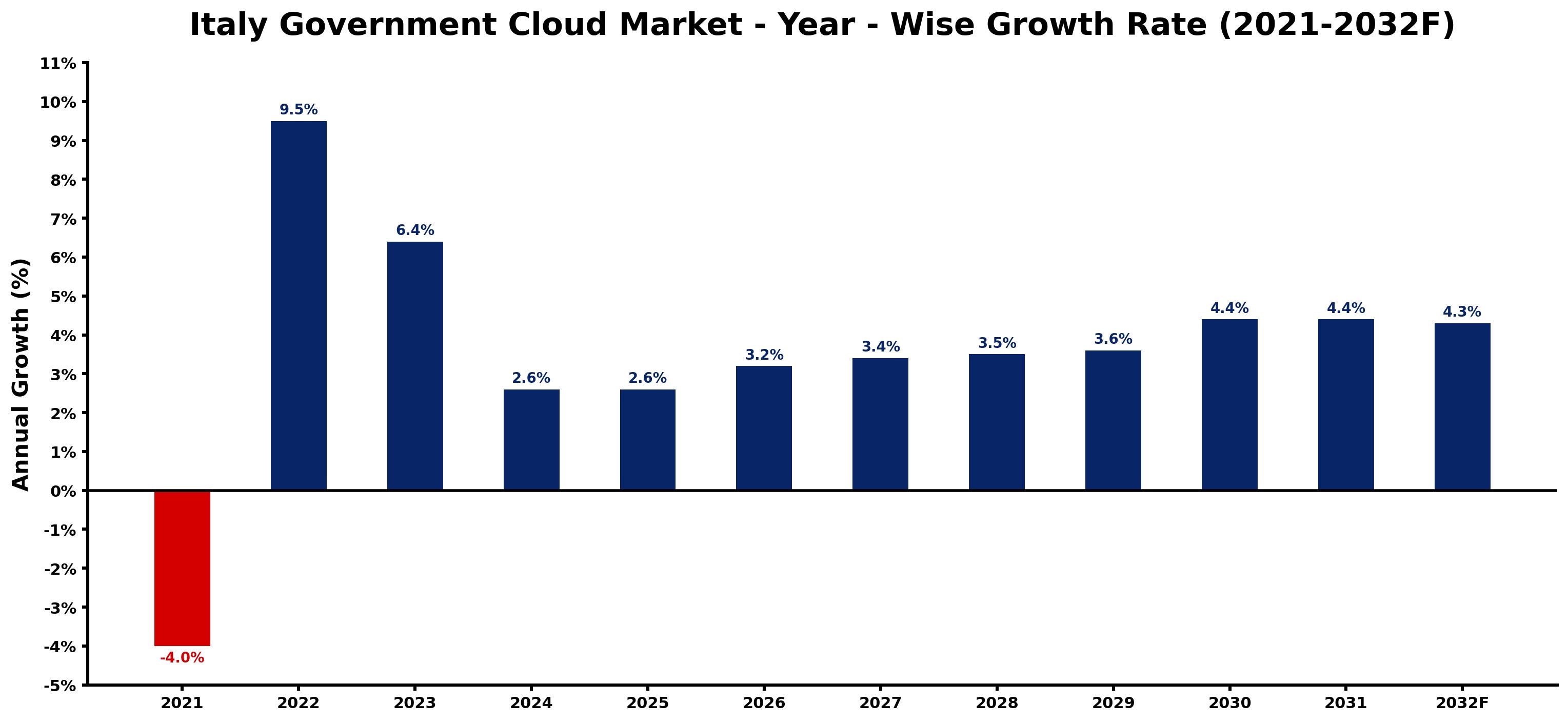
The table below presents the year‑wise growth rates along with the key drivers influencing the market
| Year | Growth Rate | Major Drivers |
| 2021 | -4.0% | Delayed Digital Transition Plan by Italian Government |
| 2022 | 9.5% | Next Generation EU funding supports digital transformation initiatives. |
| 2023 | 6.4% | Italia Digitale policy promotes cloud adoption in public sector. |
| 2024 | 2.6% | Increased cybersecurity regulations encourage cloud services migration. |
| 2025 | 2.6% | Public administration modernization drives demand for cloud solutions. |
| 2026 | 3.2% | Stimulus packages incentivize digital infrastructure investments in government. |
| 2027 | 3.4% | Growing remote work policies necessitate secure cloud environments. |
| 2028 | 3.5% | Government digitalization plan boosts cloud service uptake. |
| 2029 | 3.6% | Enhanced focus on smart cities spurs cloud technology growth. |
| 2030 | 4.4% | Regulatory support for interoperability among cloud services increases. |
| 2031 | 4.4% | Local IT investments foster innovation in government cloud services. |
| 2032 | 4.3% | Sustainability initiatives driving adoption of cloud-based solutions. |
Note: Market size estimations and growth projections presented in this report are based on 6Wresearch's proprietary forecasting methodology, utilizing the latest available industry data, government publications, and primary research inputs.
Italy Government Cloud Market Key Takeaways
Below are some of the specific key takeaways from the market, including:
- The increasing emphasis on data security and regulatory compliance is reshaping cloud adoption strategies.
- Government policies are actively encouraging the transition to cloud-based services across various public sector organizations.
- Hybrid cloud solutions are gaining traction as agencies seek to manage sensitive data effectively.
- There is a growing focus on utilizing AI and machine learning to enhance operational efficiencies within government operations.
- Cost savings and scalability are primary drivers behind the modernization of legacy IT systems.
Evaluation of Restraints in Italy Government Cloud Market
Despite the positive outlook, several constraints are hindering the progress of the Italy Government Cloud Market. Chief among these are concerns regarding data security and privacy, given the sensitive nature of government data. Compliance with stringent regulations poses another significant challenge, as entities must ensure that data storage and processing adhere to national laws.
on top of that, the complexity involved in migrating legacy systems to the cloud presents substantial obstacles. Many agencies are constrained by budget limitations, which restrict their ability to invest in necessary cloud infrastructure. Addressing these hurdles will demand close cooperation between government bodies, cloud service providers, and cybersecurity specialists.
Italy Government Cloud Market Trends
Key trends are shaping the Italy Government Cloud Market, reflecting the evolving needs of public sector agencies. The shift toward hybrid cloud environments is notable, as organizations aim to balance security with operational flexibility. In tandem, there is a pronounced focus on enhancing cybersecurity frameworks to safeguard sensitive government data against emerging threats.
The integration of artificial intelligence and machine learning is another prominent trend, allowing agencies to improve data analytics capabilities and streamline their operations. As the demand for cloud-based citizen services rises, public sector organizations are increasingly prioritizing user experience and accessibility, propelling further cloud adoption.
Italy Government Cloud Market Opportunities
The Italy Government Cloud Market is ripe with opportunities for growth and innovation. The modernization of outdated IT systems is a critical area where cloud migration can provide substantial benefits, enhancing service delivery and operational efficiency. Additionally, the implementation of cloud-based platforms for citizen services is increasingly recognized as a way to improve engagement and satisfaction.
Cloud technologies also present avenues for significant cost savings and agility, enabling government agencies to better allocate resources and respond to changing demands. Collaborative initiatives between public entities and cloud service providers are expected to foster innovation, driving the evolution of digital governance in Italy.
Government Initiatives in the Italy Government Cloud Market
The Italian government is actively shaping the cloud market through various initiatives aimed at modernizing public services and enhancing digital infrastructure. Recent policies have emphasized the adoption of cloud computing, highlighting the importance of operational efficiency and data security in governmental operations. This proactive approach is crucial for fostering innovation and collaboration across the public sector.
- A national digital infrastructure upgrade programme recently completed to enhance connectivity and access to cloud services across government agencies.
- The development of a centralized procurement framework for cloud services is currently underway, aimed at streamlining the acquisition process for public entities.
- A regulatory framework mandating compliance with data protection standards was introduced in 2025, ensuring that cloud services align with national laws.
- Planned initiatives to expand partnerships with technology vendors to promote innovation in cloud solutions by 2028.
Future Insights of the Italy Government Cloud Market
Looking ahead to 2026-2032, the Italy Government Cloud Market is expected to maintain its growth trajectory as agencies continue to embrace cloud technologies. The focus on digital transformation will likely drive further investments in cloud solutions that promote efficiency, compliance, and enhanced service delivery.
As security concerns and regulatory compliance remain paramount, government entities will seek cloud solutions that not only meet their operational needs but also align with stringent data protection requirements. The market is well-positioned for collaboration and innovation, paving the way for a more digitally advanced public sector.
Italy Government Cloud Market Latest Developments
Recent activities in the Italy Government Cloud Market indicate a dynamic environment, with numerous initiatives aimed at enhancing cloud adoption among public sector agencies. As government agencies prioritize modernization, we see a concerted effort to implement advanced cloud solutions that improve service delivery and operational efficiency.
- An initiative to implement a new cloud-based citizen service platform was launched in early 2025 and is currently in the rollout phase.
- A major technology vendor is collaborating with government agencies to enhance cybersecurity measures, an ongoing effort initiated in mid-2025.
- A planned public-private partnership to develop innovative cloud solutions for public sector applications is expected to begin in late 2026.
- Upgrades to existing cloud infrastructures are being undertaken as part of a broader strategy to enhance data management, with activities currently underway.
Italy Government Cloud Market - Key Attractiveness of the Report
- 10 Years of Market Numbers
- Historical Data Starting from 2022 to 2025
- Base Year: 2025
- Forecast Data until 2032
- Key Performance Indicators Impacting the Market
- Major Upcoming Developments and Projects
Key Highlights of the Report:
- Italy Government Cloud Market Outlook
- Market Size of Italy Government Cloud Market, 2025
- Forecast of Italy Government Cloud Market, 2032
- Historical Data and Forecast of Italy Government Cloud Revenues & Volume for the Period 2022-2032F
- Italy Government Cloud Market Trend Evolution
- Italy Government Cloud Market Drivers and Challenges
- Italy Government Cloud Price Trends
- Italy Government Cloud Porter's Five Forces
- Italy Government Cloud Industry Life Cycle
- Historical Data and Forecast of Italy Government Cloud Market Revenues & Volume By Solutions for the Period 2022-2032F
- Historical Data and Forecast of Italy Government Cloud Market Revenues & Volume By Cloud Storage for the Period 2022-2032F
- Historical Data and Forecast of Italy Government Cloud Market Revenues & Volume By Disaster Recovery for the Period 2022-2032F
- Historical Data and Forecast of Italy Government Cloud Market Revenues & Volume By Identity and Access Management (IAM) for the Period 2022-2032F
- Historical Data and Forecast of Italy Government Cloud Market Revenues & Volume By Risk and compliance management for the Period 2022-2032F
- Historical Data and Forecast of Italy Government Cloud Market Revenues & Volume By Others (reporting and analytics, and security and vulnerability) for the Period 2022-2032F
- Historical Data and Forecast of Italy Government Cloud Market Revenues & Volume By Services for the Period 2022-2032F
- Historical Data and Forecast of Italy Government Cloud Market Revenues & Volume By Training, consulting, and education for the Period 2022-2032F
- Historical Data and Forecast of Italy Government Cloud Market Revenues & Volume By Support and Maintenance for the Period 2022-2032F
- Historical Data and Forecast of Italy Government Cloud Market Revenues & Volume By Integration and Migration for the Period 2022-2032F
- Historical Data and Forecast of Italy Government Cloud Market Revenues & Volume By Service Model for the Period 2022-2032F
- Historical Data and Forecast of Italy Government Cloud Market Revenues & Volume By Infrastructure as a Service (IaaS) for the Period 2022-2032F
- Historical Data and Forecast of Italy Government Cloud Market Revenues & Volume By Platform as a Service (PaaS) for the Period 2022-2032F
- Historical Data and Forecast of Italy Government Cloud Market Revenues & Volume By Software as a Service (SaaS) for the Period 2022-2032F
- Historical Data and Forecast of Italy Government Cloud Market Revenues & Volume By Deployment Model for the Period 2022-2032F
- Historical Data and Forecast of Italy Government Cloud Market Revenues & Volume By Public Cloud for the Period 2022-2032F
- Historical Data and Forecast of Italy Government Cloud Market Revenues & Volume By Private Cloud for the Period 2022-2032F
- Historical Data and Forecast of Italy Government Cloud Market Revenues & Volume By Hybrid Cloud for the Period 2022-2032F
- Italy Government Cloud Import Export Trade Statistics
- Market Opportunity Assessment By Solutions
- Market Opportunity Assessment By Services
- Market Opportunity Assessment By Service Model
- Market Opportunity Assessment By Deployment Model
- Italy Government Cloud Top Companies Market Share
- Italy Government Cloud Competitive Benchmarking By Technical and Operational Parameters
- Italy Government Cloud Company Profiles
- Italy Government Cloud Key Strategic Recommendations






































