Italy Home Textile Market Size (2020-2030)
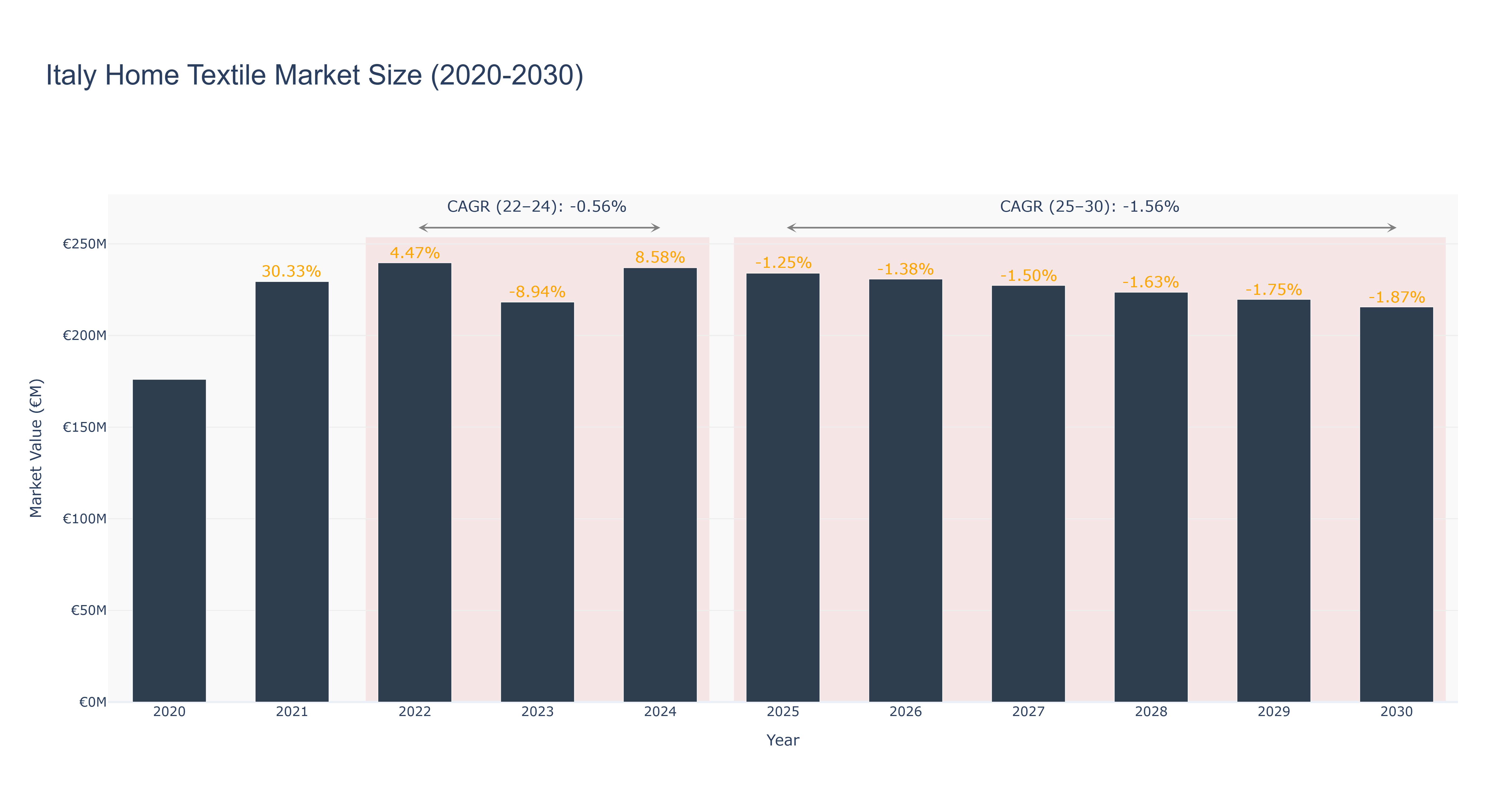
Italy Home Textile Market has shown a fluctuating trend in recent years. The peak market size was €239.65 million in 2022, with a slight decline to €236.95 million in 2024. The forecasted market size is expected to decrease further from €233.98 million in 2025 to €215.56 million in 2030, with CAGR values of -1.56% (2025-30) and -0.56% (2022-24). The market's decline can be attributed to changing consumer preferences, economic uncertainties, and increased competition. However, recent developments in sustainable textile production processes and innovative designs are expected to drive growth in the future. Projects focusing on eco-friendly materials and digital integration are anticipated to reshape the market landscape, offering opportunities for market players to adapt and thrive in the evolving industry.
Italy Home Textile Market: Production & Trade Performance (2019-2025)
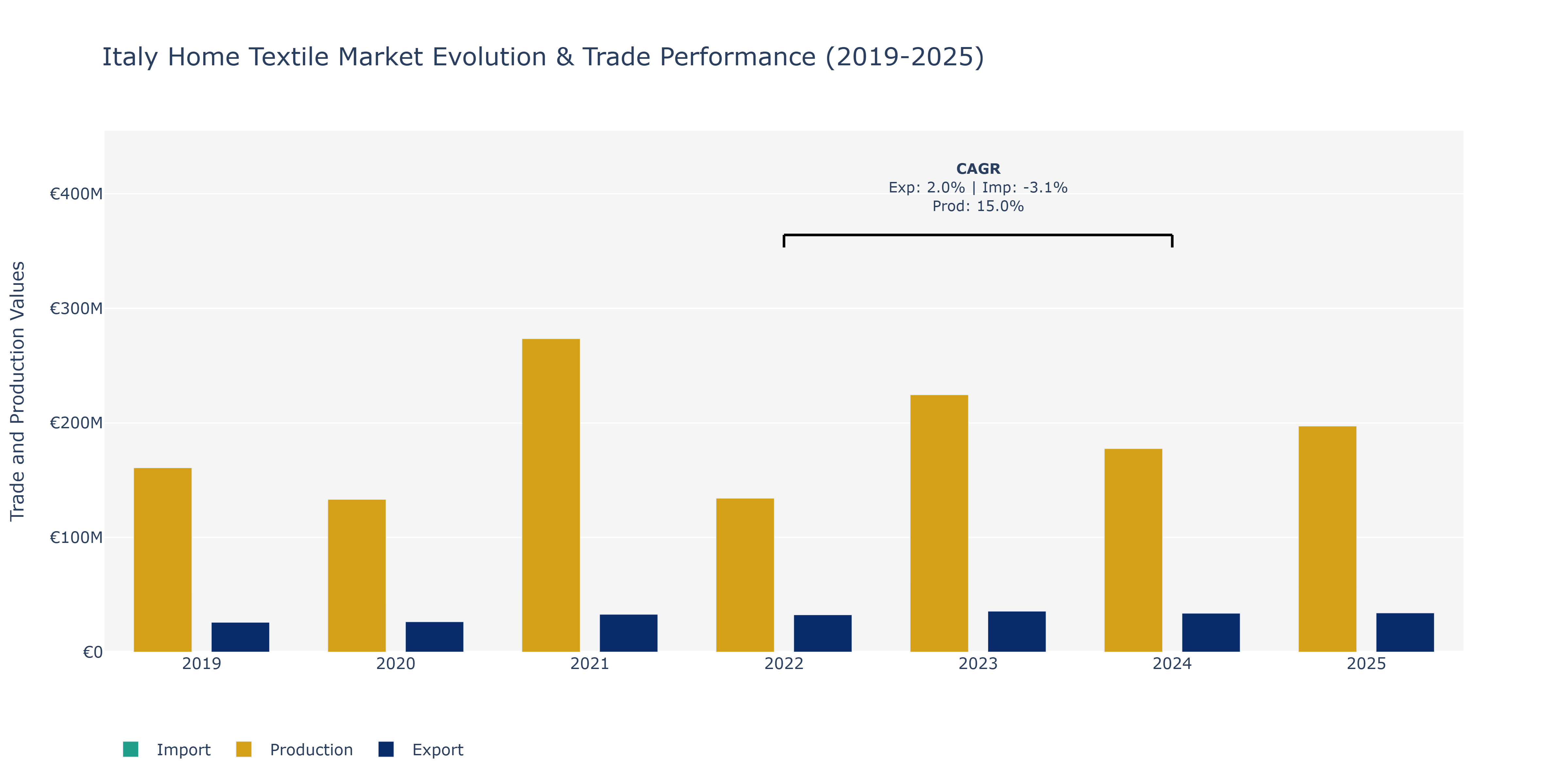
The Italy Home Textile Market witnessed fluctuations in exports, imports, and production from 2019 to 2025. Exports showed an overall increasing trend, reaching €34.12 million in 2025 from €25.96 million in 2019. In contrast, imports experienced variations, with a peak in 2021 at €51.53 million and a decrease to €56.84 million in 2025. Production displayed fluctuations, notably peaking at €273.56 million in 2021 before declining to €177.59 million in 2024. These shifts could be attributed to evolving consumer preferences for home textiles, changes in global trading dynamics impacting imports, and fluctuations in raw material costs affecting production. The market's production CAGR of 15.03% from 2022 to 2024 indicates significant growth in domestic manufacturing capacity, potentially driven by increased investments in technology and sustainable practices in the textile industry. The varying trends in exports and imports suggest a dynamic market influenced by international demand, trade agreements, and economic conditions affecting both outbound and inbound shipments within the home textile sector in Italy.
Italy Home Textile Market Overview
The Italy home textile market is a thriving industry characterized by a wide range of products including bedding, bath linens, curtains, and upholstery fabrics. Known for its high-quality craftsmanship and sophisticated designs, Italian home textiles are highly regarded both domestically and internationally. The market is driven by consumer preferences for luxury and style, with a growing demand for eco-friendly and sustainable products. Key players in the industry include renowned brands such as Frette, Missoni Home, and Society Limonta, known for their innovative designs and premium quality. The market is also influenced by changing trends in interior design and a focus on creating comfortable and stylish living spaces. With a strong tradition of textile manufacturing and a reputation for excellence, Italy continues to be a leading player in the global home textile market.
Italy Home Textile Market Trends
The Italy home textile market is currently experiencing a shift towards sustainable and eco-friendly products, driven by increasing consumer awareness of environmental issues. Consumers are seeking textiles made from natural and organic materials, such as linen, bamboo, and organic cotton, as well as products that utilize eco-friendly dyeing and manufacturing processes. Additionally, there is a growing demand for smart textiles that offer functionality and convenience, such as antimicrobial bedding and temperature-regulating fabrics. Italian home textile companies are also focusing on innovative designs and collaborations with fashion designers to create unique and stylish collections that cater to the evolving preferences of consumers. Overall, the market is witnessing a trend towards sustainability, innovation, and style in response to changing consumer preferences and global environmental concerns.
Italy Home Textile Market Challenges
In the Italy home textile market, challenges include intense competition from both domestic and international players, leading to price pressures and margin erosion. Additionally, fluctuations in raw material costs, such as cotton and polyester, can impact profitability for home textile manufacturers. Consumer preferences and trends constantly evolve, requiring companies to stay innovative and adaptive to meet changing demands. Distribution channels are also a challenge, with the need to balance traditional brick-and-mortar stores with the growing trend of online shopping. Lastly, regulations and compliance standards in the textile industry can pose challenges for companies in terms of meeting quality and safety requirements while remaining competitive in the market.
Italy Home Textile Market Investment Opportunities
Investment opportunities in the Italy home textile market are promising, with growing demand for high-quality, stylish, and sustainable home textiles. Investors can explore opportunities in innovative and eco-friendly materials, such as organic cotton, bamboo, and recycled fabrics, to cater to the increasing consumer preference for sustainable products. Additionally, leveraging e-commerce platforms and digital marketing strategies can help reach a wider audience and boost sales. Collaborating with local artisans and designers to create unique and artisanal home textile collections can differentiate products in the market. With Italy`s reputation for luxury and design excellence, investing in premium and bespoke home textile offerings can appeal to affluent consumers seeking exclusive and customized options. Overall, the Italy home textile market offers diverse investment avenues for those looking to capitalize on consumer trends and preferences in the industry.
Italy Home Textile Market Government Policy
In Italy, government policies related to the home textile market focus on promoting sustainable practices and supporting local craftsmanship. The Italian government has implemented regulations to ensure the quality and safety of home textiles, including standards for materials and production processes. Additionally, there are initiatives to encourage the use of eco-friendly materials and promote the circular economy within the textile industry. The government also provides support for small businesses and artisans in the home textile sector through funding programs and incentives to preserve traditional craftsmanship and promote "Made in Italy" products. Overall, the government policies in Italy aim to maintain the high standards of the home textile market while fostering innovation and sustainability in the industry.
Italy Home Textile Market Future Outlook
The future outlook for the Italy home textile market appears promising, driven by factors such as increasing consumer demand for sustainable and high-quality home textiles, as well as the growing trend of home decoration and interior design. The market is expected to witness steady growth due to the rising disposable income levels and changing lifestyle preferences of consumers. Additionally, the integration of advanced technologies such as smart textiles and e-commerce platforms is likely to further boost market expansion. As Italy is known for its rich textile manufacturing heritage and innovative design capabilities, the country is well-positioned to capitalize on these trends and maintain a competitive edge in the global home textile market. Overall, the Italy home textile market is anticipated to experience positive growth prospects in the foreseeable future.
Key Highlights of the Report:
- Italy Home Textile Market Outlook
- Market Size of Italy Home Textile Market,2025
- Forecast of Italy Home Textile Market, 2032
- Historical Data and Forecast of Italy Home Textile Revenues & Volume for the Period 2022-2032F
- Italy Home Textile Market Trend Evolution
- Italy Home Textile Market Drivers and Challenges
- Italy Home Textile Price Trends
- Italy Home Textile Porter's Five Forces
- Italy Home Textile Industry Life Cycle
- Historical Data and Forecast of Italy Home Textile Market Revenues & Volume By Product Type for the Period 2022-2032F
- Historical Data and Forecast of Italy Home Textile Market Revenues & Volume By Bed Linen for the Period 2022-2032F
- Historical Data and Forecast of Italy Home Textile Market Revenues & Volume By Curtains and Drapes for the Period 2022-2032F
- Historical Data and Forecast of Italy Home Textile Market Revenues & Volume By Upholstery Fabrics for the Period 2022-2032F
- Historical Data and Forecast of Italy Home Textile Market Revenues & Volume By Bathroom Textiles for the Period 2022-2032F
- Historical Data and Forecast of Italy Home Textile Market Revenues & Volume By Material Type for the Period 2022-2032F
- Historical Data and Forecast of Italy Home Textile Market Revenues & Volume By Cotton and Silk for the Period 2022-2032F
- Historical Data and Forecast of Italy Home Textile Market Revenues & Volume By Polyester and Velvet for the Period 2022-2032F
- Historical Data and Forecast of Italy Home Textile Market Revenues & Volume By Leather and Microfiber for the Period 2022-2032F
- Historical Data and Forecast of Italy Home Textile Market Revenues & Volume By Terry Cloth and Bamboo Fiber for the Period 2022-2032F
- Historical Data and Forecast of Italy Home Textile Market Revenues & Volume By End User for the Period 2022-2032F
- Historical Data and Forecast of Italy Home Textile Market Revenues & Volume By Households and Hotels for the Period 2022-2032F
- Historical Data and Forecast of Italy Home Textile Market Revenues & Volume By Homeowners and Interior Designers for the Period 2022-2032F
- Historical Data and Forecast of Italy Home Textile Market Revenues & Volume By Furniture Manufacturers for the Period 2022-2032F
- Historical Data and Forecast of Italy Home Textile Market Revenues & Volume By Families and Spas for the Period 2022-2032F
- Historical Data and Forecast of Italy Home Textile Market Revenues & Volume By Application for the Period 2022-2032F
- Historical Data and Forecast of Italy Home Textile Market Revenues & Volume By Bedroom Furnishing for the Period 2022-2032F
- Historical Data and Forecast of Italy Home Textile Market Revenues & Volume By Window and Room Dcor for the Period 2022-2032F
- Historical Data and Forecast of Italy Home Textile Market Revenues & Volume By Sofas and Seating for the Period 2022-2032F
- Historical Data and Forecast of Italy Home Textile Market Revenues & Volume By Towels and Bathrobes for the Period 2022-2032F
- Italy Home Textile Import Export Trade Statistics
- Market Opportunity Assessment By Product Type
- Market Opportunity Assessment By Material Type
- Market Opportunity Assessment By End User
- Market Opportunity Assessment By Application
- Italy Home Textile Top Companies Market Share
- Italy Home Textile Competitive Benchmarking By Technical and Operational Parameters
- Italy Home Textile Company Profiles
- Italy Home Textile Key Strategic Recommendations






































