Italy Industrial Analytics Market Size & Growth Rate (2026-2032)
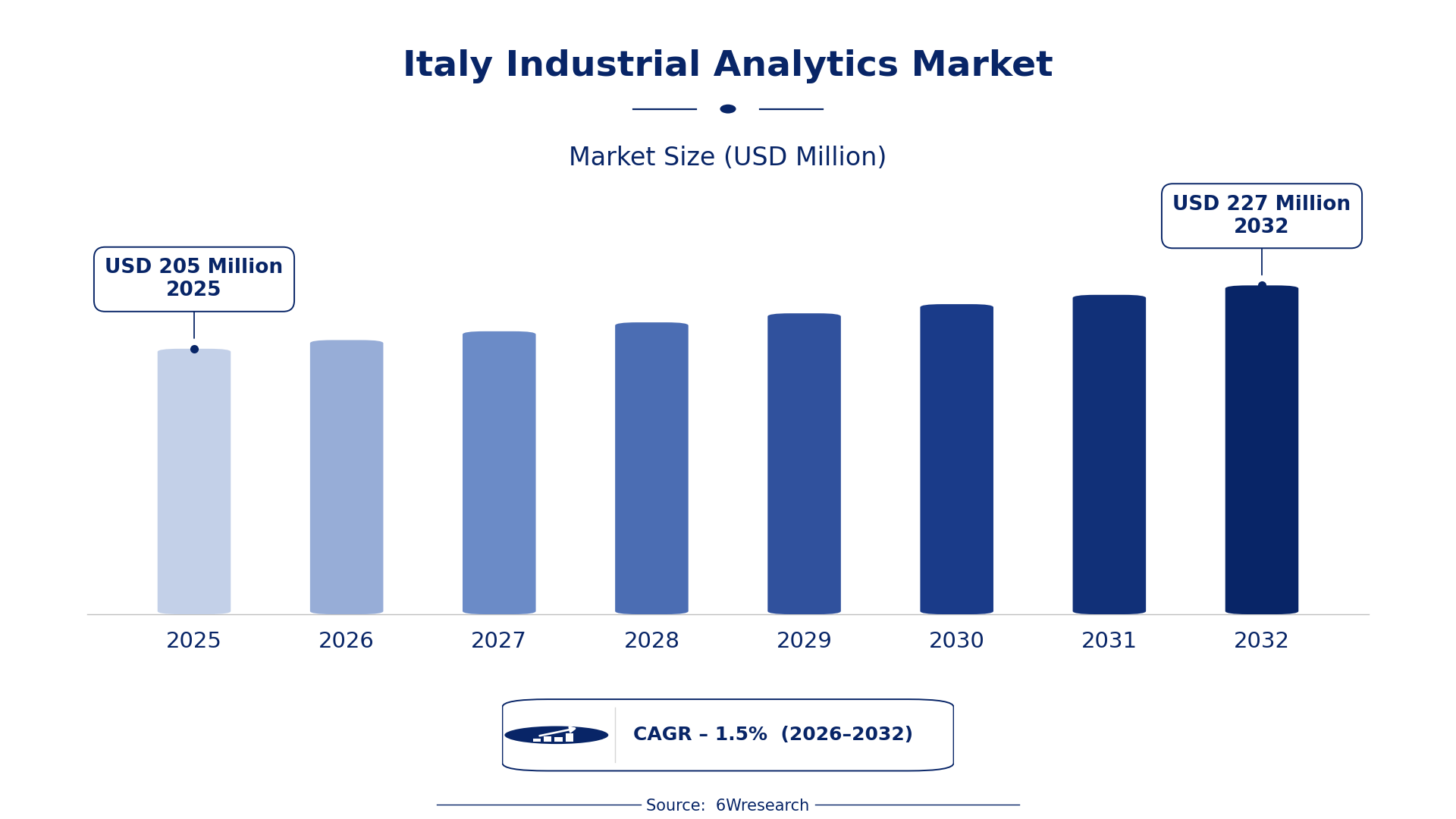
The Italy Industrial Analytics Market was estimated at USD 205 Million in 2025 and is projected to reach USD 227 Million by 2032, growing at a CAGR of 1.5% from 2026 to 2032.
Italy Industrial Analytics Market Synopsis
The increasing adoption of advanced technologies in Italy’s industrial sector is the strongest force driving the growth of the Industrial Analytics Market. Companies are increasingly recognizing the need to harness data analytics to enhance operational efficiency and competitiveness.
This market is witnessing a shift towards predictive maintenance and real-time data monitoring. As organizations in manufacturing, automotive, energy, and healthcare strive for operational excellence, industrial analytics is becoming a critical tool for informed decision-making and resource optimization.
Italy Industrial Analytics Market Year-wise Growth Rate and Key Drivers
This graph illustrates the annual growth rates of the Italy Industrial Analytics Market from 2021 to 2032, highlighting a steady upward trajectory and projected expansion over the forecast period.
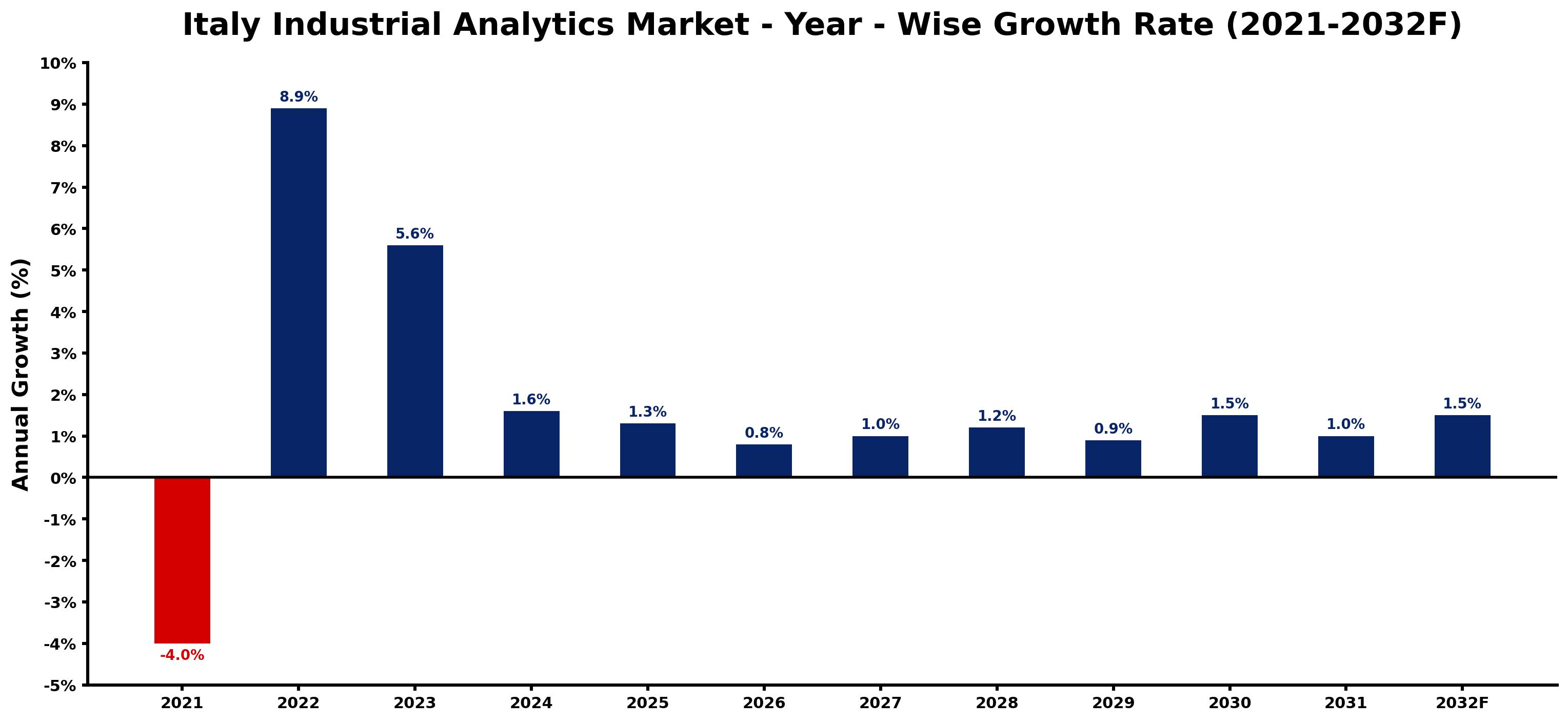
The table below presents the year‑wise growth rates along with the key drivers influencing the market
| Year | Growth Rate | Major Drivers |
| 2021 | -4.0% | Falling investments due to Italy's fluctuating economic policies. |
| 2022 | 8.9% | Increased investment in smart manufacturing technologies by government |
| 2023 | 5.6% | Adoption of Fattura Elettronica mandates for digitization |
| 2024 | 1.6% | Growing focus on sustainability in manufacturing practices |
| 2025 | 1.3% | Boost from PNRR funding for digital transformation projects |
| 2026 | 0.8% | Increased labor costs driving automation analytics needs |
| 2027 | 1.0% | Demand for real-time data analytics in production lines |
| 2028 | 1.2% | Evolving regulations boosting compliance analytics tools adoption |
| 2029 | 0.9% | Surge in remote monitoring technologies post-pandemic |
| 2030 | 1.5% | Rising export demands necessitating operational efficiency improvements |
| 2031 | 1.0% | Government incentives for R&D in industrial technologies |
| 2032 | 1.5% | Shift towards circular economy models increasing analytics requirements |
Note: Market size estimations and growth projections presented in this report are based on 6Wresearch's proprietary forecasting methodology, utilizing the latest available industry data, government publications, and primary research inputs.
Italy Industrial Analytics Market Key Takeaways
Below are some of the specific key takeaways from the market, including:
- The market is set for significant growth driven by Industry 4.0 initiatives.
- Predictive maintenance solutions are gaining traction as a means to reduce equipment downtime.
- Real-time analytics are increasingly integral to operational decision-making processes.
- Investment opportunities lie in sectors like manufacturing and healthcare, particularly in AI and IoT applications.
- Data security and privacy measures are becoming crucial as the market evolves.
Evaluation of Restraints in Italy Industrial Analytics Market
Despite its growth trajectory, the Italy Industrial Analytics Market faces several restraints. High initial investments in advanced analytics solutions can deter small and medium-sized enterprises from adopting these technologies. on top of that, there is a notable skills gap in the workforce, making it difficult for companies to find professionals adept in industrial data analytics. Concerns surrounding data privacy and security are also significant, especially in sectors handling sensitive information. Additionally, the integration of legacy systems with modern analytics platforms often complicates data management, limiting the full realization of analytics capabilities.
Italy Industrial Analytics Market Trends
The trend towards the Industrial Internet of Things (IIoT) is reshaping the Italy Industrial Analytics Market. Companies are increasingly adopting IIoT solutions to enhance operational efficiency and productivity. Another noteworthy trend is the integration of artificial intelligence and machine learning, which enable the analysis of vast data sets generated by industrial processes. There’s also a heightened focus on predictive maintenance to mitigate unexpected equipment failures, thereby improving reliability. Finally, the market is evolving to prioritize data security, as organizations realize the importance of protecting sensitive industrial data.
Italy Industrial Analytics Market Opportunities
The Italy Industrial Analytics Market presents genuine growth opportunities, particularly within manufacturing and energy sectors. As industries increasingly embrace digital transformation, there’s a rising demand for advanced analytics solutions that optimize operations and cut costs. Key investment areas include predictive maintenance, supply chain management, and quality control. Companies that provide innovative analytics tools, especially those incorporating AI and IoT, are ideally positioned to capitalize on these emerging opportunities. Collaborations with local industrial firms seeking data-driven insights can further enhance market entry strategies for foreign investors.
Government Initiatives in the Italy Industrial Analytics Market
The Italian government is actively fostering the adoption of industrial analytics through various initiatives. Recently, the National Industry 4.0 Plan was launched, aimed at assisting companies in integrating advanced technologies, including analytics, to boost competitiveness. Currently, the government is providing financial incentives and tax benefits to encourage investment in digital transformation and data analytics tools. Looking ahead, plans are in place to enhance collaboration between industries and research institutions, focusing on innovation in industrial analytics and ensuring that Italy remains competitive on a global scale.
Future Insights of the Italy Industrial Analytics Market
The outlook for the Italy Industrial Analytics Market from 2026 to 2032 is optimistic, fueled by increasing adoption of advanced technologies. Demand for analytics solutions is expected to surge as companies seek to improve operational performance and minimize downtime. The push for Industry 4.0 will likely drive investment into analytics that provide actionable insights from data. As organizations continue to evolve, the development of innovative solutions tailored to the specific needs of Italian industries will be a key factor in sustaining growth.
Italy Industrial Analytics Market Latest Developments
In the past year, the Italy Industrial Analytics Market has seen notable developments. A major technology vendor launched a new suite of predictive analytics tools aimed at the manufacturing sector, completed by late 2025. Meanwhile, an ongoing partnership between a leading regional operator and local universities is focused on developing advanced analytics training programs, which began in mid-2025 and remains underway. Looking ahead, an expansion initiative is expected to begin in the second half of 2026, aimed at integrating IoT solutions with existing analytics platforms in various industries.
Italy Industrial Analytics Market - Key Attractiveness of the Report
- 10 Years of Market Numbers
- Historical Data Starting from 2022 to 2025
- Base Year: 2025
- Forecast Data until 2032
- Key Performance Indicators Impacting the Market
- Major Upcoming Developments and Projects
Key Highlights of the Report:
- Italy Industrial Analytics Market Outlook
- Market Size of Italy Industrial Analytics Market, 2025
- Forecast of Italy Industrial Analytics Market, 2032
- Historical Data and Forecast of Italy Industrial Analytics Revenues & Volume for the Period 2022-2032F
- Italy Industrial Analytics Market Trend Evolution
- Italy Industrial Analytics Market Drivers and Challenges
- Italy Industrial Analytics Price Trends
- Italy Industrial Analytics Porter's Five Forces
- Italy Industrial Analytics Industry Life Cycle
- Historical Data and Forecast of Italy Industrial Analytics Market Revenues & Volume By Component for the Period 2022-2032F
- Historical Data and Forecast of Italy Industrial Analytics Market Revenues & Volume By Software for the Period 2022-2032F
- Historical Data and Forecast of Italy Industrial Analytics Market Revenues & Volume By Service for the Period 2022-2032F
- Historical Data and Forecast of Italy Industrial Analytics Market Revenues & Volume By Software for the Period 2022-2032F
- Historical Data and Forecast of Italy Industrial Analytics Market Revenues & Volume By Operational analytics for the Period 2022-2032F
- Historical Data and Forecast of Italy Industrial Analytics Market Revenues & Volume By Risk analytics for the Period 2022-2032F
- Historical Data and Forecast of Italy Industrial Analytics Market Revenues & Volume By Financial analytics for the Period 2022-2032F
- Historical Data and Forecast of Italy Industrial Analytics Market Revenues & Volume By Marketing analytics for the Period 2022-2032F
- Historical Data and Forecast of Italy Industrial Analytics Market Revenues & Volume By Customer analytics for the Period 2022-2032F
- Historical Data and Forecast of Italy Industrial Analytics Market Revenues & Volume By Workforce analytics for the Period 2022-2032F
- Historical Data and Forecast of Italy Industrial Analytics Market Revenues & Volume By Service for the Period 2022-2032F
- Historical Data and Forecast of Italy Industrial Analytics Market Revenues & Volume By Managed services for the Period 2022-2032F
- Historical Data and Forecast of Italy Industrial Analytics Market Revenues & Volume By Professional services for the Period 2022-2032F
- Historical Data and Forecast of Italy Industrial Analytics Market Revenues & Volume By Analytics Type for the Period 2022-2032F
- Historical Data and Forecast of Italy Industrial Analytics Market Revenues & Volume By Descriptive for the Period 2022-2032F
- Historical Data and Forecast of Italy Industrial Analytics Market Revenues & Volume By Diagnostic for the Period 2022-2032F
- Historical Data and Forecast of Italy Industrial Analytics Market Revenues & Volume By Predictive for the Period 2022-2032F
- Historical Data and Forecast of Italy Industrial Analytics Market Revenues & Volume By Prescriptive for the Period 2022-2032F
- Historical Data and Forecast of Italy Industrial Analytics Market Revenues & Volume By Organization size for the Period 2022-2032F
- Historical Data and Forecast of Italy Industrial Analytics Market Revenues & Volume By Large enterprises for the Period 2022-2032F
- Historical Data and Forecast of Italy Industrial Analytics Market Revenues & Volume By Small and medium-sized enterprises for the Period 2022-2032F
- Italy Industrial Analytics Import Export Trade Statistics
- Market Opportunity Assessment By Component
- Market Opportunity Assessment By Software
- Market Opportunity Assessment By Service
- Market Opportunity Assessment By Analytics Type
- Market Opportunity Assessment By Organization size
- Italy Industrial Analytics Top Companies Market Share
- Italy Industrial Analytics Competitive Benchmarking By Technical and Operational Parameters
- Italy Industrial Analytics Company Profiles
- Italy Industrial Analytics Key Strategic Recommendations






































