Italy Passenger Car Motor Oil Market: Import Trend Analysis
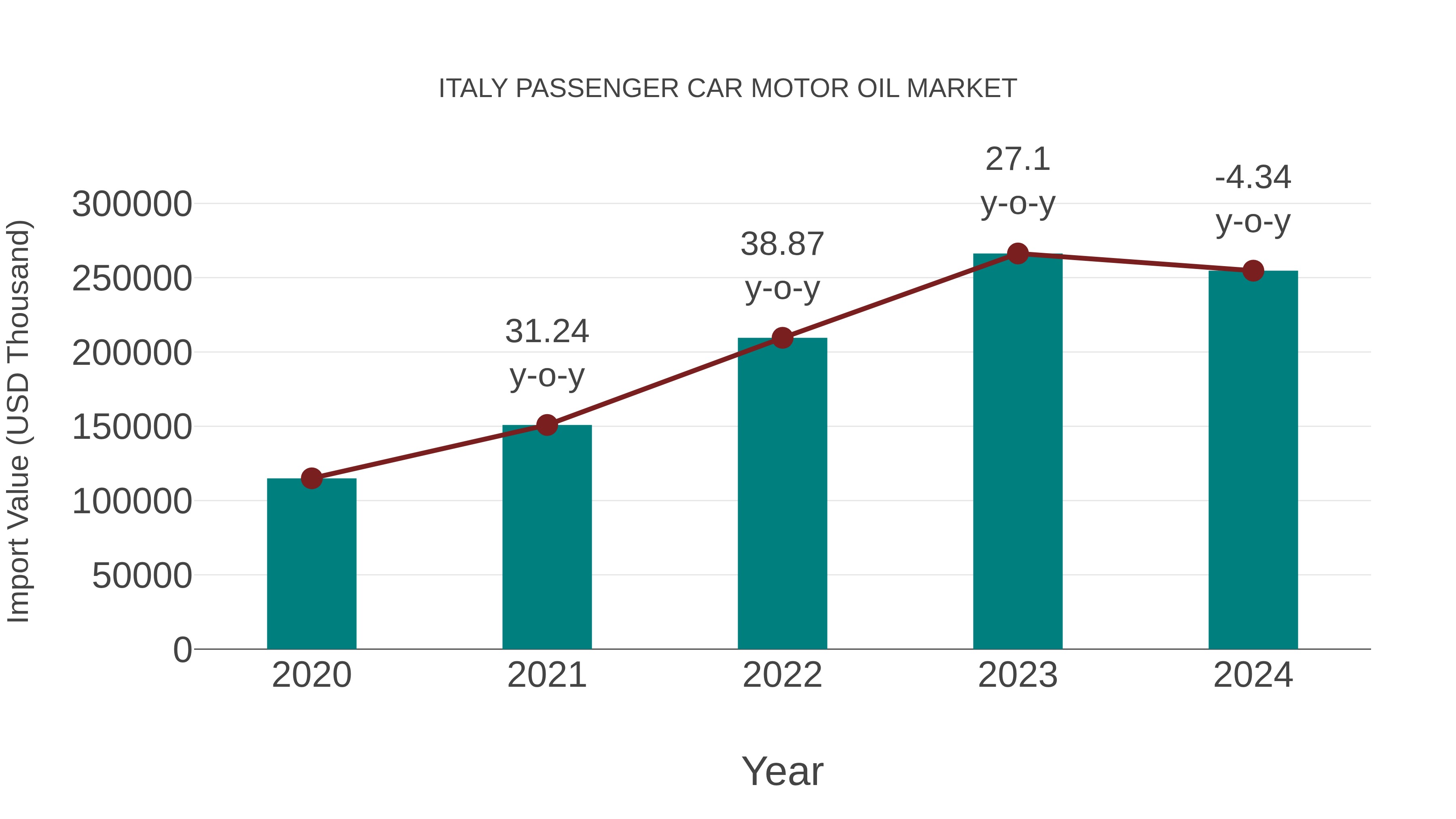
In 2024, Italy passenger car motor oil Market: Import Trend Analysis saw a notable increase in imports. The trend reflected a growing demand for foreign motor oil products in the country, indicating a shift in consumer preferences towards imported brands over domestic options.
Italy Passenger Car Motor Oil Market Overview
The Italy passenger car motor oil market is a significant segment within the country`s automotive industry. It is characterized by a high level of competition among major players such as Eni, Total, and Shell, as well as several smaller local and international brands. The market is driven by factors such as the increasing number of vehicles on the road, growing consumer awareness about the importance of regular oil changes, and technological advancements in motor oil formulations. Synthetic oils are gaining popularity due to their superior performance and longer lifespan, although conventional mineral oils still hold a considerable market share. With a strong focus on sustainability and environmental regulations, there is a growing trend towards eco-friendly and bio-based motor oil products in Italy. Overall, the Italy passenger car motor oil market is expected to continue growing steadily in the coming years.
Italy Passenger Car Motor Oil Market Trends
Currently, the Italy passenger car motor oil market is experiencing a shift towards synthetic and semi-synthetic oils due to their superior performance and environmental benefits. Consumers are increasingly opting for these higher-quality oils to ensure better engine protection, fuel efficiency, and extended oil change intervals. There is also a growing demand for low-viscosity oils to meet the requirements of modern engines and improve overall vehicle performance. Additionally, eco-friendly and renewable motor oil options are gaining traction as environmental consciousness among consumers rises. Manufacturers are focusing on developing innovative formulations to cater to these evolving preferences and regulations, driving the market towards more sustainable and efficient solutions.
Italy Passenger Car Motor Oil Market Challenges
In the Italy passenger car motor oil market, several challenges are being faced. One major challenge is the increasing environmental regulations and the shift towards more sustainable and eco-friendly products. This has led to the demand for motor oils that are not only efficient in performance but also comply with strict environmental standards. Additionally, the market is highly competitive with a large number of players vying for market share, making it challenging for companies to differentiate their products and stand out. Furthermore, the economic instability and fluctuations in oil prices can also impact the market dynamics, leading to uncertainties in consumer behavior and purchasing patterns. Overall, navigating these challenges requires companies to innovate, adapt quickly to changing regulations, and focus on sustainability to stay competitive in the Italy passenger car motor oil market.
Italy Passenger Car Motor Oil Market Investment Opportunities
The Italy passenger car motor oil market offers promising investment opportunities due to the growing automotive industry and increasing consumer demand for high-quality lubricants. With a strong focus on sustainable practices and environmental regulations, there is a rising trend towards synthetic and eco-friendly motor oils in Italy. Investing in innovative products that cater to these preferences, such as low-viscosity oils and hybrid-specific lubricants, can position companies for success in the market. Additionally, partnerships with automotive manufacturers and service providers can help access a wider customer base. As Italy transitions towards electric and hybrid vehicles, investing in research and development for specialized lubricants for these technologies can also be a lucrative opportunity in the passenger car motor oil market.
Italy Passenger Car Motor Oil Market Government Policy
The Italian government has implemented several policies related to the passenger car motor oil market to ensure environmental protection and consumer safety. These include regulations on the quality and performance standards of motor oils to reduce emissions and improve fuel efficiency, as well as guidelines for proper disposal to minimize environmental impact. Additionally, there are measures in place to promote the use of eco-friendly and bio-based motor oils to support sustainability efforts in the automotive industry. The government also monitors and enforces compliance with these policies through inspections and penalties for non-compliance to safeguard consumers and the environment. Overall, these policies aim to create a more sustainable and efficient passenger car motor oil market in Italy.
Italy Passenger Car Motor Oil Market Future Outlook
The future outlook for the Italy passenger car motor oil market is expected to remain steady with moderate growth potential. Factors such as increasing vehicle ownership, automotive industry advancements, and a growing focus on sustainability and environmental regulations are likely to drive the demand for high-quality motor oils. The market is also anticipated to witness a shift towards synthetic and premium motor oils due to their superior performance and longer lifespan. Additionally, the rise of electric vehicles may impact the market to some extent, but the overall demand for motor oil in Italy is expected to remain resilient. Key players in the industry are likely to focus on product innovation, strategic partnerships, and marketing initiatives to maintain a competitive edge and capitalize on emerging opportunities in the market.
Key Highlights of the Report:
- Italy Passenger Car Motor Oil Market Outlook
- Market Size of Italy Passenger Car Motor Oil Market,2025
- Forecast of Italy Passenger Car Motor Oil Market, 2032
- Historical Data and Forecast of Italy Passenger Car Motor Oil Revenues & Volume for the Period 2022-2032F
- Italy Passenger Car Motor Oil Market Trend Evolution
- Italy Passenger Car Motor Oil Market Drivers and Challenges
- Italy Passenger Car Motor Oil Price Trends
- Italy Passenger Car Motor Oil Porter's Five Forces
- Italy Passenger Car Motor Oil Industry Life Cycle
- Historical Data and Forecast of Italy Passenger Car Motor Oil Market Revenues & Volume By Type for the Period 2022-2032F
- Historical Data and Forecast of Italy Passenger Car Motor Oil Market Revenues & Volume By Synthetic for the Period 2022-2032F
- Historical Data and Forecast of Italy Passenger Car Motor Oil Market Revenues & Volume By Conventional for the Period 2022-2032F
- Historical Data and Forecast of Italy Passenger Car Motor Oil Market Revenues & Volume By Semi-Synthetic for the Period 2022-2032F
- Historical Data and Forecast of Italy Passenger Car Motor Oil Market Revenues & Volume By High-Mileage for the Period 2022-2032F
- Historical Data and Forecast of Italy Passenger Car Motor Oil Market Revenues & Volume By Viscosity Grade for the Period 2022-2032F
- Historical Data and Forecast of Italy Passenger Car Motor Oil Market Revenues & Volume By 5W-30 for the Period 2022-2032F
- Historical Data and Forecast of Italy Passenger Car Motor Oil Market Revenues & Volume By 10W-40 for the Period 2022-2032F
- Historical Data and Forecast of Italy Passenger Car Motor Oil Market Revenues & Volume By 15W-50 for the Period 2022-2032F
- Historical Data and Forecast of Italy Passenger Car Motor Oil Market Revenues & Volume By 0W-20 for the Period 2022-2032F
- Historical Data and Forecast of Italy Passenger Car Motor Oil Market Revenues & Volume By Application for the Period 2022-2032F
- Historical Data and Forecast of Italy Passenger Car Motor Oil Market Revenues & Volume By High Performance for the Period 2022-2032F
- Historical Data and Forecast of Italy Passenger Car Motor Oil Market Revenues & Volume By Standard Driving for the Period 2022-2032F
- Historical Data and Forecast of Italy Passenger Car Motor Oil Market Revenues & Volume By Long Mileage for the Period 2022-2032F
- Historical Data and Forecast of Italy Passenger Car Motor Oil Market Revenues & Volume By Fuel Efficiency for the Period 2022-2032F
- Historical Data and Forecast of Italy Passenger Car Motor Oil Market Revenues & Volume By End Use for the Period 2022-2032F
- Historical Data and Forecast of Italy Passenger Car Motor Oil Market Revenues & Volume By Car Owners for the Period 2022-2032F
- Historical Data and Forecast of Italy Passenger Car Motor Oil Market Revenues & Volume By Dealerships for the Period 2022-2032F
- Historical Data and Forecast of Italy Passenger Car Motor Oil Market Revenues & Volume By Service Centers for the Period 2022-2032F
- Historical Data and Forecast of Italy Passenger Car Motor Oil Market Revenues & Volume By Automotive for the Period 2022-2032F
- Italy Passenger Car Motor Oil Import Export Trade Statistics
- Market Opportunity Assessment By Type
- Market Opportunity Assessment By Viscosity Grade
- Market Opportunity Assessment By Application
- Market Opportunity Assessment By End Use
- Italy Passenger Car Motor Oil Top Companies Market Share
- Italy Passenger Car Motor Oil Competitive Benchmarking By Technical and Operational Parameters
- Italy Passenger Car Motor Oil Company Profiles
- Italy Passenger Car Motor Oil Key Strategic Recommendations






































