Italy Pressure Sensor Market: Import Trend Analysis
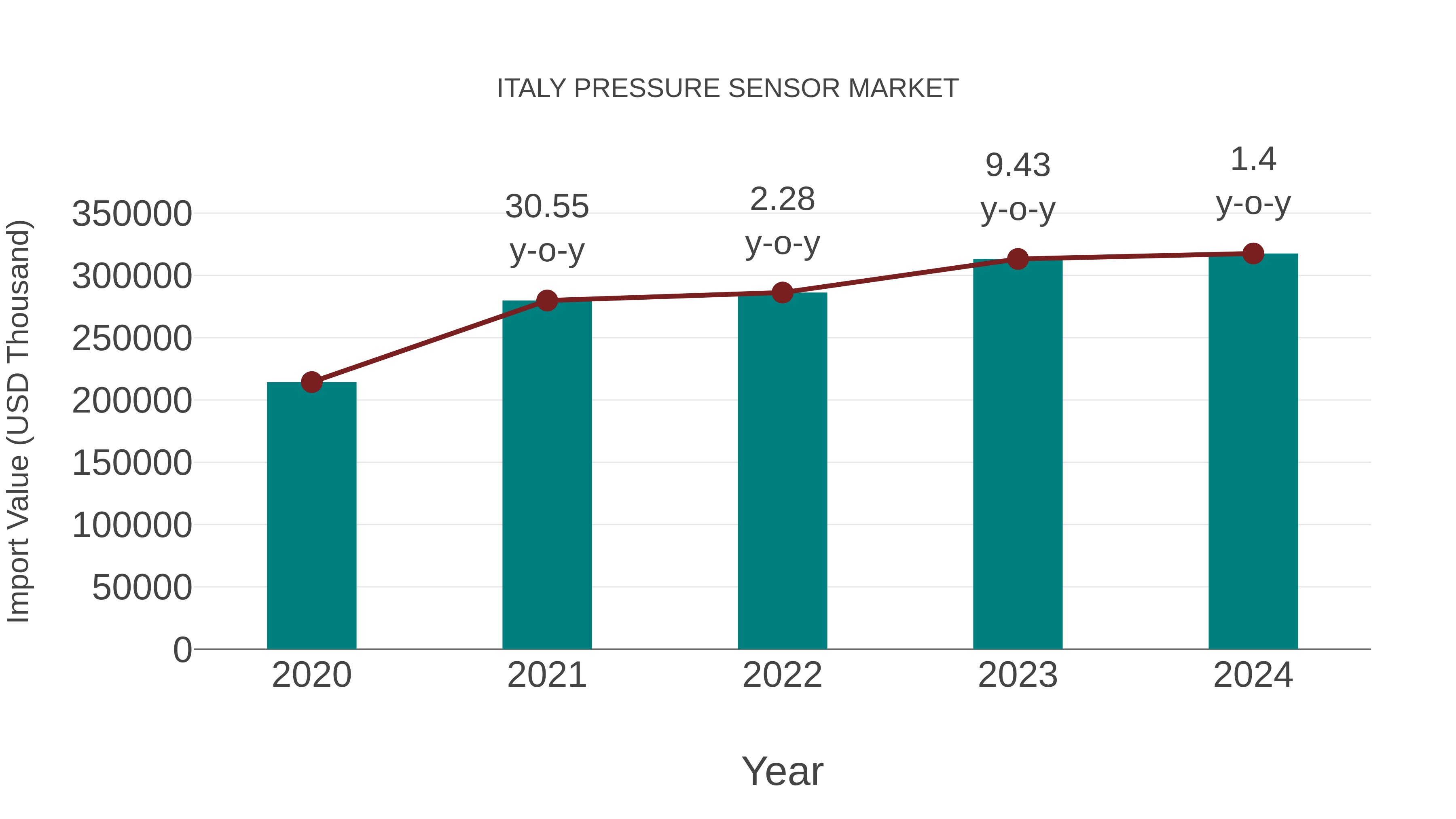
In 2024, Italy import trend for pressure sensors showed a steady increase, driven by demand across industries like automotive and healthcare. The Market: Import Trend Analysis experienced a notable rise in imported pressure sensor products from various global suppliers, reflecting Italy reliance on international Market: Import Trend Analysiss for these key components.
Italy Pressure Sensor Market Synopsis
Pressure sensors are used in numerous applications to measure and monitor pressure. This market includes automotive, healthcare, industrial, and consumer electronics sectors, where accurate pressure measurement is vital for performance and safety.
Drivers of the market
The Italy Pressure Sensor Market, factors such as increasing automation across industries, rising demand for smart devices and IoT applications, and advancements in MEMS technology drive market growth. Pressure sensors play a crucial role in various applications, including automotive, healthcare, consumer electronics, and industrial automation, by providing accurate and reliable pressure measurements. Factors such as miniaturization, cost-effectiveness, and integration with wireless communication technologies accelerate market adoption. Additionally, the emergence of Industry 4.0 initiatives and the need for predictive maintenance further propel market expansion.
Challenges of the market
The pressure sensor market in Italy faces challenges related to miniaturization, accuracy, and reliability. Meeting the increasing demand for compact and high-performance sensors across diverse applications requires continuous innovation in sensor design and manufacturing processes. Additionally, ensuring the compatibility and interoperability of pressure sensors with existing systems and protocols is critical for seamless integration and functionality.
Government Policy of the market
The Italy government supports the pressure sensor market through initiatives that promote industrial automation and smart manufacturing. Policies include tax breaks for companies adopting advanced sensor technologies and funding for research in sensor innovation. Regulatory standards ensure the accuracy and reliability of pressure sensors used in critical applications.
Key Highlights of the Report:
- Italy Pressure Sensor Market Outlook
- Market Size of Italy Pressure Sensor Market, 2024
- Forecast of Italy Pressure Sensor Market, 2031
- Historical Data and Forecast of Italy Pressure Sensor Revenues & Volume for the Period 2018 - 2031
- Italy Pressure Sensor Market Trend Evolution
- Italy Pressure Sensor Market Drivers and Challenges
- Italy Pressure Sensor Price Trends
- Italy Pressure Sensor Porter's Five Forces
- Italy Pressure Sensor Industry Life Cycle
- Historical Data and Forecast of Italy Pressure Sensor Market Revenues & Volume By Application for the Period 2018 - 2031
- Historical Data and Forecast of Italy Pressure Sensor Market Revenues & Volume By Automotive for the Period 2018 - 2031
- Historical Data and Forecast of Italy Pressure Sensor Market Revenues & Volume By Medical for the Period 2018 - 2031
- Historical Data and Forecast of Italy Pressure Sensor Market Revenues & Volume By Consumer Electronics for the Period 2018 - 2031
- Historical Data and Forecast of Italy Pressure Sensor Market Revenues & Volume By Industrial for the Period 2018 - 2031
- Historical Data and Forecast of Italy Pressure Sensor Market Revenues & Volume By Aerospace and Defense for the Period 2018 - 2031
- Historical Data and Forecast of Italy Pressure Sensor Market Revenues & Volume By Food and Beverage for the Period 2018 - 2031
- Historical Data and Forecast of Italy Pressure Sensor Market Revenues & Volume By HVAC for the Period 2018 - 2031
- Italy Pressure Sensor Import Export Trade Statistics
- Market Opportunity Assessment By Application
- Italy Pressure Sensor Top Companies Market Share
- Italy Pressure Sensor Competitive Benchmarking By Technical and Operational Parameters
- Italy Pressure Sensor Company Profiles
- Italy Pressure Sensor Key Strategic Recommendations






































