Italy RegTech Market Size & Growth Rate (2026-2032)
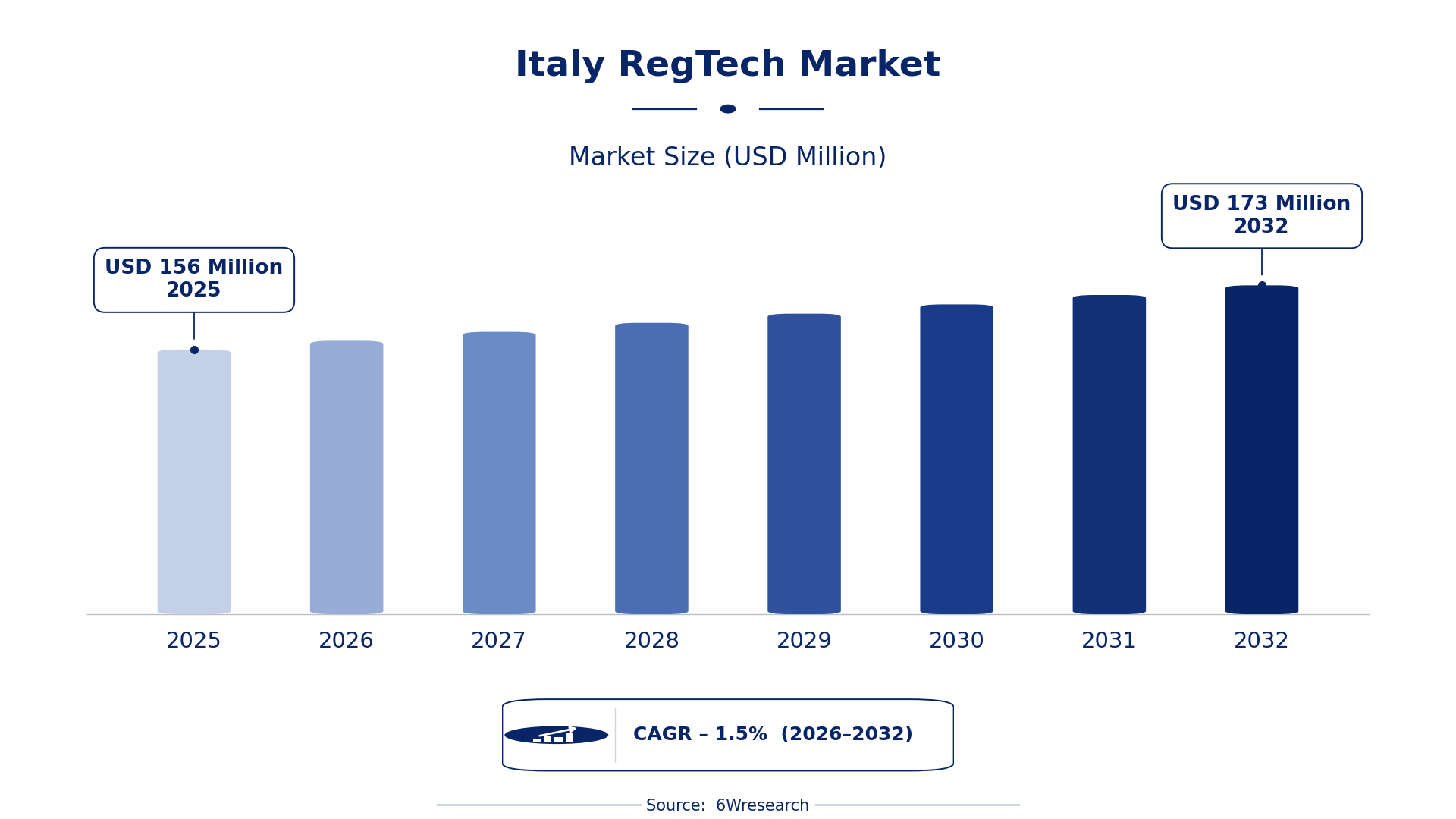
The Italy RegTech Market was estimated at USD 156 Million in 2025 and is projected to reach USD 173 Million by 2032, growing at a CAGR of 1.5% from 2026 to 2032.
Italy RegTech Market Synopsis
The Italy RegTech market is currently witnessing a surge in adoption, propelled by increasing regulatory complexities across various sectors. As organizations scramble to meet stringent compliance demands, the need for innovative regulatory solutions is more critical than ever. This urgency is expected to translate into sustained growth as businesses invest in technology-driven compliance strategies.
Looking ahead, the market is likely to evolve with advancements in artificial intelligence and blockchain, enhancing regulatory efficiency and risk management. Companies that embrace these technologies will gain a competitive edge, as the pressure to comply with evolving regulations intensifies.
Italy RegTech Market Year-wise Growth Rate and Key Drivers
This graph illustrates the annual growth rates of the Italy RegTech Market from 2021 to 2032, highlighting a steady upward trajectory and projected expansion over the forecast period.
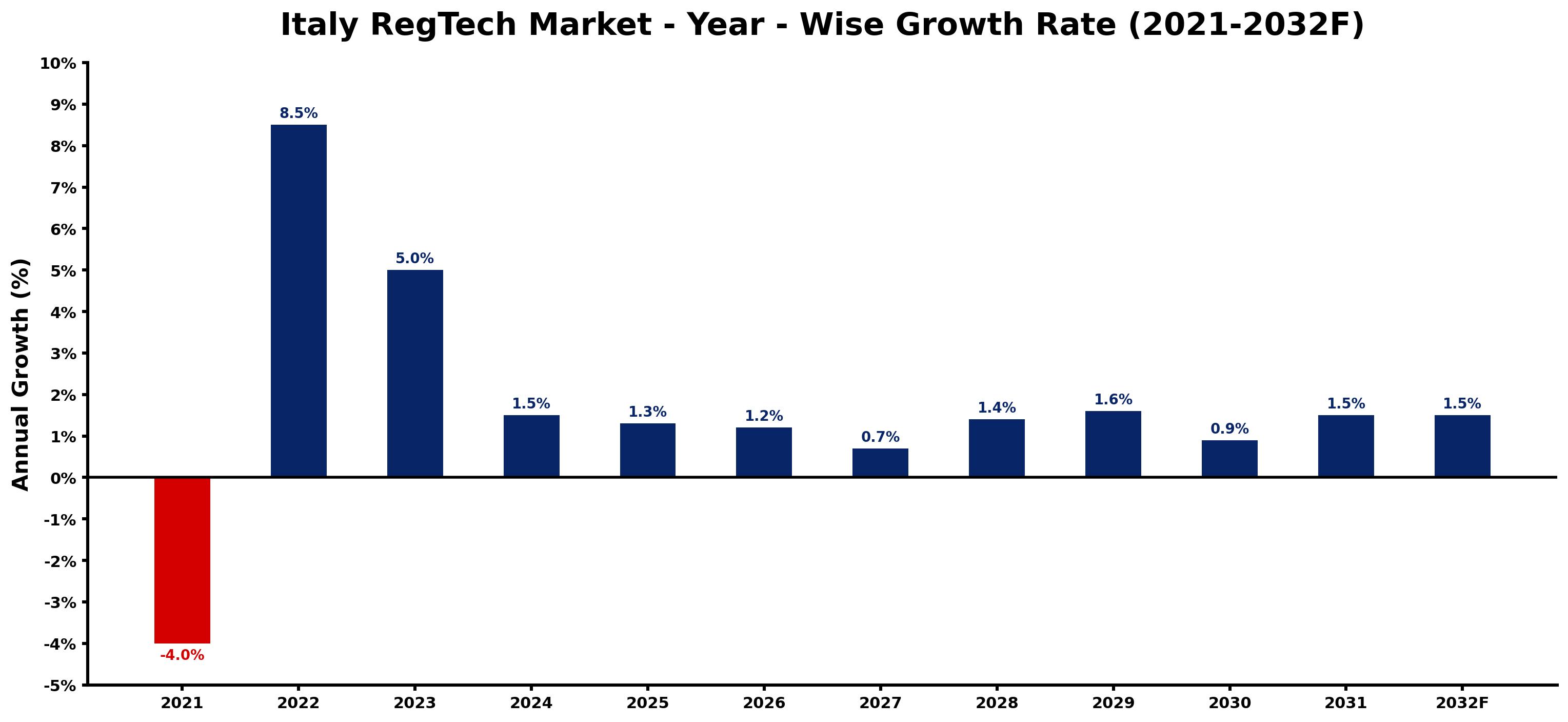
The table below presents the year‑wise growth rates along with the key drivers influencing the market
| Year | Growth Rate | Major Drivers |
| 2021 | -4.0% | Delays in PSD2 implementation by Banca d'Italia. |
| 2022 | 8.5% | EU's Digital Finance Strategy boosting regulatory tech adoption. |
| 2023 | 5.0% | Increased focus on anti-money laundering regulations in Italy. |
| 2024 | 1.5% | Implementation of Italy’s National Cybersecurity Strategy driving demand. |
| 2025 | 1.3% | Growing fintech startups requiring compliance solutions and tools. |
| 2026 | 1.2% | Adoption of PSD2 fostering open banking regulatory frameworks. |
| 2027 | 0.7% | Rise of digital identity verification mandates for businesses. |
| 2028 | 1.4% | Increased investment in sustainable finance regulatory technologies. |
| 2029 | 1.6% | Strengthened GDPR compliance requirements creating RegTech opportunities. |
| 2030 | 0.9% | Growth in e-commerce necessitating enhanced regulatory compliance tools. |
| 2031 | 1.5% | Further integration of blockchain in regulatory reporting frameworks. |
| 2032 | 1.5% | Government incentives for tech firms improving regulatory efficiencies. |
Note: Market size estimations and growth projections presented in this report are based on 6Wresearch's proprietary forecasting methodology, utilizing the latest available industry data, government publications, and primary research inputs.
Italy RegTech Market Key Takeaways
Below are some of the specific key takeaways from the market, including:
- The Italy RegTech market is experiencing rapid growth due to increasing regulatory demands in finance and insurance.
- Advanced technologies like AI and blockchain are being integrated into RegTech solutions to enhance compliance efficiency.
- Data privacy and security regulations are driving investment in RegTech tools aimed at protecting sensitive information.
- Collaboration between startups and established financial institutions is fostering innovation within the market.
- Investment opportunities abound, particularly in compliance monitoring and regulatory reporting solutions.
Evaluation of Restraints in Italy RegTech Market
Despite its potential, the Italy RegTech market faces several constraints that could hinder growth. The intricate regulatory frameworks specific to Italy can be daunting for new entrants. Companies must navigate these complexities while ensuring compliance with evolving standards, which can be resource-intensive. on top of that, cultural differences in adopting technological solutions may slow down acceptance rates, limiting the overall market expansion. Businesses need to address these challenges head-on to fully capitalize on the opportunities within this sector.
Italy RegTech Market Trends
Several key trends are shaping the Italy RegTech market. Firstly, there is a noticeable shift towards the automation of compliance tasks, driven by the adoption of AI and machine learning technologies. Secondly, RegTech startups are emerging with niche solutions tailored to address specific regulatory challenges, enhancing overall market dynamism. Finally, as data privacy concerns mount, companies are increasingly prioritizing tools that ensure compliance with stringent data protection regulations.
Italy RegTech Market Opportunities
The investment landscape within the Italy RegTech market is rich with opportunities. As regulatory complexity continues to escalate, demand for innovative compliance solutions will grow. Companies offering advanced regulatory reporting and risk management tools are well-positioned to attract investment. Additionally, strategic partnerships with financial institutions and regulatory bodies can further enhance market prospects, allowing businesses to implement tailored solutions that meet specific compliance requirements.
Government Initiatives in the Italy RegTech Market
The Italian government is actively fostering the growth of the RegTech sector through targeted policies and initiatives. By promoting innovative technologies, the government aims to enhance compliance and risk management within the financial services industry. The current regulatory environment is becoming increasingly supportive, facilitating collaboration between RegTech startups and established players to drive efficiency and transparency.
- A recently completed initiative focused on streamlining the regulatory approval process for RegTech companies, aiming to reduce bureaucratic obstacles.
- Ongoing collaborations between the government and technology incubators to nurture RegTech startups through funding and mentorship programs.
- A planned public-private initiative expected to launch in 2026 aimed at integrating advanced technologies into regulatory frameworks.
- Recent legislation mandating the adoption of digital compliance tools across financial institutions to enhance reporting accuracy.
- Current efforts to develop a national strategy for digital transformation in financial services, emphasizing RegTech solutions.
Future Insights of the Italy RegTech Market
The Italy RegTech market is set for a transformative phase from 2026 to 2032. As regulatory demands become more intricate, the reliance on technology to streamline compliance will increase. The integration of AI and machine learning will enable organizations to better manage risks and enhance reporting accuracy. This evolution will not only drive growth but also reshape how financial institutions approach regulatory compliance, making it a core component of their operational strategies.
Italy RegTech Market Latest Developments
In the past year, the Italy RegTech market has seen significant activity, reflecting the sector's dynamic nature. Companies are increasingly launching innovative solutions that address specific regulatory challenges, while partnerships are forming to enhance compliance capabilities across industries.
- A major technology vendor introduced a new compliance automation platform in early 2025, aimed at enhancing regulatory reporting for financial institutions.
- An initiative that began in mid-2025 focuses on developing AI-driven tools for anti-money laundering processes, which remains underway.
- A rollout expected to begin in late 2026 aims to enhance data protection measures within RegTech solutions across the banking sector.
- A partnership between a leading fintech and a regulatory body was announced in Q3 2025, focusing on collaborative development of compliance standards.
- Several RegTech startups are currently piloting blockchain solutions for real-time regulatory reporting, with results anticipated by early 2026.
Italy RegTech Market - Key Attractiveness of the Report
- 10 Years of Market Numbers
- Historical Data Starting from 2022 to 2025
- Base Year: 2025
- Forecast Data until 2032
- Key Performance Indicators Impacting the Market
- Major Upcoming Developments and Projects
Key Highlights of the Report:
- Italy RegTech Market Outlook
- Market Size of Italy RegTech Market, 2025
- Forecast of Italy RegTech Market, 2032
- Historical Data and Forecast of Italy RegTech Revenues & Volume for the Period 2022-2032F
- Italy RegTech Market Trend Evolution
- Italy RegTech Market Drivers and Challenges
- Italy RegTech Price Trends
- Italy RegTech Porter's Five Forces
- Italy RegTech Industry Life Cycle
- Historical Data and Forecast of Italy RegTech Market Revenues & Volume By Component for the Period 2022-2032F
- Historical Data and Forecast of Italy RegTech Market Revenues & Volume By Solutions for the Period 2022-2032F
- Historical Data and Forecast of Italy RegTech Market Revenues & Volume By Services for the Period 2022-2032F
- Historical Data and Forecast of Italy RegTech Market Revenues & Volume By Application for the Period 2022-2032F
- Historical Data and Forecast of Italy RegTech Market Revenues & Volume By Risk & Compliance Management for the Period 2022-2032F
- Historical Data and Forecast of Italy RegTech Market Revenues & Volume By Identity Management for the Period 2022-2032F
- Historical Data and Forecast of Italy RegTech Market Revenues & Volume By Regulatory Reporting for the Period 2022-2032F
- Historical Data and Forecast of Italy RegTech Market Revenues & Volume By AML and Fraud Management for the Period 2022-2032F
- Historical Data and Forecast of Italy RegTech Market Revenues & Volume By Regulatory Intelligence for the Period 2022-2032F
- Historical Data and Forecast of Italy RegTech Market Revenues & Volume By Organization Size for the Period 2022-2032F
- Historical Data and Forecast of Italy RegTech Market Revenues & Volume By SMEs for the Period 2022-2032F
- Historical Data and Forecast of Italy RegTech Market Revenues & Volume By Large Enterprises for the Period 2022-2032F
- Historical Data and Forecast of Italy RegTech Market Revenues & Volume By Deployment Mode for the Period 2022-2032F
- Historical Data and Forecast of Italy RegTech Market Revenues & Volume By On-Premises for the Period 2022-2032F
- Historical Data and Forecast of Italy RegTech Market Revenues & Volume By Cloud for the Period 2022-2032F
- Historical Data and Forecast of Italy RegTech Market Revenues & Volume By Vertical for the Period 2022-2032F
- Historical Data and Forecast of Italy RegTech Market Revenues & Volume By Banking for the Period 2022-2032F
- Historical Data and Forecast of Italy RegTech Market Revenues & Volume By Insurance for the Period 2022-2032F
- Historical Data and Forecast of Italy RegTech Market Revenues & Volume By Non-Financial for the Period 2022-2032F
- Italy RegTech Import Export Trade Statistics
- Market Opportunity Assessment By Component
- Market Opportunity Assessment By Application
- Market Opportunity Assessment By Organization Size
- Market Opportunity Assessment By Deployment Mode
- Market Opportunity Assessment By Vertical
- Italy RegTech Top Companies Market Share
- Italy RegTech Competitive Benchmarking By Technical and Operational Parameters
- Italy RegTech Company Profiles
- Italy RegTech Key Strategic Recommendations






































