Italy Sports Nutrition Market Size, Share & Growth Rate
The Italy Sports Nutrition Market was estimated at USD 220 Million in 2025 and is projected to reach USD 242 Million by 2032, growing at a CAGR of 1.4% from 2026 to 2032. This growth trajectory is largely fueled by an increasing health consciousness among Italian consumers, particularly among the younger demographic who are actively seeking products that can enhance their fitness regimens. The surge in fitness club memberships and a growing culture around health and wellness are also pivotal factors contributing to this expansion.
Italy Sports Nutrition Market Year-wise Growth Rate and Key Drivers
This graph highlights how the Italy Sports Nutrition Market has steadily grown over the years, supported by major growth factors.
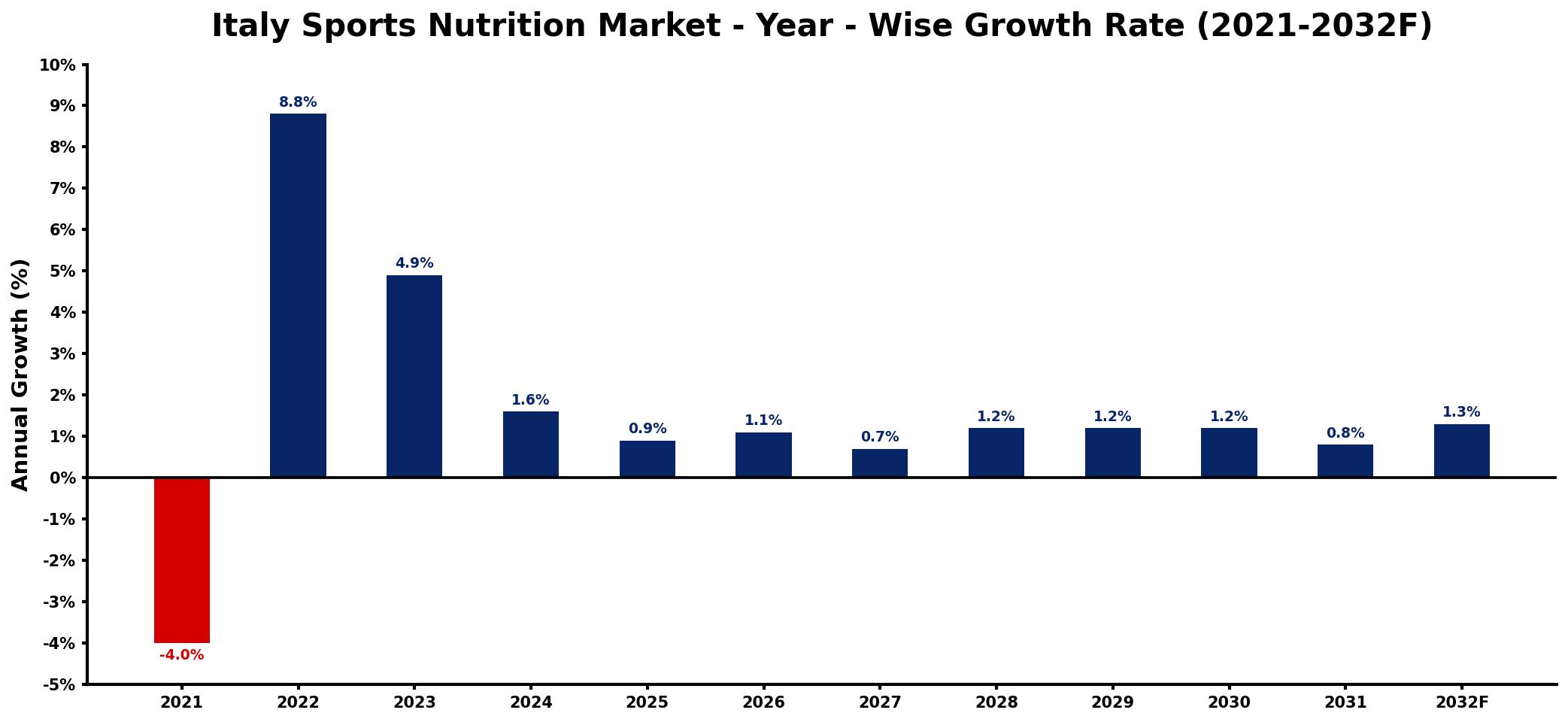
The table below presents the year‑wise growth rates along with the key drivers influencing the market
| Year | Growth Rate | Major Drivers |
| 2021 | -4.0% | Consumer spending shift trends |
| 2022 | 8.8% | Increased health awareness initiatives |
| 2023 | 4.9% | Emergence of new fitness trends |
| 2024 | 1.6% | Growth in online retail platforms |
| 2025 | 0.9% | Expansion of fitness community events |
| 2026 | 1.1% | Rise in influencer marketing strategies |
| 2027 | 0.7% | Development of innovative product formulations |
| 2028 | 1.2% | Increased corporate wellness programs |
| 2029 | 1.2% | Surge in e-commerce adoption rates |
| 2030 | 1.2% | Growing interest in plant-based options |
| 2031 | 0.8% | Investment in research and development |
| 2032 | 1.3% | Enhanced distribution channel partnerships |
Note: Market size estimations and growth projections presented in this report are based on 6Wresearch's proprietary forecasting methodology, utilizing the latest available industry data, government publications, and primary research inputs.
Italy Sports Nutrition Market Synopsis
A significant demand for protein-rich supplements and energy products is transforming the landscape of the Italy Sports Nutrition Market. With athletes and casual fitness enthusiasts alike gravitating towards supplements that support performance and recovery, the need for high-quality, effective nutrition products has never been more pronounced.
Moreover, the trend towards personalized nutrition solutions is gaining traction, as consumers seek tailored products that align with their individual health goals. This growing customization indicates an evolving market where companies must innovate to capture the attention and loyalty of their clientele.
Italy Sports Nutrition Market Key Takeaways
- The market is significantly influenced by the rising popularity of plant-based protein and natural ingredients.
- Increased consumer interest in personalized nutrition is driving product innovation and tailored offerings.
- Growth in online retailing is enhancing consumer access to a diverse range of sports nutrition products.
- Partnerships with fitness influencers are instrumental in enhancing brand credibility and consumer engagement.
- Health and wellness trends are creating fertile ground for both new entrants and established players to thrive.
Evaluation of Restraints in Italy Sports Nutrition Market
Despite its growth potential, the Italy Sports Nutrition Market faces several restraints. Stringent regulations on labeling and ingredient safety pose challenges for manufacturers seeking to introduce innovative products. Additionally, the traditional eating habits prevalent in Italy may limit the widespread acceptance of sports nutrition products among certain demographics. Competition is another factor, with both local and international brands vying for market share, which can complicate efforts for newcomers to establish themselves effectively. Furthermore, economic fluctuations can influence consumer spending patterns, creating variability in market demand.
Italy Sports Nutrition Market Trends
Current trends indicate a shift toward cleaner labels and sustainable ingredients, as consumers increasingly prioritize health-conscious choices. The rise of e-commerce is revolutionizing product distribution, enabling consumers to explore a broader array of options conveniently. The growing interest in personalized nutrition means brands are innovating formulations to cater to specific dietary needs and fitness goals. Additionally, the integration of technology in sports nutrition, such as apps for tracking nutrient intake and fitness levels, is set to redefine consumer engagement.
Italy Sports Nutrition Market Opportunities
There are significant investment opportunities within the Italy Sports Nutrition Market, particularly in areas like protein supplements, energy bars, and sports drinks tailored to both amateur and professional athletes. Companies focusing on innovative, organic, and personalized products stand to gain a competitive advantage. The burgeoning demand for plant-based options offers another lucrative avenue for growth. Moreover, leveraging digital platforms for marketing and sales, as well as establishing partnerships with gyms and wellness centers, can enhance visibility and market penetration.
Government Initiatives in the Italy Sports Nutrition Market
The Italian government has instituted several regulations aimed at ensuring the safety and quality of sports nutrition products. These policies, overseen by the Ministry of Health, require that sports supplements be registered and approved to comply with safety standards and accurate labeling. Furthermore, regulations are in place to oversee the marketing practices of these products, fostering transparency and consumer trust. The government actively enforces guidelines related to the use of specific ingredients, ensuring that potential health risks are minimized for consumers.
Future Insights of the Italy Sports Nutrition Market
Looking ahead to 2026-2032, the Italy Sports Nutrition Market is expected to see continued expansion driven by rising disposable incomes and increasing awareness of health and fitness. The focus on performance enhancement, weight management, and overall wellness will shape product offerings. Companies that innovate with natural, organic ingredients and personalization will likely lead the market. Social media and digital marketing will remain crucial in connecting with health-conscious consumers, making their influence felt in purchasing decisions.
Italy Sports Nutrition Market Latest Developments (2025 - 2026)
In recent months, the Italy Sports Nutrition Market has experienced a surge in product launches focusing on clean label ingredients and sustainability. Brands are increasingly collaborating with fitness professionals to enhance the credibility of their offerings. Additionally, e-commerce platforms are introducing more efficient delivery systems to improve customer satisfaction. As consumer preferences shift towards transparency and health consciousness, companies are adapting by revising their marketing strategies to align with these evolving expectations.
Italy Sports Nutrition Market - Key Attractiveness of the Report
- 10 Years of Market Numbers
- Historical Data Starting from 2022 to 2025
- Base Year: 2025
- Forecast Data until 2032
- Key Performance Indicators Impacting the Market
- Major Upcoming Developments and Projects
Key Highlights of the Report:
- Italy Sports Nutrition Market Outlook
- Market Size of Italy Sports Nutrition Market, 2025
- Forecast of Italy Sports Nutrition Market, 2032
- Historical Data and Forecast of Italy Sports Nutrition Revenues & Volume for the Period 2022-2032F
- Italy Sports Nutrition Market Trend Evolution
- Italy Sports Nutrition Market Drivers and Challenges
- Italy Sports Nutrition Price Trends
- Italy Sports Nutrition Porter's Five Forces
- Italy Sports Nutrition Industry Life Cycle
- Historical Data and Forecast of Italy Sports Nutrition Market Revenues & Volume By Type for the Period 2022-2032F
- Historical Data and Forecast of Italy Sports Nutrition Market Revenues & Volume By Sports Food for the Period 2022-2032F
- Historical Data and Forecast of Italy Sports Nutrition Market Revenues & Volume By Sports Drinks for the Period 2022-2032F
- Historical Data and Forecast of Italy Sports Nutrition Market Revenues & Volume By Sports Supplements for the Period 2022-2032F
- Historical Data and Forecast of Italy Sports Nutrition Market Revenues & Volume By Distribution Channel for the Period 2022-2032F
- Historical Data and Forecast of Italy Sports Nutrition Market Revenues & Volume By Supermarkets/Hypermarkets for the Period 2022-2032F
- Historical Data and Forecast of Italy Sports Nutrition Market Revenues & Volume By Specialty Stores for the Period 2022-2032F
- Historical Data and Forecast of Italy Sports Nutrition Market Revenues & Volume By Convenience Stores for the Period 2022-2032F
- Historical Data and Forecast of Italy Sports Nutrition Market Revenues & Volume By Online Stores for the Period 2022-2032F
- Historical Data and Forecast of Italy Sports Nutrition Market Revenues & Volume By Other Distribution Channels for the Period 2022-2032F
- Italy Sports Nutrition Import Export Trade Statistics
- Market Opportunity Assessment By Type
- Market Opportunity Assessment By Distribution Channel
- Italy Sports Nutrition Top Companies Market Share
- Italy Sports Nutrition Competitive Benchmarking By Technical and Operational Parameters
- Italy Sports Nutrition Company Profiles
- Italy Sports Nutrition Key Strategic Recommendations






































