Italy Supply Chain Analytics Market Size & Growth Rate (2026-2032)
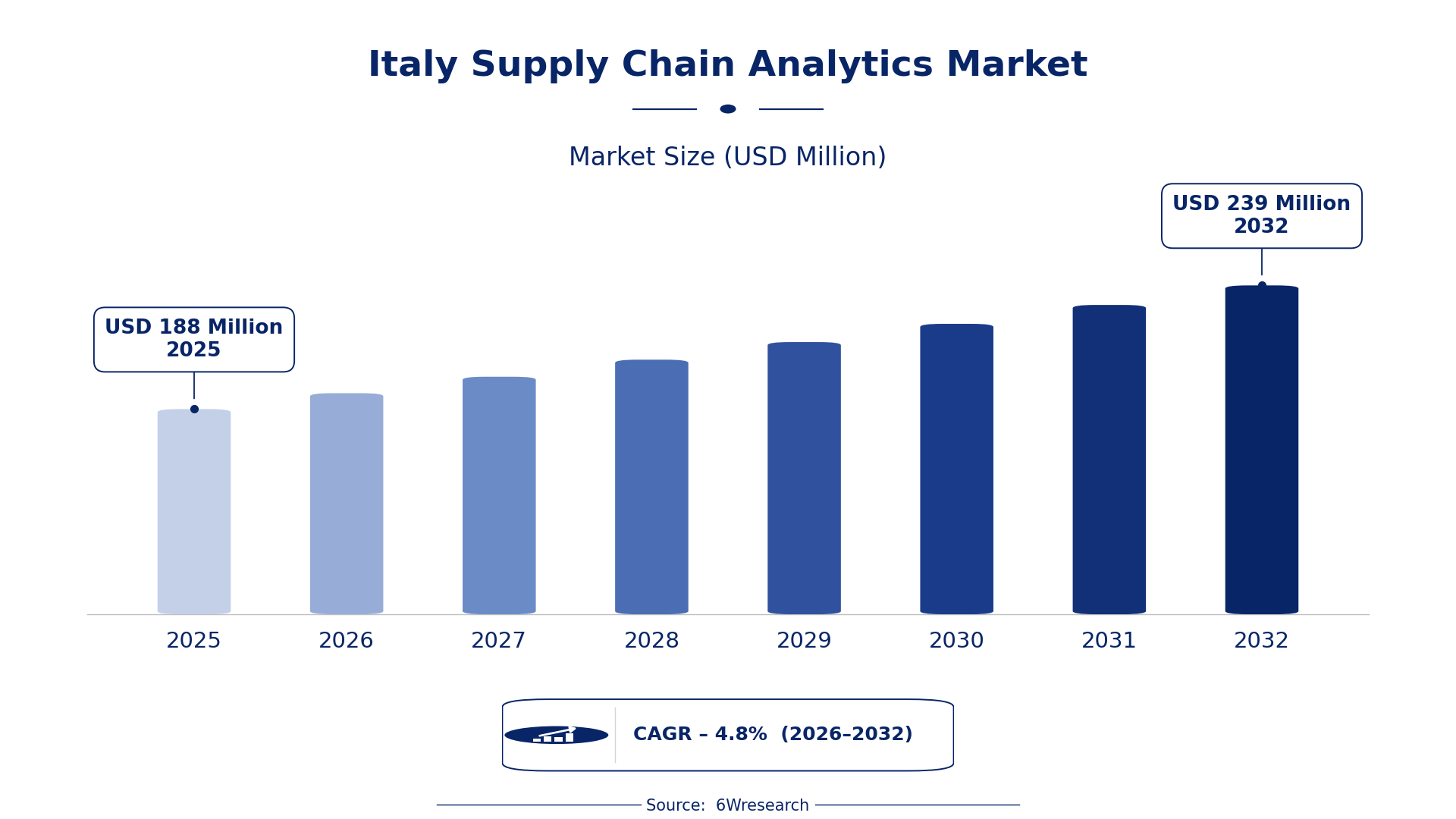
The Italy Supply Chain Analytics Market was estimated at USD 188 Million in 2025 and is projected to reach USD 239 Million by 2032, growing at a CAGR of 4.8% from 2026 to 2032.
Italy Supply Chain Analytics Market Synopsis
The Italy Supply Chain Analytics Market is experiencing a pivotal moment as organizations increasingly adopt advanced technologies to enhance their supply chain operations. The focus is shifting from traditional methods to data-driven insights that enable smarter decision-making and operational efficiency.
Looking ahead, the market is set for considerable growth as businesses strive to improve forecasting accuracy, inventory management, and risk mitigation. With the rise of e-commerce and a growing emphasis on real-time analytics, the demand for effective supply chain analytics solutions is projected to escalate.
Italy Supply Chain Analytics Market Year-wise Growth Rate and Key Drivers
This graph illustrates the annual growth rates of the Italy Supply Chain Analytics Market from 2021 to 2032, highlighting a steady upward trajectory and projected expansion over the forecast period.
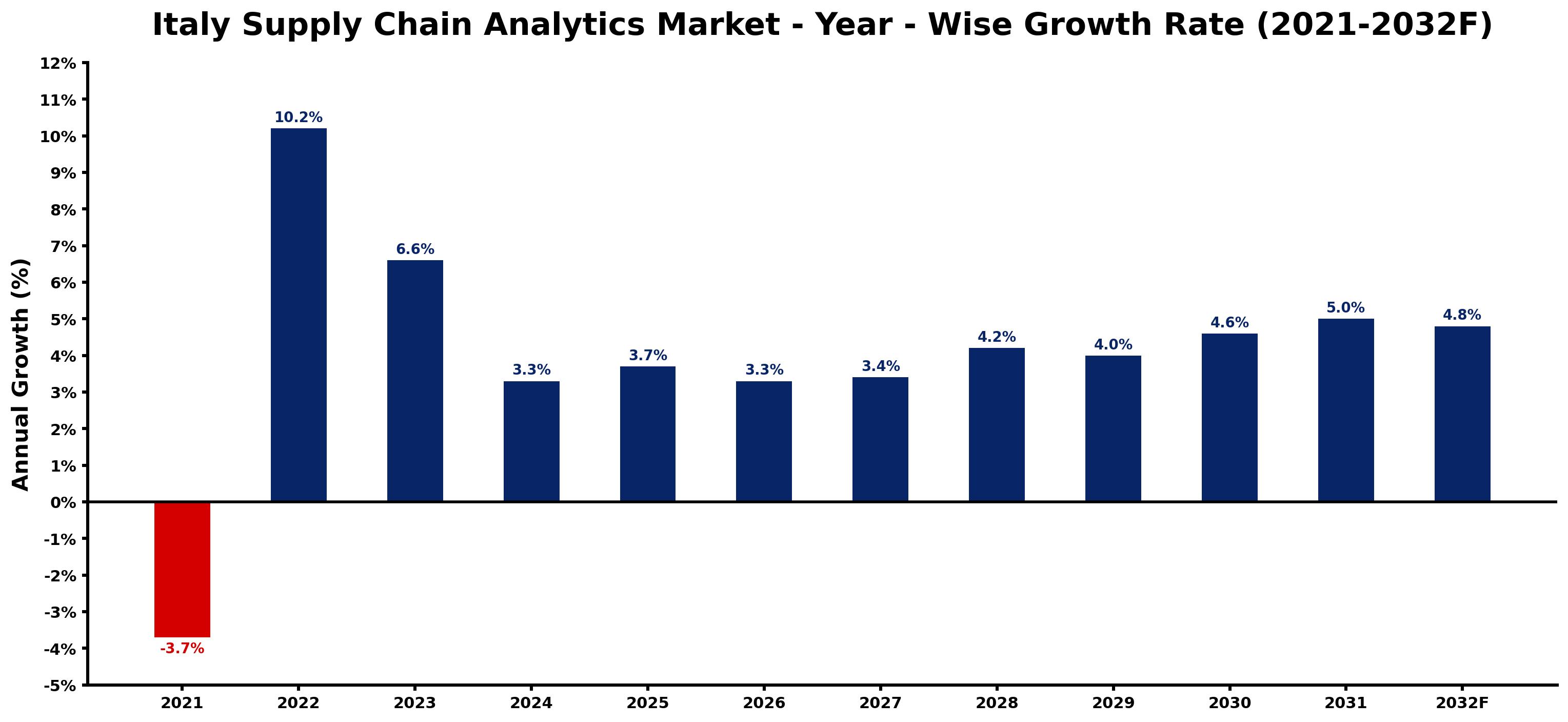
The table below presents the year‑wise growth rates along with the key drivers influencing the market
| Year | Growth Rate | Major Drivers |
| 2021 | -3.7% | Slow adoption of AI-driven analytics in Italy's logistics. |
| 2022 | 10.2% | Italy's National Recovery Plan boosts digital transformation efforts. |
| 2023 | 6.6% | Increased e-commerce demand drives advanced analytics adoption. |
| 2024 | 3.3% | Sustainable supply chain practices gaining traction among SMEs. |
| 2025 | 3.7% | Italian manufacturing seeks efficiency through predictive analytics tools. |
| 2026 | 3.3% | Government incentives for technology investments enhance analytics usage. |
| 2027 | 3.4% | Growing logistics sector demands real-time data visibility solutions. |
| 2028 | 4.2% | Consumer behavior shifts promote agile supply chain strategies. |
| 2029 | 4.0% | Regulatory focus on supply chain transparency impacts businesses. |
| 2030 | 4.6% | Rising need for risk management pushes analytics integration. |
| 2031 | 5.0% | Local startups innovate with AI-driven supply chain solutions. |
| 2032 | 4.8% | Emergence of cross-border collaborations enhances data sharing capabilities. |
Note: Market size estimations and growth projections presented in this report are based on 6Wresearch's proprietary forecasting methodology, utilizing the latest available industry data, government publications, and primary research inputs.
Italy Supply Chain Analytics Market Key Takeaways
Below are some of the specific key takeaways from the market, including:
- The integration of AI and machine learning is becoming essential for optimized supply chain processes.
- Real-time visibility and predictive analytics are prioritized to mitigate risks and enhance performance.
- Cloud-based analytics platforms are gaining traction, offering better data access and collaboration.
- The market is set to expand as companies recognize the competitive edge offered by data-driven decision-making.
- Investment opportunities are emerging, particularly in tailored analytics solutions for various sectors.
Evaluation of Restraints in Italy Supply Chain Analytics Market
Despite the promising trajectory, the Italy Supply Chain Analytics Market faces several challenges that could impede growth. Data integration remains a significant hurdle, as organizations often deal with silos that create inconsistencies across systems. This fragmentation complicates the extraction of actionable insights.
on top of that, there is a notable lack of skilled professionals adept in advanced analytics, limiting the effective deployment of supply chain solutions. The challenge of aligning analytics initiatives with overall business strategies also prevents many companies from fully leveraging the potential benefits of analytics.
Italy Supply Chain Analytics Market Trends
The current trends in the Italy Supply Chain Analytics Market reflect a strong inclination towards technological advancements. Companies are increasingly leveraging big data analytics to improve operational efficiencies and customer satisfaction. Emphasis is being placed on real-time analytics to streamline processes and enhance visibility across the supply chain.
Another critical trend is the rising demand for analytics tools that can provide not only predictive insights but also prescriptive recommendations. This shift is essential for organizations looking to adapt to the rapidly changing market dynamics and customer expectations.
Italy Supply Chain Analytics Market Opportunities
Investment opportunities in the Italy Supply Chain Analytics Market are abundant, particularly as companies navigate the complexities of supply chain management. The necessity for real-time data access and enhanced operational efficiency creates a fertile ground for advanced analytics solutions. Targeting software providers and consulting services that specialize in local market needs can yield significant returns.
on top of that, the ongoing digital transformation and the increasing importance of sustainability in supply chain management are prompting firms to seek out innovative analytics tools. This creates avenues for both new entrants and established players to capitalize on the evolving demands.
Government Initiatives in the Italy Supply Chain Analytics Market
Government policies in Italy are actively shaping the supply chain analytics market by promoting technology adoption and innovation. The Italian government is making strides to support digital transformation initiatives that encourage businesses to harness advanced analytics for optimization. Current priorities include data security, privacy, and sustainability, all of which are essential for market growth.
- A national digital infrastructure upgrade programme recently launched aims to enhance data accessibility across supply chains.
- Ongoing initiatives focus on developing public-private partnerships to facilitate technology transfer and skills development in analytics.
- The Italian government is in the process of implementing new regulations to bolster data protection measures within supply chains.
- Planned investment in sustainability programs is expected to promote ethical sourcing practices within supply chain operations by 2026.
Future Insights of the Italy Supply Chain Analytics Market
Looking forward to the period from 2026 to 2032, the Italy Supply Chain Analytics Market is set to experience a robust expansion, largely driven by technological adoption. As businesses increasingly prioritize efficiency and data-driven insights, the demand for sophisticated analytics solutions will continue to rise. Companies that effectively incorporate real-time and predictive capabilities into their operations will likely gain a competitive advantage.
on top of that, the increasing complexity of supply chains in the face of globalization and e-commerce will necessitate that organizations invest in analytics to manage risk and enhance decision-making processes. This sets the stage for innovation and growth in the coming years.
Italy Supply Chain Analytics Market Latest Developments
In the past year, the Italy Supply Chain Analytics Market has seen a surge in activities as companies embrace new technologies and methodologies. The focus has been on improving analytics capabilities to meet the growing demands of a competitive business environment. Many organizations are looking to enhance their technological infrastructure to keep pace with industry standards.
- A leading analytics provider launched a new suite of machine learning tools in Q1 2025 to help businesses improve forecasting accuracy.
- Several companies are currently developing partnerships to integrate AI solutions into their supply chain operations, with initiatives ongoing since mid-2025.
- An upcoming webinar series planned for late 2025 will focus on educating stakeholders about the latest trends in supply chain analytics.
- A major technology vendor is expected to initiate a product rollout of a cloud-based analytics platform in early 2026.
Italy Supply Chain Analytics Market - Key Attractiveness of the Report
- 10 Years of Market Numbers
- Historical Data Starting from 2022 to 2025
- Base Year: 2025
- Forecast Data until 2032
- Key Performance Indicators Impacting the Market
- Major Upcoming Developments and Projects
Key Highlights of the Report:
- Italy Supply Chain Analytics Market Outlook
- Market Size of Italy Supply Chain Analytics Market, 2025
- Forecast of Italy Supply Chain Analytics Market, 2032
- Historical Data and Forecast of Italy Supply Chain Analytics Revenues & Volume for the Period 2022-2032F
- Italy Supply Chain Analytics Market Trend Evolution
- Italy Supply Chain Analytics Market Drivers and Challenges
- Italy Supply Chain Analytics Price Trends
- Italy Supply Chain Analytics Porter's Five Forces
- Italy Supply Chain Analytics Industry Life Cycle
- Historical Data and Forecast of Italy Supply Chain Analytics Market Revenues & Volume By Software for the Period 2022-2032F
- Historical Data and Forecast of Italy Supply Chain Analytics Market Revenues & Volume By Supplier Performance Analytics for the Period 2022-2032F
- Historical Data and Forecast of Italy Supply Chain Analytics Market Revenues & Volume By Dem for the Period 2022-2032F
- Historical Data and Forecast of Italy Supply Chain Analytics Market Revenues & Volume By Analysis & Forecasting for the Period 2022-2032F
- Historical Data and Forecast of Italy Supply Chain Analytics Market Revenues & Volume By Spend & Procurement Analytics for the Period 2022-2032F
- Historical Data and Forecast of Italy Supply Chain Analytics Market Revenues & Volume By Component for the Period 2022-2032F
- Historical Data and Forecast of Italy Supply Chain Analytics Market Revenues & Volume By Software for the Period 2022-2032F
- Historical Data and Forecast of Italy Supply Chain Analytics Market Revenues & Volume By Services for the Period 2022-2032F
- Historical Data and Forecast of Italy Supply Chain Analytics Market Revenues & Volume By Deployment Mode for the Period 2022-2032F
- Historical Data and Forecast of Italy Supply Chain Analytics Market Revenues & Volume By Cloud for the Period 2022-2032F
- Historical Data and Forecast of Italy Supply Chain Analytics Market Revenues & Volume By On-premises for the Period 2022-2032F
- Historical Data and Forecast of Italy Supply Chain Analytics Market Revenues & Volume By Organization Size for the Period 2022-2032F
- Historical Data and Forecast of Italy Supply Chain Analytics Market Revenues & Volume By Large Enterprises for the Period 2022-2032F
- Historical Data and Forecast of Italy Supply Chain Analytics Market Revenues & Volume By SMEs for the Period 2022-2032F
- Historical Data and Forecast of Italy Supply Chain Analytics Market Revenues & Volume By Service for the Period 2022-2032F
- Historical Data and Forecast of Italy Supply Chain Analytics Market Revenues & Volume By Professional Services for the Period 2022-2032F
- Historical Data and Forecast of Italy Supply Chain Analytics Market Revenues & Volume By Managed Services for the Period 2022-2032F
- Historical Data and Forecast of Italy Supply Chain Analytics Market Revenues & Volume By Vertical for the Period 2022-2032F
- Historical Data and Forecast of Italy Supply Chain Analytics Market Revenues & Volume By Automotive for the Period 2022-2032F
- Historical Data and Forecast of Italy Supply Chain Analytics Market Revenues & Volume By Retail & Consumer Goods for the Period 2022-2032F
- Historical Data and Forecast of Italy Supply Chain Analytics Market Revenues & Volume By F&B Manufacturing for the Period 2022-2032F
- Historical Data and Forecast of Italy Supply Chain Analytics Market Revenues & Volume By Machinery & Industrial Equipment Manufacturing for the Period 2022-2032F
- Historical Data and Forecast of Italy Supply Chain Analytics Market Revenues & Volume By Pharmaceutical for the Period 2022-2032F
- Historical Data and Forecast of Italy Supply Chain Analytics Market Revenues & Volume By Government for the Period 2022-2032F
- Historical Data and Forecast of Italy Supply Chain Analytics Market Revenues & Volume By Energy & Utilities for the Period 2022-2032F
- Italy Supply Chain Analytics Import Export Trade Statistics
- Market Opportunity Assessment By Software
- Market Opportunity Assessment By Component
- Market Opportunity Assessment By Deployment Mode
- Market Opportunity Assessment By Organization Size
- Market Opportunity Assessment By Service
- Market Opportunity Assessment By Vertical
- Italy Supply Chain Analytics Top Companies Market Share
- Italy Supply Chain Analytics Competitive Benchmarking By Technical and Operational Parameters
- Italy Supply Chain Analytics Company Profiles
- Italy Supply Chain Analytics Key Strategic Recommendations






































