Ivory Coast Non-Alcoholic Drink Market Growth Rate Analysis (2025 - 2031)
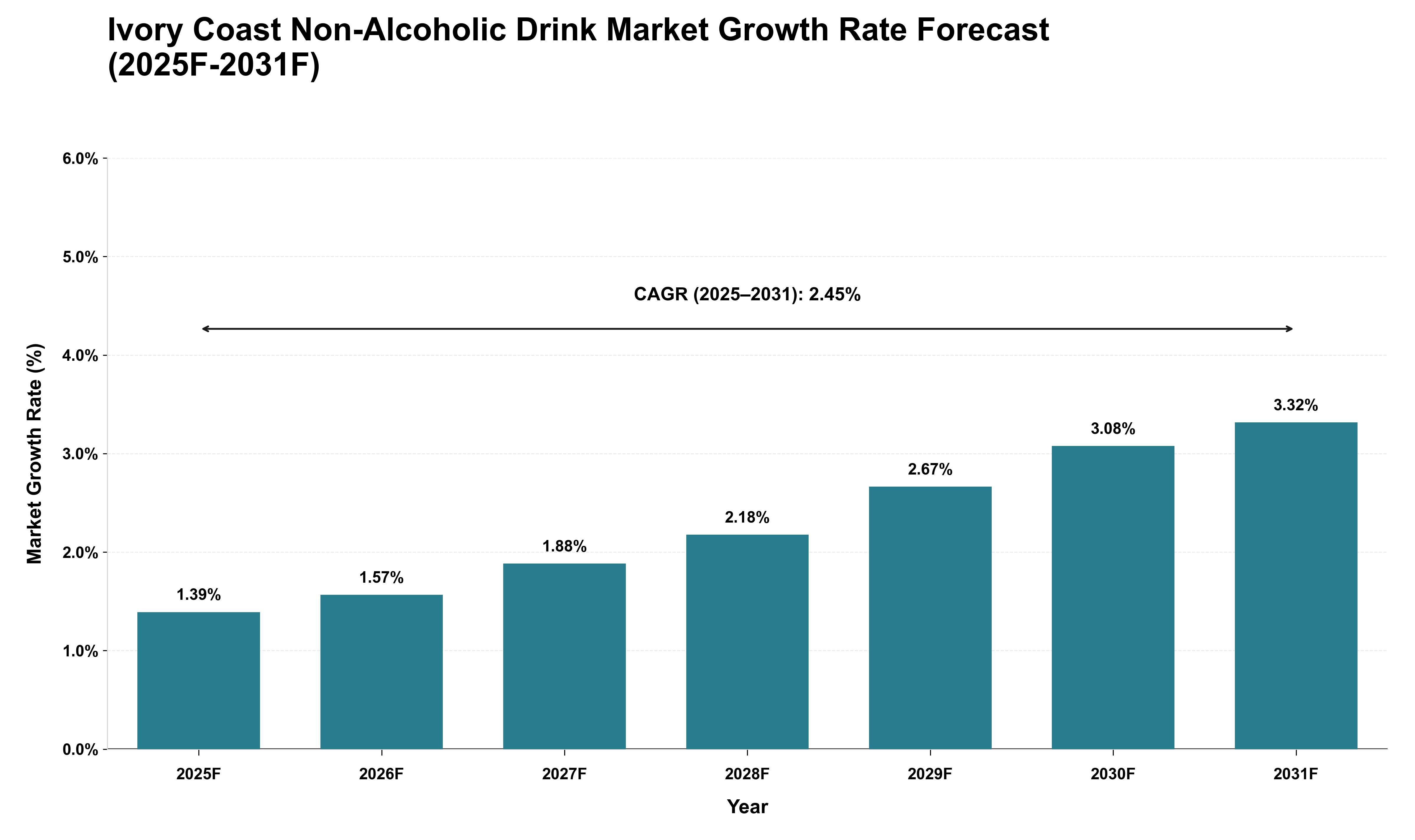
The Ivory Coast non-alcoholic drink market is projected to experience a compound annual growth rate of 2.45% from 2025 to 2031, reflecting a gradual acceleration in growth as the period progresses. Initial growth rates will be modest, starting at 1.39% in 2025 and increasing to 3.32% by 2031, indicating a response to evolving consumer preferences and demographic shifts favoring healthier beverage options. Macroeconomic factors such as rising disposable incomes and urbanization will likely enhance demand for diverse non-alcoholic beverages, while import dependencies may influence pricing dynamics and availability. Additionally, cyclical trends in consumer spending patterns could lead to increased consumption during economic upturns, further bolstering market performance. As the economy stabilizes post-pandemic disruptions, the sector is expected to benefit from enhanced distribution networks and marketing strategies aimed at capturing emerging consumer segments.
Key Highlights of the Report:
- Ivory Coast Non-alcoholic Drink Market Outlook
- Market Size of Ivory Coast Non-alcoholic Drink Market, 2025
- Forecast of Ivory Coast Non-alcoholic Drink Market, 2032
- Historical Data and Forecast of Ivory Coast Non-alcoholic Drink Revenues & Volume for the Period 2022 - 2032F
- Ivory Coast Non-alcoholic Drink Market Trend Evolution
- Ivory Coast Non-alcoholic Drink Market Drivers and Challenges
- Ivory Coast Non-alcoholic Drink Price Trends
- Ivory Coast Non-alcoholic Drink Porter`s Five Forces
- Ivory Coast Non-alcoholic Drink Industry Life Cycle
- Historical Data and Forecast of Ivory Coast Non-alcoholic Drink Market Revenues & Volume By Product Types for the Period 2022 - 2032F
- Historical Data and Forecast of Ivory Coast Non-alcoholic Drink Market Revenues & Volume By CarbonatedDrinks for the Period 2022 - 2032F
- Historical Data and Forecast of Ivory Coast Non-alcoholic Drink Market Revenues & Volume By Non-CarbonatedDrinks for the Period 2022 - 2032F
- Historical Data and Forecast of Ivory Coast Non-alcoholic Drink Market Revenues & Volume By Distribution Channel for the Period 2022 - 2032F
- Historical Data and Forecast of Ivory Coast Non-alcoholic Drink Market Revenues & Volume By Online for the Period 2022 - 2032F
- Historical Data and Forecast of Ivory Coast Non-alcoholic Drink Market Revenues & Volume By Offline for the Period 2022 - 2032F
- Ivory Coast Non-alcoholic Drink Import Export Trade Statistics
- Market Opportunity Assessment By Product Types
- Market Opportunity Assessment By Distribution Channel
- Ivory Coast Non-alcoholic Drink Top Companies Market Share
- Ivory Coast Non-alcoholic Drink Competitive Benchmarking By Technical and Operational Parameters
- Ivory Coast Non-alcoholic Drink Company Profiles
- Ivory Coast Non-alcoholic Drink Key Strategic Recommendations






































