Japan 3D Holographic Display and Services Market Size, Share & Growth Rate
The Japan 3D Holographic Display and Services Market was estimated at USD 143 Million in 2025 and is projected to reach USD 153 Million by 2032, growing at a CAGR of 1.0% from 2026 to 2032. This steady growth trajectory is fueled by technological advancements that enhance display quality and interactivity. Industries ranging from healthcare to entertainment are increasingly recognizing the value of immersive visual solutions, prompting investments that further stimulate market expansion.
Japan 3D Holographic Display and Services Market Year-wise Growth Rate and Key Drivers
This graph highlights how the Japan 3D Holographic Display and Services Market has steadily grown over the years, supported by major growth factors.
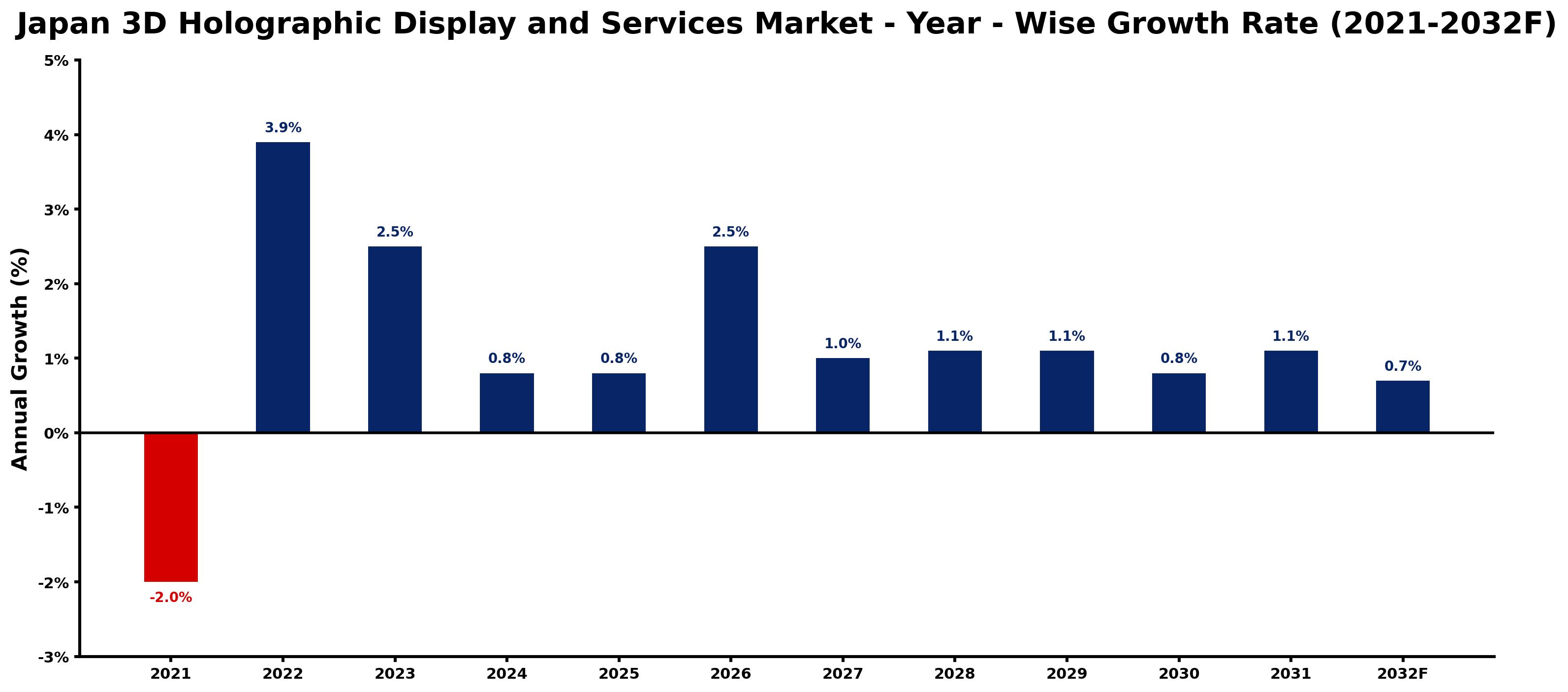
The table below presents the year‑wise growth rates along with the key drivers influencing the market
| Year | Growth Rate | Major Drivers |
| 2021 | -2.0% | Growing urbanization and commercial development |
| 2022 | 3.9% | Government infrastructure modernization initiatives |
| 2023 | 2.5% | Expansion of commercial construction activities |
| 2024 | 0.8% | Increasing adoption of advanced technologies |
| 2025 | 0.8% | Growing urbanization and commercial development |
| 2026 | 2.5% | Increasing smart city development projects |
| 2027 | 1.0% | Government infrastructure modernization initiatives |
| 2028 | 1.1% | Expansion of commercial construction activities |
| 2029 | 1.1% | Rising electricity demand across industries |
| 2030 | 0.8% | Expansion of transportation and logistics networks |
| 2031 | 1.1% | Expansion of commercial construction activities |
| 2032 | 0.7% | Increasing industrial automation investments |
Note - Market size estimations and growth projections presented in this report are based on 6Wresearch’s advanced forecasting approach, validated with industry datasets as of June 2026.
Japan 3D Holographic Display and Services Market Synopsis
The recent momentum in the Japan 3D holographic display market reflects a broader shift towards more immersive customer experiences. As demand accelerates for innovative visual displays across various sectors, this market is poised for continuous evolution. The increasing integration of augmented reality and virtual reality into holographic services stands as a testament to the dynamic capabilities and applications of these technologies.
While current growth rates are promising, challenges such as high production costs and limited content availability still linger. However, ongoing investments in R&D and collaborative initiatives between technology firms and content creators are expected to mitigate these issues. Consequently, the market outlook remains optimistic, with new developments likely to broaden its appeal and accessibility.
Japan 3D Holographic Display and Services Market Key Takeaways
- The market is projected to reach USD 153 Million by 2032, reflecting consistent growth driven by technological innovations.
- Increased adoption of immersive visual experiences is particularly notable in entertainment, healthcare, and retail sectors.
- Strategic partnerships between technology companies and content creators are vital for generating compelling holographic content.
- Government initiatives are fostering a supportive environment for research and development in holographic technologies.
- As AR and VR applications expand, they are likely to catalyze greater demand for holographic display solutions.
Evaluation of Restraints in Japan 3D Holographic Display and Services Market
Despite the promising growth, the Japan 3D holographic display market faces tangible challenges. High production costs are a primary concern, making it difficult for companies to maintain competitive pricing. Additionally, the current pool of holographic content is limited, which restricts the market's capacity to attract a broader consumer base. Technological limitations such as resolution and viewing angles further hinder the delivery of fully immersive experiences. Addressing these restraints will require a concerted focus on innovation and investment in content development.
Japan 3D Holographic Display and Services Market Trends
Current trends indicate a rising adoption of 3D holographic displays across diverse industries, particularly in advertising and education. The seamless integration of AR and VR technologies is creating new avenues for interactive applications, transforming how consumers engage with brands. Furthermore, the demand for high-quality, lifelike visuals is pushing companies to invest heavily in R&D to improve holographic display capabilities, further enhancing user engagement and satisfaction.
Japan 3D Holographic Display and Services Market Opportunities
The opportunities within the Japan 3D holographic display market are vast and varied. There is significant potential for investment in advanced display technologies that cater to sectors like retail, where interactive product demonstrations can enhance customer engagement. Furthermore, businesses offering holographic display rental services for events and exhibitions represent a lucrative avenue for growth. As the demand for captivating visual solutions continues to rise, the market will likely attract a new wave of investments targeting innovative content creation and service delivery.
Government Initiatives in the Japan 3D Holographic Display and Services Market
The Japanese government has implemented a range of initiatives to bolster the growth of the 3D holographic display market. These efforts include funding for research projects and incentives for companies engaged in holographic technology development. Collaborative efforts between industry, academia, and governmental bodies are encouraged to drive innovation, while regulations are enforced to ensure safety and quality standards in holographic displays. Collectively, these measures create a conducive environment for market growth and competitiveness.
Future Insights of the Japan 3D Holographic Display and Services Market
Looking ahead to 2026-2032, the Japan 3D holographic display and services market is poised for remarkable growth, fueled by the rising adoption of holographic technology in entertainment, healthcare, automotive, and advertising sectors. Innovations in display technology will continue to reshape market dynamics, making holographic solutions more accessible and cost-effective. The integration of AR and VR will also play a pivotal role, further propelling demand as consumers seek out engaging, immersive experiences.
Japan 3D Holographic Display and Services Market Latest Developments (May 2025 - June 2026)
The industry has recently seen a surge in collaborations aimed at enhancing content creation for 3D holographic displays. Companies are focusing on developing new applications for various sectors, particularly in advertising and healthcare, where visual engagement is critical. Additionally, advancements in technology are being prioritized, with a push towards improving the realism and interactivity of holographic projections to meet consumer expectations.
Japan 3D Holographic Display and Services Market - Key Attractiveness of the Report
- 10 Years of Market Numbers
- Historical Data Starting from 2022 to 2025
- Base Year: 2025
- Forecast Data until 2032
- Key Performance Indicators Impacting the Market
- Major Upcoming Developments and Projects
Key Highlights of the Report:
- Japan 3D Holographic Display and Services Market Outlook
- Market Size of Japan 3D Holographic Display and Services Market, 2025
- Forecast of Japan 3D Holographic Display and Services Market, 2032
- Historical Data and Forecast of Japan 3D Holographic Display and Services Revenues & Volume for the Period 2022-2032F
- Japan 3D Holographic Display and Services Market Trend Evolution
- Japan 3D Holographic Display and Services Market Drivers and Challenges
- Japan 3D Holographic Display and Services Price Trends
- Japan 3D Holographic Display and Services Porter's Five Forces
- Japan 3D Holographic Display and Services Industry Life Cycle
- Historical Data and Forecast of Japan 3D Holographic Display and Services Market Revenues & Volume By End-users for the Period 2022-2032F
- Historical Data and Forecast of Japan 3D Holographic Display and Services Market Revenues & Volume By Media and Entertainment for the Period 2022-2032F
- Historical Data and Forecast of Japan 3D Holographic Display and Services Market Revenues & Volume By Consumer Electronics for the Period 2022-2032F
- Historical Data and Forecast of Japan 3D Holographic Display and Services Market Revenues & Volume By Healthcare for the Period 2022-2032F
- Historical Data and Forecast of Japan 3D Holographic Display and Services Market Revenues & Volume By Automotive for the Period 2022-2032F
- Historical Data and Forecast of Japan 3D Holographic Display and Services Market Revenues & Volume By Retail for the Period 2022-2032F
- Historical Data and Forecast of Japan 3D Holographic Display and Services Market Revenues & Volume By Others for the Period 2022-2032F
- Japan 3D Holographic Display and Services Import Export Trade Statistics
- Market Opportunity Assessment By End-users
- Japan 3D Holographic Display and Services Top Companies Market Share
- Japan 3D Holographic Display and Services Competitive Benchmarking By Technical and Operational Parameters
- Japan 3D Holographic Display and Services Company Profiles
- Japan 3D Holographic Display and Services Key Strategic Recommendations






































