Japan 3D Printing Plastic Market Growth Rate
According to 6Wresearch internal database and industry insights, the Japan 3D Printing Plastic Market is growing at a compound annual growth rate (CAGR) of 6.9% during the forecast period (2026-2032).
Japan 3D Printing Plastic Market Year-wise Growth Rate and Key Drivers (2022-2032)
This graph highlights how the Japan 3D Printing Plastic Market has rapidly evolved over the years 2022-2032, supported by aggressive telecom modernization and digital transformation initiatives.
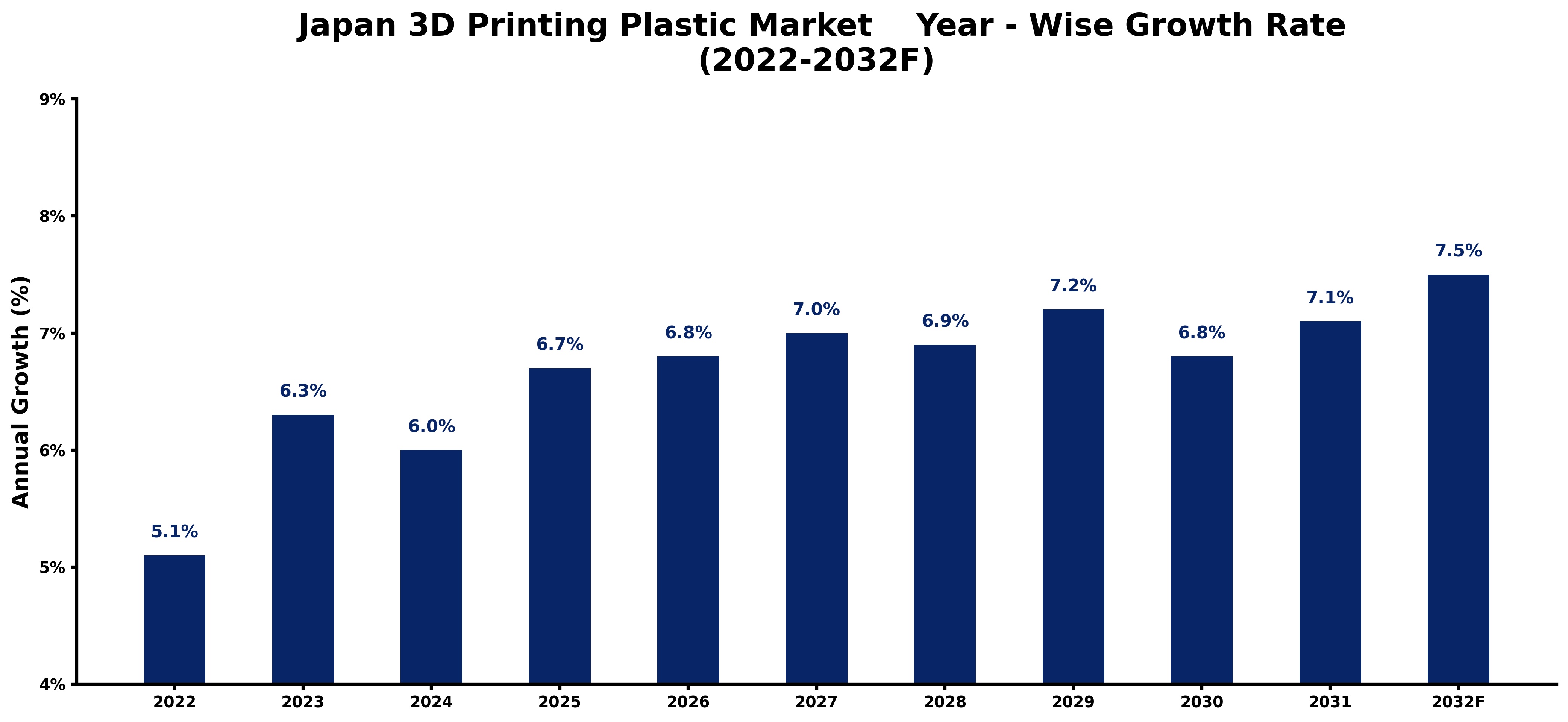
The table below presents the year wise growth rates along with the key drivers influencing the market.
| Year | Estimated Growth | Market Rationale |
| 2022 | 5.1% | Recovery in manufacturing and increased adoption of additive manufacturing in automotive and industrial applications supported market expansion. |
| 2023 | 6.3% | Rising demand for engineering-grade 3D printing materials from healthcare, electronics, and prototyping industries accelerated growth. |
| 2024 | 6% | Moderate expansion driven by wider industrial implementation and improved material availability. |
| 2025 | 6.7% | Higher investments in advanced manufacturing and rapid prototyping increased demand for specialty printing plastics. |
| 2026 | 6.8% | Growing adoption of high-performance polymers across aerospace and automotive sectors supported forecast-period growth. |
| 2027 | 7% | Increased industrial-scale 3D printing and product innovation strengthened market demand. |
| 2028 | 6.9% | Stable adoption of sustainable and engineering-grade materials maintained consistent market expansion. |
| 2029 | 7.2% | Rising investments in digital manufacturing and customized production solutions boosted material consumption. |
| 2030 | 6.8% | Broader commercialization of additive manufacturing across industrial sectors sustained growth. |
| 2031 | 7.1% | Expansion of healthcare, consumer electronics, and precision manufacturing applications supported higher demand. |
| 2032 | 7.5% | Continuous innovation in high-performance and recyclable printing plastics drove long-term market growth. |
Topics Covered in the Japan 3D Printing Plastic Market Report
The Japan 3D Printing Plastic Market report covers the market by plastic type, technology, form, and end user. The report provides detailed analysis of trends, opportunities, and growth drivers, helping stakeholders align strategies with evolving market dynamics.
Japan 3D Printing Plastic Market Highlights
| Report Name | Japan 3D Printing Plastic Market |
| Forecast period | 2026-2032 |
| CAGR | 6.9% |
| Growing Sector | Advanced Manufacturing |
Japan 3D Printing Plastic Market Synopsis
The Japan 3D Printing Plastic Market is expanding due to increasing demand for rapid prototyping, lightweight components, and customized manufacturing solutions. Growth is supported by strong automotive and consumer goods industries, along with rising adoption of FDM and SLA technologies. Japan’s focus on digital manufacturing transformation and sustainability is further accelerating adoption of recyclable polymers and high-performance thermoplastics across industrial applications, improving design flexibility and production efficiency. Additionally, growing integration of AI-based design tools and localized production hubs enhances scalability and reduces lead times significantly.
Evaluation of Growth Drivers in the Japan 3D Printing Plastic Market (2026-2032)
Below are some major drivers and their influence on the market dynamics:
| Drivers | Primary Segments Affected | Why It Matters |
| Lightweight Manufacturing Demand | Automotive, Aerospace | Enhances fuel efficiency, performance and lowers material consumption for advanced industrial manufacturing applications. |
| Mass Customization Growth | Consumer Goods, Healthcare | Enables custom product development and patient-specific solutions, thus significantly increasing efficiency and user satisfaction. |
| Digital Manufacturing Adoption | Manufacturing, Industrial Design | Increases production speed, design flexibility, cuts cost and improves prototyping accuracy across industries. |
| Sustainable Plastic Materials | Automotive, Consumer Goods | Supports sustainable manufacturing, with recyclable and bio-based polymers, with significant reduction of environmental impact. |
| Industrial Automation Expansion | Automotive, Aerospace | Improves production efficiency, incorporates smart factories, and enables scalable additive manufacturing systems worldwide. |
The Japan 3D Printing Plastic Market is expected to grow steadily, registering a CAGR of 6.9% during the forecast period 2026–2032. The growth is due to increasing demand for light weight, durable and cost-effective polymer components in automotive, aerospace and healthcare sectors. Increasing adoption of FDM and SLS technologies is also enhancing the efficiency of production and flexibility of design. In addition, growing mass customization, sustainable materials and digital manufacturing initiatives are accelerating market penetration, while government-backed R&D programs and smart factory integration are consistently accelerating the adoption of advanced additive manufacturing nationwide.
Evaluation of Restraints in Japan 3D Printing Plastic Market
Below is the tabular representation of some major restraints and their influence on market dynamics:
| Restraints | Primary Segment Affected | What This Means |
| High Material Costs | Industrial Manufacturers, SMEs | Expensive polymer materials increase overall production cost and limit large-scale adoption |
| Limited Material Standardization | Automotive, Aerospace | Lack of uniform standards reduces interoperability and slows mass industrial deployment |
| Technical Complexity in Printing Processes | Manufacturing, R&D Units | Requires skilled operators and slows integration into existing production workflows |
| Dependency on Imported Advanced Polymers | Industrial Supply Chain | Creates supply risks and price volatility affecting consistent manufacturing output |
| Mechanical Performance Limitations | End-use Industrial Applications | Restricts use in high-stress environments compared to traditional manufacturing methods |
Japan 3D Printing Plastic Market Challenges
The market confronts challenges as high material costs, limited recycling infrastructure for engineering plastics, and lack of standardization across additive systems restrict large-scale adoption. In addition, performance limitations of low-cost polymers and dependency on imported high-grade materials create supply chain vulnerabilities, slowdown industrial scalability. Moreover, the insufficient skilled workforce and complex certification requirements further delay the commercialization and increase operational challenges for manufacturers in Japan’s advanced 3D printing plastic ecosystem.
Japan 3D Printing Plastic Market Trends
Listed below are the major trends responsible for Japan 3D Printing Plastic Market Growth:
- Bio-Based Plastic Adoption: Increasing use of eco-friendly and recyclable polymers supports sustainability-driven manufacturing, reducing environmental impact and enhancing circular economy practices globally.
- AI-Driven Design Optimization: Intelligent simulation and generative design tools are used to improve product accuracy, reduce material waste, and increase production efficiency in additive manufacturing.
- Hybrid Manufacturing Integration: Integration of plastic printing with CNC and composite systems to increase performance, scalability, and precision in complex industrial production environments.
Investment Opportunities in Japan 3D Printing Plastic Market
Given below are the investment opportunities available in Japan 3D Printing Plastic Industry:
- Customization of Consumer Products: Increasing demand for customized products presents profitable business opportunities, allowing brands to provide unique designs and engage consumers more effectively.
- Lightweight Automotive Components: Increasing demand for long-lasting plastic parts in the fast-growing EV market aids in significantly improving vehicle efficiency, reducing emissions and supporting advanced lightweight engineering applications.
- Healthcare Device Manufacturing: Expanding use in prosthetics and dental applications drives investment potential, improving patient-specific treatment solutions and enhancing precision healthcare outcomes across Japan.
Top 5 Leading Players in the Japan 3D Printing Plastic Market
Stated below are some of the leading companies holding majority of Japan 3D Printing Plastic Market Share:
1. SOLIZE Corporation
| Company Name | SOLIZE Corporation |
|---|---|
| Established Year | 1990 |
| Headquarters | Tokyo, Japan |
| Official Website | Click Here |
SOLIZE has established itself as a forerunner in Japan's 3D printing sector, introducing additive manufacturing technology to the country, and now holds the most extensive collection of high-end 3D printers in the nation.
2. Mimaki Engineering Co., Ltd.
| Company Name | Mimaki Engineering Co., Ltd. |
|---|---|
| Established Year | 1975 |
| Headquarters | Nagano, Japan |
| Official Website | Click Here |
Mimaki Engineering targets visual prototyping and modeling applications across automotive, healthcare, and consumer goods sectors.
3. Toray Industries, Inc.
| Company Name | Toray Industries, Inc. |
|---|---|
| Established Year | 1926 |
| Headquarters | Tokyo, Japan |
| Official Website | Click Here |
Toray Industries specializes in advanced polymer materials and high-performance resins, supporting 3D printing plastic solutions for industrial applications with a strong focus on sustainable material innovation.
4. Asahi Kasei Corporation
| Company Name | Asahi Kasei Corporation |
|---|---|
| Established Year | 1922 |
| Headquarters | Tokyo, Japan |
| Official Website | Click Here |
Asahi Kasei specializes in high-performance polymer and engineering plastic materials, supporting advanced 3D printing applications for industrial sectors with emphasis on sustainable material development.
5. Roland DG Corporation (DGSHAPE)
| Company Name | Roland DG Corporation (DGSHAPE) |
|---|---|
| Established Year | 1981 |
| Headquarters | Shizuoka, Japan |
| Official Website | Click Here |
Roland DG specializes in precision digital fabrication and 3D printing technologies, offering polymer-based additive manufacturing solutions for customized production applications with high accuracy and reliability.
Government Regulations Introduced in the Japan 3D Printing Plastic Market
According to Japanese government data, the Japan’s Ministry of Economy, Trade and Industry (METI) has initiated programs such as “Green Manufacturing Promotion Program” and “Digital Industry Transformation Strategy” to encourage adoption of sustainable polymer based additive manufacturing. These initiatives support the utilization of recyclable plastics, funding R&D of proficient polymers and certification systems for industrial safety. For example, smart manufacturing policies promoted by METI encourage the deployment of FDM and SLS systems in the automotive and healthcare sectors.
Future Insights of the Japan 3D Printing Plastic Market
The Japan 3D Printing Plastic Market is expected to evolve into a highly advanced manufacturing ecosystem driven by AI-enabled design optimization, sustainable materials, and large-scale industrial adoption. Also, an increasing use of bio-based polymers and high-performance thermoplastics will enhance applications in automotive and healthcare sectors. Furthermore, the expansion of decentralized production systems and hybrid manufacturing will improve supply chain efficiency, reduce costs, and strengthen Japan’s global competitiveness in polymer-based additive manufacturing technologies.
Market Segmentation Analysis
The report offers a comprehensive study of the following market segments and their leading categories:
By Plastic Type – Market Dominated by ABS, Polyamide Set for Strong Growth
According to Bhawna Singh, Senior Research Analyst, 6Wresearch, ABS dominated the Japan 3D Printing Plastic Market in 2025 with an estimated 33.4% share, driven by strong demand in prototyping and industrial design applications due to its durability and cost efficiency. However, during 2026–2032, Polyamide is expected to emerge as the fastest-growing segment with a CAGR of around 7.8%, supported by rising adoption in aerospace and automotive lightweight structural components requiring high strength and thermal resistance.
By Technology – Market Dominated by FDM, SLS Set for Rapid Expansion
FDM technology maintained the leading position with an approximate market share of 45.1% in 2025 due to its low cost and extensive industrial use in consumer goods and automotive prototyping. However, SLS technology is projected to grow at the fastest CAGR of around 8.2% during 2026-2032, owing to the rising demand for high-precision and complex polymer components in aerospace and healthcare applications in Japan’s advanced manufacturing ecosystem.
By Form – Market Dominated by Filament, Powder Set for Strong Growth
Filament-based materials dominated the market in 2025 with approximately 52.6% share, supported by strong usage in FDM printing systems across prototyping and production workflows. However, powder form is projected to register the fastest CAGR of around 7.5% during 2026–2032, driven by expanding industrial SLS applications requiring high-performance polymer powders for complex geometries and functional end-use parts.
By End User – Market Dominated by Automotive, Healthcare Set for Rapid Expansion
Automotive led the market in 2025 with a 38.9% share, driven by increasing use of lightweight plastic components for EVs and prototyping applications. However, during 2026–2032, Healthcare is expected to be the fastest-growing segment with a CAGR of around 8.4%, supported by rising adoption of 3D printed dental models and patient-specific medical devices across Japan’s advanced healthcare infrastructure.
Note: Market size estimations and growth projections presented in this report are based on 6Wresearch’s advanced forecasting approach, validated with industry datasets as of June 2026.
Key attractiveness of the report
- 10 Years Market Numbers.
- Historical Data Starting from 2022 to 2025.
- Base Year: 2025.
- Forecast Data until 2032.
- Key Performance Indicators Impacting the Market.
- Major Upcoming Developments and Projects.
Key Highlights of the Report:
- Japan 3D Printing Plastic Market Outlook
- Market Size of Japan 3D Printing Plastic Market, 2025
- Forecast of Japan 3D Printing Plastic Market, 2032
- Historical Data and Forecast of Japan 3D Printing Plastic Revenues & Volume for the Period 2022-2032
- Japan 3D Printing Plastic Market Trend Evolution
- Japan 3D Printing Plastic Market Drivers and Challenges
- Japan 3D Printing Plastic Price Trends
- Japan 3D Printing Plastic Porter's Five Forces
- Japan 3D Printing Plastic Industry Life Cycle
- Historical Data and Forecast of Japan 3D Printing Plastic Market Revenues & Volume By Plastic Type for the Period 2022-2032
- Historical Data and Forecast of Japan 3D Printing Plastic Market Revenues & Volume By ABS for the Period 2022-2032
- Historical Data and Forecast of Japan 3D Printing Plastic Market Revenues & Volume By PLA for the Period 2022-2032
- Historical Data and Forecast of Japan 3D Printing Plastic Market Revenues & Volume By PETG for the Period 2022-2032
- Historical Data and Forecast of Japan 3D Printing Plastic Market Revenues & Volume By Polyamide for the Period 2022-2032
- Historical Data and Forecast of Japan 3D Printing Plastic Market Revenues & Volume By Others for the Period 2021 - 2031
- Historical Data and Forecast of Japan 3D Printing Plastic Market Revenues & Volume By Technology for the Period 2022-2032
- Historical Data and Forecast of Japan 3D Printing Plastic Market Revenues & Volume By FDM for the Period 2022-2032
- Historical Data and Forecast of Japan 3D Printing Plastic Market Revenues & Volume By SLS for the Period 2022-2032
- Historical Data and Forecast of Japan 3D Printing Plastic Market Revenues & Volume By SLA for the Period 2022-2032
- Historical Data and Forecast of Japan 3D Printing Plastic Market Revenues & Volume By DLP for the Period 2022-2032
- Historical Data and Forecast of Japan 3D Printing Plastic Market Revenues & Volume By Form for the Period 2022-2032
- Historical Data and Forecast of Japan 3D Printing Plastic Market Revenues & Volume By Filament for the Period 2022-2032
- Historical Data and Forecast of Japan 3D Printing Plastic Market Revenues & Volume By Powder for the Period 2022-2032
- Historical Data and Forecast of Japan 3D Printing Plastic Market Revenues & Volume By Others for the Period 2022-2032
- Historical Data and Forecast of Japan 3D Printing Plastic Market Revenues & Volume By End User for the Period 2022-2032
- Historical Data and Forecast of Japan 3D Printing Plastic Market Revenues & Volume By Consumer Goods for the Period 0
- Historical Data and Forecast of Japan 3D Printing Plastic Market Revenues & Volume By Automotive for the Period 2022-2032
- Historical Data and Forecast of Japan 3D Printing Plastic Market Revenues & Volume By Aerospace for the Period 2022-2032
- Historical Data and Forecast of Japan 3D Printing Plastic Market Revenues & Volume By Healthcare for the Period 2022-2032
- Japan 3D Printing Plastic Import Export Trade Statistics
- Market Opportunity Assessment By Plastic Type
- Market Opportunity Assessment By Technology
- Market Opportunity Assessment By Form
- Market Opportunity Assessment By End User
- Japan 3D Printing Plastic Top Companies Market Share
- Japan 3D Printing Plastic Competitive Benchmarking By Technical and Operational Parameters
- Japan 3D Printing Plastic Company Profiles
- Japan 3D Printing Plastic Key Strategic Recommendations
Market covered
The report subsequently covers the market by following segments and subsegments.
By Plastic Type
- ABS
- PLA
- PETG
- Polyamide
- Others
By Technology
- FDM
- SLS
- SLA
- DLP
By Form
- Filament
- Powder
- Others
By End User
- Consumer Goods
- Automotive
- Aerospace
- Healthcare






































