Japan 3D Technology Market Growth Rate
According to 6Wresearch internal database and industry insights, the Japan 3D Technology Market is growing at a compound annual growth rate (CAGR) of 4.3% during the forecast period (2026-2032).
Japan 3D Technology Market Year-wise Growth Rate and Key Drivers (2022-2032)
This graph illustrates the annual growth rates of the Japan 3D Technology Market from 2022 to 2032, highlighting a steady upward trajectory and projected market expansion over the forecast period.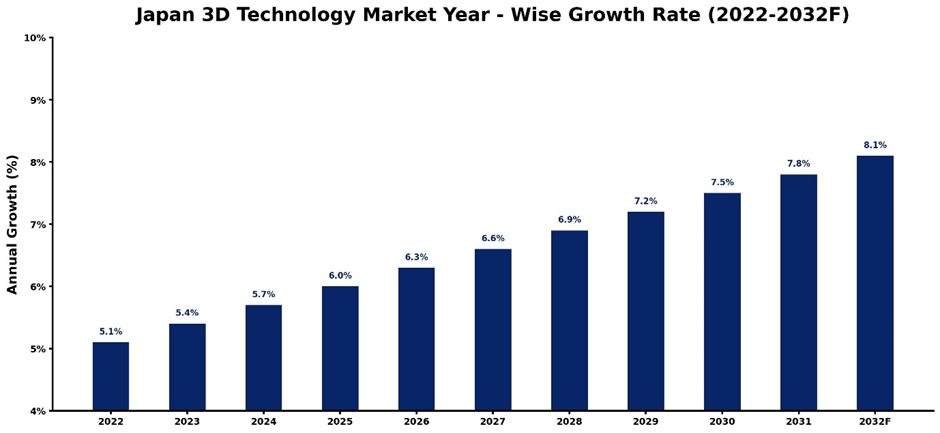
The table below represents the historical and projected growth rates for the Japan 3D Technology Market and the rationale behind each year’s performance.
| Year | Estimated Annual Growth (%) | Market Rationale |
| 2022 | 5.1% | Early-stage adoption of 3D printing and imaging technologies across industrial and healthcare sectors. |
| 2023 | 5.4% | Expansion of AR/VR applications and increased investment in digital manufacturing ecosystems. |
| 2024 | 5.7% | Growing government support under Society 5.0 and rising use of AI-based design tools. |
| 2025 | 6% | Strong uptake of 3D printing in healthcare customization and automotive prototyping applications. |
| 2026 | 6.3% | Increased deployment of digital twin systems and expansion of smart factory automation initiatives. |
| 2027 | 6.6% | Rising adoption of AR/VR ecosystems and AI-driven 3D modeling across enterprise applications. |
| 2028 | 6.9% | Healthcare imaging and surgical planning demand accelerate advanced 3D technology integration. |
| 2029 | 7.2% | Automotive and aerospace sectors expand simulation and design optimization using 3D systems. |
| 2030 | 7.5% | Government-led digital transformation and semiconductor innovation strengthen ecosystem scalability. |
| 2031 | 7.8% | High penetration of real-time 3D visualization and cloud-based industrial platforms increases efficiency. |
| 2032 | 8.1% | Mature adoption phase driven by AI integration, smart manufacturing, and immersive technologies. |
Topics Covered in the Japan 3D Technology Market Report
Japan 3D Technology Market report thoroughly covers the market by type and application. The market report provides an unbiased and detailed analysis of ongoing market trends, opportunities/high growth areas, and market drivers, which would help stakeholders devise and align their market strategies according to the current and future market dynamics.
Japan 3D Technology Market Highlights
| Report Name | Japan 3D Technology Market |
| Forecast period | 2026-2032 |
| CAGR | 4.3% |
| Growing Sector | Advanced Digital Technologies |
Japan 3D Technology Market Synopsis
The market is set to expand strongly driven by rapid advancements in 3D printing, 3D imaging, and immersive visualization systems across multiple industries. The Japan 3D Technology Market Growth is supported by Japan’s strong semiconductor ecosystem, robotics leadership, and increasing adoption of digital manufacturing solutions. The adoption is accelerating with government initiatives such as the Digital Agency Japan’s “Society 5.0 Industrial Digital Transformation Program” and METI’s “Advanced Manufacturing Innovation Strategy.” Additionally, integration of AI, AR/VR, and spatial computing technologies is enhancing product design, simulation accuracy, and operational efficiency across healthcare, automotive, aerospace, and consumer electronics industries.
Evaluation of Growth Drivers in the Japan 3D Technology Market (2026-2032)
Below mentioned are some major growth drivers and their influence on market dynamics:
| Drivers | Primary Segments Affected | Why It Matters |
| Rising Adoption of 3D Printing Technologies | Industrial, Healthcare | Surges rapid prototyping, enables mass customization, shortens product development cycles, and improves production flexibility across industries. |
| Expansion of Automotive 3D Design & Simulation | Automotive | Augmentation in vehicle design, permits autonomous vehicle growth, and notably minimizing development costs. |
| Government Digital Manufacturing Initiatives | Industrial, Aerospace | Encourages the implementation of smart factories, supports the adoption of Industry 4.0, and surges digital transformation investments. |
| Growth of AR/VR and 3D Visualization Systems | Consumer Electronics | Expanding demand for immersive applications, rising user engagement and expanding opportunities in entertainment, education and enterprise solutions. |
| Increasing Use of 3D Imaging in Healthcare | Healthcare | Improves surgical planning, helps in personalizing treatment strategies, enables sophisticated medical visualization, and boosts the overall efficiency of patient management. |
Japan 3D Technology Market is projected to grow significantly, with a CAGR of 4.3% during the forecast period of 2026-2032. The rapid industrial adoption of 3D printing, alongside surging demand for automotive 3D visualization and immersive consumer electronics, is significantly accelerating market growth. On account of, Japan’s dedicated commitment to digital transformation and advanced smart manufacturing initiatives continues to strengthen this expansion across multiple sectors, fostering long-term innovation and competitive development in the global landscape.
Evaluation of Restraints in the Japan 3D Technology Market
Below mentioned are some major restraints and their influence on market dynamics:
| Restraints | Primary Segments Affected | What This Means |
| High Cost of Advanced 3D Systems | SMEs, Industrial | Limits adoption due to expensive hardware, software licensing, integration costs, and ongoing maintenance expenses significantly. |
| Technical Complexity of Integration | Industrial, Automotive | Slows deployment due to compatibility issues with legacy systems, workflow disruption, and extended implementation timelines. |
| Shortage of Skilled 3D Engineers | All Segments | Hinders scalability, slowdown innovation, and limits effective application of latest 3D technologies across industries. |
| High Computational Requirements | AI & Simulation Systems | Increases operational costs, demands high-performance computing framework, and raises energy consumption across applications. |
| Intellectual Property Concerns | Industrial, Consumer Electronics | Limits technology sharing, restricts collaboration, and slows innovation due to strict protection and licensing issues. |
Japan 3D Technology Market Challenges
The major challenges in Japan 3D Technology market are the high system cost, difficulty in the integration with the legacy industrial systems and the shortage of skilled professionals in 3D modeling and simulation technologies. Moreover, fast evolution of technology would require frequent upgrades, thus increasing R&D burden on the companies. Moreover, the absence of standardization across 3D platforms also leads to interoperability challenges, which impedes the widespread adoption across industries, as well as collaboration between industries, extending implementation timelines, and limiting overall scalability for enterprise-wide deployments.
Japan 3D Technology Market Trends
Below are some major trends contributing to the Japan 3D Technology Market Growth:
- 3D Printing Expansion: Accelerates rapid prototyping and customized manufacturing across industries, reducing production time, improving design flexibility, and enabling cost-efficient small batch manufacturing solutions globally.
- AR/VR Integration Growth: Boosts immersive experiences in gaming and simulation applications, increasing user engagement, and interactive learning environments across various industrial and consumer sectors.
- AI-Driven 3D Design: Augments precision and automation of engineering manufacturing systems and products, boosts repetition, minimizes errors, and widen engineering ability.
Investment Opportunities in Japan 3D Technology Market
Here are some investment opportunities in the Japan 3D Technology Industry:
- Automotive Simulation Platforms 3D: The next generation of design and testing systems for EVs and autonomous vehicles, improving safety validation, optimizing performance and reducing physical prototyping costs.
- Healthcare 3D Visualization Systems: Investment in surgical planning and diagnostic imaging technologies, resulting in improved clinical accuracy, increased treatment success rate, and the ability to perform advanced medical decision-making processes efficiently.
- Industrial Digital Twin Platforms: Deployment of real-time simulation systems for intelligent manufacturing operations for predictive maintenance, operational efficiency, and better asset lifecycle management in multiple sectors.
Top 5 Leading Players in the Japan 3D Technology Market
Here are some top companies contributing to Japan 3D Technology Market Share:
1. Sony Group Corporation
| Company Name | Sony Group Corporation |
|---|---|
| Established | 1946 |
| Headquarters | Tokyo, Japan |
| Official Website | Click Here |
Sony Group Corporation is a global technology and entertainment company specializing in imaging sensors, consumer electronics, gaming systems, and advanced 3D sensing and visualization technologies.
2. KEYENCE CORPORATION
| Company Name | KEYENCE CORPORATION |
|---|---|
| Established | 1974 |
| Headquarters | Osaka, Japan |
| Official Website | Click Here |
KEYENCE CORPORATION is a leading automation and sensing technology company specializing in industrial sensors, 3D measurement systems, machine vision, and advanced imaging solutions for manufacturing and quality inspection applications.
3. Canon Inc.
| Company Name | Canon Inc. |
|---|---|
| Established | 1937 |
| Headquarters | Tokyo, Japan |
| Official Website | Click Here |
Canon Inc. is a global imaging and optical products company specializing in cameras, medical imaging systems, semiconductor lithography equipment, and advanced 3D imaging and diagnostic technologies for healthcare and industrial applications.
4. Panasonic Holdings Corporation
| Company Name | Panasonic Holdings Corporation |
|---|---|
| Established | 1918 |
| Headquarters | Osaka, Japan |
| Official Website | Click Here |
Panasonic Holdings Corporation is a diversified electronics and technology company specializing in consumer electronics, industrial solutions, imaging sensors, smart mobility systems, and advanced 3D sensing and automation technologies.
5. OMRON Corporation
| Company Name | OMRON Corporation |
|---|---|
| Established | 1933 |
| Headquarters | Kyoto, Japan |
| Official Website | Click Here |
OMRON Corporation is a global automation and sensing technology company specializing in industrial sensors, machine vision systems, robotics, healthcare devices, and advanced 3D inspection and control solutions for smart manufacturing environments.
Government Regulations Introduced in the Japan 3D Technology Market
According to Japanese government data, regulatory support includes METI’s “Advanced Manufacturing Innovation Policy”, Digital Agency Japan’s “Society 5.0 Digital Transformation Program” and MIC’s “Smart Industry Connectivity Framework”. Society 5.0 initiatives support the integration of AI, robotics and 3D technologies in manufacturing and healthcare sectors. METI’s innovation programs are supporting the development of the domestic semiconductor and 3D printing ecosystem. Furthermore, government-supported digitalization policies are aiding the adoption of immersive 3D technologies in automotive, aerospace, and healthcare industries for increased productivity and innovation.
Future Insights of the Japan 3D Technology Market
Japan 3D Technology Market is projected to be a highly integrated ecosystem of AI, robotics and digital manufacturing systems. Increasing adoption of 3D printing, digital twins, and immersive AR/VR platforms will significantly transform industrial and consumer applications. Besides, the strong government backing for smart manufacturing and continued innovations in semiconductor and sensing technologies will also further propel Japan’s leadership in advanced 3D technologies by 2032, enabling long-term industrial transformation and global competitiveness in several sectors.
Market Segmentation Analysis
The report offers a comprehensive study of the following market segments and their leading categories:
By Type – 3D Printing Led the Market, 3D Imaging Set for Strong Growth
According to Bhawna Singh, Senior Research Analyst, 6Wresearch, 3D Printing dominated the Japan market till 2025 with an estimated 34% market share, driven by strong adoption in industrial manufacturing and healthcare customization applications. However, during 2026–2032, 3D Imaging is expected to emerge as the fastest-growing segment with a CAGR of around 7.4%, supported by rising demand in healthcare diagnostics and industrial inspection systems.
By Application – Consumer Electronics Dominated the Market, Automotive Set for Strong Growth
Consumer Electronics dominated the market till 2025 with around 31% market share, driven by strong demand for AR/VR devices. Meanwhile, during 2026–2032, Automotive is expected to grow strongly with a CAGR of around 7.9%, supported by expansion of autonomous vehicles and advanced driver-assistance systems across Japan’s mobility ecosystem.
Note: Market size estimations and growth projections presented in this report are based on 6Wresearch's proprietary forecasting methodology, utilizing the latest available industry data, government publications, and primary research inputs.
Key attractiveness of the report
- 10 Years Market Numbers.
- Historical Data Starting from 2022 to 2025.
- Base Year: 2025.
- Forecast Data until 2032.
- Key Performance Indicators Impacting the Market.
- Major Upcoming Developments and Projects.
Key Highlights of the Report:
- Japan 3D Technology Market Outlook
- Market Size of Japan 3D Technology Market, 2025
- Forecast of Japan 3D Technology Market, 2032
- Historical Data and Forecast of Japan 3D Technology Revenues & Volume for the Period 2022-2032
- Japan 3D Technology Market Trend Evolution
- Japan 3D Technology Market Drivers and Challenges
- Japan 3D Technology Price Trends
- Japan 3D Technology Porter's Five Forces
- Japan 3D Technology Industry Life Cycle
- Historical Data and Forecast of Japan 3D Technology Market Revenues & Volume By Type for the Period 2022-2032
- Historical Data and Forecast of Japan 3D Technology Market Revenues & Volume By 3D Printing for the Period 2022-2032
- Historical Data and Forecast of Japan 3D Technology Market Revenues & Volume By 3D Display for the Period 2022-2032
- Historical Data and Forecast of Japan 3D Technology Market Revenues & Volume By 3D Scanning for the Period 2022-2032
- Historical Data and Forecast of Japan 3D Technology Market Revenues & Volume By 3D Imaging for the Period 2022-2032
- Historical Data and Forecast of Japan 3D Technology Market Revenues & Volume By Others for the Period 2022-2032
- Historical Data and Forecast of Japan 3D Technology Market Revenues & Volume By Application for the Period 2022-2032
- Historical Data and Forecast of Japan 3D Technology Market Revenues & Volume By Healthcare for the Period 2022-2032
- Historical Data and Forecast of Japan 3D Technology Market Revenues & Volume By Automotive for the Period 2022-2032
- Historical Data and Forecast of Japan 3D Technology Market Revenues & Volume By Aerospace & Defense for the Period 2022-2032
- Historical Data and Forecast of Japan 3D Technology Market Revenues & Volume By Consumer Electronics for the Period 2022-2032
- Historical Data and Forecast of Japan 3D Technology Market Revenues & Volume By Others for the Period 2022-2032
- Japan 3D Technology Import Export Trade Statistics
- Market Opportunity Assessment By Type
- Market Opportunity Assessment By Application
- Japan 3D Technology Top Companies Market Share
- Japan 3D Technology Competitive Benchmarking By Technical and Operational Parameters
- Japan 3D Technology Company Profiles
- Japan 3D Technology Key Strategic Recommendations
Market covered
The report subsequently covers the market by following segments and subsegments.
By Type
- 3D Printing
- 3D Display
- 3D Scanning
- 3D Imaging
- Others
By Application
- Healthcare
- Automotive
- Aerospace & Defense
- Consumer Electronics
- Others






































